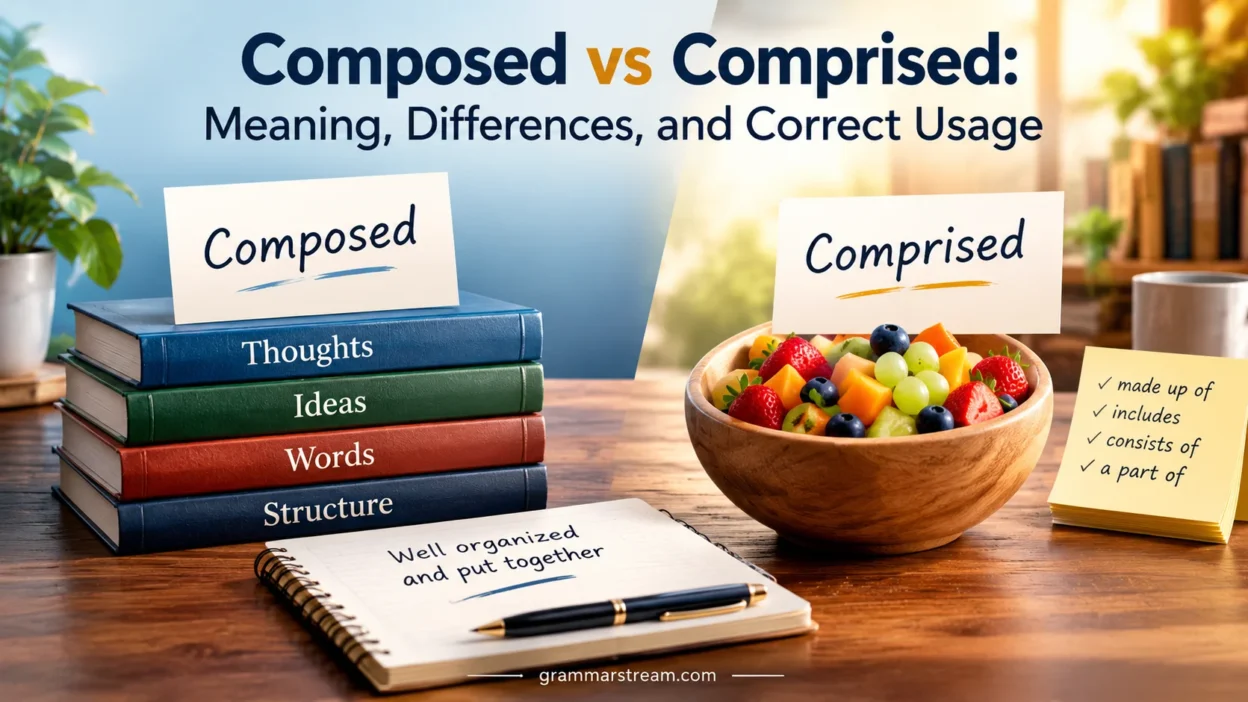
Composed vs comprised is a common grammar question because the two words describe a similar relationship between a whole and its parts. However, they don’t work the same way in a sentence.
The safest distinction is straightforward: composed of means “made up of,” while comprises traditionally means “includes” or “consists of.” For example, you can say, “The committee is composed of five members” or “The committee comprises five members.”
The biggest problem appears with comprised of. You’ll see this phrase frequently in modern English, including professional writing. Still, many editors, style guides, and traditional grammar authorities consider it questionable. If you want writing that avoids the debate, composed of and comprises give you clear alternatives.
Quick Answer
Composed of means that something is made up of particular parts or members.
The research team is composed of six scientists.
Comprises means that a whole includes or contains its component parts.
The research team comprises six scientists.
Consists of has a similar meaning to is composed of.
The research team consists of six scientists.
The main construction to avoid in careful formal writing is comprises of:
The research team comprises of six scientists.
Use:
The research team comprises six scientists.
The phrase comprised of is more complicated. It appears widely in contemporary English, but traditional usage guidance often recommends avoiding it.
| Expression | Meaning | Standard formal pattern |
| is composed of | Is made up of | The team is composed of five players. |
| comprises | Includes its parts | The team comprises five players. |
| consists of | Is made up of | The team consists of five players. |
| is comprised of | Widely used but disputed | Prefer composed of in cautious formal writing. |
| comprises of | Incorrect in standard usage | Use comprises without of. |
Comparison Overview
The easiest way to understand composed vs comprised is to look at sentence direction.
With composed of, you normally start with the whole and describe the parts that make it up:
The university department is composed of 12 faculty members.
With comprises, you also start with the whole, but the verb directly introduces the parts:
The university department comprises 12 faculty members.
The meaning remains very close. The grammar changes.
| Feature | Composed of | Comprises |
| Core meaning | Made up of | Includes |
| Word type in common construction | Past participle | Verb |
| Needs of? | Yes | No |
| Typical structure | Whole + is/are composed of + parts | Whole + comprises + parts |
| Example | The book is composed of 10 chapters. | The book comprises 10 chapters. |
| Formal acceptance | Widely accepted | Widely accepted |
| Usage concern | Minimal | Don’t add of |
A useful memory trick is simple:
Parts compose a whole. A whole comprises its parts.
That rule won’t solve every stylistic question, but it gives you a reliable starting point.
What Does “Composed” Mean?
The verb compose has several meanings in English. In the context of this comparison, it means to form or make up something by combining parts.
If several elements create one larger thing, those elements compose the whole.
For example:
Several chapters compose the book.
You can reverse that relationship:
The book is composed of several chapters.
The second construction is much more common in everyday writing.
How “Composed Of” Works
The standard pattern is:
Whole + be + composed of + parts
Here are several examples:
- The committee is composed of eight members.
- The meal is composed of several regional dishes.
- The atmosphere is composed of different gases.
- The collection is composed of more than 200 paintings.
- The course is composed of six units.
The phrase composed of tells the reader what elements form the larger thing.
Think of a puzzle. The completed picture is the whole. The individual puzzle pieces make up that picture. The picture is composed of those pieces.
Examples of Composed Of
Organizations:
The board is composed of seven directors.
Groups:
The audience was composed of students, teachers, and parents.
Materials:
The alloy is composed of several metals.
Documents:
The report is composed of five major sections.
Biological structures:
Bone is composed of organic and inorganic materials.
The construction works because the subject represents the whole while the phrase after of identifies its components.
What Does “Comprised” Mean?
Comprise means to include or consist of the parts that form a whole.
Unlike compose, the traditional construction doesn’t require of.
For example:
The committee comprises eight members.
Here, the committee is the whole. The phrase eight members identifies the parts included within that whole.
Another example makes the relationship even clearer:
The United States comprises 50 states.
The country is the whole. The 50 states are its constituent parts.
How “Comprises” Works
The standard structure is:
Whole + comprises + parts
Examples include:
- The course comprises six units.
- The collection comprises 150 photographs.
- The committee comprises representatives from five departments.
- The building comprises three connected structures.
- The report comprises four major sections.
Notice something important: no “of” follows comprises.
That’s why this sentence is not recommended:
The course comprises of six units.
Instead, write:
The course comprises six units.
Why “Comprised” Causes Confusion
Comprised is simply a form of the verb comprise. The confusion begins when writers treat it as though it were interchangeable with composed.
Consider these two sentences:
The committee is composed of five members.
The committee comprises five members.
Both express essentially the same relationship.
However, replacing composed with comprised creates:
The committee is comprised of five members.
That construction has become common, but it remains controversial in formal usage.
Main Differences Between Composed vs Comprised
The most important difference isn’t really about meaning. It’s about grammar and sentence structure.
Meaning and Perspective
Composed of emphasizes what something is made from.
The machine is composed of several interconnected parts.
Comprises emphasizes what the whole contains or includes.
The machine comprises several interconnected parts.
The practical meaning is almost identical.
The construction changes the grammatical relationship between the words.
Grammar and Sentence Structure
Compare these examples:
The committee is composed of five members.
The committee comprises five members.
The first sentence uses is composed of as a passive construction. The second uses comprises as an active verb.
This difference matters because you can’t simply mix their grammatical patterns.
For example:
The committee comprises of five members.
The problem is the unnecessary of.
A useful comparison looks like this:
| Whole | Correct construction |
| The team | is composed of five players |
| The team | comprises five players |
| The team | consists of five players |
All three communicate the basic composition of the team.
Whole-to-Parts vs. Parts-to-Whole
There is another useful way to remember the distinction.
With compose, the parts can act as the things that form the whole:
Five players compose the team.
With comprise, the whole takes the subject position:
The team comprises five players.
This gives you a practical transformation:
Five players compose the team.
becomes:
The team comprises five players.
Meanwhile:
The team is composed of five players.
expresses the same basic idea through a different grammatical structure.
Formality and Style
Both composed of and comprises work well in formal writing.
However, comprises can sound more concise because it avoids the passive construction.
Compare:
The report is composed of eight sections.
The report comprises eight sections.
The second sentence is shorter while retaining the same basic meaning.
Still, clarity matters more than shaving off a few words. If composed of sounds more natural in your sentence, use it.
Read More: Persue or Pursue: Which Spelling Is Correct?
Is “Comprised Of” Correct?
This is where the composed vs comprised debate gets interesting.
The Traditional Rule
Traditional grammar guidance generally treats comprise as a verb that takes the whole as its subject and the components as its object.
So:
The committee comprises five members.
is traditionally correct.
By contrast:
The committee is comprised of five members.
has traditionally been criticized because it combines comprise with of in a way that resembles be composed of.
Traditional editors often recommend replacing it with:
The committee is composed of five members.
or:
The committee comprises five members.
Modern Usage
Modern English presents a more complicated picture.
Comprised of appears frequently in contemporary writing. Many readers encounter it without confusion. Dictionaries and usage references also document the phrase as an established construction in modern English.
That doesn’t mean every editor accepts it equally.
The important point is that widespread usage and traditional stylistic preference aren’t always identical.
Language changes. A construction can become common even while some formal writing traditions continue to discourage it.
Should You Use “Comprised Of”?
If your goal is clear, conservative, formal English, avoiding comprised of is the easiest approach.
Use:
is composed of
or:
comprises
For example:
The panel is composed of nine judges.
or:
The panel comprises nine judges.
There’s no need to enter the grammar debate when two clear alternatives already express the intended meaning.
In casual writing, you’ll frequently encounter comprised of. In academic, professional, technical, or edited writing, however, composed of is often the safer choice.
Composed vs. Comprised vs. Consists Of
A third expression belongs in this discussion: consists of.
It means essentially the same thing as is composed of in many contexts.
Composed Of
The committee is composed of ten members.
This means the ten members make up the committee.
Comprises
The committee comprises ten members.
This means the committee includes those ten members.
Consists Of
The committee consists of ten members.
This also means the committee is made up of those ten members.
How the Three Compare
| Sentence | Meaning | Grammar |
| The team is composed of ten players. | The team is made up of ten players. | composed of |
| The team comprises ten players. | The team includes ten players. | comprises |
| The team consists of ten players. | The team is made up of ten players. | consists of |
One important distinction remains: consists of requires of in this construction, while comprises does not.
So:
The team consists of ten players.
but:
The team comprises of ten players.
The extra of is the problem.
Common Mistakes With Composed and Comprised
Even experienced writers sometimes mix these constructions. The mistakes usually come from treating similar expressions as though they followed identical grammar.
“Is Comprised Of”
Example:
The department is comprised of six divisions.
This construction is common, but traditional formal usage often recommends changing it.
Better:
The department is composed of six divisions.
Or:
The department comprises six divisions.
“Comprises Of”
This is the clearest mistake in the group.
The organization comprises of four departments.
Correct:
The organization comprises four departments.
If you remember only one rule about comprise, remember this:
Don’t put “of” immediately after comprises.
Reversing the Parts and Whole
Consider:
Five departments comprise of the organization.
The phrase comprise of remains incorrect.
A better version is:
Five departments compose the organization.
Or:
The organization comprises five departments.
The second version is usually more natural for formal writing.
Using “Comprised” as a Direct Synonym for “Composed”
You can’t always replace one word with the other without changing the grammar.
Compare:
The team is composed of five players.
You can’t mechanically change it to:
The team is comprises five players.
That doesn’t work grammatically.
Likewise, this:
The team comprises five players.
doesn’t become:
The team composed five players.
without changing the tense and meaning of the sentence.
The words overlap semantically, but their grammatical behavior differs.
FAQs:
Is “comprised of” grammatically correct?
Comprised of is widely used in contemporary English, but traditional grammar guidance has long objected to the construction. If you’re writing formal or carefully edited content, is composed of or comprises is the safer choice.
Is “composed of” the same as “comprised of”?
They often communicate the same basic idea: something consists of particular parts. However, composed of follows an established grammatical pattern, while comprised of has a long history of usage debate.
Is “comprised” more formal than “composed”?
Not necessarily. Comprise can sound more formal or concise in some contexts, but composed of is fully appropriate in professional and academic writing.
Which is better for academic writing?
For academic writing, is composed of, comprises, and consists of are all useful constructions. If a style guide or editor discourages comprised of, avoid that form and choose one of the established alternatives.
Conclusion:
The difference between composed vs comprised becomes much easier once you focus on sentence structure rather than memorizing isolated definitions. Use is composed of when you mean that something is made up of particular parts. Use comprises when the whole includes those parts. Use consists of when you want another clear way to express the same basic idea.