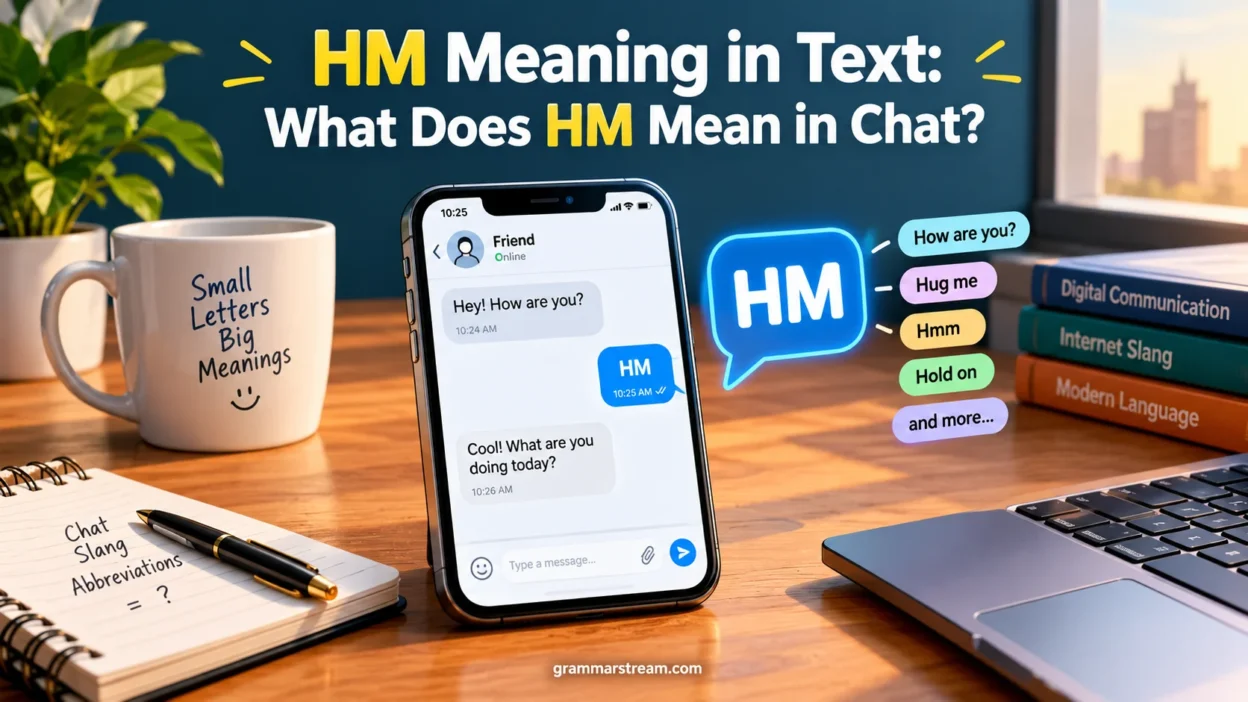
Have you ever received a text that simply says “HM” and wondered what the other person was trying to tell you? Maybe you asked a friend a question, suggested a plan, or shared some surprising news. Instead of getting a clear answer, you received two letters that left you guessing.
The HM meaning in text usually relates to thinking, hesitation, or a brief reaction. People often use it to express a thought similar to “hmm” when they’re considering something, feeling unsure, or reacting to information. Depending on the conversation, it may also communicate doubt or mild skepticism.
However, HM doesn’t have one fixed meaning in every situation. A friend responding to an invitation might use it differently from someone asking about a price. Understanding the surrounding conversation helps you interpret the message without jumping to conclusions.
This guide explains what HM means in texting, how people use it in different situations, how it compares with “hmm” and “hmmm,” and how you can respond naturally.
Quick Answer:
HM usually means a thoughtful or hesitant reaction in text messages. It can suggest that someone is thinking, considering an idea, expressing uncertainty, or questioning something. Its exact meaning depends on the conversation.
For example:
- You: “Do you want to watch a movie tonight?”
- Friend: “Hm, let me think.”
Here, HM suggests that your friend is considering the invitation rather than giving an immediate answer.
In another conversation, someone might write “HM for this jacket?” to ask how much it costs. In that case, the surrounding words suggest that HM stands for “how much.”
The key is to read the entire message instead of interpreting the abbreviation on its own.
Comparison Overview
HM can communicate different reactions depending on the topic, wording, and relationship between the people texting. The following table highlights common interpretations.
| Texting context | Possible meaning | Example message | Likely interpretation |
| Thinking | Considering something | “Hm, interesting.” | The person is processing information. |
| Uncertainty | Feeling unsure | “Hm, maybe.” | The person hasn’t decided yet. |
| Doubt | Questioning a claim | “Hm, are you sure?” | The person wants more information. |
| Casual conversation | A brief reaction | “Hm, okay.” | The person acknowledges the message. |
| Making plans | Considering an invitation | “Hm, that could work.” | The person is weighing the suggestion. |
| Shopping or pricing | How much, if context supports it | “HM for these shoes?” | The person is asking about the price. |
Remember: HM doesn’t automatically mean agreement, rejection, anger, or disinterest. The conversation provides the clues needed to understand its intended meaning.
Main Differences Between HM Meaning in Text
The main difference between HM and similar expressions lies in how people use them to communicate thoughts and reactions. Although HM, hmm, and hmmm can overlap, their spelling and surrounding words may influence how a message feels.
| Expression | Common use | Example |
| HM | Short expression of thought or hesitation | “Hm, I’ll consider it.” |
| Hmm | Thinking, curiosity, or uncertainty | “Hmm, that’s interesting.” |
| Hmmm | A prolonged or emphasized thoughtful reaction | “Hmmm, I’m not convinced.” |
| How much | A question about price or quantity when context supports it | “How much is this?” |
These differences aren’t strict rules. People often choose a spelling based on personal texting habits, convenience, or the tone they want to convey.
For example, one person might type “hm” when thinking and “hmm” when curious. Another person might use both expressions interchangeably. Neither style has a universal meaning that applies to every conversation.
Read More: What Does IMSG Mean in Text? Definition, and Examples
What Does HM Mean in Texting and Chat?
HM is often used as a short written reaction rather than a formal abbreviation with one universally accepted expansion. It can represent the sound people make when they’re thinking before speaking.
Imagine someone asks you an unexpected question. You might pause, consider the possibilities, and say “Hmm.” In a text conversation, HM can serve a similar purpose.
The exact interpretation depends on what happened before the message. Four common uses are thinking, hesitation, skepticism, and acknowledgment.
HM as a Sign of Thinking
When someone uses HM while considering a suggestion, they may need a moment to decide what they think. The message doesn’t necessarily express a positive or negative opinion.
For example:
- Person A: “What if we visit the beach this weekend?”
- Person B: “Hm, that sounds interesting.”
- Person A: “We could leave early Saturday.”
In this exchange, HM signals that Person B is considering the idea. The following words provide a stronger clue about their reaction.
People may use HM when discussing plans, comparing options, answering unexpected questions, or thinking through a problem. It works as a brief pause in a written conversation.
HM as Hesitation or Uncertainty
HM can also indicate that someone isn’t ready to give a definite answer. They may feel uncertain, need additional information, or want to weigh the advantages and disadvantages.
Consider this example:
- You: “Should we book the tickets today?”
- Friend: “Hm, I’m not sure yet.”
- You: “We can wait until tomorrow.”
The phrase “I’m not sure yet” makes the uncertainty clear. HM introduces the hesitation but doesn’t explain its cause by itself.
When you receive this kind of response, avoid pressuring the person for an immediate decision. A simple message such as “Take your time” keeps the conversation comfortable.
HM as Doubt or Skepticism
Sometimes HM suggests that something doesn’t seem convincing. The sender may question a statement, notice a possible problem, or want you to explain your reasoning.
For example:
- Person A: “He finished the entire project in ten minutes.”
- Person B: “Hm, that seems unlikely.”
Here, HM introduces skepticism. However, the phrase “that seems unlikely” is what makes the doubt explicit.
A standalone HM isn’t enough to prove that someone distrusts you. Look for additional clues, such as a direct question, a request for evidence, or wording that challenges what you said.
HM as a Short Reaction
People also use HM as a minimal response when they don’t have much to add. It may acknowledge information or keep a conversation moving while the sender decides what to say next.
For example:
- You: “The meeting has moved to Friday.”
- Coworker: “Hm, okay.”
- You: “I’ll send you the updated schedule.”
In this exchange, the response acknowledges the information without offering much detail. It doesn’t necessarily indicate annoyance or disapproval.
Still, a short reply can feel distant if you’re expecting a more enthusiastic response. That feeling depends on the relationship, the conversation, and the sender’s usual communication style.
What Does HM Mean From a Girl or a Guy?
The meaning of HM doesn’t change automatically based on someone’s gender. A girl, guy, or anyone else can use it to express thought, uncertainty, curiosity, or skepticism.
The more useful clues are the words surrounding HM, the topic being discussed, and the person’s typical texting habits.
What Does HM Mean From a Girl?
When a girl texts HM, she may be considering your suggestion, thinking about a question, or reacting to something you said. The message alone doesn’t reveal whether she’s interested, upset, or simply busy.
For example:
- You: “Would you like to get coffee this weekend?”
- Her: “Hm, maybe Saturday.”
- You: “Saturday works for me.”
In this example, her response suggests that she’s considering the invitation and has offered a possible day. The additional wording provides more useful information than HM alone.
In a different exchange, she might write “Hm, really?” after hearing surprising news. That could express curiosity or doubt, depending on the situation.
Don’t assume HM is a secret romantic signal. Look at the whole exchange rather than trying to decode two letters as a definite statement about someone’s feelings.
What Does HM Mean From a Guy?
When a guy texts HM, he may be thinking about a question, deciding whether to accept a suggestion, or reacting to information. The abbreviation doesn’t have a special male-specific definition.
For example:
- You: “Want to play basketball tomorrow?”
- Him: “Hm, what time?”
- You: “Around 4 p.m.”
- Him: “That should work.”
His follow-up question shows that he’s considering the plan. The conversation makes his intention clearer than the first message alone.
In another situation, “Hm, I don’t know about that” could suggest hesitation or disagreement. As always, the additional words help establish the tone.
Does HM Mean Someone Is Mad or Upset?
Not necessarily. Although HM can sound reserved in some conversations, it doesn’t automatically indicate anger.
Consider two examples:
- Neutral: “Hm, I’ll check the schedule.”
- Potentially skeptical: “Hm, that’s not what you told me yesterday.”
The first message suggests that someone is thinking about a practical task. The second introduces a possible inconsistency and may sound doubtful.
To understand whether someone is upset, consider several clues together:
- Previous messages: Did the conversation involve a disagreement?
- Word choice: Did the person add criticism or express frustration?
- Follow-up: Did they explain their reaction or ask a question?
- Usual style: Do they normally send short replies?
- Recent interaction: Did something happen that might explain a change in tone?
Even these clues don’t guarantee an accurate interpretation. If the relationship matters and the message feels unclear, asking politely is usually better than assuming the worst.
Different Meanings of HM Depending on Context
The surrounding conversation often determines how you should interpret HM. The same two letters can communicate different things when the topic changes.
HM in Everyday Conversations
In casual texting, HM often functions as a brief thinking sound. Someone might use it after hearing news, receiving a suggestion, or being asked an unexpected question.
Example:
- Friend: “I heard our favorite restaurant is opening another location.”
- You: “Hm, that’s interesting.”
Your response communicates interest or thought without requiring a detailed explanation. The following conversation would reveal whether you want to know more.
HM When Making Plans
When people discuss plans, HM may signal that they’re considering an invitation or deciding whether a suggestion fits their schedule.
Example:
- Person A: “Let’s go hiking Sunday.”
- Person B: “Hm, I might be free.”
- Person A: “Let me know when you decide.”
Here, the response indicates uncertainty about availability. It doesn’t amount to a firm yes or no.
If you receive this message, give the person room to decide. You can also ask whether another day would work better.
HM in Flirty Conversations
In a flirty conversation, HM may introduce playful curiosity, a thoughtful reaction, or mild teasing. However, the abbreviation itself doesn’t establish romantic interest.
For example:
- Person A: “I have a surprise for you.”
- Person B: “Hm, should I be excited?”
- Person A: “You’ll find out soon.”
The playful wording gives the exchange its tone. HM simply helps introduce the reaction.
If someone sends HM during a romantic conversation, look at the rest of the exchange before deciding what it means. Their questions, responses, and willingness to continue the conversation provide more context than the abbreviation alone.
HM During an Argument
During a disagreement, HM can signal doubt, careful consideration, or a pause before responding. Its tone may feel more serious because the conversation already involves tension.
For example:
- Person A: “You said you would call me yesterday.”
- Person B: “Hm, I thought I did.”
- Person A: “I didn’t receive a call.”
Here, HM introduces a response to a possible misunderstanding. The disagreement comes from the situation, not from the abbreviation itself.
When a conversation becomes tense, a clear explanation is often more useful than trying to interpret every short message. Ask what the other person means if the response remains unclear.
HM in Shopping or Price Conversations
In shopping conversations, HM may stand for “how much” when the surrounding words clearly point to a price question. This use is different from HM as a thinking sound.
For example:
- Buyer: “HM for this jacket?”
- Seller: “It’s $45.”
The buyer is asking about the price. However, “HM” isn’t the only or clearest way to ask that question. Writing “How much is this jacket?” or “How much for the jacket?” reduces confusion.
Don’t assume HM means “how much” in every message. If someone writes “Hm, that’s expensive,” the expression more likely signals a reaction or judgment about the price.
FAQs:
What Does HM Mean From a Girl in Text?
HM from a girl usually represents a thoughtful reaction, hesitation, curiosity, or uncertainty. Its meaning depends on the conversation. It doesn’t automatically indicate romantic interest, anger, or rejection.
What Does HM Mean From a Guy in Text?
HM from a guy can signal that he’s thinking, considering a suggestion, or reacting to something. Look at the surrounding words and his usual texting style before interpreting the message.
Does HM Mean Yes or No?
No. HM doesn’t automatically mean yes or no. It often signals that someone is thinking or hasn’t reached a decision. If you need a definite answer, ask a polite follow-up question.
What Is the Difference Between HM and Hmm?
Both can represent a thinking sound or a hesitant reaction. Hmm is a familiar spelling of that sound, while HM is a shorter form that may also have context-specific meanings. Neither has a fixed emotional meaning.
How Should You Reply When Someone Texts HM?
Respond according to the conversation. You could say “Take your time” if they’re considering something, ask “What do you think?” if they’re unsure, or request clarification if their meaning isn’t clear.
Conclusion:
The HM meaning in text usually involves thinking, hesitation, uncertainty, or a brief reaction. Depending on the context, it can also suggest curiosity or skepticism. In shopping conversations, it may stand for “how much” when the surrounding words support that interpretation. HM, hmm, and hmmm often serve similar purposes, although people use their preferred spellings to express themselves in different ways. None of these forms has a universal emotional meaning.