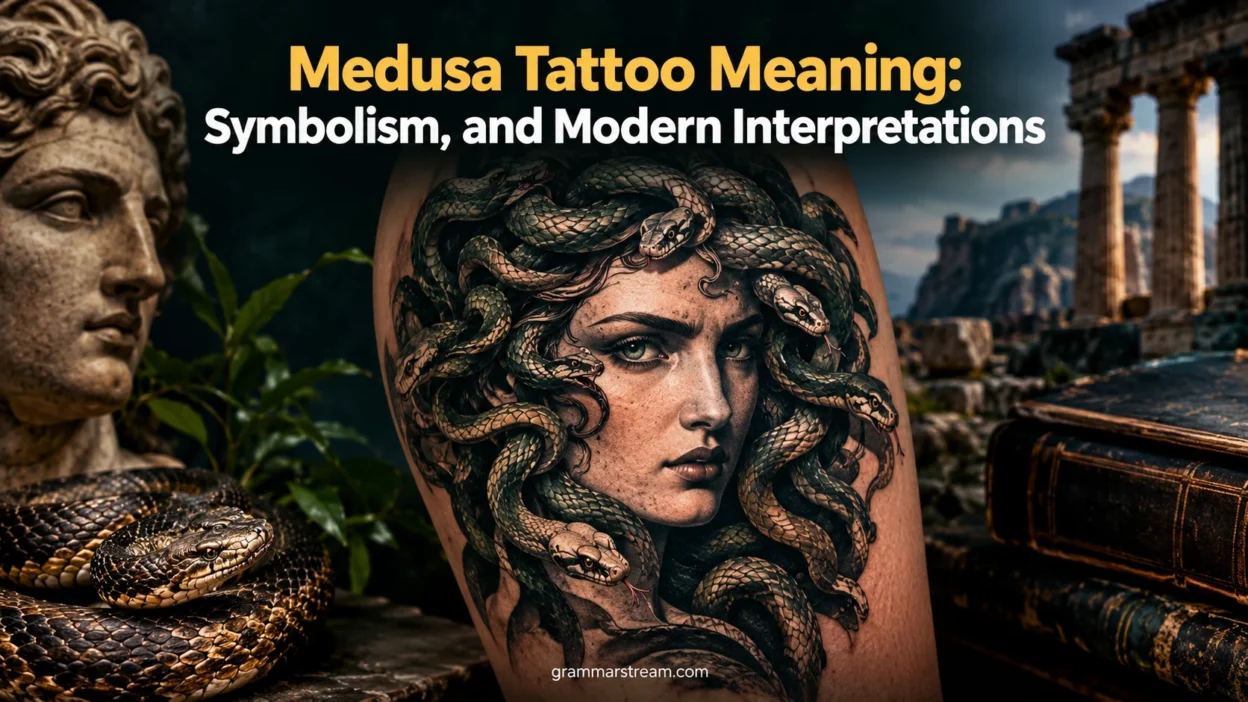
A Medusa tattoo can look striking at first glance, but the image carries far more meaning than snakes, sharp eyes, and a famous face. Its symbolism stretches from ancient Greek protective imagery to modern ideas about survival, personal power, boundaries, transformation, and reclaiming one’s story.
Medusa has also taken on a particularly important meaning in modern tattoo culture. Some people use her image to represent survival after sexual violence or abuse. Others choose her because they connect with protection, feminine strength, Greek mythology, or the visual contrast between beauty and danger. Not every Medusa tattoo carries the same message.
The history behind the symbol makes that flexibility understandable. Ancient Greek artists repeatedly used the Gorgoneion, or the head of a Gorgon, as a protective image. Medusa’s frightening face appeared on architecture, pottery, jewelry, armor, and other objects. The Metropolitan Museum of Art notes that her image was commonly understood as an apotropaic symbol, meaning it was intended to ward off danger.
Modern interpretations add another layer. In recent tattoo culture, Medusa has become associated with survival and empowerment, particularly among some survivors of sexual violence. That association became especially visible through social media during the early 2020s. However, the meaning remains personal, and a Medusa tattoo doesn’t automatically reveal anything about the wearer’s experiences.
Quick Answer
A Medusa tattoo meaning can include protection, survival, strength, personal power, transformation, boundaries, feminine independence, and connection to Greek mythology.
For some people, a Medusa tattoo represents surviving sexual assault or abuse. In that interpretation, Medusa’s transformation and frightening gaze become symbols of reclaiming power after harm. The association is now widely recognized in contemporary tattoo culture, although it doesn’t apply to every person who wears the design.
Historically, Medusa’s image had a protective role. Ancient Greeks used the Gorgoneion on temples, shields, armor, vessels, jewelry, and other objects. The intimidating face essentially fought danger with danger: a frightening image was used to repel threatening forces.
So, when you ask “What does a Medusa tattoo mean?”, there isn’t one universal answer. The design can be a historical reference, a protective emblem, a survivor symbol, an expression of strength, or a deeply personal combination of several meanings.
Comparison Overview
| Medusa tattoo interpretation | What it can represent | Historical or modern origin |
| Protection | Warding off danger and negative forces | Ancient |
| Strength | Inner resilience and courage | Modern and symbolic |
| Survival | Overcoming trauma or hardship | Modern |
| Sexual-violence survival | Reclaiming power after assault or abuse | Modern |
| Personal boundaries | Protecting yourself from unwanted harm | Modern interpretation |
| Feminine power | Independence, agency, and resistance | Modern |
| Transformation | A major change in identity or life | Mythological and modern |
| Greek mythology | Interest in Medusa’s story and ancient culture | Ancient |
| Beauty and danger | Holding contrasting qualities at once | Artistic and modern |
| Defiance | Refusing fear, control, or victimization | Modern |
The most important distinction is between historical symbolism and modern symbolism. Ancient Medusa imagery had a documented protective function. The survivor interpretation is much newer and grew from modern readings of Medusa’s story, especially the version associated with Ovid.
Main Differences Between Medusa Tattoo Meaning
| Medusa tattoo meaning | Main idea | Typical visual emphasis |
| Protection | Keep danger away | Fierce eyes, snakes, Gorgoneion |
| Survival | Endure and move forward | Strong facial expression |
| Sexual-assault survival | Reclaim power after violence | Direct gaze, emotional portrait |
| Feminine strength | Independence and authority | Confident expression |
| Transformation | Becoming stronger through change | Snakes, flowers, evolving imagery |
| Boundaries | “Keep your distance” | Direct stare and defensive posture |
| Greek mythology | Honor the ancient story | Classical details, Perseus, Athena |
| Personal identity | Express an individual experience | Custom symbols and meaningful details |
The same design can combine several interpretations. For example, a person might choose Medusa because she represents both protection and survival. Another person may simply love classical mythology and want a detailed portrait inspired by ancient art.
That personal distinction matters. Tattoo symbolism works more like a language than a dictionary. The image provides familiar associations, while the wearer supplies the full sentence.
The Myth Behind Medusa
Who Was Medusa?
Medusa was one of the three Gorgon sisters in Greek mythology. According to Hesiod’s Theogony, her parents were the primordial sea deities Keto and Phorkys. Her sisters, Stheno and Euryale, were immortal, while Medusa was mortal.
Medusa became famous for several defining features. Artists commonly portrayed her with snakes around her head and a gaze capable of turning anyone who looked directly at her into stone.
Her story became closely connected with Perseus, the Greek hero who was tasked with obtaining her head. Because looking directly at Medusa was deadly, Perseus used a polished shield as a reflective surface to approach her without meeting her gaze.
This detail helps explain why the Medusa gaze remains such an important part of tattoo symbolism. Her eyes don’t simply represent appearance. They represent a power that forces anyone who confronts her to face consequences.
Medusa in Early Greek Mythology
Medusa wasn’t created as a modern symbol of empowerment. Her earliest mythology is much older than today’s tattoo culture and contains several versions of her story.
Ancient sources don’t all describe Medusa in exactly the same way. The Metropolitan Museum of Art points out that Greek writers and artists presented Medusa in varied forms across different periods.
That distinction matters because many modern explanations compress centuries of mythology into one simple story.
In ancient art, Medusa was often depicted as a frightening creature. Her face could feature huge eyes, sharp teeth, a protruding tongue, wings, and other monstrous traits. Later representations gradually became more human and conventionally beautiful.
Medusa in Ovid’s Metamorphoses
The version of Medusa that strongly influences modern survivor interpretations comes from the Roman poet Ovid.
In Ovid’s account, Medusa was originally described as a beautiful young woman. The story connects her with Poseidon and Athena’s temple before her transformation into a Gorgon. This later version differs from earlier Greek traditions and became highly influential in later European interpretations of Medusa.
Modern discussions often interpret Ovid’s story through the lens of sexual violence and victim-blaming. That reading helps explain why some survivors identify with Medusa.
However, it would be misleading to present Ovid’s version as the only ancient version. Medusa existed in Greek mythology before Ovid’s Roman retelling, and her story changed across time.
Why Medusa Became a Symbol of Protection
The Ancient Gorgoneion
One of the most important facts behind Medusa tattoo meaning is the ancient use of her face as a protective emblem.
The term Gorgoneion refers to the head or face of a Gorgon, especially Medusa. Ancient artists placed the image on buildings, pottery, jewelry, weapons, armor, and other objects.
The logic was simple but powerful: use a terrifying image to frighten away danger.
The Met describes Medusa’s ancient image as an apotropaic symbol, meaning something designed to ward off evil or harmful forces. Her frightening appearance wasn’t merely decorative. It could serve a protective purpose.
That gives modern Medusa tattoos a surprisingly old symbolic foundation.
Medusa as a Guardian Symbol
Imagine a shield with Medusa’s face staring directly at an approaching enemy. The symbolism becomes almost immediate.
“You are looking at the thing that protects me.”
Ancient Greek armor sometimes featured the Gorgoneion. The image also appeared on Athena’s aegis and on other military equipment. The Met notes that Medusa’s presence on armor reinforced her protective association.
A modern tattoo can borrow that same concept without claiming supernatural protection. The design can function as a personal reminder of strength, vigilance, and boundaries.
Modern Medusa Tattoo Meaning
Medusa as a Symbol of Survival
Modern tattoo culture has given Medusa a powerful new interpretation: survival.
For some wearers, the tattoo represents surviving sexual violence, abuse, or another traumatic experience. The story becomes a way to reinterpret Medusa not simply as a monster but as someone whose identity was transformed by violence and punishment.
This interpretation has become widely recognized in contemporary culture. Dictionary.com describes the modern Medusa tattoo as a symbol that some survivors use to express strength and empowerment after sexual violence. It also emphasizes that not everyone with a Medusa tattoo is a survivor.
That final point deserves attention.
A tattoo cannot tell you someone’s personal history with certainty. Assuming that every Medusa tattoo represents sexual assault can turn a meaningful symbol into an unwanted assumption.
Read More: IMY Meaning in Text: What Does IMY Mean in Text Messages?
Medusa and Reclaimed Power
Another major interpretation centers on reclaiming power.
The modern reading flips the traditional image on its head. Instead of seeing Medusa only as something frightening, the wearer can see her as someone who cannot easily be controlled.
Her snakes become part of her identity.
Her gaze becomes defensive rather than helpless.
Her frightening appearance becomes a source of power rather than shame.
That’s why Medusa can work as a strong symbol for someone who wants to mark a transition from vulnerability toward greater self-possession.
Medusa and Feminine Power
Medusa also appears in modern discussions about feminine power and autonomy.
Her image combines qualities that traditional beauty standards often separate. She can be beautiful and terrifying. Vulnerable and dangerous. Human and monstrous.
That contradiction makes her visually compelling.
For some people, the tattoo represents independence, confidence, resistance to control, or the freedom to define femininity on their own terms.
Still, feminine power isn’t the only possible meaning. A man, woman, or nonbinary person can choose Medusa for many different reasons, including mythology, art, protection, or personal symbolism.
Medusa and Personal Boundaries
The famous gaze creates another modern interpretation: boundaries.
Medusa doesn’t need to chase anyone. She looks.
The person who crosses the boundary pays the price.
As a tattoo metaphor, that can represent a firm decision to protect personal space and refuse unwanted behavior. A direct-facing Medusa with an intense expression can make this message especially strong.
In that sense, the tattoo can become a permanent reminder that being kind doesn’t require being defenseless.
Medusa and Transformation
Transformation sits at the heart of Medusa’s mythology.
Her appearance changes dramatically in ancient art as well. Early depictions often emphasize monstrous features, while later Classical and Hellenistic representations increasingly humanize her appearance.
Modern tattoo wearers can interpret that transformation more personally.
A Medusa tattoo may mark:
- A major life change
- Recovery from hardship
- A new sense of identity
- Leaving an unhealthy situation
- Becoming more independent
- Learning to establish boundaries
- Turning painful experiences into personal strength
The tattoo doesn’t erase the past. Instead, it can symbolize what came after it.
Medusa Tattoo Meaning for Survivors
Why Some Survivors Choose Medusa
For survivors of sexual violence, Medusa can carry a particularly personal meaning.
The modern interpretation often focuses on survival, reclaiming control, rejecting shame, and rebuilding personal power. Dictionary.com documents this association while also noting that its exact origin as a tattoo-specific symbol isn’t firmly established. The association became particularly visible through social media around 2021.
The symbolism can be especially powerful because Medusa’s story contains themes of transformation and punishment.
Her image can become a way of saying:
- I survived.
- What happened to me doesn’t define my entire identity.
- I have the right to protect myself.
- I don’t have to carry someone else’s shame.
- My body and identity belong to me.
These statements aren’t inherent definitions of every Medusa tattoo. They’re examples of how survivors may personally interpret the symbol.
Does Every Medusa Tattoo Mean Sexual Assault?
No.
This is one of the most important facts to understand about Medusa tattoos.
The sexual-assault interpretation is a recognized modern association, but it isn’t the historical definition of the symbol. Medusa’s protective symbolism existed for thousands of years before modern tattoo culture developed this survivor-centered interpretation.
Someone might choose Medusa because they:
- Love Greek mythology.
- Want a protective symbol.
- Admire classical art.
- Connect with themes of strength.
- Like snakes and mythological imagery.
- Identify with transformation.
- Want a symbol of personal boundaries.
- Appreciate the contrast between beauty and danger.
A Medusa tattoo therefore shouldn’t be treated as a secret code for someone’s personal history.
Medusa Tattoo Meaning by Design
Medusa Face Tattoo
A Medusa face tattoo puts the character herself at the center of the design.
Because ancient depictions frequently use frontal imagery, a straight-on face also connects naturally with the historical visual tradition. The Met notes that Medusa’s direct gaze remains one of her most consistent features across different periods of ancient art.
A realistic face can emphasize:
- Strength
- Beauty
- Defiance
- Emotional depth
- Mythological identity
The facial expression makes a major difference. A calm Medusa can feel mysterious or regal, while an angry expression creates a much more confrontational effect.
Medusa With Snakes
The snakes immediately identify the character.
They can also strengthen modern associations with danger, defense, transformation, and power. Their placement matters visually. Snakes wrapping around the face create a protective frame, while loose serpents can make the design feel more chaotic.
Historically, snake imagery became one of the defining features associated with Medusa in later traditions and popular representations.
Medusa With a Direct Gaze
The direct gaze is perhaps the most meaningful design feature.
Ancient representations repeatedly used Medusa facing outward toward the viewer. That unusual frontal presentation made the image feel confrontational and immediate.
In a modern tattoo, that stare can suggest:
- Confidence
- Warning
- Fearlessness
- Protection
- Defiance
- Personal boundaries
It’s the visual equivalent of standing your ground.
FAQs:
What does a Medusa tattoo symbolize?
A Medusa tattoo can symbolize protection, strength, survival, transformation, personal power, boundaries, feminine independence, or Greek mythology. For some people, it represents survival after sexual violence. However, that interpretation doesn’t apply to everyone with a Medusa tattoo.
Does a Medusa tattoo mean sexual assault?
Not necessarily. The connection between Medusa tattoos and sexual-assault survival is a recognized modern interpretation, but people also choose Medusa for mythology, protection, strength, aesthetics, and other personal reasons.
What does Medusa represent spiritually?
Medusa can represent protection, confronting danger, transformation, and personal strength in spiritual or symbolic interpretations. Ancient evidence particularly supports her association with warding off danger rather than one single modern spiritual meaning.
What does a Medusa tattoo mean for women?
For some women, Medusa represents feminine power, independence, boundaries, or survival. Some survivors of sexual violence also use the image as a symbol of reclaiming power. However, the meaning remains personal rather than gender-specific.
What does a Medusa tattoo symbolize for men?
Men may choose Medusa for Greek mythology, protection, strength, artistic reasons, or personal symbolism. The ancient Gorgoneion appeared on military equipment and protective objects, so the protective interpretation isn’t limited to women.
Conclusion:
The Medusa tattoo meaning reaches far beyond a woman with snakes for hair. At its oldest documented level, Medusa’s image served as a powerful protective symbol. Ancient Greeks placed the Gorgoneion on temples, armor, vessels, jewelry, and other objects because her frightening face could symbolically ward off danger.
Modern tattoo culture has added another powerful layer. For some people, Medusa represents survival, reclaimed power, personal boundaries, and recovery after sexual violence. That interpretation has become especially visible in contemporary culture, but it shouldn’t be treated as a universal explanation for every Medusa tattoo.