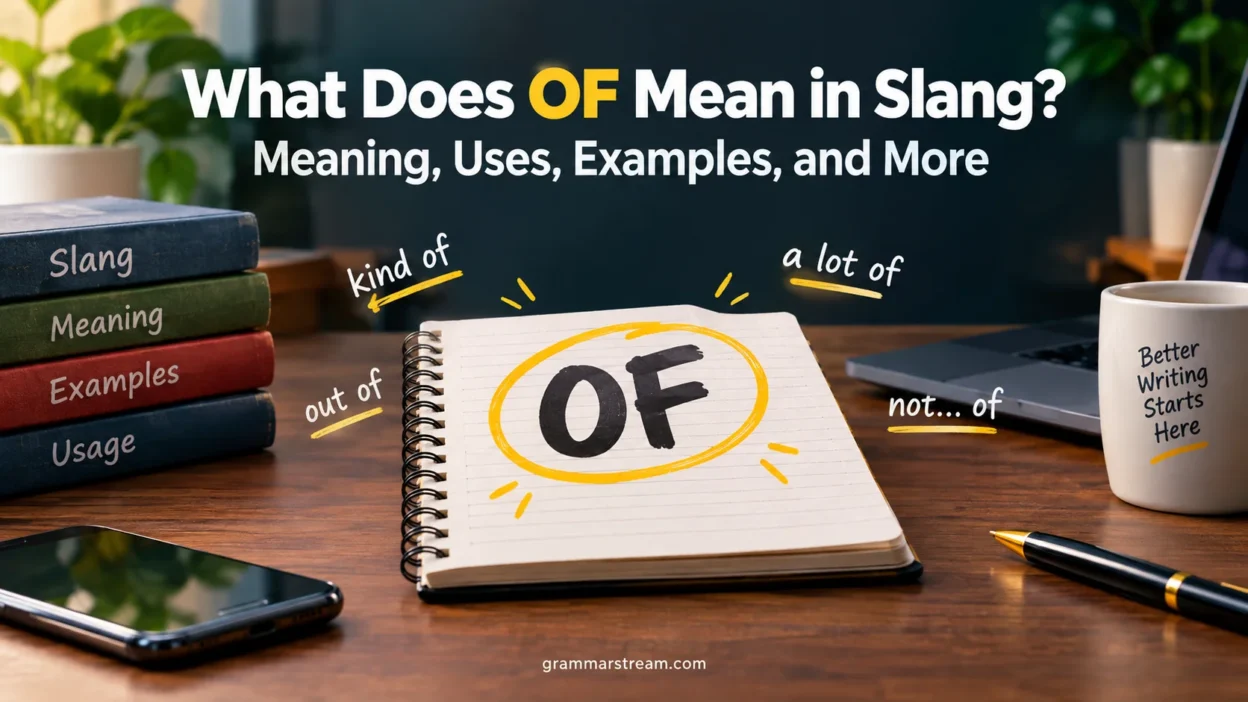
If someone sends you a message saying, “Does she have an OF?” you might wonder what those two letters mean. In online conversations, OF commonly means OnlyFans, especially when people discuss creators, subscriptions, links, or online content. However, context matters because “of” is also one of the most common words in ordinary English.
The abbreviation has become common across social media, texting, forums, and casual conversations. Instead of typing “OnlyFans,” users often shorten the platform’s name to OF. This makes messages quicker and gives people a familiar shorthand for conversations about the platform.
Still, not every use of “OF” refers to OnlyFans. A lowercase “of” inside a normal sentence usually has its standard English meaning. For example, “a cup of coffee” has nothing to do with internet slang.
So, what does OF mean in slang? The answer depends on the surrounding words, the platform where you see it, and the subject of the conversation. Understanding those clues can help you interpret the abbreviation correctly without jumping to the wrong conclusion.
Quick Answer
OF usually means “OnlyFans” in internet slang and text messages. People use it as a short form when talking about an OnlyFans account, creator, subscription, link, or content.
For example:
- “Does he have an OF?” means “Does he have an OnlyFans account?”
- “Her OF is in her bio.” means “Her OnlyFans link is in her profile.”
- “I found his OF.” means “I found his OnlyFans account.”
- “She makes money from OF.” means “She makes money through OnlyFans.”
However, OF doesn’t always mean OnlyFans. When “of” appears as an ordinary English word, it usually functions as a preposition.
For example:
“That’s a picture of my dog.”
Here, of has its normal grammatical meaning. It isn’t slang.
Comparison Overview
| Use of “OF” | Meaning | Typical Context | Example |
| OF | OnlyFans | Social media, texting, online discussions | “Does she have an OF?” |
| OF account | OnlyFans account | Creator discussions | “He started an OF account.” |
| OF link | OnlyFans profile or subscription link | Social media profiles | “The OF link is in her bio.” |
| OF creator | OnlyFans creator | Online creator discussions | “She works as an OF creator.” |
| of | Standard English preposition | Everyday English | “A glass of water” |
| OF in another abbreviation | Depends on the community | Specialized conversations | Context determines the meaning |
The capitalized form OF often signals the abbreviation for OnlyFans when it appears independently. Meanwhile, lowercase of usually functions as the ordinary English word.
Main Differences Between What Does OF Mean in Slang
The biggest difference comes from context. When someone writes “OF” as a standalone abbreviation in a social-media conversation, they may mean OnlyFans. When “of” appears naturally inside a sentence, it almost certainly has its standard grammatical role.
Consider these two examples:
“She has an OF.”
This most likely refers to an OnlyFans account.
“She has a bottle of water.”
Here, “of” simply connects “bottle” with “water.”
The spelling looks almost identical. The meaning isn’t.
Another important difference involves related expressions. Someone might say OF account, OF link, or OF creator. Those combinations make the intended meaning much clearer because they connect the abbreviation to OnlyFans-related activity.
OF vs. “of”
| Feature | OF | of |
| Common meaning | OnlyFans | Standard English word |
| Typical setting | Texting and social media | Almost every type of English |
| Capitalization | Often uppercase | Usually lowercase |
| Example | “Her OF is popular.” | “A piece of cake.” |
| Type | Internet abbreviation | Preposition |
| Meaning depends on context | Yes | Usually clear from grammar |
What Does OF Mean in Slang?
In modern online slang, OF is commonly used as an abbreviation for OnlyFans. OnlyFans is a subscription-based social platform where creators can share content with paying subscribers.
People often shorten the name because the abbreviation is quick, recognizable, and easy to type. Online conversations move quickly, especially in comments and private messages. A two-letter abbreviation can replace a longer platform name without requiring much explanation.
For example, someone might write:
“He has an OF now.”
The person isn’t saying that someone possesses the ordinary English word “of.” The sentence uses OF as shorthand for an OnlyFans account or presence.
The same pattern appears in phrases such as:
- OF account
- OF creator
- OF subscriber
- OF content
- OF link
- OF page
- OF profile
- OF subscription
These expressions make the intended meaning easier to recognize.
Why OF Became Common Online
Internet language constantly creates shorter ways to express familiar ideas. People abbreviate names, phrases, and platforms because typing speed matters in casual communication.
OnlyFans is a long platform name compared with the simple abbreviation OF. Once users become familiar with the abbreviation, they can understand it almost instantly.
The process is similar to other internet shorthand. For instance, people commonly shorten “direct message” to DM and “frequently asked questions” to FAQ.
In the same way, OF can work as a compact reference to OnlyFans.
OF Meaning in Text Messages
When you see OF in a text message, the surrounding words usually reveal what the sender means.
A message such as:
“Do you have an OF?”
normally asks whether someone has an OnlyFans account.
Likewise:
“Send me your OF.”
usually refers to an OnlyFans profile or link.
However, capitalization alone doesn’t guarantee the meaning. People don’t always follow consistent capitalization rules when texting. Someone might type “of” when they mean OnlyFans or “OF” when they simply type quickly.
That’s why the surrounding sentence matters more than capitalization by itself.
Common OF Text Examples
| Text Message | Likely Meaning |
| “Do you have OF?” | Do you have an OnlyFans account? |
| “What’s your OF?” | What is your OnlyFans profile/account? |
| “She has an OF.” | She has an OnlyFans account. |
| “He posted it on OF.” | He posted it on OnlyFans. |
| “Where’s your OF link?” | Where is your OnlyFans link? |
| “I saw her OF.” | I saw her OnlyFans account or content. |
The exact interpretation can vary slightly depending on the conversation. For example, “I saw her OF” might refer to the account itself, the content on it, or material associated with the account.
What Does OF Mean on Social Media?
On social media, OF commonly appears as shorthand for OnlyFans. Users may mention it in captions, comments, direct messages, profile descriptions, and discussions about online creators.
A creator might write something like:
“New content on OF.”
In that context, OF clearly points to OnlyFans.
You might also see phrases such as:
- “OF in bio”
- “OF link”
- “OF page”
- “OF subscribers”
- “OF creator”
- “New OF content”
Social media context makes the abbreviation easier to interpret because users frequently discuss platforms, creators, links, and subscriptions.
OF on Different Social Platforms
The abbreviation can appear across many online communities, although its frequency varies.
Instagram: Users may mention an OF page or link in a profile.
TikTok: Comments and creator discussions may use OF as shorthand.
X: Posts and replies can use the abbreviation when discussing creators or online content.
Reddit: Communities may use OF when discussing creators, accounts, or subscription-based content.
Snapchat: Private conversations can also use the abbreviation when discussing someone’s online presence.
The meaning still depends on context. A platform doesn’t automatically give every use of “OF” the same definition.
Read More: Ohio Slang Meaning: Complete Guide to Ohio Slang, and Phrases
OF Meaning on OnlyFans
When someone says OF account, they generally mean an account on OnlyFans.
OnlyFans operates around creator pages and subscriptions. Creators can publish material for subscribers, while users can subscribe to creators whose content they want to access.
Because the platform’s name contains two words, online users often replace it with the two-letter abbreviation OF.
Common OF Terms
OF creator: A person who creates and publishes content on OnlyFans.
OF account: An OnlyFans account or profile.
OF link: A link that directs someone to an OnlyFans profile or page.
OF subscriber: A person who subscribes to an OnlyFans creator.
OF content: Content published through an OnlyFans account.
OF subscription: A paid subscription that gives a user access to a creator’s subscriber content.
These terms aren’t separate slang systems. They simply combine the abbreviation OF with familiar words related to the platform.
Why Do People Say OF Instead of OnlyFans?
The main reason is simple: shorter words are faster to type.
Typing “OnlyFans” takes significantly longer than typing “OF.” In casual online conversations, users often prefer compact expressions that other people already understand.
There are several practical reasons for this habit:
- Speed: OF takes only two letters.
- Convenience: It’s easier to type repeatedly.
- Recognition: Regular users understand the abbreviation.
- Casual tone: Short forms fit naturally into social-media conversations.
- Space: Short abbreviations work well in captions and profile descriptions.
- Familiarity: Online communities often develop shared shorthand.
Internet language behaves a little like a busy highway. When people use the same route repeatedly, they look for shortcuts. OF is one of those linguistic shortcuts.
Examples of OF in Slang
Understanding examples is often easier than memorizing a definition.
Asking About an Account
“Does she have an OF?”
Here, the speaker wants to know whether she has an OnlyFans account.
Mentioning a Profile
“Her OF is in her bio.”
This means her OnlyFans profile or link appears in her social-media biography.
Talking About Income
“He makes money from OF.”
In this context, OF refers to OnlyFans as a source of income.
Discussing Content
“She posted it on OF.”
The speaker means that she posted it on OnlyFans.
Asking for a Link
“Can you send me the OF link?”
The speaker wants a link to the person’s OnlyFans page.
How to Tell What OF Means From Context
Context works like a signpost. It tells you which meaning makes sense.
Start by looking at the words around OF. If the message includes terms such as link, creator, subscriber, account, page, bio, content, or subscription, the abbreviation probably refers to OnlyFans.
For example:
“Her OF link is in her bio.”
There isn’t much ambiguity here.
On the other hand:
“I drank a cup of tea.”
The word “of” clearly has its ordinary grammatical meaning.
Questions That Can Help
When you’re unsure, ask yourself:
- Is the conversation about social media?
- Is someone talking about an account or profile?
- Does the message mention a creator?
- Is there a reference to a link or subscription?
- Does “OF” stand alone as an abbreviation?
- Does the word fit naturally into ordinary English grammar?
These clues usually provide enough information.
OF vs. OnlyFans: What’s the Difference?
There is no difference in the underlying platform when OF means OnlyFans. The difference is mainly form and context.
OnlyFans is the full platform name.
OF is the shortened internet form.
For example:
“She has an OnlyFans account.”
and
“She has an OF.”
can communicate essentially the same idea in a casual conversation.
The full name works better when you want maximum clarity. The abbreviation works well when the audience already knows what you’re talking about.
When to Use the Full Name
Use OnlyFans when:
- You’re introducing the platform to someone.
- You’re writing formal or informational content.
- Your audience may not recognize OF.
- The context doesn’t make the abbreviation clear.
When OF Works Naturally
Use OF when:
- You’re chatting casually.
- You’re talking with people familiar with internet slang.
- The surrounding conversation already concerns OnlyFans.
- You’re discussing an OF account, link, or creator.
Other Meanings of OF
Although OF commonly means OnlyFans in internet slang, it can have other meanings.
The ordinary lowercase of remains one of the most frequently used words in English. It’s a preposition that expresses relationships involving things, people, amounts, possession, and other concepts.
Examples include:
- “A bottle of water”
- “The owner of the house”
- “A group of friends”
- “The end of the movie”
- “One of my favorite songs”
None of these examples refers to OnlyFans.
In specialized communities, OF can also appear as part of other abbreviations. That means you shouldn’t automatically assign one meaning to every capitalized use.
Why Context Matters
Abbreviations aren’t mathematical formulas. The same letters can represent different things in different communities.
For instance, OP can mean “original poster” online. In another context, it can refer to something entirely different. OF works in a similar way.
The surrounding words provide the missing information.
Is OF a Slang Word or an Abbreviation?
Strictly speaking, OF is better described as an abbreviation or shorthand for OnlyFans rather than a traditional slang word.
Slang often involves informal words or expressions that carry meanings different from standard language. An abbreviation simply shortens an existing name or phrase.
When someone writes OF instead of OnlyFans, they’re shortening a proper name.
Still, people may casually call it internet slang because it appears heavily in informal online communication.
A Simple Distinction
| Term | Explanation |
| Slang | Informal language used within a group or community |
| Abbreviation | A shortened form of a word or name |
| Shorthand | A quick, informal way to express something |
| OF | Commonly an abbreviation for OnlyFans |
So, if someone asks, “Is OF slang?” a precise answer is that OF is an internet abbreviation that people commonly use as slang in casual conversations.
Is OF Appropriate to Use in Texting?
In casual texting, OF is generally easy to understand when the context is clear.
However, not everyone knows internet abbreviations. If you’re communicating with someone unfamiliar with the term, writing OnlyFans may prevent confusion.
The same principle applies to almost every abbreviation.
For example, “DM me” makes sense to most social-media users. A person unfamiliar with online shorthand might still need clarification.
Casual vs. Formal Communication
| Situation | Better Choice |
| Casual text | OF |
| Social-media conversation | OF |
| Chat with friends | OF |
| Formal article | OnlyFans, with OF explained |
| Professional communication | OnlyFans |
| Audience unfamiliar with internet slang | OnlyFans |
Clarity should come first. A two-letter shortcut isn’t useful if your reader has no idea what it means.
FAQs:
What does OF stand for in slang?
In internet slang, OF commonly stands for OnlyFans. People use the abbreviation when discussing the platform, its creators, accounts, links, subscriptions, or content.
What does OF mean in text?
In a text message, OF commonly means OnlyFans when the conversation involves social media, creators, accounts, links, or subscriptions.
For example, “Does she have an OF?” usually means “Does she have an OnlyFans account?”
Does OF always mean OnlyFans?
No. Context determines the meaning. The ordinary word of appears throughout standard English, while OF can also represent other abbreviations in specialized contexts.
What does OF account mean?
An OF account generally means an OnlyFans account. The exact reference can depend on whether the conversation concerns a creator or subscriber.
What does OF link mean?
An OF link generally means a link to an OnlyFans profile or page.
Conclusion:
So, what does OF mean in slang? In most online conversations where the abbreviation appears independently, OF means OnlyFans. People use it as a short, convenient way to refer to the platform or something connected with it. You’ll often see it in phrases such as OF account, OF link, OF creator, and OF content. Those combinations make the intended meaning especially clear.