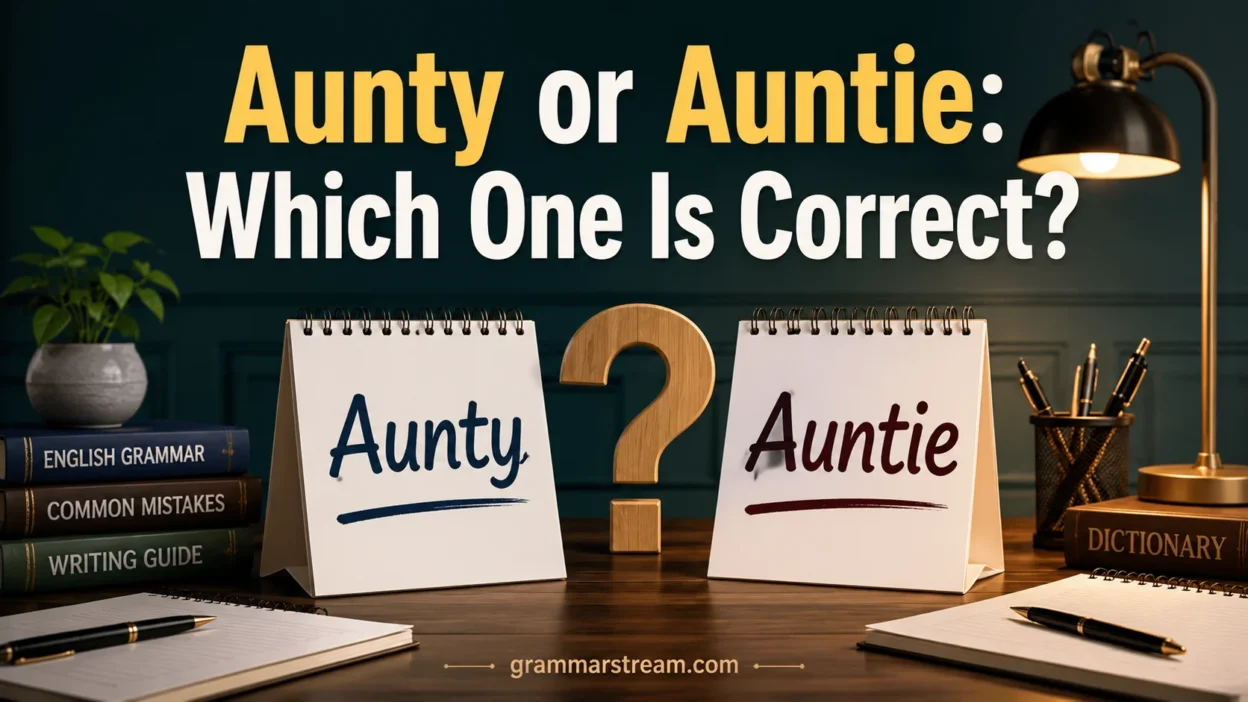
Have you ever wondered whether to write aunty or auntie when talking about a family member or greeting an older woman? Both spellings appear in everyday English, so it’s easy to assume that one must be wrong. The good news is that both aunty and auntie are correct spellings.
The difference comes down to spelling preferences, regional usage, and personal choice rather than meaning. In some English-speaking communities, auntie feels more familiar, while aunty is especially common in British English and South Asian English. However, neither spelling belongs exclusively to one country.
Both words can describe your parent’s sister, an aunt by marriage, or a woman whom you affectionately treat like family. Understanding how people use these terms will help you choose the right spelling for conversations, messages, schoolwork, and blog posts.
Quick Answer
Aunty and auntie are both correct. They share the same basic meaning and function as informal, affectionate terms for an aunt or an older woman regarded as an aunt.
- Aunty: A common spelling in British English, South Asian English, and several other English-speaking communities.
- Auntie: A familiar spelling in American English and many other varieties of English.
- Aunt: The standard, more neutral term for a parent’s sister or a woman related to you through an aunt-by-marriage relationship.
For example:
- “My aunty lives in Lahore.”
- “My auntie lives in New York.”
- “My aunt is visiting us this weekend.”
All three sentences are grammatically correct. The best choice depends on your audience, local spelling conventions, and the preference of the person you’re addressing.
Comparison Overview
Although aunty and auntie look different, they communicate essentially the same idea. The following table highlights their main similarities and differences.
| Feature | Aunty | Auntie |
| Meaning | An aunt or an aunt-like woman | An aunt or an aunt-like woman |
| Spelling | A-U-N-T-Y | A-U-N-T-I-E |
| Grammatical role | Noun | Noun |
| Tone | Usually affectionate and informal | Usually affectionate and informal |
| American English | Understood; usage varies | A familiar spelling |
| British English | Commonly used | Also widely used |
| South Asian English | Commonly used | Also used |
| Formal writing | Less common than aunt | Less common than aunt |
| Plural form | Aunties | Aunties |
| Possessive form | Aunty’s | Auntie’s |
The central point is simple: neither spelling changes the meaning of the word. You can use either form to refer to your aunt or address a woman affectionately.
One practical distinction concerns spelling consistency. If you’re writing an article for an American audience, you might choose auntie. For a publication that commonly uses aunty, that spelling may fit better. In personal messages, the individual’s preference matters more than a regional convention.
What Does Aunty Mean?
Aunty is an informal noun used for an aunt or a woman who holds a similar place in someone’s family or community. People often use it to express affection, familiarity, or respect.
The word can describe a biological relative, such as your mother’s sister. It can also refer to your father’s sister, an aunt by marriage, or a close family friend whom your family treats like a relative.
For example, a child might call a parent’s longtime friend “Aunty Sara” even though they aren’t related by blood. The word communicates a familiar relationship rather than a precise biological connection.
Definition of Aunty
The word aunty is an affectionate variant of aunt. It typically appears in casual conversation, family messages, greetings, and everyday storytelling.
Here are its common uses:
- Family relationship: Referring to your mother’s or father’s sister.
- Marriage relationship: Referring to an aunt by marriage.
- Affectionate address: Speaking to a family friend who feels like an aunt.
- Respectful address: Addressing an older woman as a sign of familiarity or respect in some communities.
Consider this example: “My aunty always brings homemade cookies when she visits.”
The sentence tells you about a familiar family relationship. It also gives the word an affectionate tone. The spelling itself doesn’t indicate whether the woman is related by blood.
In some cultures, aunty carries a broader social meaning. A child may use it for a trusted adult who helps the family, while an adult may use it for an older woman they know well. These conventions differ across families and communities, so the word doesn’t always signal the same relationship everywhere.
Examples of Aunty in Sentences
Seeing aunty in context makes its meaning easier to understand. Notice how the word works in different situations.
- “My aunty is coming over for dinner tonight.”
- “I learned how to bake bread from my aunty.”
- “Aunty Maria gave me a thoughtful birthday present.”
- “We’re spending the weekend at our aunty’s house.”
- “Please ask your aunty whether she wants some tea.”
- “Everyone in the neighborhood calls her Aunty because she’s so caring.”
These examples show that aunty can appear in the middle of a sentence or as part of a name-like form of address.
Capitalization depends on how you use it. Write “my aunty” with a lowercase a when the word functions as an ordinary noun. When it directly precedes a name as a title, as in “Aunty Maria,” capitalization is common.
The same general principle applies to auntie.
Where Is Aunty Commonly Used?
Aunty appears in several English-speaking regions, but its frequency varies.
In British English, aunty is an established spelling alongside auntie. Both forms are understood, and individual writers may prefer one over the other.
South Asian English also commonly uses aunty. In countries such as Pakistan and India, the word may refer to a relative, a family friend, or an older woman addressed respectfully. Its use can reflect local social customs as well as English spelling preferences.
The term also appears in Australian English and other Commonwealth varieties. However, it’s inaccurate to say that everyone in these regions uses aunty instead of auntie.
Remember these points:
- Regional preferences are tendencies, not strict rules.
- Families may preserve a preferred spelling across generations.
- A person’s preferred form of address can matter more than geography.
- Both spellings are generally understood by English speakers.
What Does Auntie Mean?
Auntie is an informal and affectionate term for an aunt or a woman treated like an aunt. It has the same core meaning as aunty and can be used in family conversations, greetings, letters, and everyday messages.
For example, someone might say, “My auntie taught me how to swim when I was little.” Another person could write, “Auntie Grace is bringing dessert.” Both sentences use the word naturally.
The spelling auntie is familiar in American English, although aunty is also understood. It’s also used in British English and many other English varieties.
Definition of Auntie
Auntie is a noun that expresses an aunt’s family relationship or an affectionate connection with a woman outside the immediate family.
Its meaning can depend on context:
- A biological aunt: Your mother’s or father’s sister.
- An aunt by marriage: A woman who becomes your aunt through a family marriage.
- A family friend: A close friend whom children or adults regard as an aunt.
- A familiar form of address: A way to speak to a woman affectionately or respectfully in some cultures.
For example, imagine that your mother’s closest friend has known you since birth. Your family might call her Auntie Grace even though she isn’t your biological aunt. The title reflects a close social bond.
This use is particularly important in communities where family relationships extend beyond biological connections. The term can communicate trust, belonging, and respect.
However, context matters. Not every older woman expects to be called auntie. In some settings, the term sounds warm and respectful; in others, it may feel overly familiar or suggest an age difference the person doesn’t want to emphasize. When in doubt, follow the person’s preferred form of address.
Examples of Auntie in Sentences
Here are several examples of auntie in everyday English:
- “My auntie makes the best apple pie.”
- “We’re visiting Auntie Helen during the holidays.”
- “My auntie’s birthday is next Friday.”
- “I called my auntie to ask for her recipe.”
- “Auntie, would you like another cup of tea?”
- “The children affectionately call their mother’s best friend Auntie.”
Each sentence uses auntie to describe or address a familiar woman.
Notice the possessive example: “My auntie’s birthday is next Friday.” The apostrophe indicates that the birthday belongs to the auntie. This rule applies to both spellings: aunty’s and auntie’s.
Where Is Auntie Commonly Used?
Auntie is a familiar spelling in American English. American writers also commonly use the shorter, neutral term aunt, especially in general descriptions and formal writing.
British English uses auntie alongside aunty. The same is true of several other English varieties, where the choice can depend on family habits, publishing conventions, and personal preference.
In everyday speech, the difference between the two spellings is usually invisible because people pronounce them alike within a given accent. The spelling difference becomes relevant when writing a text message, letter, school assignment, or article.
For example, an American family might consistently write “Auntie Rose,” while a British family might prefer “Aunty Rose.” Neither family is making a grammatical mistake.
Read More: In Person or In-Person: Which Is Correct?
Main Differences Between Aunty and Auntie
The difference between aunty and auntie is mainly orthographic, meaning it concerns how the word is written. Both spellings generally refer to the same kind of relationship.
Still, several practical factors can influence which spelling you should choose.
Spelling Differences Between Aunty and Auntie
The most obvious difference is the final part of each word.
- Aunty: Ends in -y.
- Auntie: Ends in -ie.
Both spellings are established English variants. The difference doesn’t create a new meaning, grammatical category, or family relationship.
Consider these sentences:
- “My aunty lives near the beach.”
- “My auntie lives near the beach.”
The sentences communicate the same basic information. The only change is the spelling of the affectionate term.
This is an example of spelling variation rather than a difference in definition. English contains many words whose accepted forms vary by region or convention. In this case, writers can generally choose either form unless a publication, school, or individual specifies a preference.
Regional Usage Differences Between Aunty and Auntie
Regional usage can help you decide which form feels most natural for your audience. However, the distinction isn’t absolute.
American English: Auntie is a familiar affectionate spelling. The neutral word aunt is also widely used, particularly when the writer doesn’t want an especially informal tone.
British English: Both aunty and auntie are established. Some writers favor aunty, but auntie isn’t incorrect.
South Asian English: Aunty is common in family and community settings. People may use it for relatives, family friends, and older women as a respectful form of address.
Australian and New Zealand English: Both variants are understood and used. Personal and family preferences can determine which spelling appears.
| Region | Practical guidance |
| United States | Auntie is a familiar affectionate spelling; aunt is neutral |
| United Kingdom | Both aunty and auntie are accepted |
| Pakistan and India | Aunty is common in many everyday settings |
| Australia and New Zealand | Both forms are used |
| International writing | Choose one form and keep it consistent |
These descriptions reflect broad tendencies rather than official rules for every speaker. English spelling habits vary within countries, too.
Differences in Tone and Familiarity
Neither aunty nor auntie is inherently warmer, kinder, or more respectful than the other. Both generally convey familiarity or affection.
The relationship between the speakers matters more than the final letters.
For example, a child saying “Aunty, look what I made!” may sound affectionate. Another child saying “Auntie, look what I made!” can express the same feeling.
Tone also depends on the situation. Calling someone “Auntie Sarah” at a family gathering may feel natural, while referring to the same person as “my aunt” in a formal biography may be more suitable.
In some communities, aunty and auntie also function as respectful social titles. In other settings, people may prefer their first names or professional titles instead.
The safest approach is straightforward: use the form of address that the person prefers.
Pronunciation Differences Between Aunty and Auntie
In ordinary use, aunty and auntie generally have the same pronunciation within a particular English accent. The spelling difference doesn’t normally indicate a different sound.
However, the word aunt itself has more than one established pronunciation across English varieties. Some speakers use a vowel similar to the one in ant, while others use a broader vowel similar to the one in father.
Because aunty and auntie share the same base word, their pronunciation usually follows the local pronunciation of aunt.
For example, two speakers may pronounce “Auntie Lisa” differently because they have different regional accents. That doesn’t mean one has chosen the wrong spelling.
If you’re learning English, focus on the pronunciation common in your community or the accent you’re studying. Don’t assume that changing -y to -ie changes the sound.
FAQs:
Is Aunty or Auntie Correct in American English?
Both spellings are understood and accepted. Auntie is a familiar affectionate form in American English, while aunt is a common neutral term. Some Americans also use aunty, especially when following family preferences or other English spelling conventions.
Is Aunty British or American?
Aunty is commonly associated with British English and several Commonwealth varieties, including South Asian English. However, it isn’t exclusive to those regions. American English speakers can understand and use it, too. Likewise, auntie is used in both British and American English.
Is Auntie More Respectful Than Aunty?
No. Neither spelling is inherently more respectful. The relationship, tone, and cultural setting determine how the word comes across. If you’re addressing a specific person, use the form they prefer rather than assuming one spelling carries more respect.
Can You Call Someone Auntie If She Isn’t Your Relative?
Yes. In many families and communities, people use auntie for a close family friend or an older woman they know. This usage can express affection, trust, or respect. However, customs vary, so it’s sensible to follow the person’s preference.
What Is the Plural of Aunty or Auntie?
The plural of both aunty and auntie is aunties.
Examples:
- “My aunties are visiting us this weekend.”
- “All three aunties attended the family gathering.”
The spelling aunties applies to both singular forms. You don’t write aunties for one person or auntieses for several people.
Conclusion:
When deciding between aunty or auntie, you don’t need to worry about choosing a universally correct spelling. Both forms are accepted and share the same basic meaning.Aunty is common in British English, South Asian English, and several other communities. Auntie is a familiar affectionate spelling in American English and is also widely used elsewhere. Neither form is exclusive to a particular country, and individual preferences can differ.