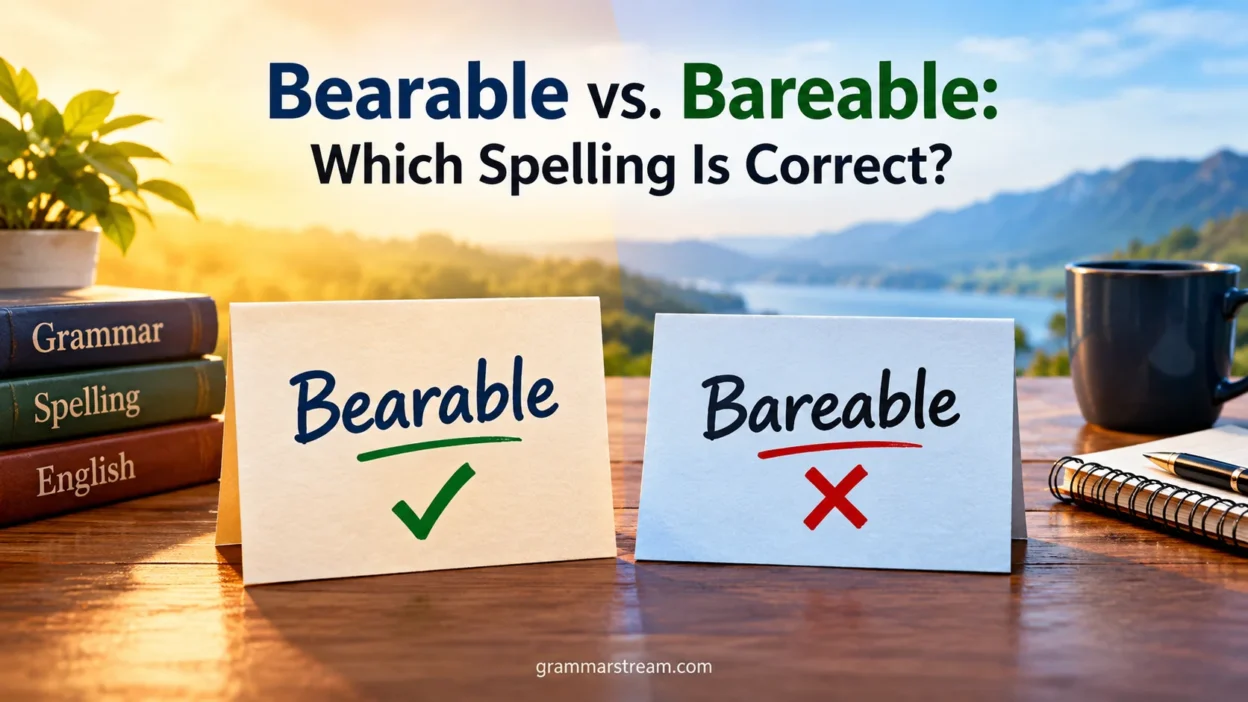
Have you ever wondered whether to write bearable or bareable when describing something unpleasant that you can tolerate? These two spellings look almost identical and sound the same in standard American English. However, only one is the standard spelling for this meaning. Choosing the right word can make your writing clearer and help you avoid common spelling mistakes.
The confusion usually comes from the words bear and bare. Although they sound alike, they have different meanings. The word bear can mean to endure or tolerate something, while bare means uncovered or exposed. Understanding this distinction makes it much easier to remember which spelling belongs in your sentence.
Whether you’re writing a school assignment, preparing a professional email, or creating an article, knowing the difference between bearable and bareable will help you communicate accurately. Let’s explore their meanings, spelling rules, practical examples, and common mistakes so you can use the correct word confidently.
Quick Answer
Bearable is the correct spelling when you mean something can be endured, tolerated, or managed despite being unpleasant or difficult. Bareable is a nonstandard spelling generally considered incorrect when used with this meaning.
For example:
- Correct: The heat became bearable after the sun went down.
- Incorrect: The heat became bareable after the sun went down.
The adjective bearable comes from the verb bear, which can mean to endure or tolerate. Adding the suffix -able creates a word that describes something you can endure.
Remember this simple rule: If you can bear it, it’s bearable.
Comparison Overview
Bearable and bareable differ in standard spelling and usage, even though they sound alike. The following table highlights the key points.
| Feature | Bearable | Bareable |
| Standard spelling | Correct | Nonstandard for the intended meaning |
| Part of speech | Adjective | Not a standard substitute for this adjective |
| Meaning | Able to be endured or tolerated | Generally intended as a misspelling of bearable |
| Root word | Bear | Bare |
| Word formation | Bear + -able | Bare + -able |
| Common usage | Describing pain, discomfort, stress, or difficult situations | Should be avoided when meaning tolerable |
| Example | The long wait was bearable. | The long wait was bareable. |
| Recommended in formal writing | Yes | No |
The main distinction comes from the root word. Bearable relates to enduring something, while bare relates to being uncovered or exposed.
Although bareable follows a pattern that might look reasonable to an English learner, it isn’t the standard spelling of the adjective meaning tolerable. Use bearable in everyday writing, academic work, professional communication, and published content.
Main Differences Between Bearable vs. Bareable
The most important difference between bearable and bareable is that only bearable is the accepted standard spelling for something that can be endured. The spelling makes sense when you understand the meaning of the original verb.
Bearable Is the Correct Standard Spelling
The word bearable describes something you can tolerate or withstand. It often refers to an unpleasant experience that remains manageable.
For example, a headache might be bearable even when it isn’t comfortable. A demanding workday might also be bearable if you have enough time and support to finish your tasks.
Consider these sentences:
- The pain was bearable after I took a break.
- The temperature became bearable in the evening.
- With better planning, the workload felt more bearable.
- The family made the difficult journey bearable by helping one another.
In each example, bearable describes something unpleasant or challenging that a person can tolerate.
Bareable Is a Nonstandard Spelling
The spelling bareable often appears when someone confuses the words bear and bare. Since both words have the same pronunciation in standard American English, it’s easy to understand why people make this mistake.
However, their meanings differ. The verb bear can mean to endure, while the adjective bare means uncovered or lacking a covering.
For example:
- Bearable: The noise was bearable after I closed the windows.
- Bare: The room had bare walls and an unfinished floor.
The word bareable isn’t the standard adjective for something tolerable. If you want to describe an unpleasant situation that someone can endure, write bearable instead.
Both Spellings Sound the Same
Another reason people confuse these words is pronunciation. In standard American English, bearable and bareable would ordinarily be pronounced alike because bear and bare are homophones.
Homophones are words that share a pronunciation but have different meanings or spellings. Other familiar examples include right and write, flower and flour, and pair and pear.
Because pronunciation doesn’t help distinguish bearable from bareable, the best solution is to remember the meaning of the root word.
Ask yourself: Am I describing something I can endure?
If the answer is yes, bearable is the correct spelling.
What Does Bearable Mean?
Bearable is an adjective that means capable of being endured, tolerated, or managed. It describes something that might be uncomfortable, difficult, painful, or unpleasant but isn’t completely intolerable.
The word doesn’t mean that something is enjoyable. Instead, it suggests that a person can cope with a situation without finding it too difficult to withstand.
For instance, imagine sitting in a room that’s slightly too warm. You might feel uncomfortable, but you can continue working without much trouble. In that situation, the temperature is bearable.
Now imagine that the room becomes extremely hot and you can no longer concentrate. The conditions might become unbearable instead.
This contrast shows how the word works in everyday English.
Bearable as an Adjective
An adjective describes a person, place, thing, condition, or experience. The word bearable commonly appears after linking verbs such as is, was, seems, feels, and became.
Here are some examples:
- The discomfort was bearable.
- The new schedule seems bearable.
- The heat became bearable after sunset.
- The long meeting felt more bearable after the break.
- The financial burden is bearable with careful budgeting.
You can also use bearable before a noun.
For example:
- We experienced bearable discomfort during the procedure.
- The team worked through a bearable level of stress.
- They found a bearable solution to the scheduling problem.
In these sentences, the adjective describes the level of discomfort, stress, or difficulty involved.
What Does Bearable Mean in Different Contexts?
The meaning stays consistent across different situations, but the details depend on what you’re describing.
Pain and discomfort: Bearable pain is pain that someone can tolerate, even if it remains unpleasant.
Weather: Bearable weather allows people to remain outside or continue their activities without excessive discomfort.
Work and stress: A bearable workload is demanding but manageable within someone’s available time and resources.
Expenses: A bearable expense is a cost someone can afford without placing too much strain on their budget.
Noise: Bearable noise might be distracting or irritating without becoming impossible to tolerate.
The common idea is simple: Something doesn’t have to be pleasant to be bearable. It only needs to remain tolerable under the circumstances.
Why Is Bareable Incorrect?
The spelling bareable is generally incorrect when you intend to describe something that can be tolerated. The standard word is bearable, formed from the verb bear and the suffix -able.
The confusion makes sense because English spelling isn’t always predictable. Words that sound alike can have unrelated meanings, and familiar spelling patterns sometimes lead writers toward incorrect forms.
However, understanding the word’s construction helps prevent this particular error.
Read More: Natzi vs Nazi: Which Spelling Is Correct?
Bear + -able = Bearable
The word bearable combines the verb bear with the suffix -able.
The suffix -able commonly means capable of or suitable for something. When added to an appropriate word, it can form an adjective describing a possibility or ability.
Consider these examples:
| Root word | Adjective | Meaning |
| Bear | Bearable | Capable of being endured |
| Manage | Manageable | Capable of being managed |
| Read | Readable | Easy or possible to read |
| Understand | Understandable | Capable of being understood |
| Avoid | Avoidable | Capable of being avoided |
The pattern helps explain the meaning of bearable. Something bearable is something a person can bear.
By contrast, bare means uncovered or exposed. Although adding -able might seem logical, bareable isn’t the standard spelling used to express the meaning of tolerable.
Why Do People Write Bareable?
Several factors contribute to this spelling mistake.
The words sound alike. In American English, bear and bare share the same pronunciation. People who rely on sound rather than spelling may choose the wrong form.
The spelling looks plausible. English has many adjectives ending in -able. A writer might assume that bareable follows the same pattern as other words.
The root meaning isn’t obvious. Someone who hasn’t connected bearable with the verb bear might not recognize why the word contains those particular letters.
Spell-checking may not catch every mistake. Some spelling tools identify common errors, but their ability to flag unusual or nonstandard forms varies. Writers should still consider meaning and context.
The easiest solution is to remember that bearable relates to enduring something, not to the idea of being bare.
Bearable vs. Bareable: Understanding Bear and Bare
To remember the correct spelling, you need to understand the difference between bear and bare. These words sound alike but perform different jobs in English.
What Does Bear Mean?
The word bear has several meanings. As a verb, it can mean to endure, tolerate, carry, support, or accept something, depending on the context.
For example:
- I can’t bear the constant noise.
- She had to bear the responsibility for the decision.
- He couldn’t bear the thought of leaving his family.
- The bridge can bear a heavy load.
- I can’t bear to watch that frightening scene.
In the first three examples, bear relates to enduring an emotional or physical experience. In the fourth, it means to support weight.
The connection to bearable becomes clear when you focus on the meaning of endurance.
If you can bear a difficult experience, that experience is bearable.
What Does Bare Mean?
The word bare usually means uncovered, exposed, or lacking something that would normally cover or decorate a surface.
It can function as an adjective or a verb.
As an adjective:
- She walked across the grass with bare feet.
- The apartment had bare walls.
- Only the bare essentials fit inside the suitcase.
- The tree’s bare branches stood against the winter sky.
As a verb, bare means to uncover or reveal something.
For example:
- He bared his arm so the nurse could examine it.
- The investigation bared the truth about the scheme.
Notice the distinction between bare and bear. Neither word is inherently incorrect. They simply serve different purposes.
The spelling mistake happens when someone uses bare in a word that should come from bear.
How Does Bear Become Bearable?
The word formation is straightforward:
Bear + -able = Bearable
The adjective describes something capable of being endured.
For example:
- The pain was difficult to bear.
- The pain was bearable.
Both sentences express a similar idea. The first uses the verb bear, while the second uses the adjective bearable.
You can apply the same connection to many situations:
| Verb phrase | Adjective | Example |
| Bear the pain | Bearable | The pain was bearable. |
| Bear the heat | Bearable | The heat was bearable. |
| Bear the expense | Bearable | The expense was bearable. |
| Bear the pressure | Bearable | The pressure was bearable. |
This relationship provides a practical spelling reminder. Whenever you mean that something can be endured, connect the adjective to the verb bear.
Bearable vs. Bareable Examples in Everyday Writing
Examples make spelling rules easier to apply. Instead of memorizing a definition alone, look at how bearable works in everyday sentences.
Bearable in Sentences About Pain and Discomfort
People frequently use bearable when discussing physical discomfort. The word indicates that the pain can be tolerated, although it may still be unpleasant.
Examples:
- The headache was bearable after I rested for an hour.
- The dentist explained that some temporary discomfort might be bearable.
- Her sore muscles were more bearable the following morning.
- The cold water made the heat outside feel more bearable.
- The minor injury caused bearable discomfort throughout the day.
Important distinction: Bearable doesn’t describe the medical severity of a condition by itself. It describes how tolerable the experience feels. Pain that seems bearable to one person might feel unbearable to another.
Bearable in Sentences About Weather and Noise
Weather and noise can affect comfort, concentration, and daily activities. The adjective helps communicate whether those conditions remain tolerable.
Examples:
- The weather was bearable early in the morning.
- The afternoon heat became more bearable after a rain shower.
- The traffic noise was bearable with the windows closed.
- The loud music remained bearable until the party moved outside.
- A cool breeze made the warm evening more bearable.
These sentences show that bearable often describes changing conditions. A situation may begin as uncomfortable and become easier to tolerate later.
FAQs:
Is Bearable or Bareable Correct?
Bearable is the correct standard spelling when you mean something can be endured, tolerated, or managed. Bareable is generally considered a misspelling when used with that meaning.
Example: The long journey was bearable because we stopped for breaks.
Is Bareable a Real Word?
Bareable is not the standard English spelling of the adjective meaning tolerable. Although people sometimes use it because it resembles bearable, standard writing calls for bearable.
If you mean that something can be endured, use bearable.
What Does Bearable Mean in Simple Terms?
Bearable means that something is difficult or unpleasant but still possible to tolerate.
For example, a long wait might be bearable if you have a comfortable place to sit. The word doesn’t mean the experience is enjoyable. It means you can manage it.
What Is the Opposite of Bearable?
The common opposite of bearable is unbearable.
Something bearable can be tolerated, while something unbearable is too difficult or unpleasant to endure.
For example:
- The noise was bearable during the day.
- The noise became unbearable at night.
How Do You Use Bearable in a Sentence?
Use bearable as an adjective to describe something tolerable.
For example: “The workload became more bearable after the manager assigned tasks fairly.”
You can place the word after a linking verb, as in “The pain was bearable,” or before a noun, as in “We found a bearable solution.”
Conclusion:
When comparing bearable vs. bareable, the choice is straightforward: bearable is the correct standard spelling when describing something that can be endured or tolerated. Bareable is a nonstandard spelling generally treated as a mistake in this context. The easiest way to remember the difference is to focus on the root word. Bear can mean to endure, while bare means uncovered or exposed. Adding -able to bear produces bearable, an adjective that describes something manageable despite its difficulties.