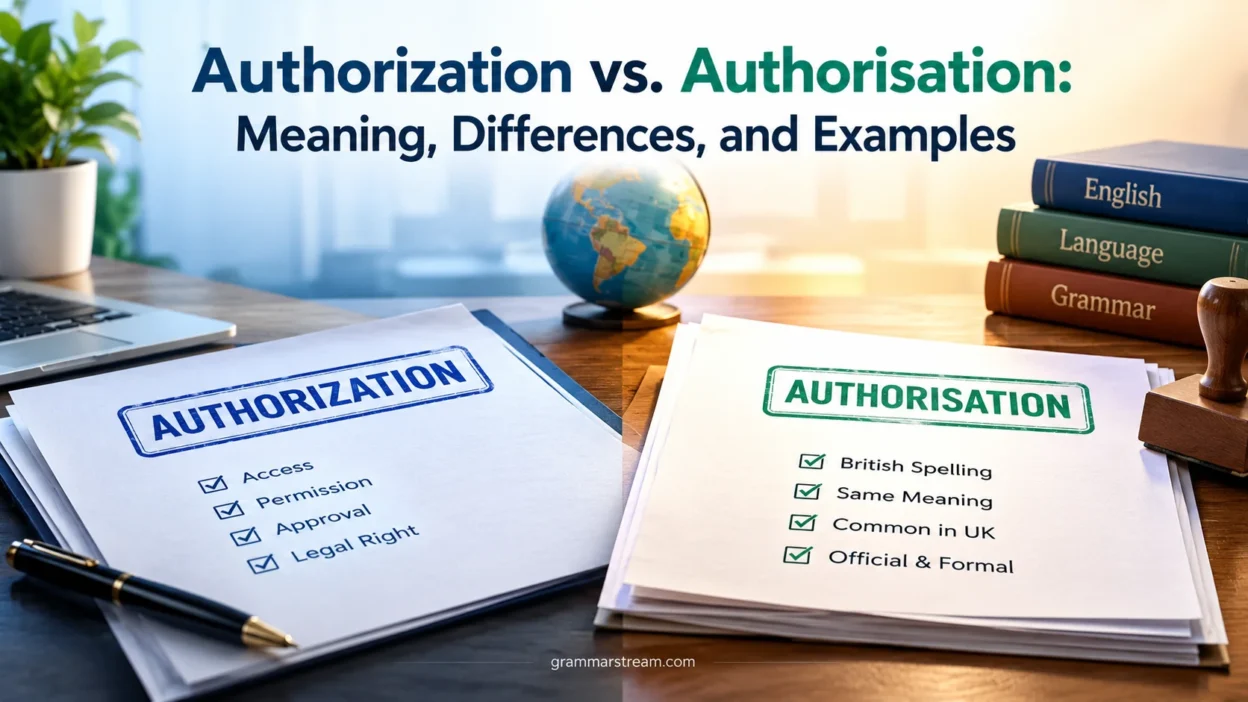
Have you ever wondered whether to write authorization or authorisation? Both spellings look correct, and they mean the same thing. However, the version you should use depends on the type of English you follow.
The main difference between authorization and authorisation comes down to regional spelling conventions. American English generally uses authorization, while British English typically uses authorisation. Both words refer to permission, approval, or the power to perform a particular action.
You might encounter these words in business documents, banking transactions, legal agreements, healthcare procedures, and computer security systems. Although their spelling differs, their meaning and grammatical function remain the same.
Understanding this distinction helps you write clearly and maintain consistency. Whether you’re preparing a professional email, writing an academic paper, or documenting software, choosing the appropriate spelling makes your work look polished and professional.
Quick Answer
Authorization is the standard American English spelling, while authorisation is the standard British English spelling. Both words mean official permission, approval, or the granting of authority to do something.
For example:
- American English: The manager granted authorization for the purchase.
- British English: The manager granted authorisation for the purchase.
Both sentences communicate the same meaning. The only difference is the spelling convention.
Choose authorization when writing for an American audience. Use authorisation when following British English conventions, unless your organization or publication specifies another style.
Comparison Overview
Authorization and authorisation share the same definition, pronunciation, and grammatical role. Their primary difference is the regional spelling convention each represents.
The following table highlights their main characteristics.
| Feature | Authorization | Authorisation |
| English variety | American English | British English |
| Meaning | Permission, approval, or granting authority | Permission, approval, or granting authority |
| Spelling difference | Uses z | Uses s |
| Pronunciation | Generally the same | Generally the same |
| Part of speech | Noun | Noun |
| Verb form | Authorize | Authorise |
| Past-tense form | Authorized | Authorised |
| Present participle | Authorizing | Authorising |
| Common contexts | US business, government, and technology | UK business, government, and technology |
| Correctness | Standard American spelling | Standard British spelling |
Neither spelling is inherently wrong. The appropriate choice depends on your audience, regional English conventions, and any applicable style requirements.
For example, an American company might request written authorization before approving an expense. A British company might use written authorisation for the same procedure.
The underlying process remains unchanged. Only the spelling differs.
Main Differences Between Authorization and Authorisation
The difference between authorization and authorisation becomes clearer when you examine their spelling, meaning, regional usage, pronunciation, and related word forms.
Authorization vs. Authorisation: Spelling Differences
The most obvious difference is the letter z in authorization and the letter s in authorisation.
American English generally favors the -ize and -ization spellings in words such as authorize, organize, and authorization. British English commonly uses -ise and **-isation* in these words, particularly in publications that follow traditional British spelling conventions.
Consider these examples:
- Authorization — American English
- Authorisation — British English
- Organization — American English
- Organisation — British English
- Realization — American English
- Realisation — British English
These spelling patterns help readers recognize which English convention a writer follows.
However, the distinction isn’t an absolute rule for every word. British English also accepts many -ize spellings, and some British dictionaries and publications prefer them. Therefore, you shouldn’t assume that every British word containing s must contain z in American English.
The key point: Both authorization and authorisation are established spellings. Choose the one that matches your intended English variety or required style guide.
Here are two sentences that demonstrate the difference:
- American: The director provided authorization to release the report.
- British: The director provided authorisation to release the report.
Both sentences are grammatically correct and express the same idea.
Authorization vs. Authorisation: Meaning and Definition
Although their spelling differs, authorization and authorisation have the same meaning.
Both words describe the act of granting permission or the state of having permission to perform a particular action. They can also refer to the formal approval that allows someone to proceed with a task.
For example, a supervisor might authorize an employee to purchase equipment. A bank might authorize a payment, or an administrator might grant a user permission to access restricted files.
In each situation, authorization establishes that an action is permitted by someone or something with the appropriate authority.
Common meanings of authorization and authorisation include:
- Permission: Approval to perform an action.
- Official approval: Formal acceptance of a request or proposal.
- Delegated authority: Permission to act on behalf of another person or organization.
- Access permission: Rights that allow someone to use a system or resource.
- Transaction approval: Confirmation that a financial transaction can proceed under the applicable rules.
Consider this example:
The employee requested authorization before purchasing the new computer.
The sentence means that the employee needed approval before completing the purchase.
The British spelling produces the same meaning:
The employee requested authorisation before purchasing the new computer.
Neither version suggests a different level of permission or formality.
It’s also useful to distinguish authorization from authority. Authority refers to the power or right to make decisions, issue instructions, or take action. Authorization usually refers to permission granted or the act of granting it.
For example, a department manager might have the authority to approve expenses. When that manager approves a specific purchase, the approval provides authorization for the transaction.
Authorization vs. Authorisation in American and British English
Regional spelling conventions explain why these two forms exist.
American English generally uses authorization. British English commonly uses authorisation, although some British style guides prefer authorization.
American spelling conventions were shaped partly by efforts to simplify and standardize English spelling. Noah Webster, an American lexicographer, helped popularize several spelling differences through his dictionaries, although not every modern American spelling originated with him.
The broader -ize versus -ise distinction has a more complex history. Both forms have appeared in English, and British usage has never been completely uniform.
Today, the choice often depends on the country, publication, institution, or style guide.
American English commonly uses:
- Authorization
- Authorize
- Authorized
- Authorizing
- Organization
- Realization
British English commonly uses:
- Authorisation
- Authorise
- Authorised
- Authorising
- Organisation
- Realisation
Other English-speaking countries may follow British spelling conventions while maintaining local preferences. For example, Canadian English often uses British-style spellings for some words but also follows American conventions in other cases.
Therefore, don’t rely on geography alone when a publication has an established style guide.
If you’re writing for a US company, authorization is generally the safest choice. For a UK publication that follows -ise spellings, authorisation will usually fit better.
Authorization vs. Authorisation: Pronunciation
Despite their different spellings, authorization and authorisation generally have the same pronunciation.
The spelling change from z to s doesn’t create a different word or a different meaning. In both forms, the letter represents the same voiced consonant sound in standard pronunciation.
A common pronunciation guide is:
- Authorization: aw-thuh-ruh-ZAY-shun
- Authorisation: aw-thuh-ruh-ZAY-shun
The exact vowel sounds may vary slightly by accent.
Both words contain five syllables in standard pronunciation, with the primary stress falling on the syllable containing -za-.
Pronunciation differences between American and British speakers may reflect broader accent differences. They don’t arise simply because one spelling contains z and the other contains s.
When speaking, you generally don’t need to change your pronunciation to match the spelling convention you’re using in writing.
Read More: Flys vs. Flies: Meaning, Spelling, Differences, and Examples
Authorization vs. Authorisation: Grammar and Word Forms
Both words function as nouns. They describe permission, approval, or the granting of authority.
Their related forms follow the same regional spelling patterns. If you choose American English, use authorize, authorized, and authorizing. If you follow a British -ise convention, use authorise, authorised, and authorising.
| American English | British English | Part of Speech | Example |
| Authorize | Authorise | Verb | The director will authorize the request. |
| Authorization | Authorisation | Noun | The request requires authorization. |
| Authorized | Authorised | Past-tense verb or adjective | The authorized employee entered the room. |
| Authorizing | Authorising | Present participle | She is authorizing the payment. |
| Authorizer | Authoriser | Noun | The authorizer reviewed the request. |
The word authorizer is valid, particularly in administrative and technical contexts, but it’s less common in everyday conversation.
You may also encounter the word authoritative. However, it doesn’t simply represent another spelling of authorization. It describes something that carries authority, commands respect, or provides reliable information.
For example:
- Authorization: The manager gave authorization to proceed.
- Authoritative: The manager issued an authoritative statement.
These words serve different grammatical and semantic purposes.
When writing longer documents, check every related form rather than correcting only the main noun. Consistent spelling makes your writing easier to follow.
When to Use Authorization
The word authorization is the preferred spelling in standard American English. It appears in everyday communication, professional documents, financial transactions, legal discussions, and technology.
American English Writing
If your audience primarily uses American English, choose authorization.
The word appears in formal reports, business correspondence, academic papers, government publications, and general writing. It works in both casual and professional contexts.
For example:
- The principal granted authorization for the school trip.
- Employees need authorization before accessing confidential records.
- The company requires written authorization for large purchases.
- The committee received authorization to begin the project.
Each sentence uses the American spelling naturally.
American English also uses related forms such as authorize and authorized. Switching between these forms and British spellings can make a document inconsistent.
For instance, writing The manager authorised the purchase and provided authorization mixes conventions. A consistent American version would use authorized and authorization.
Business and Workplace Communication
Authorization plays an important role in business because organizations need clear approval procedures.
Employees often require authorization before spending company money, sharing confidential information, signing agreements, or making decisions outside their assigned responsibilities.
A typical workplace process might involve three stages:
- Request: An employee submits a request for approval.
- Review: A manager or designated approver evaluates the request.
- Authorization: The responsible person grants permission or rejects the request.
For example, an employee might request authorization to attend a professional conference. The manager reviews the budget and business benefits before approving the expense.
The word also appears in policies and procedures.
Common workplace expressions include:
- Manager authorization
- Written authorization
- Purchase authorization
- Authorization request
- Authorization form
- Authorized representative
These phrases help clarify who can approve an action and which actions require permission.
However, authorization doesn’t automatically mean that an action is legally valid in every circumstance. A person granting permission must have the necessary authority, and the action must still comply with applicable rules.
Banking and Financial Transactions
Authorization is especially important in banking and payment processing.
When you pay with a credit or debit card, the payment system may request authorization from the card issuer. The issuer evaluates the transaction under its applicable controls and returns an approval or decline response.
An approved authorization generally allows the transaction to move forward. It doesn’t necessarily mean the merchant has received the money.
Payment authorization and settlement are separate stages.
For example, when you pay for a hotel room, the hotel may place an authorization hold on your card. The hold reduces the amount of available credit or funds, depending on the account and payment arrangement.
The final amount may differ from the initial authorized amount. The merchant may also complete the transaction later, subject to the payment system’s rules.
Common financial expressions include:
- Credit card authorization
- Payment authorization
- Bank authorization
- Transaction authorization
- Authorized payment
- Authorization hold
These terms describe different aspects of financial approval, so context matters.
A payment can receive authorization without having reached final settlement. Likewise, an authorization hold may affect available funds without representing a completed charge.
Technology and Access Control
In technology, authorization determines what a user, application, or system is allowed to do.
For example, a company employee might be allowed to view a document but not edit it. A manager might have permission to approve expenses, while an ordinary employee can only submit requests.
These permissions help organizations limit access to sensitive information and prevent unauthorized actions.
Consider a simple example:
An employee signs in to a company dashboard successfully. However, the system refuses access to the payroll administration page because the employee doesn’t have the required permissions.
In this situation, authentication succeeded, but authorization denied the requested action.
The distinction matters because authentication verifies identity, while authorization determines access rights.
Common technical expressions include:
- User authorization
- Access authorization
- Authorization rules
- Authorization server
- Authorization request
- Role-based authorization
For example, a role-based access control system may assign permissions according to a person’s job responsibilities. An accountant might access financial reports, while a human resources employee can access personnel records.
This arrangement supports security by limiting access to the resources each user needs.
When to Use Authorisation
The word authorisation is common in British English and in other contexts that follow British -ise spelling conventions.
Its meaning is identical to authorization. The spelling simply reflects a different regional convention.
British English Writing
Use authorisation when writing for a British English audience that follows the -ise convention.
The word appears in business reports, official correspondence, educational materials, and general writing.
Examples include:
- The director granted authorisation for the project.
- Written authorisation is required before the records can be released.
- The employee requested authorisation to work remotely.
- The organization updated its authorisation procedures.
Each example uses the British spelling consistently.
The same convention generally applies to related forms such as authorise, authorised, and authorising.
However, British English isn’t entirely uniform. Some dictionaries, publishers, and institutions accept or prefer -ize spellings. Follow the style guide that governs your document rather than assuming every British organization uses authorisation.
FAQs:
Is Authorization or Authorisation Correct?
Both spellings are correct. Authorization is the standard American English spelling, while authorisation is common in British English and other varieties that follow British -ise conventions.
The best choice depends on your audience and style guide.
What Is the Difference Between Authorization and Authorisation?
The difference is spelling rather than meaning. Both words refer to permission, approval, or the granting of authority.
American English generally uses authorization, while British English commonly uses authorisation.
Is Authorization American or British English?
Authorization is the standard American English spelling. It also appears in British English publications that accept or prefer -ize spellings.
If you’re writing for a US audience, this is generally the appropriate form.
Is Authorisation British English?
Yes. Authorisation is a standard British English spelling.
It’s also used in other English-speaking contexts that follow British spelling conventions. However, some British publishers and institutions prefer authorization.
How Do You Spell Authorization in the UK?
In British English, the spelling is commonly authorisation.
However, some British style guides accept or prefer authorization. Follow the spelling convention required by your publication or organization.
Conclusion:
The difference between authorization and authorisation comes down to regional spelling conventions. Authorization is the standard American English spelling, while authorisation is common in British English. Both words have the same meaning. They refer to permission, approval, or the granting of authority to perform an action. You’ll encounter them in business documents, financial transactions, healthcare procedures, legal material, and computer security systems. Although their spelling differs, their grammatical role and core meaning remain unchanged.