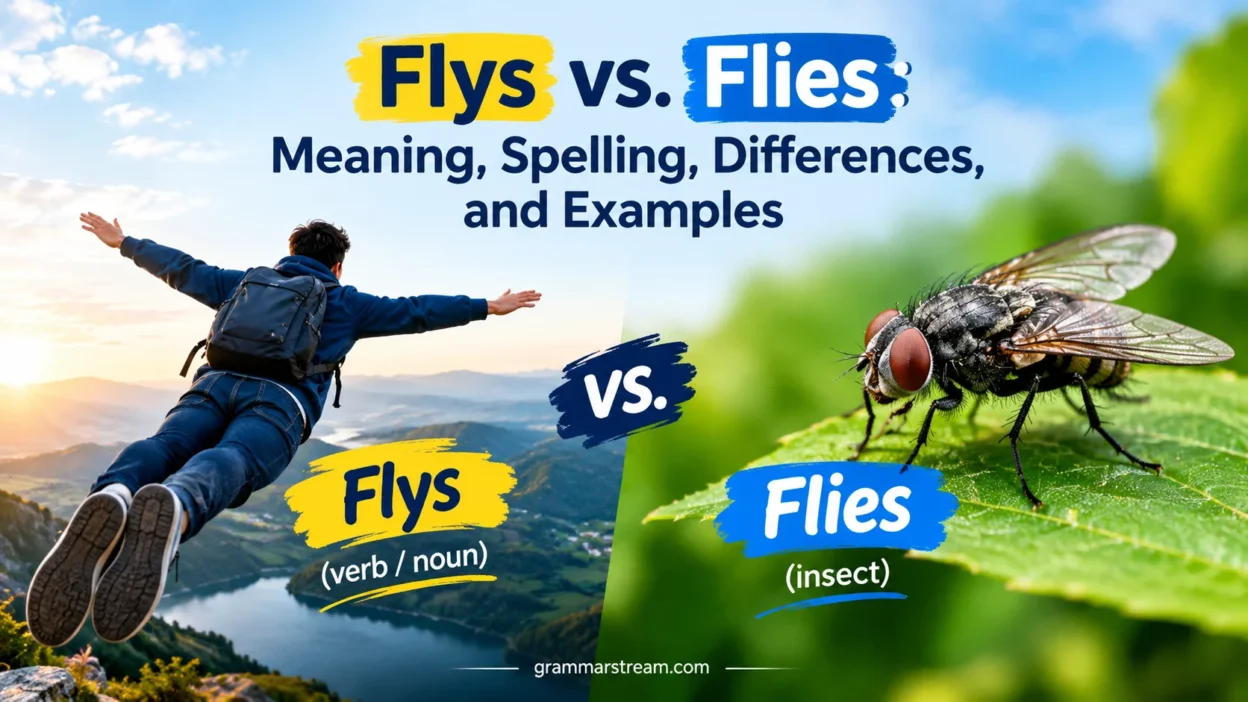
Have you ever wondered whether to write flys or flies? You’re not alone. These two spellings can confuse writers because they look similar and sound alike when flys is intended as a misspelling of flies. However, standard English follows a clear spelling rule that makes the correct choice easy to remember.
Flies is the correct spelling when you mean more than one flying insect or describe someone or something that flies. For example, you might write, “Several flies gathered around the fruit bowl,” or “The bird flies over the lake.” In both sentences, flies follows standard English spelling and grammar rules.
On the other hand, flys is generally incorrect when used as the plural of fly or as the third-person singular form of the verb fly. The confusion usually happens because many English nouns form their plurals by adding -s. However, words ending in a consonant followed by y typically change the y to i before adding -es.
Understanding this simple rule will help you avoid spelling mistakes in emails, school assignments, blog posts, and everyday conversations. Let’s explore the differences between flys and flies, including their meanings, grammatical uses, examples, and related spelling rules.
Quick Answer: Flys vs. Flies
Flies is the correct spelling in standard English when referring to multiple insects or using fly as a third-person singular present-tense verb. Flys is generally a misspelling in these contexts.
Consider these examples:
- Correct: Two flies landed on the kitchen counter.
- Incorrect: Two flys landed on the kitchen counter.
- Correct: My brother flies to Chicago every month.
- Incorrect: My brother flys to Chicago every month.
- Correct: Time flies when you’re having fun.
- Incorrect: Time flys when you’re having fun.
The spelling rule is straightforward: when a word ends in a consonant followed by y, change the y to i and add -es to form the regular plural or the third-person singular present-tense verb.
For example:
- Fly → Flies
- Baby → Babies
- City → Cities
- Try → Tries
Remember that flys may appear in a proper name, brand, or deliberately stylized expression. Those special cases don’t make it the standard spelling for ordinary grammatical use.
Comparison Overview
The easiest way to understand flys vs. flies is to compare their spelling, meaning, and grammatical functions.
| Feature | Flies | Flys |
| Standard English spelling | Correct | Generally incorrect for ordinary grammatical uses |
| Plural of the insect fly | Yes | No |
| Third-person singular present-tense form of fly | Yes | No |
| Example as a noun | Several flies entered the room. | Several flys entered the room. |
| Example as a verb | The bird flies south. | The bird flys south. |
| Use in formal writing | Recommended | Avoid unless reproducing a specific name or intentional spelling |
| Pronunciation | /flaɪz/ | Usually intended to sound like flies when written incorrectly |
The key difference isn’t pronunciation. It’s standard spelling and grammatical correctness.
The word flies has two common grammatical functions. It can refer to multiple insects, or it can describe an action performed by a singular third-person subject.
For example, in “The flies are buzzing,” the word is a plural noun. In “The airplane flies overhead,” it is a verb.
Although flys might look reasonable at first glance, it doesn’t follow the standard spelling pattern for either use.
Main Differences Between Flys and Flies
The distinction between these spellings becomes much clearer when you examine how each form relates to the original word fly.
What Does Flies Mean?
Flies is the standard plural form of the noun fly. It is also the third-person singular present-tense form of the verb fly.
These two meanings are related to the same base word, but they perform different jobs in a sentence.
Flies as a plural noun
When flies functions as a noun, it refers to more than one fly. In everyday English, the word most commonly describes flying insects.
Examples include:
- Several flies gathered around the uncovered food.
- The flies kept buzzing near the window.
- Fruit flies appeared beside the overripe bananas.
- A few flies entered through the open door.
- Those flies disappeared when we closed the screen.
In each example, flies names multiple insects.
The singular form is fly. When you refer to more than one, the spelling changes to flies.
Flies as a verb
The word flies also describes the action of flying when the subject is third-person singular.
Examples include:
- The eagle flies above the mountains.
- My mother flies to New York for work.
- The airplane flies over the ocean.
- A butterfly flies from flower to flower.
- The pilot flies the aircraft professionally.
Notice how the subject determines the verb form. We write I fly, but we write he flies. Similarly, they fly is correct, while the bird flies follows the third-person singular pattern.
Quick tip: If the word refers to several insects, it is a noun. If it describes an action performed by someone or something, it is a verb.
What Does Flys Mean?
In standard English, flys is generally a misspelling of flies when writers intend to form the plural noun or the third-person singular present-tense verb.
For example, consider this sentence:
“Three flys were buzzing around the kitchen.”
The sentence contains a spelling mistake. The correct version is:
“Three flies were buzzing around the kitchen.”
The same issue occurs with verbs.
Incorrect: “She flys to London every summer.”
Correct: “She flies to London every summer.”
Why do people make this mistake? English has many words that form plurals by adding -s. Writers sometimes apply that familiar pattern to fly without considering the consonant-plus-y rule.
However, the spelling of fly changes before the ending is added.
There are situations in which Flys may appear intentionally. A business, product, fictional character, or creative title might use that spelling as part of its official name. In those cases, preserve the intended name rather than automatically correcting it.
Outside such specific contexts, use flies.
Flys vs. Flies: Which Spelling Is Correct?
Flies is the correct spelling for ordinary grammatical uses of the word. You should use it when referring to multiple flies or describing an action performed by a third-person singular subject.
Here are several examples:
| Incorrect sentence | Correct sentence | Explanation |
| Two flys landed on the table. | Two flies landed on the table. | Flies is the standard plural form of fly. |
| She flys to Boston every week. | She flies to Boston every week. | A third-person singular subject takes flies. |
| Time flys when you’re busy. | Time flies when you’re busy. | The singular subject time requires flies. |
| The flys are near the window. | The flies are near the window. | The plural noun requires the standard spelling. |
| He flys the plane professionally. | He flies the plane professionally. | The verb must agree with he. |
The correct choice remains the same whether you’re writing casually or formally.
For school assignments, professional emails, articles, and social media posts, choose flies whenever you need the ordinary plural or verb form.
Why Does Fly Become Flies?
The spelling change happens because English follows a common rule for words ending in a consonant followed by y.
When you form the regular plural of many nouns ending in consonant + y, you change y to i and add -es. The same pattern applies to the third-person singular present-tense forms of many verbs.
The transformation looks like this:
Fly → Flies
The letter l is a consonant. Because fly ends in a consonant followed by y, the standard form changes the final y to i and adds -es.
Here are more examples:
| Base word | Correct form | Example |
| Fly | Flies | The flies are outside. |
| Baby | Babies | The babies are sleeping. |
| City | Cities | Several cities attract tourists. |
| Story | Stories | She writes interesting stories. |
| Try | Tries | He tries his best. |
| Carry | Carries | She carries a small bag. |
| Reply | Replies | He replies to every message. |
| Apply | Applies | She applies for new jobs. |
This rule explains why flys isn’t the standard form. The spelling changes before the ending is added.
However, remember that not every word ending in y follows this pattern. The letter immediately before y matters.
Read More: Phoenix vs. Pheonix: Meaning, Differences, and Examples
When to Use Flies Correctly
Understanding the spelling rule is helpful, but recognizing the word’s role in a sentence makes your writing even more accurate.
Flies as a Plural Noun
Use flies when you mean more than one insect commonly called a fly.
A fly belongs to the insect order Diptera, a group characterized by having one functional pair of wings. Houseflies and fruit flies are familiar examples, although many different kinds of flies exist.
In everyday writing, you don’t need to know an insect’s scientific classification to choose the correct spelling. You simply need to recognize that flies is the plural of fly.
Examples:
- The flies gathered around the picnic table.
- Several flies entered the house through the open window.
- We noticed flies near the kitchen trash can.
- The gardener saw flies around the compost bin.
- Those flies kept landing on the ripe peaches.
Singular vs. plural:
| Number | Correct form | Example |
| One | Fly | A fly landed on my arm. |
| Two | Flies | Two flies landed on my arm. |
| Several | Flies | Several flies gathered near the fruit. |
| Many | Flies | Many flies filled the outdoor area. |
You can also use flies in compound nouns such as fruit flies, house flies, and horseflies. Compound-word styling can vary by term and dictionary, but the plural spelling of fly remains flies when the word is written as a separate noun.
Flies as a Verb
Use flies when the subject is a singular third-person noun or pronoun and the verb describes the present tense.
The verb fly can describe movement through the air, travel by aircraft, or operating an aircraft. It also appears in figurative expressions.
Consider these examples:
- The bird flies across the field.
- She flies to Dallas every Monday.
- My father flies a small airplane.
- The kite flies high above the park.
- The flag flies proudly over the building.
- Time flies when you’re enjoying yourself.
In each sentence, the subject determines the verb form.
Compare the following:
| Subject | Correct verb form | Example |
| I | Fly | I fly to Miami twice a year. |
| You | Fly | You fly often for work. |
| We | Fly | We fly home tomorrow. |
| They | Fly | They fly across the country. |
| He | Flies | He flies to Seattle every month. |
| She | Flies | She flies for an airline. |
| It | Flies | It flies above the trees. |
| The bird | Flies | The bird flies toward its nest. |
The important point is that flies isn’t simply the plural form of fly. It also serves a different grammatical purpose as a verb.
The Expression “Time Flies”
The familiar expression “time flies” means that time seems to pass quickly.
People often use it when they’re enjoying themselves, staying busy, or reflecting on how quickly a period has passed.
For example:
- Time flies when you’re having fun.
- Time flies during the summer holidays.
- Time flies when you’re working on an exciting project.
- It’s hard to believe how quickly time flies.
The expression uses flies because time is the subject and functions as a singular noun.
Therefore, the correct expression is time flies, not time flys.
You can remember it by thinking about how quickly a bird flies across the sky. In the same way, time can seem to move faster than expected.
Flies in Other Noun Contexts
Although insects are the most familiar meaning, flies has other meanings in English.
Flies as part of clothing
In clothing terminology, a fly refers to the opening in the front of trousers or similar garments. It often contains a zipper, buttons, or another fastening.
For example:
- The zipper on his jeans was stuck.
- Make sure the fly on your trousers is closed.
The plural flies may appear when discussing multiple garments or their openings.
Flies in theater terminology
In theater, the flies refer to the space above the stage where scenery, lighting equipment, and other theatrical elements may be stored or moved.
For example:
“The stage crew raised the scenery into the flies.”
This is a specialized theatrical use rather than the everyday insect meaning.
These examples show why context matters. The same spelling can represent different meanings, but flies remains the standard spelling in these ordinary noun uses.
The Spelling Rule Behind Flys vs. Flies
English spelling can feel inconsistent, but the difference between flys and flies follows a familiar pattern.
Words Ending in a Consonant + Y
When a regular noun ends in a consonant followed by y, its plural commonly changes the final y to i and adds -es.
For example:
- Fly → Flies
- Baby → Babies
- City → Cities
- Country → Countries
- Family → Families
- Party → Parties
- Penny → Pennies
- Puppy → Puppies
The same pattern appears in the third-person singular present tense of many verbs.
For example:
- Try → Tries
- Carry → Carries
- Study → Studies
- Hurry → Hurries
- Reply → Replies
- Worry → Worries
Consider the difference between these sentences:
- The baby cries at night.
- The babies cry at night.
In the first sentence, cries agrees with the singular subject baby. In the second, cry agrees with the plural subject babies.
The same principle explains fly and flies.
Words Ending in a Vowel + Y
When a word ends in a vowel followed by y, it generally keeps the y and adds -s to form a regular plural or third-person singular present-tense verb.
Examples include:
| Base word | Correct form | Example |
| Boy | Boys | The boys are playing outside. |
| Toy | Toys | The toys are on the floor. |
| Day | Days | The days seem shorter in winter. |
| Key | Keys | She carries two keys. |
| Play | Plays | He plays basketball after school. |
| Enjoy | Enjoys | She enjoys reading novels. |
| Stay | Stays | He stays home on Sundays. |
| Buy | Buys | She buys fresh fruit weekly. |
Notice the difference:
- Fly → Flies
- Play → Plays
The word fly ends in consonant + y, while play ends in vowel + y.
That single difference determines the usual spelling pattern.
Memory tip: Look at the letter immediately before the final y. If it’s a consonant, the word commonly changes y to i before adding -es. If it’s a vowel, the word generally keeps y and adds -s.
Why “Flys” Looks Plausible but Is Incorrect
The spelling flys may look reasonable because many English plurals simply add -s.
For example:
- Cat → Cats
- Dog → Dogs
- Book → Books
- Car → Cars
It’s easy to assume that fly follows the same pattern. However, English uses different spelling patterns depending on the word’s ending.
Because fly ends in consonant + y, the standard form is flies.
The same reasoning applies to verbs. We write she tries, not she trys, and he carries, not he carrys.
Once you recognize the pattern, the correct spelling becomes easier to remember.
FAQs:
Is It Flys or Flies?
Flies is correct in standard English when referring to multiple flies or using fly as a third-person singular present-tense verb.
For example, “The flies are outside” uses the plural noun, while “The bird flies south” uses the verb.
Is Flys a Real Word?
Flys is generally considered a nonstandard spelling when used as the ordinary plural of fly or its third-person singular present-tense verb form.
However, it may appear in proper names, brands, titles, or deliberately stylized expressions. In ordinary writing, use flies.
What Is the Plural of Fly?
The standard plural of fly is flies.
For example:
- One fly landed on the table.
- Three flies landed on the table.
The spelling changes because fly ends in a consonant followed by y.
Why Does Fly Change to Flies?
The change follows a common English spelling rule. When a word ends in consonant + y, its regular plural or third-person singular present-tense form commonly changes y to i and adds -es.
Examples include fly → flies, baby → babies, and try → tries.
Is It “Time Flies” or “Time Flys”?
“Time flies” is the correct expression.
The subject time is singular, so the verb takes the third-person singular present-tense form flies.
For example, “Time flies when you’re having fun” means that time seems to pass quickly when you’re enjoying yourself.
Conclusion:
The difference between flys and flies comes down to a simple English spelling rule. Flies is the standard form when you mean multiple insects or use fly as a third-person singular present-tense verb. Flys is generally incorrect in these ordinary grammatical contexts. Remember the consonant-plus-y rule: change the final y to i and add -es. That’s why we write fly → flies, baby → babies, and try → tries.