If you’ve ever typed “bellys” while trying to write the plural of belly, you’re not alone. The two forms look almost identical, and the difference comes down to one small spelling rule. However, that tiny change from y to ie makes one form standard English and the other incorrect in ordinary writing.
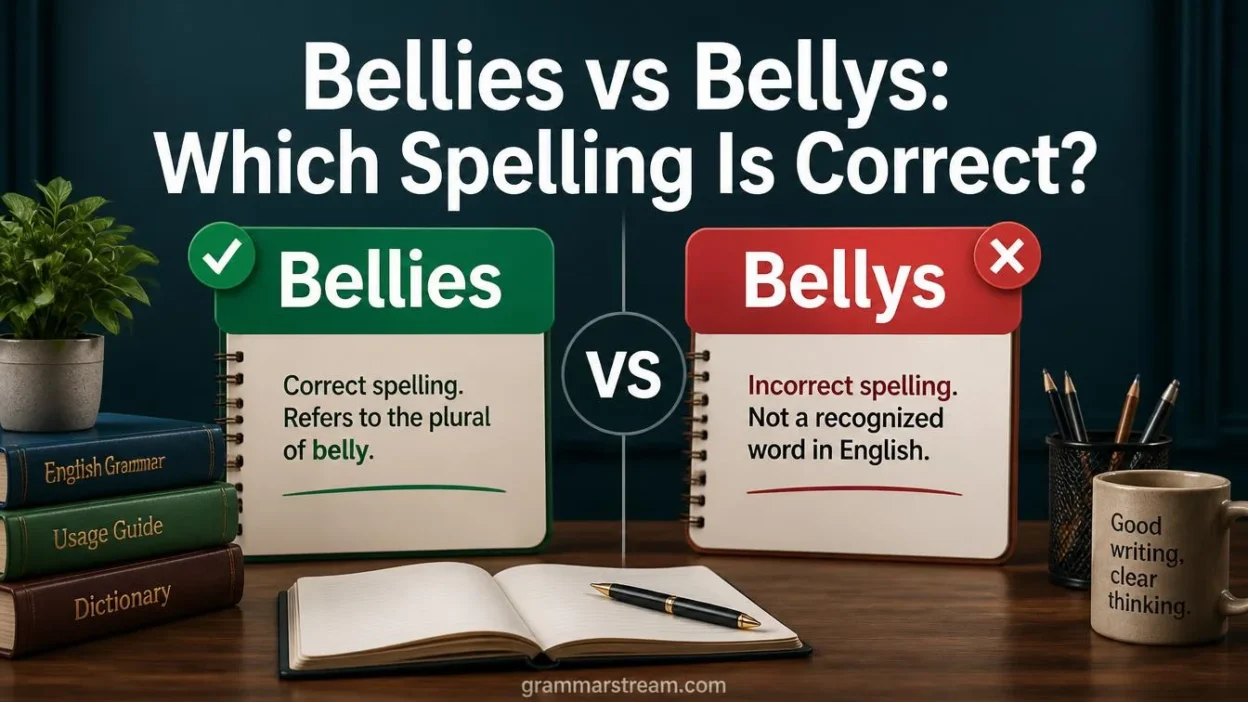
So, when should you use bellies? The answer is simple: bellies is the correct plural of belly. The spelling bellys does not follow the standard English pluralization rule for nouns ending in a consonant followed by y.
The word belly can refer to a person’s or animal’s abdomen. It can also describe the rounded or lower part of something, such as the belly of a boat or the belly of a drum. Whenever you need the plural form, the spelling changes from belly to bellies.
Understanding this distinction helps you avoid a surprisingly common spelling mistake. It also gives you a useful rule that applies to many other English words, including baby → babies, puppy → puppies, and city → cities.
Quick Answer
Bellies is correct. Bellys is incorrect as the standard plural of belly.
The reason is straightforward. When a noun ends in a consonant + y, English usually changes the y to i and adds -es to create the plural.
So:
belly → bellies
Not:
belly → bellys
Here’s the difference at a glance:
| Word | Correct? | Meaning |
| Belly | Yes | Singular form |
| Bellies | Yes | Plural form |
| Belly’s | Yes | Singular possessive or contraction, depending on context |
| Bellies’ | Yes | Plural possessive |
| Bellys | No | Incorrect standard plural spelling |
For example:
- Correct: The puppies rolled onto their bellies.
- Incorrect: The puppies rolled onto their bellys.
The rule isn’t unique to belly. It follows the same pattern as:
- Baby → babies
- Family → families
- City → cities
- Story → stories
- Puppy → puppies
There is one important exception to remember. If a word ends in a vowel + y, you normally keep the y and simply add -s. For example, boy → boys and toy → toys.
Comparison Overview
The difference between bellies vs bellys isn’t a difference in meaning. In standard English, only bellies works as the regular plural of belly.
| Feature | Bellies | Bellys |
| Standard English | Yes | No |
| Plural of belly | Yes | No |
| Spelling pattern | y changes to ie | Incorrectly keeps y |
| Used in formal writing | Yes | No |
| Used in everyday writing | Yes | No |
| Example | Their bellies were full. | Their bellys were full. ❌ |
The key point is simple: “bellys” isn’t an alternative spelling of “bellies.” If you’re using the word as the plural of belly, use bellies.
Main Differences Between Bellies vs Bellys
The main difference between bellies vs bellys comes from English spelling rules rather than pronunciation or meaning. Bellies is the established plural form, while bellys is a spelling error in standard English.
Bellies Is the Correct Plural Form
Bellies means more than one belly.
A belly usually refers to the front or lower part of the body between the chest and hips. In animals, it often means the underside or abdominal area. The word can also describe a rounded section of an object.
For example:
- The babies had round bellies.
- The kittens stretched out on their bellies.
- The birds had pale bellies.
- Everyone left the dinner table with full bellies.
- The fish had silver bellies.
In each sentence, you’re talking about more than one belly. That’s why bellies is the correct form.
Bellys Is Not the Standard Plural
Bellys doesn’t follow the normal spelling rule for nouns ending in a consonant and y.
It’s easy to see why someone might write it. Many regular English plurals simply take -s:
- book → books
- chair → chairs
- dog → dogs
- table → tables
However, English has several spelling patterns that change the form of the word. Words ending in consonant + y belong to one of those patterns.
Writing bellys is similar to writing babys instead of babies. Most readers will understand what you mean, but the spelling isn’t considered standard.
Why Does Belly Become Bellies?
The spelling change happens because belly ends with a consonant followed by y.
The final two letters of belly are:
l + y
The l is a consonant. Therefore, belly follows the consonant-plus-y plural rule.
The standard pattern is:
Consonant + y → change y to i + es
Applied to belly:
belly → bellies
The final y becomes i, then -es is added.
This gives us bellies.
The Consonant + Y Rule
Several everyday English words follow exactly the same pattern.
| Singular | Plural |
| Baby | Babies |
| City | Cities |
| Family | Families |
| Lady | Ladies |
| Puppy | Puppies |
| Story | Stories |
| Party | Parties |
| Belly | Bellies |
This pattern makes bellies much easier to remember. If you already know that baby becomes babies, you’ve already learned the basic rule needed for belly.
When Words Ending in Y Take Only S
Here’s where English can trip you up.
Not every word ending in y changes to ies. The letter immediately before the y matters.
When a word ends in a vowel + y, you generally keep the y and add -s.
For example:
| Singular | Plural |
| Boy | Boys |
| Toy | Toys |
| Day | Days |
| Key | Keys |
| Monkey | Monkeys |
| Valley | Valleys |
Compare belly and boy.
In belly, the letter before y is l, a consonant.
In boy, the letter before y is o, a vowel.
That’s why:
belly → bellies
but:
boy → boys
This small distinction explains most of the confusion surrounding bellies vs bellys.
What Does Bellies Mean?
Bellies is the plural form of belly. It can refer to the abdomens of people or animals, but its meaning can extend beyond the body.
The word belly is fairly flexible in everyday English. Depending on context, it can describe a person’s stomach area, an animal’s underside, or a rounded portion of an object.
Bellies Referring to People
When talking about people, bellies commonly refers to the abdominal area.
For example:
The children laughed so hard that their bellies hurt.
Here, bellies means the stomach or abdominal areas of several children.
Another example:
The babies had soft, round bellies.
The plural makes sense because each baby has one belly.
Bellies Referring to Animals
You’ll also see bellies frequently in descriptions of animals.
For example:
- The puppies slept on their bellies.
- The kittens had white bellies.
- The penguins have pale bellies.
- The fish showed their silver bellies as they turned.
Animal descriptions often use belly because the underside of an animal’s body can have a distinctive color, shape, or texture.
Bellies in Food-Related Expressions
The word can also appear in informal expressions involving eating.
For example:
After the holiday feast, everyone had full bellies.
Here, bellies doesn’t require a literal anatomical explanation. It simply refers to people’s stomachs in a casual, friendly way.
The expression full bellies is common because it sounds warmer and more conversational than a clinical term such as full stomachs.
Bellies Referring to Objects
A less obvious use appears when belly describes a curved, bulging, or lower portion of an object.
For example, writers may describe the belly of a boat, the belly of a drum, or another rounded section.
When there is more than one:
The boats had deep bellies designed to carry heavy loads.
The meaning has moved beyond human anatomy, but the plural spelling stays exactly the same.
Read More: All-Time Favorite vs. All Times: Which One Is Correct?
Bellies vs Belly’s: Don’t Confuse the Apostrophe
One of the most common problems isn’t actually bellies vs bellys. It’s confusion between bellies and belly’s.
The apostrophe changes the grammatical function of the word.
Bellies Means More Than One Belly
Bellies is simply the plural form.
For example:
The children rubbed their bellies after dinner.
There is no apostrophe because you’re talking about multiple bellies.
Belly’s Can Show Possession
Belly’s can function as a singular possessive form.
For example:
The baby’s belly’s movement was noticeable.
However, this construction can sound awkward because it places two possessive relationships close together. A clearer version might be:
The movement of the baby’s belly was noticeable.
The apostrophe in belly’s doesn’t make the word plural. That’s an important distinction.
Bellies’ Shows Plural Possession
Bellies’ can indicate that something belongs to or relates to multiple bellies.
For example:
The animals’ bellies’ movements were visible.
Grammatically, this can work. Stylistically, however, it often sounds clumsy.
A cleaner sentence would be:
The movement of the animals’ bellies was visible.
That version keeps the meaning while making the sentence easier to read.
Bellies vs Bellys in Example Sentences
Seeing the words in context makes the distinction much easier.
Correct Examples With Bellies
The puppies rolled onto their bellies.
This sentence refers to multiple puppies and therefore multiple bellies.
The children held their bellies while laughing.
Each child has one belly, so the plural form is bellies.
The birds had bright yellow bellies.
Again, you’re describing the abdominal areas of several birds.
The kittens slept with their bellies touching the warm blanket.
The plural noun refers to the bellies of multiple kittens.
After dinner, the family had full bellies.
Here, bellies is used informally to refer to everyone’s stomachs.
Incorrect Examples With Bellys
The following sentences contain the common spelling mistake:
- The puppies rolled onto their bellys. ❌
- The birds had yellow bellys. ❌
- The children rubbed their bellys. ❌
- The kittens showed their white bellys. ❌
The corrections are straightforward:
- The puppies rolled onto their bellies. ✅
- The birds had yellow bellies. ✅
- The children rubbed their bellies. ✅
- The kittens showed their white bellies. ✅
The meaning doesn’t change. Only the spelling needs correction.
Common Mistakes With Bellies
Several mistakes tend to appear when people form the plural of belly.
Adding Only S
The biggest mistake is simply adding s:
belly + s = bellys
That approach works for many nouns, but it doesn’t work here.
The correct transformation is:
belly → bellies
Using Belly for Multiple People or Animals
Another issue occurs when writers leave belly in the singular even though they’re referring to several individuals.
For example:
The puppies slept on their belly. ❌
If each puppy has a belly, the noun needs to agree with the plural context:
The puppies slept on their bellies. ✅
The possessive pronoun their also signals that multiple body parts are involved.
Adding an Unnecessary Apostrophe
Some writers may produce:
The children rubbed their belly’s. ❌
The apostrophe doesn’t belong there because belly’s isn’t the regular plural.
The correct form is:
The children rubbed their bellies. ✅
A useful rule is simple: don’t use an apostrophe to make an ordinary noun plural.
Bellies vs Bellys in American English
In American English, bellies is the standard plural spelling of belly.
You don’t need to change the spelling depending on whether you’re writing for a school assignment, website, email, article, or casual conversation. The standard plural remains bellies.
The same spelling rule also appears throughout everyday American English:
- baby → babies
- country → countries
- library → libraries
- family → families
- hobby → hobbies
- belly → bellies
The consistency makes this a useful spelling rule rather than an isolated exception.
Bellies vs Bellys in British English
British English also uses bellies as the standard plural of belly.
That means the choice between bellies and bellys isn’t an American-versus-British spelling issue.
| Form | American English | British English |
| Belly | Correct | Correct |
| Bellies | Correct | Correct |
| Bellys | Incorrect | Incorrect |
| Belly’s | Context-dependent | Context-dependent |
| Bellies’ | Grammatically possible | Grammatically possible |
Whether your audience lives in New York, London, Chicago, or Manchester, the standard plural is bellies.
FAQs:
Is Bellies or Bellys Correct?
Bellies is correct. It is the standard plural form of belly. Bellys is a nonstandard spelling when intended as the plural.
What Is the Plural of Belly?
The plural of belly is bellies.
The final y changes to i, and -es is added:
belly → bellies
Is Bellys a Word?
Bellys is not the standard plural form of belly. You may encounter it as a stylized name, username, brand, or other proper name, but standard English uses bellies.
Why Does Belly Become Bellies?
Because belly ends in a consonant followed by y. Standard English generally changes the y to i and adds -es when forming the plural.
Is Bellies Correct in American English?
Yes. Bellies is the standard American English plural of belly.
Conclusion:
When choosing between bellies vs bellys, there is a clear winner: bellies. Belly is the singular noun. When you need its plural, change the final y to i and add -es: Belly → Bellies The spelling bellys doesn’t follow the standard English pluralization rule. Although you might encounter it as a typo or a deliberately stylized name, it isn’t the correct plural in ordinary writing. The easiest way to remember the rule is to compare belly with familiar words such as baby and puppy.