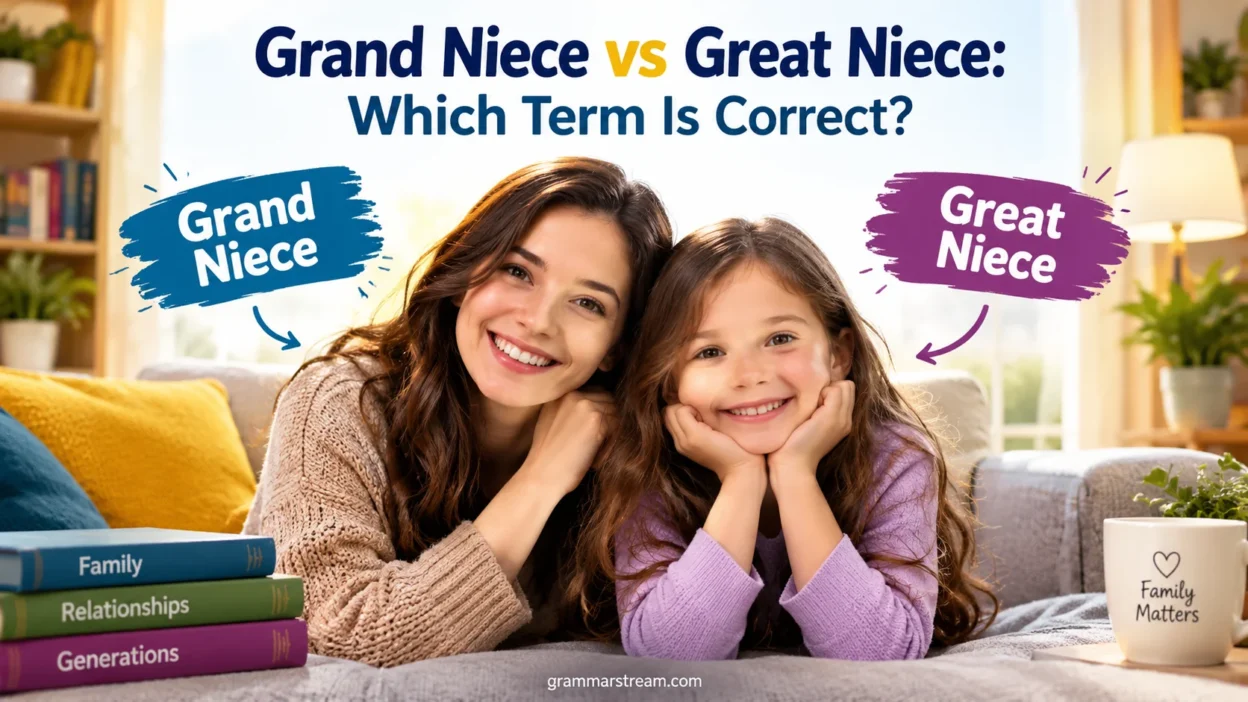
If you’ve ever stopped while writing grand niece or great niece, you’re not alone. Family relationship words can become surprisingly tricky, especially when English uses similar terms for different generations.
The confusion gets even stronger because great-niece, grandniece, and grand niece can appear in books, family conversations, genealogy records, and online writing. At first glance, they may seem like three different relationships. In most everyday contexts, however, great-niece and grandniece refer to the same relationship.
A great-niece is the daughter of your niece or nephew. In other words, she belongs one generation below your niece or nephew. Grandniece can describe that same relationship and is an accepted alternative term.
The real issue usually isn’t the family relationship. It’s the spelling, hyphenation, and preferred form.
For most modern American English writing, great-niece is the clearest choice. If you use grandniece, you’re not automatically making a mistake. The two terms can describe the same family connection.
Quick Answer
Great-niece is the daughter of your niece or nephew. Grandniece can also mean the daughter of your niece or nephew. The two terms generally describe the same relationship.
If you’re deciding which form to use in everyday American English, great-niece is a clear and familiar choice.
The spelling matters, too. Great-niece normally takes a hyphen when it functions as the family relationship term. Grandniece is normally written as one word.
The simplest rule
Your niece’s or nephew’s daughter is your great-niece, also called your grandniece.
For example:
- Your sister has a daughter → she is your niece.
- Your niece has a daughter → that child is your great-niece.
- That same child can also be called your grandniece.
So, if someone asks, “What do I call my niece’s daughter?” the straightforward answer is great-niece.
Comparison Overview
| Term | Meaning | Standard Form | Example |
| Great-niece | Daughter of your niece or nephew | Hyphenated | “My great-niece starts school this year.” |
| Grandniece | Daughter of your niece or nephew | One word | “His grandniece sent him a birthday card.” |
| Grand niece | Usually intended to mean the same relationship | Less conventional as a two-word form | “She visited her grandniece.” |
The biggest distinction is therefore not the family relationship. It is the form of the word.
Great-niece uses a hyphen. Grandniece appears as a closed compound. The two-word grand niece is generally less conventional when you’re using the term to mean the daughter of a niece or nephew.
This distinction becomes much easier once you picture the family tree rather than memorizing isolated vocabulary.
Main Differences Between Grand Niece vs Great Niece
The main differences between grand niece vs great niece involve spelling, word formation, and usage rather than the actual family connection.
Great-Niece Means the Daughter of Your Niece or Nephew
A great-niece is a female descendant of your niece or nephew.
Here’s the family chain:
You → Your sibling → Your niece or nephew → Their daughter
That final daughter is your great-niece.
For example, suppose your brother has a daughter named Emma. Emma is your niece. Years later, Emma has a daughter named Lily.
Lily is your great-niece.
The relationship doesn’t depend on whether the parent is your niece or nephew. Both relationships lead to the same term.
You could say:
- “My great-niece is visiting this weekend.”
- “I bought my great-niece a birthday present.”
- “My nephew’s daughter is my great-niece.”
- “My niece recently had a baby girl. She’s my great-niece.”
The term describes the generational relationship between you and the child.
Grandniece Can Mean the Same Relationship
Grandniece is another term for the daughter of your niece or nephew.
That can seem strange because many people associate grand- with grandparents and grandchildren. English family terminology, however, doesn’t always follow one perfectly uniform pattern.
You may therefore encounter sentences such as:
- “Her grandniece lives in Texas.”
- “He brought a gift for his grandniece.”
- “The elderly woman celebrated her 90th birthday with her children and grandniece.”
In these examples, grandniece refers to the same type of family relationship commonly described with great-niece.
That’s why treating the two words as completely different relationships can create unnecessary confusion.
Grand Niece Is Usually Not the Preferred Form
The phrase grand niece can appear in writing, especially when people create the expression themselves. However, when the intended meaning is the established kinship term, grandniece is the conventional closed form.
So these forms shouldn’t be treated equally:
- Great-niece — standard and clear
- Grandniece — accepted alternative
- Grand niece — less conventional as a fixed kinship term
If clarity is your goal, great-niece is usually the easiest choice for a broad American English audience.
What Is a Great-Niece?
A great-niece is the daughter of your niece or nephew.
The relationship becomes clearer when you break it into generations.
Imagine a family with three generations:
Generation 1: You and your siblings
Generation 2: Your nieces and nephews
Generation 3: Their children
A girl in Generation 3 is your great-niece.
This differs from a niece, who belongs to the generation immediately below you.
Niece vs Great-Niece
Consider this simple example:
Your sister has a daughter named Sarah.
Sarah is your niece.
Sarah later has a daughter named Ava.
Ava is your great-niece.
The word great- signals another generational step in the relationship.
This pattern resembles other familiar family terms such as:
- great-grandmother
- great-grandfather
- great-grandchild
- great-grandson
- great-granddaughter
The terminology tells you that another generation exists between the people being compared.
Read More: Message vs Messege: Which Spelling Is Correct?
A Great-Niece Can Come Through a Niece or Nephew
A common misconception is that a great-niece must come through a niece.
That’s not correct.
A great-niece can be:
- Your niece’s daughter
- Your nephew’s daughter
For example:
Your nephew → his daughter → your great-niece
The gender of the intermediate parent doesn’t change the relationship term.
What Is a Grandniece?
A grandniece is another term used for the daughter of your niece or nephew.
The word combines grand with niece to create a single kinship term.
Although great-niece may feel more immediately understandable to many readers, grandniece has a legitimate place in English usage.
That’s important because calling every use of grandniece “wrong” oversimplifies the issue.
English has accumulated family terminology over centuries. Different naming traditions sometimes developed alongside one another. As a result, you can find alternative terms for certain relationships.
Why Does Grandniece Sound Different?
The word can feel unusual because English speakers commonly learn grandmother, grandfather, grandson, and granddaughter first.
Those terms are deeply familiar.
However, kinship terminology contains many less common compounds. Grandniece belongs to that larger vocabulary.
Think of it like regional vocabulary. Two expressions can point to the same thing without one automatically being an error.
Grand Niece vs Great Niece: Are They the Same?
In common modern usage, great-niece and grandniece generally refer to the same family relationship.
Both can describe the daughter of your niece or nephew.
The difference lies primarily in word choice and form.
| Relationship | Common Term |
| Daughter of your sibling | Niece |
| Daughter of your niece | Great-niece |
| Daughter of your nephew | Great-niece |
| Daughter of your niece or nephew | Grandniece can also be used |
This is why a person can have both a great-niece and a grandniece as terms for the same individual.
Why Two Terms Exist
English doesn’t always create family terms through one consistent system.
For some relationships, speakers use great- to indicate another generational level. For others, historical usage has produced terms involving grand-.
Over time, dictionaries and speakers have preserved these variants.
The result is a vocabulary that sometimes looks more complicated than the family tree itself.
Family Relationship Diagram
A family tree makes the relationship much easier to understand.
You
↓
Your sibling
↓
Your niece or nephew
↓
Their daughter
↓
Your great-niece / grandniece
Here’s another example:
You → Brother → Nephew → Daughter
The daughter of your nephew is your great-niece.
Or:
You → Sister → Niece → Daughter
The daughter of your niece is also your great-niece.
The path can differ. The final relationship remains the same.
Why Is It Called a Great-Niece?
The term great-niece follows the broader idea that great- can identify an additional generation in a family relationship.
You can see this clearly with direct descendants.
For example:
- Your child has a child → your grandchild
- Your grandchild has a child → your great-grandchild
Extended family terminology can use similar generational logic.
Your sibling’s daughter is your niece. Her daughter is another generation removed from you. That’s where great-niece comes into play.
The word doesn’t mean the person is “greater” than a niece. The great- element indicates a generational relationship.
That’s an important distinction because the everyday meaning of “great” can otherwise make the term sound confusing.
Why Do People Say Grandniece?
People use grandniece because it has developed as an established kinship term in English.
It isn’t simply a random combination of two words.
You may encounter grandniece in family histories, genealogical discussions, literature, and ordinary conversation.
The form can also seem logical to speakers because English uses grand- in several family terms.
However, familiarity varies. Some readers immediately understand grandniece, while others find great-niece clearer.
That difference in familiarity is one reason great-niece remains a practical choice when writing for a general audience.
Grand Niece or Grandniece: Which Spelling Is Better?
If you specifically want the grand- form, use grandniece rather than grand niece when referring to the established kinship relationship.
The closed form treats the word as one compound term.
Preferred Forms
Great-niece
This is a clear and widely understood form.
Grandniece
This is an accepted alternative term.
Grand niece
This two-word form is less conventional as the fixed kinship term.
For polished writing, consistency matters. If you choose great-niece, keep the hyphen throughout the article or document.
Great-Niece or Great Niece: Hyphenation Rules
The standard spelling is generally great-niece, with a hyphen.
The hyphen helps readers recognize that great and niece function together as one compound relationship term.
Correct Examples
- “My great-niece is turning five.”
- “We visited our great-niece last summer.”
- “Her great-niece lives nearby.”
- “I sent a birthday card to my great-niece.”
What About the Possessive Form?
When the term becomes possessive, the apostrophe comes after the complete compound word:
great-niece’s
For example:
“My great-niece’s birthday is next Saturday.”
The hyphen remains part of the compound term.
What About the Plural?
If you’re talking about more than one great-niece, the plural is:
great-nieces
For example:
“She has three great-nieces.”
The hyphen remains intact while the plural ending attaches to the final word.
Grand-Niece vs Grandniece: Don’t Mix the Forms
You’ll sometimes see variations involving the hyphen:
- grandniece
- grand-niece
- grand niece
For the established alternative term, grandniece is commonly treated as the closed compound.
By contrast, great-niece is conventionally hyphenated.
That means the two preferred forms don’t look identical:
great-niece
grandniece
This difference can make spelling questions seem harder than they really are.
Great-Niece vs Grandniece in American English
For general American English writing, great-niece offers a particularly clear choice.
Most readers already understand the familiar pattern of great-grandmother, great-grandfather, and great-grandchild. The word therefore provides a useful clue about the additional generation.
Grandniece is still a valid alternative term.
The important point is not to confuse “less familiar” with “incorrect.” A word can be less common in everyday speech while still being established English vocabulary.
Which Form Should You Use?
Choose great-niece when:
- You want maximum clarity.
- You’re writing for a broad audience.
- You’re explaining a family relationship.
- You want the relationship to be immediately understandable.
- You’re writing an article, school assignment, or general informational piece.
Choose grandniece when:
- You’re following a family’s preferred terminology.
- You’re preserving wording from a genealogy or historical document.
- The surrounding context already uses that form.
- You prefer the established alternative term.
Examples of Great-Niece and Grandniece in Sentences
Examples With Great-Niece
- “My great-niece is learning how to play the piano.”
- “We bought our great-niece a birthday gift.”
- “His great-niece graduated from college last spring.”
- “My nephew introduced me to his daughter, my great-niece.”
- “Her great-niece’s first birthday was a family celebration.”
These examples show how naturally the term works in everyday writing.
Examples With Grandniece
- “Her grandniece visits every summer.”
- “He gave his grandniece an old family photograph.”
- “The family gathered to celebrate their grandniece.”
- “His grandniece inherited several family letters.”
- “She proudly introduced her grandniece to the guests.”
Here, grandniece performs the same basic relationship function.
Examples With Grand Niece
The phrase grand niece may appear in informal writing. However, when you’re deliberately choosing the established kinship term, grandniece is the cleaner form.
Instead of:
“My grand niece is visiting.”
Prefer:
“My grandniece is visiting.”
Or, for maximum familiarity:
“My great-niece is visiting.”
Common Mistakes to Avoid
Confusing a Niece With a Great-Niece
A niece is your sibling’s daughter.
A great-niece is your niece’s or nephew’s daughter.
Those are different generations.
Assuming Grandniece Means Granddaughter
A grandniece isn’t your granddaughter.
A granddaughter is your child’s daughter.
A grandniece is the daughter of your niece or nephew.
These relationships come through completely different branches of the family tree.
Treating Great-Niece and Grandniece as Different Generations
In the common usage discussed here, these terms describe the same relationship.
The different prefixes don’t automatically indicate different generations.
Forgetting the Hyphen in Great-Niece
When using the standard compound form, write:
great-niece
rather than:
great niece
The hyphen makes the compound relationship clear.
Assuming Grandniece Is a Spelling Error
Grandniece is not simply a misspelling of great-niece.
It is an established alternative term for the relationship.
Calling it “wrong” misses an important part of English vocabulary.
Great-Niece vs Grandniece vs Granddaughter
These three relationships are worth comparing because they often cause family-tree confusion.
| Term | Relationship |
| Niece | Daughter of your sibling |
| Great-niece | Daughter of your niece or nephew |
| Grandniece | Another term for a great-niece |
| Granddaughter | Daughter of your child |
Here’s the easiest way to separate them:
Your child → granddaughter
Your sibling’s child → niece
Your niece or nephew’s child → great-niece
The family branch determines the relationship.
Great-Niece vs Great-Granddaughter
A great-niece and a great-granddaughter aren’t the same person in relation to you.
A great-granddaughter comes through your own descendants.
A great-niece comes through your sibling’s descendants.
Consider these two family paths:
You → Your child → Your grandchild → Your great-granddaughter
versus:
You → Your sibling → Your niece/nephew → Their daughter → Your great-niece
The two relationships sit on different branches.
That’s why replacing one term with the other can completely change the meaning of a family history.
Is “Grand Niece” Grammatically Correct?
The phrase grand niece can be understood, but it’s not the preferred closed form for the established kinship term.
If you mean the daughter of your niece or nephew, the clearest choices are:
- great-niece
- grandniece
Of those two, great-niece is often the easiest for a general American audience to understand immediately.
The issue isn’t whether someone will understand grand niece. Context usually makes the meaning clear. The issue is whether you’re using the most conventional form.
FAQs:
Is a grandniece the same as a great-niece?
Yes, in common usage, grandniece can refer to the same relationship as great-niece: the daughter of your niece or nephew.
Is “grand niece” one word or two?
When using the established kinship term, grandniece is normally written as one word. Great-niece is normally hyphenated.
Should great-niece have a hyphen?
Yes. Great-niece is the standard hyphenated form of the compound relationship term.
Is a great-niece the daughter of a niece or nephew?
Yes. Your great-niece is the daughter of your niece or nephew.
Is a great-niece the same as a granddaughter?
No. Your great-niece comes through your sibling’s descendants. Your granddaughter comes through your own child.
Conclusion:
The grand niece vs great niece question becomes much easier once you focus on the family relationship instead of the spelling alone. A great-niece is the daughter of your niece or nephew. Grandniece can describe that same relationship. The main difference lies in the form of the word, not necessarily in the person being described. For polished American English, great-niece is a clear and familiar choice. If you prefer or encounter grandniece, it isn’t automatically incorrect. It’s an established alternative.