Message vs messege is a common spelling confusion, especially when you’re typing quickly. The two forms look almost identical, but only one belongs in standard English writing.
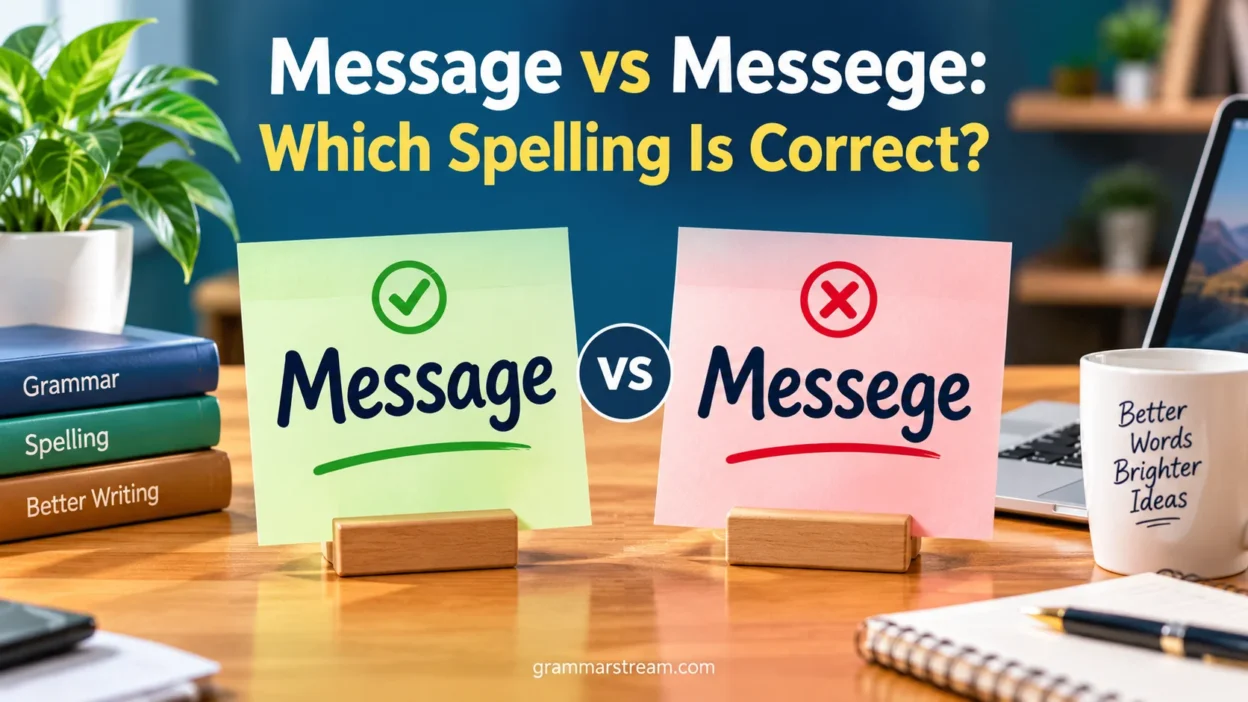
The correct spelling is message. The spelling messege is a misspelling and shouldn’t be used in formal or informal English. You may see “messege” in texts, social media posts, comments, or casual online conversations, but that doesn’t make it an accepted spelling.
The confusion makes sense. When you say the word aloud, its pronunciation doesn’t clearly reveal every letter. English spelling can be a bit sneaky that way. The good news is that one simple pattern makes the correct spelling much easier to remember.
Quick Answer
Message is the correct spelling. Messege is incorrect.
The correct word contains -age at the end:
message = mess + age
The incorrect form changes the vowel pattern:
messege ❌
Here are a few quick examples:
- I sent you a message. ✅
- Please check my message. ✅
- She messaged me yesterday. ✅
- I sent you a messege. ❌
- Please check the messege. ❌
Message can work as both a noun and a verb. As a noun, it refers to information communicated to someone. As a verb, it means to send someone a written or digital communication.
Comparison Overview
| Word | Correct Spelling | Part of Speech | Meaning | Example |
| message | Yes | Noun, verb | Information sent to someone or the act of sending it | I sent a message. |
| messege | No | — | Misspelling of “message” | I sent a messege. ❌ |
The difference comes down to just two letters, but those letters matter. Message follows the standard English spelling, while messege does not.
| Correct | Incorrect |
| message ✅ | messege ❌ |
| messages ✅ | messeges ❌ |
| messaged ✅ | messeged ❌ |
| messaging ✅ | messeging ❌ |
If you’re writing an email, school assignment, article, work message, or professional document, always use message.
Main Differences Between Message vs Messege
The biggest difference between message vs messege is simple: message is correct, while messege is a misspelling.
However, understanding why the mistake happens can help you avoid repeating it. The words look nearly identical, and their pronunciation doesn’t make the spelling especially obvious.
Message Is the Correct Spelling
Message is the standard English spelling.
As a noun, it describes information communicated from one person, organization, or group to another. The communication might appear in writing, speech, a text, an email, a note, or another form.
For example:
- I received your message this morning.
- She left a message on my phone.
- His message was short but clear.
- The teacher sent a message to the parents.
- I couldn’t understand the message behind the advertisement.
The word also works as a verb.
For example:
- Message me when you arrive.
- I’ll message you tonight.
- She messaged her brother.
- They were messaging each other during lunch.
This noun-and-verb flexibility makes message especially common in modern English.
Messege Is a Misspelling
Messege isn’t the standard spelling of the English word.
People usually write it when they remember the sound of the word but aren’t sure about the vowel sequence. Since English doesn’t always spell words exactly as they sound, this kind of mistake happens often.
For example, someone might type:
I sent you a messege.
The intended word is obvious. However, the spelling is still incorrect.
The corrected sentence is:
I sent you a message.
A useful rule is simple: whenever you see messege, replace it with message.
What Does Message Mean?
The word message has several closely related meanings. Its central idea involves communication.
A message carries information from one person or source to another. That information could be a simple sentence, an important announcement, a warning, an emotional statement, or even an idea communicated through art.
Message as a Noun
As a noun, message can mean a piece of information communicated to another person.
For example:
- I got a message from Sarah.
- The message arrived this afternoon.
- Please leave a message after the tone.
- Your message made me smile.
The word doesn’t necessarily refer to digital communication. A handwritten note can be a message. A spoken statement can be a message. A public announcement can also carry a message.
Consider this sentence:
The coach delivered a strong message about teamwork.
Here, message doesn’t mean a text or chat. It means the main idea the coach wanted people to understand.
That broader meaning is important because message isn’t limited to phones and computers.
Message as a Verb
Message also functions as a verb.
When you message someone, you communicate with that person by sending a written message. In modern American English, this use is especially common in digital communication.
For example:
- Message me when you’re free.
- I’ll message you after dinner.
- She messaged me about the meeting.
- We were messaging throughout the afternoon.
The verb became especially useful as texting, social media, and instant messaging became everyday forms of communication.
Instead of saying:
Send me a message when you arrive.
You can simply say:
Message me when you arrive.
Both sentences are correct.
Why Is “Messege” Incorrect?
The spelling messege looks believable because English has many words containing similar letter patterns.
The problem appears in the middle of the word.
The correct spelling is:
m-e-s-s-a-g-e
The incorrect spelling is:
m-e-s-s-e-g-e
Notice the important difference:
- message → mess + age
- messege → mess + ege
The standard word uses a after the double s.
The Correct Vowel Pattern
The easiest part to remember is the ending:
-age
The word is spelled:
mess + age = message
That pattern gives you a useful visual anchor. If you remember age at the end, you’re much less likely to type messege.
Why People Type “Messege”
Several factors can lead to this spelling mistake.
Pronunciation is one reason. The spoken word doesn’t make the written a particularly obvious.
Fast typing is another. When people type quickly, they often rely on sound rather than checking each letter.
Visual confusion also matters. The incorrect form looks close enough to the correct form that it can escape notice during casual writing.
These mistakes aren’t unusual. English contains many words whose pronunciation doesn’t provide a perfect guide to their spelling.
How to Spell Message Correctly
If you frequently confuse message vs messege, break the word into two parts:
mess + age
Then combine them:
message
Think of it as the word mess followed by age.
A Simple Memory Trick
Use this phrase:
A message has “age” at the end.
The spelling becomes easier when you visually separate it:
mess | age
Not:
mess | ege
You can also remember that the correct spelling contains double s and ends with age.
So the structure is:
m + e + s + s + a + g + e
Once that pattern becomes familiar, the misspelling starts to look noticeably wrong.
Message Pronunciation
The American English pronunciation of message is commonly represented as /ˈmesɪdʒ/.
The word has two syllables, with the stress on the first syllable.
The pronunciation is roughly:
MESS-ij
The second syllable sounds like the ending found in words such as “village” and “image.”
This pronunciation explains part of the spelling problem. The spoken form doesn’t clearly signal that the written word contains a in the middle.
That’s why memorizing the spelling pattern can work better than trying to spell the word entirely from sound.
Examples of Message in a Sentence
Seeing the correct spelling in different contexts makes the distinction easier to remember.
Message as a Noun
Here are several natural examples:
- I received your message this morning.
- She left a message on my phone.
- His message was clear and direct.
- The message appeared on my screen.
- I read your message twice.
- The manager sent an important message to the team.
- Her message helped everyone understand the situation.
- Please check the message before you respond.
In each example, message refers to information that someone communicates.
The communication doesn’t have to be a text. A voicemail, note, email, or spoken statement can also qualify as a message.
Message as a Verb
The verb form is equally common:
- Message me when you get home.
- I’ll message you after work.
- She messaged me last night.
- He messaged his friend about the event.
- They messaged each other throughout the day.
- Please message the manager if you have questions.
Notice how the spelling changes slightly when the word takes different grammatical forms.
The base form is message.
The past tense is messaged.
The continuous form is messaging.
Read More: Plural of Goose: What Is the Plural of Goose?
Common Mistakes With Message
The most obvious mistake is messege, but it’s not the only spelling error people make.
Messege vs Message
This is the main confusion:
- message ✅
- messege ❌
Remember the a in the middle.
Mesage vs Message
Another common typo removes one of the two s letters:
- message ✅
- mesage ❌
The correct word has two s’s:
me + ss + age
Messeges vs Messages
The same mistake can appear in the plural form.
Correct:
messages
Incorrect:
messeges
For example:
I have three messages waiting for me.
Not:
I have three messeges waiting for me.
Messaged vs Messeged
The past-tense form follows the correct base spelling:
messaged ✅
messeged ❌
For example:
She messaged me yesterday.
The word doesn’t suddenly change its internal vowel pattern when you add -ed.
Message vs Messages vs Messaged vs Messaging
Understanding the different grammatical forms can prevent spelling mistakes.
| Word | Grammatical Use | Meaning | Example |
| message | Noun / base verb | One communication or the act of sending one | Send me a message. |
| messages | Plural noun / third-person verb | More than one message or repeated action | She messages me daily. |
| messaged | Past tense | Sent a message in the past | He messaged me yesterday. |
| messaging | Present participle / gerund | Sending messages | They are messaging now. |
The spelling foundation stays consistent.
message → messages → messaged → messaging
The incorrect messege pattern doesn’t become correct in another grammatical form.
Message in Modern Digital Communication
The word message has become deeply connected with digital communication.
People send messages through phones, computers, social networks, workplace platforms, and email services. Yet the basic meaning hasn’t changed.
A message still carries information from one person to another.
Text Messages
A text message is a short written communication sent through a mobile device.
For example:
“I’m running ten minutes late.”
That’s a message because it communicates information to another person.
Social Media Messages
Social platforms also use the word message for private communication.
You might say:
“Send me a message on Instagram.”
Here, message describes the communication itself. The platform is simply the place where that communication happens.
Workplace Messages
The word also appears frequently in professional communication.
Examples include:
- Please send me a message when the report is ready.
- I received a message from the client.
- The team received an important message from management.
- I’ll message you once the meeting ends.
Although digital communication feels modern, the word message isn’t new. People have used it for communication across many different forms for centuries.
The Broader Meaning of Message
A message isn’t always something you type.
The word can describe an idea or meaning that someone wants an audience to understand.
For example:
The movie has a powerful message about friendship.
Here, nobody necessarily sends a text. Instead, message means the central idea or lesson communicated through the story.
You can also talk about:
- a political message
- a religious message
- a social message
- a marketing message
- a personal message
- a warning message
- an emotional message
This broader meaning shows why message remains such a useful word.
Message and Communication: What’s the Connection?
Communication involves sharing information, while a message represents the information being communicated.
Think of communication as a delivery system.
The message is what’s inside the package.
For example, if a manager tells an employee that a meeting has moved to Friday, the communication is the act of telling them. The message is the information about the changed meeting.
This distinction becomes useful when discussing communication skills.
A person can communicate clearly but still deliver the wrong message. Likewise, someone can have an important message but communicate it poorly.
FAQs:
Is Message or Messege Correct?
Message is correct.
Messege is a misspelling and shouldn’t be used in standard English writing.
Correct:
I sent her a message.
Incorrect:
I sent her a messege.
Is Messege a Word?
No. Messege isn’t the standard English spelling of the word.
It is generally a misspelling of message.
If you see “messege” online, the writer almost certainly intends message.
How Do You Spell Message?
The correct spelling is:
M-E-S-S-A-G-E
A simple memory trick is:
mess + age = message
Remembering the -age ending helps prevent the common messege mistake.
What Is the Plural of Message?
The plural is messages.
For example:
I have five messages on my phone.
Don’t write messeges.
The correct spelling keeps the original message structure and adds s.
Is Message a Noun or a Verb?
Message can be both a noun and a verb.
As a noun:
I received a message.
As a verb:
Message me later.
Its grammatical role depends on how you use it in the sentence.
Conclusion:
When choosing between message vs messege, the answer is straightforward: message is correct. The incorrect form messege usually appears because the word’s pronunciation doesn’t make its spelling obvious. Fast typing and vowel confusion can make the mistake even easier to miss. Once you remember that simple mess + age pattern, this spelling confusion becomes much easier to avoid.