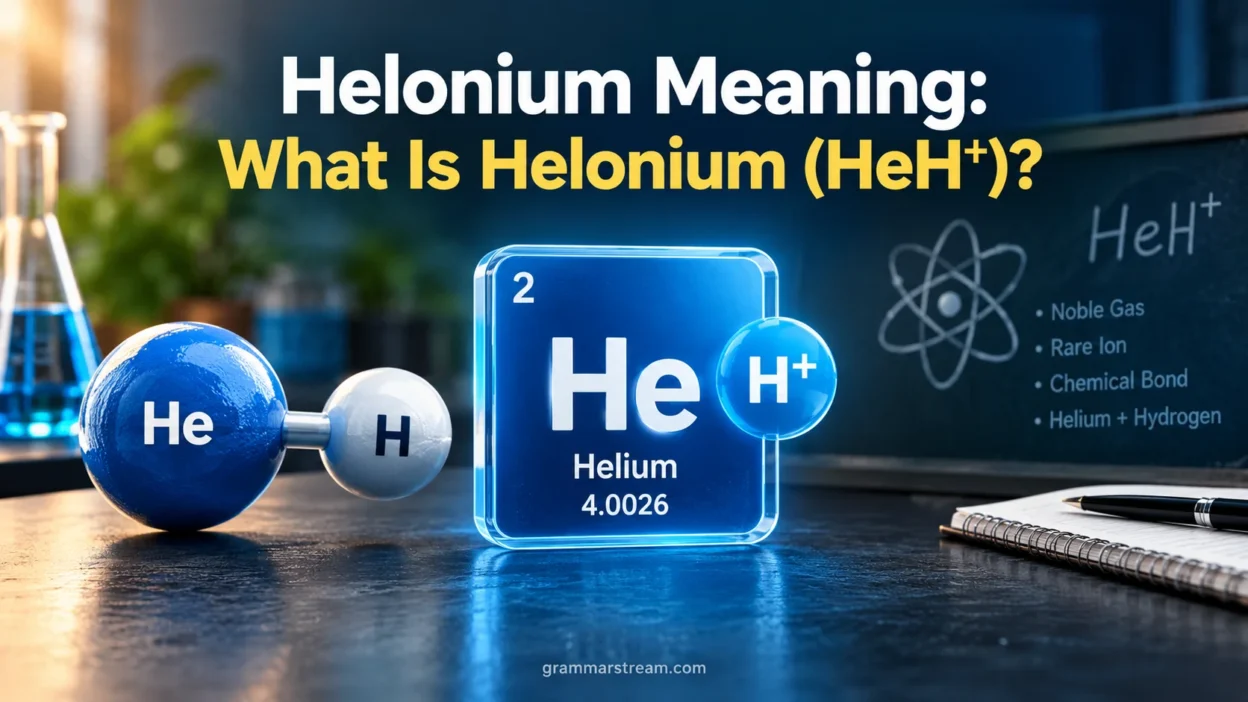
The word helonium sounds like the name of an element from the periodic table. In reality, it refers to something far more unusual: a positively charged molecule made from helium and hydrogen. Its chemical formula is HeH⁺, commonly called the helium hydride ion.
At first glance, helium and hydrogen seem like an unlikely pair. Helium belongs to the noble gases and rarely forms ordinary chemical bonds under everyday conditions. Yet under the right conditions, helium can combine with a hydrogen-related species to create one of the simplest molecular ions known to chemistry.
That tiny ion has an enormous scientific story behind it. Researchers first identified HeH⁺ in the laboratory in 1925. Decades later, astronomers searched for evidence of the same species in space. In 2019, observations of the planetary nebula NGC 7027 finally provided a clear astronomical detection of HeH⁺.
The importance of helonium goes even deeper. Scientists study HeH⁺ because it helps explain molecular chemistry under extreme conditions, including the chemistry associated with the early universe. Its simple structure also makes it an excellent system for testing highly accurate molecular physics calculations.
Quick Answer
Helonium refers to the helium hydride ion, HeH⁺, a positively charged molecular ion containing one helium atom and one hydrogen nucleus.
It is not a chemical element. Helium is an element with the symbol He and atomic number 2. Helonium, by contrast, is a molecular species formed from helium and hydrogen.
The key facts are:
| Fact | Helonium |
| Common scientific name | Helium hydride ion |
| Formula | HeH⁺ |
| Type | Molecular cation |
| Overall charge | +1 |
| Atoms/nuclei involved | Helium and hydrogen |
| Chemical element? | No |
| Atomic number | None of its own |
| Laboratory discovery | 1925 |
| Astronomical detection | 2019 |
| Important astronomical source | NGC 7027 |
| Major fields | Chemistry, molecular physics, spectroscopy, astrochemistry |
| Connection with early-universe chemistry | Important |
The plus sign matters. HeH⁺ carries one positive charge, which makes it an ion rather than a neutral molecule.
Comparison Overview
Helonium becomes much easier to understand when you compare it with the substances and ions people often confuse with it.
| Term | Formula | What it is | Charge |
| Helium | He | Chemical element | 0 |
| Hydrogen | H | Chemical element | 0 |
| Hydrogen ion | H⁺ | Positively charged hydrogen nucleus | +1 |
| Molecular hydrogen | H₂ | Molecule containing two hydrogen atoms | 0 |
| Helium hydride ion | HeH⁺ | Molecular ion containing helium and hydrogen | +1 |
| Hydronium | H₃O⁺ | Protonated water molecule | +1 |
The biggest distinction is simple: helium is an element, while helonium is a molecular ion.
That difference prevents a common misunderstanding. Helonium doesn’t occupy a separate square on the periodic table. The periodic table lists elements, not every molecule or ion that scientists can create.
HeH⁺ also differs from ordinary helium in another important way. A helium atom contains two protons and normally two electrons. HeH⁺ is a charged molecular system in which helium interacts with hydrogen and the overall species has a positive charge.
Main Differences Between Helonium
The most important differences become clear when you examine helonium, helium, hydrogen, and related ions side by side.
| Feature | Helonium | Helium | Hydrogen |
| Chemical formula | HeH⁺ | He | H |
| Category | Molecular ion | Element | Element |
| Charge | +1 | Neutral | Neutral |
| Contains helium | Yes | Yes | No |
| Contains hydrogen | Yes | No | Yes |
| Periodic table entry | No | Yes | Yes |
| Atomic number | None | 2 | 1 |
| Scientific importance | Molecular and astrophysical chemistry | Noble-gas physics and chemistry | Fundamental chemistry and astrophysics |
The difference between He and HeH⁺ is especially important.
When you write He, you’re talking about the helium element. When you write HeH⁺, you’re describing a specific molecular ion containing helium and hydrogen.
Think of it like the difference between an ingredient and a finished combination. Helium is one component. HeH⁺ is a distinct chemical species with its own structure, energy levels, reactions, and spectral behavior.
What Is Helonium?
Helonium is another name associated with the helium hydride ion, HeH⁺. In modern scientific writing, however, helium hydride ion or simply HeH⁺ is generally clearer and more widely used.
The species contains a helium nucleus and a hydrogen nucleus. Because the system carries a positive charge, scientists classify it as a molecular cation.
Its simplicity makes it scientifically valuable.
Many molecules contain dozens or hundreds of atoms. HeH⁺ contains only two nuclei. That doesn’t make its physics trivial. Instead, the small size allows researchers to calculate its properties with extraordinary precision.
A recent 2026 study described HeH⁺ as the simplest molecular system made from nuclei with unequal charges and used it to calculate extremely small relativistic and quantum-electrodynamic effects.
That is one reason this tiny ion continues to attract attention more than a century after its laboratory discovery.
Helonium Formula: What Does HeH⁺ Mean?
The formula HeH⁺ contains three important pieces of information.
He represents helium.
H represents hydrogen.
⁺ indicates that the complete molecular species has a positive charge of one.
The formula doesn’t mean that helium and hydrogen behave like two ordinary neutral atoms simply stuck together. Their interaction involves molecular bonding and the electronic structure of a charged system.
The positive charge changes the entire chemical picture.
Why Does HeH⁺ Have a Positive Charge?
A molecular ion becomes positively charged when it has fewer electrons than the corresponding neutral combination of nuclei would have.
In HeH⁺, the electronic structure allows helium and hydrogen to form a bound molecular ion. The resulting species has a net charge of +1.
This makes HeH⁺ chemically different from neutral hydrogen, neutral helium, and molecular hydrogen.
Is HeH⁺ a Molecule or an Ion?
It is both a molecular species and an ion.
More specifically, scientists call it a molecular cation.
The word “molecular” tells you that multiple nuclei participate in one bound system. The word “cation” tells you that the overall species carries a positive charge.
Is Helonium a Chemical Element?
No. Helonium is not a chemical element.
This point deserves emphasis because the name can be misleading.
A chemical element consists of atoms with the same number of protons. Each element receives an atomic number based on its proton count. Hydrogen has atomic number 1. Helium has atomic number 2.
HeH⁺ doesn’t have its own atomic number because it isn’t an element.
Instead, it is a molecular ion made from different nuclei.
The periodic table therefore contains helium, but it doesn’t contain a separate entry for helonium.
Helium vs. Helonium
| Property | Helium | Helonium |
| Symbol/formula | He | HeH⁺ |
| Classification | Element | Molecular ion |
| Atomic number | 2 | Not applicable |
| Contains hydrogen | No | Yes |
| Net charge | 0 | +1 |
| Periodic-table entry | Yes | No |
Calling HeH⁺ a “new element” would therefore be scientifically incorrect.
Read More: Huzz Meaning: What Does Huzz Mean in Text and Slang?
Helonium vs. Helium: What’s the Difference?
The easiest way to remember the difference is to focus on composition.
Helium is a single chemical element. Its nucleus contains two protons.
Helonium contains a helium nucleus interacting with a hydrogen nucleus. The resulting molecular system carries a positive charge.
Helium also has a famously stable electron configuration. That stability explains why ordinary helium is chemically unreactive compared with many other elements.
HeH⁺ exists under very different conditions. Its formation becomes possible when helium ions and hydrogen-related particles interact in environments energetic enough to support the reaction.
So although the word “helium” appears in both descriptions, helium and HeH⁺ are not interchangeable terms.
Origin and Etymology of the Word “Helonium”
The word helonium has an obvious connection with helium.
The ending -onium also appears in names for positively charged chemical species. Familiar examples include hydronium and ammonium.
However, chemical names can vary between historical, descriptive, and systematic usage. For modern scientific communication, helium hydride ion and HeH⁺ remove much of the ambiguity.
The important thing isn’t the suffix itself. The important detail is the actual chemical identity represented by the formula.
When you see HeH⁺, there’s no mystery about what scientists mean.
History of Helonium and HeH⁺
The history of HeH⁺ stretches back to the early days of molecular ion research.
Scientists Theodore R. Hogness and E. G. Lunn reported experimental evidence for the ion in 1925. Their work appeared in Physical Review and became a foundational piece of the history of helium hydride chemistry.
That discovery happened long before scientists could observe HeH⁺ in astronomical environments.
The laboratory result established that the species could exist under controlled experimental conditions. The much harder question was whether nature produced the same molecular ion in space.
That question remained open for decades.
Why Was Astronomical Detection So Difficult?
Finding HeH⁺ in space presented a frustrating problem.
Scientists knew what they were looking for, but the relevant spectral signal occurs in a difficult part of the electromagnetic spectrum. Ground-based observations also face strong atmospheric limitations at the relevant wavelengths.
Researchers proposed that planetary nebulae could provide suitable environments for HeH⁺. Several searches followed, but convincing astronomical detection remained elusive.
The 2019 Nature study noted that the ion had been known in the laboratory since 1925, yet its unequivocal detection in interstellar space had remained out of reach.
Then the right combination of technology and observing conditions finally changed the story.
Helonium and the Early Universe
One of the most fascinating parts of the helonium meaning story involves the early universe.
After the Big Bang, the universe contained mostly light elements, particularly hydrogen and helium. As the universe expanded and cooled, charged particles gradually combined into neutral atoms.
According to the chemical model described in the 2019 Nature study, helium chemistry played an important role in the earliest molecular processes. Neutral helium could participate in the formation of HeH⁺ through reactions involving protons.
This matters because molecular hydrogen, H₂, became an important molecule in the later chemical evolution of primordial gas.
HeH⁺ could participate in reaction pathways that ultimately helped connect early helium chemistry with the formation of molecular hydrogen.
Was Helonium the First Molecule in the Universe?
This claim needs careful wording.
Scientific sources often describe HeH⁺ as the first molecular bond formed in the universe or as the first molecule to form during the early chemical era.
However, calling it simply “the first molecule” without explaining the context can oversimplify the science.
The important point is that HeH⁺ is predicted to have formed extremely early in cosmic chemical history and played a role in the reaction network that preceded more familiar molecules such as H₂.
That makes this tiny ion an important piece of the story of how a nearly primordial universe developed increasingly complex chemistry.
Where Has Helonium Been Found in Space?
The breakthrough came from the planetary nebula NGC 7027.
In 2019, an international team reported the first unequivocal astrophysical detection of HeH⁺. Researchers observed its rotational ground-state transition at a wavelength of approximately 149.1 micrometers.
The observations came from the SOFIA airborne observatory using the GREAT instrument.
This was a major milestone because it confirmed that HeH⁺ isn’t merely a laboratory curiosity. Nature produces it in astronomical environments too.
Why NGC 7027 Matters
NGC 7027 provides unusually favorable conditions for HeH⁺ formation.
The planetary nebula contains ionized hydrogen and helium exposed to intense radiation from its hot central star. Such an environment can support the chemical reactions needed to produce HeH⁺.
The detection therefore gave researchers more than a photograph of an unusual molecule.
It provided a way to test theoretical models describing how helium hydride forms and disappears in astrophysical gas.
The Nature researchers specifically noted that the observation could constrain important formation and destruction rates for HeH⁺.
Why Is Helonium Scientifically Important?
The small size of HeH⁺ hides an impressive amount of scientific value.
Molecular Physics
HeH⁺ is an exceptionally simple molecular system.
Its simplicity allows researchers to perform calculations that would become much harder in larger molecules. Scientists can investigate molecular structure, energy levels, vibration, rotation, and subtle quantum effects with remarkable precision.
The system therefore works almost like a precision laboratory for molecular theory.
Recent work published in Physical Review A in 2026 examined relativistic and quantum-electrodynamic corrections in HeH⁺.
Spectroscopy
Spectroscopy allows scientists to identify substances by studying how they absorb or emit electromagnetic radiation.
Every molecule has characteristic energy transitions. Those transitions can act like a fingerprint.
For HeH⁺, scientists can predict its rotational and vibrational transitions and then search astronomical spectra for those signatures.
That’s exactly what made the 2019 detection possible.
Astrochemistry
Astrochemistry examines chemical reactions in astronomical environments.
HeH⁺ provides a useful example because it forms under conditions very different from those found in an ordinary laboratory or on Earth’s surface.
Its behavior helps researchers understand chemical networks inside ionized gas and planetary nebulae.
FAQs:
What does helonium mean?
Helonium refers to the helium hydride ion, HeH⁺. It is a positively charged molecular species containing helium and hydrogen.
What is the chemical formula for helonium?
The chemical formula is HeH⁺. The plus sign indicates that the molecular ion has a net positive charge.
Is helonium an element?
No. Helonium is not an element. It is a molecular ion. Helium itself is an element with atomic number 2.
Is helonium the same as helium?
No. Helium is He, a neutral chemical element. Helonium is HeH⁺, a positively charged molecular ion involving helium and hydrogen.
Why is HeH⁺ called helonium?
The term combines the association with helium with the chemical naming pattern associated with positively charged species. However, modern scientific sources generally favor the clearer term helium hydride ion.
Conclusion:
The helonium meaning is much more interesting than the unusual word might suggest. Helonium refers to HeH⁺, the helium hydride ion, a positively charged molecular species made from helium and hydrogen. It isn’t a chemical element, and it isn’t simply another name for helium. Instead, it represents a distinct molecular ion with unusual chemistry and a remarkable scientific history. Researchers first identified HeH⁺ in the laboratory in 1925. Nearly a century later, astronomers confirmed its presence in space by detecting its spectral signature in NGC 7027.