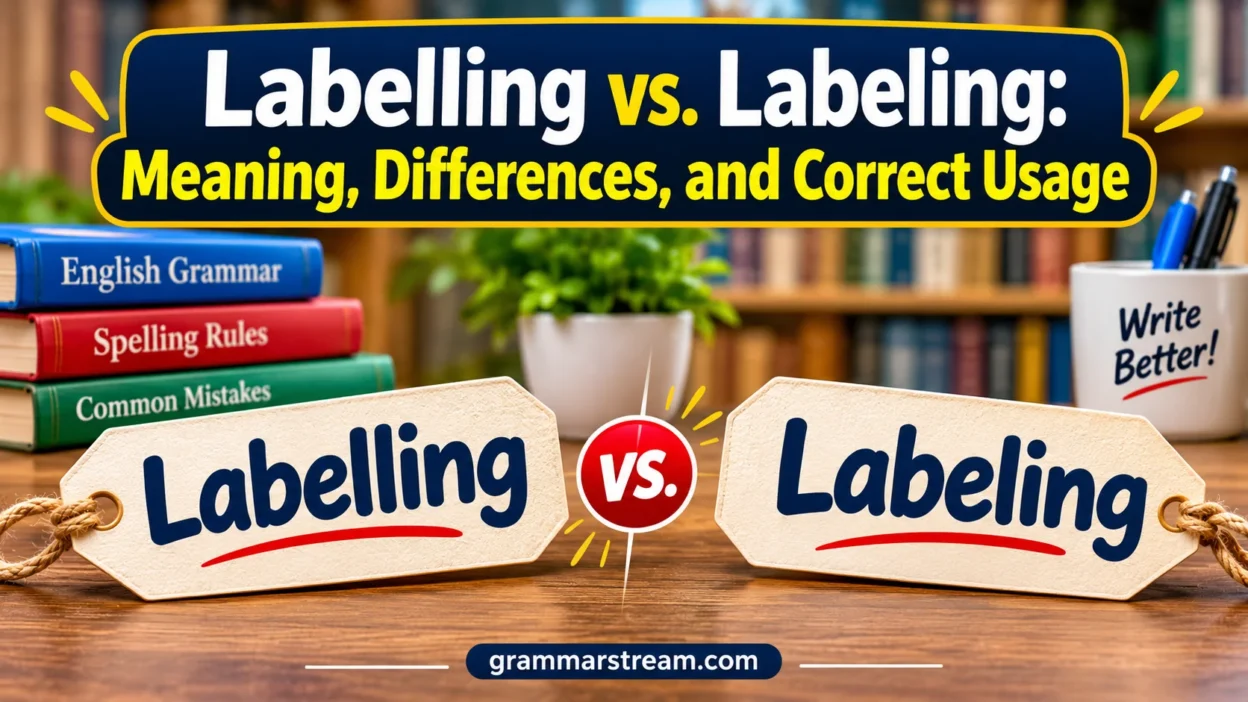
Have you ever wondered whether to write labelling or labeling? Both spellings look familiar, yet choosing the right one can feel confusing. The difference becomes especially important when writing for American or British audiences. The good news is that neither spelling is incorrect. Both words have the same meaning and grammatical function. However, their preferred usage depends on the variety of English you’re writing in.
American English generally uses labeling, while British English prefers labelling. This difference follows a broader spelling pattern involving verbs that end in a consonant followed by an unstressed vowel. Whether you’re preparing a school assignment, writing a business document, or creating website content, understanding this distinction helps you avoid unnecessary spelling mistakes. Let’s explore both forms, their grammatical uses, and practical examples.
Quick Answer:
Labeling is the preferred spelling in American English, while labelling is the standard spelling in British English. Both words describe the act of attaching, applying, or assigning a label to something.
Here is the simplest way to remember the difference:
- Labeling: American English spelling.
- Labelling: British English spelling.
- Meaning: Identical in both varieties.
- Pronunciation: Generally identical.
- Part of speech: Both can function as a present participle or gerund.
Examples:
- American English: The company is labeling its new products.
- British English: The company is labelling its new products.
Neither spelling is universally better. Your choice should depend on your target audience and preferred English convention.
Comparison Overview:
Although labeling and labelling differ by one letter, they communicate exactly the same idea. The distinction comes from regional spelling conventions rather than meaning or pronunciation.
| Feature | Labeling | Labelling |
| Preferred variety | American English | British English |
| Base word | Label | Label |
| Spelling pattern | Single L before -ing | Double L before -ing |
| Meaning | Applying or assigning a label | Applying or assigning a label |
| Pronunciation | Same | Same |
| Grammatical function | Gerund and present participle | Gerund and present participle |
| Related past tense | Labeled | Labelled |
| Common usage | United States | United Kingdom |
Both forms appear in dictionaries and published writing. However, American publications generally follow the single-L spelling. British publications usually retain the double L.
For example, an American manufacturer might describe its packaging process as product labeling. A British manufacturer would typically call the same process product labelling.
The activity remains unchanged. Only the spelling convention differs.
What Does Labeling Mean?
Labeling means attaching, writing, printing, or assigning identifying information to something. People use labels to describe objects, organize information, identify products, and communicate important details.
The word comes from the verb label, which refers to marking something with identifying information.
In American English, adding the suffix -ing usually produces labeling. The final L remains single.
You can encounter labeling in several everyday situations, including:
- Product identification: Adding names, ingredients, or instructions to packaging.
- Office organization: Identifying folders, files, and storage containers.
- Education: Marking parts of diagrams, maps, and illustrations.
- Science: Identifying samples, equipment, and laboratory materials.
- Psychology: Assigning descriptive categories to people or behaviors.
- Technology: Adding tags or descriptions to digital information.
For example, a food manufacturer might print nutritional information on every package. This process is called product labeling.
Similarly, a teacher might ask students to identify different parts of a plant. Students would complete the diagram by labeling its roots, stem, leaves, and flowers.
Examples of Labeling in Sentences
Understanding labeling becomes easier when you see how writers use it in everyday situations.
- The factory is labeling every bottle before shipping the order.
- Proper food labeling helps customers understand product ingredients.
- Sarah spent the afternoon labeling folders for the office.
- The teacher asked students to practice labeling the human heart.
- The company improved its product labeling to provide clearer instructions.
- Scientists are labeling each sample before conducting the experiment.
- The warehouse requires accurate labeling to prevent inventory mistakes.
- The website uses automatic image labeling to organize uploaded photographs.
Notice that the spelling remains the same regardless of the situation. Whether you’re discussing packaging, education, or technology, American English uses labeling.
Labeling as a Gerund and Present Participle
One interesting feature of labeling is that it performs two grammatical functions.
As a gerund: It acts as a noun and identifies an activity.
Example: Labeling products correctly requires attention to detail.
Here, the word labeling describes an activity rather than directly modifying another action.
As a present participle: It forms part of a continuous verb tense or describes an ongoing action.
Example: The employees are labeling the boxes right now.
In this sentence, labeling works with the helping verb are to describe an action happening currently.
Understanding these functions helps you use the word correctly in different sentence structures.
What Does Labelling Mean?
Labelling has exactly the same meaning as labeling. It describes the process of attaching identifying information, marking objects, or assigning descriptive categories.
The main difference is its spelling convention. British English generally doubles the final L when adding the suffix -ing to label.
For example, a British supermarket might describe the information printed on food packages as food labelling. An American supermarket would normally use food labeling.
The double-L spelling also appears in countries and publications that follow British English conventions.
Common examples include:
- United Kingdom
- Australia
- New Zealand
- Ireland
- South Africa
However, individual publications and organizations may follow their own style guides. Canadian English also uses a mixture of American and British spelling conventions.
Examples of Labelling in Sentences
Here are several examples showing how British English uses labelling naturally.
- The manufacturer is labelling all its products before distribution.
- Accurate food labelling helps consumers make informed decisions.
- The teacher asked the children to practice labelling the classroom objects.
- The company introduced new packaging and improved its product labelling.
- Workers are labelling storage containers in the warehouse.
- The laboratory requires careful labelling of chemical samples.
- Clear labelling makes it easier to identify different ingredients.
- The students finished labelling the geographical features on their maps.
These sentences demonstrate that British English uses labelling across different subjects and situations.
Labelling as a Gerund and Present Participle
Like its American counterpart, labelling can function as both a gerund and a present participle.
As a gerund:
Labelling food products correctly is an important responsibility.
Here, labelling functions as the subject of the sentence.
As a present participle:
The workers are labelling the packages before delivery.
In this example, labelling forms part of the present continuous tense.
The grammatical rules remain identical. Only the spelling changes.
Main Differences Between Labelling and Labeling
The most important distinction between these spellings involves regional English conventions. However, understanding the spelling rules and related word forms makes the difference easier to remember.
American vs. British English
American and British English sometimes use different spelling patterns for words ending in certain consonants.
One familiar difference involves doubling the final L before adding suffixes such as -ed and -ing.
American English often keeps one L in words such as:
- Labeling
- Labeled
- Traveling
- Traveled
- Canceling
- Canceled
British English generally doubles the final L in corresponding forms:
- Labelling
- Labelled
- Travelling
- Travelled
- Cancelling
- Cancelled
This pattern explains why American writers choose labeling while British writers prefer labelling.
American English example:
The company is labeling its products before distribution.
British English example:
The company is labelling its products before distribution.
Both sentences communicate the same information. The spelling simply reflects the writer’s chosen English variety.
Spelling Rules: Why Does One Version Have Two Ls?
The spelling difference becomes easier to understand when you examine how English forms words using suffixes.
The base word is label. When writers add -ing, American and British English generally follow different conventions.
In American English, the final L usually remains single:
– Label + ing = Labeling
In British English, the final L is generally doubled:
– Label + ling? No. Label + ing = Labelling
The correct spelling is labelling, with two Ls together before the suffix’s remaining letters.
This difference also appears in the past-tense form:
- Label + ed = Labeled (American English)
- Label + led = Labelled (British English)
The British form doubles the final consonant before adding the suffix. American English generally does not double the L in these particular words.
However, don’t assume that every American and British spelling difference follows this exact pattern. English has several suffix rules and exceptions.
For instance, both varieties generally write beginning with two Ns. The spelling depends on the word’s stress pattern and final consonant, not simply its regional variety.
Meaning and Usage: Are Labeling and Labelling Different?
No. Neither spelling changes the meaning of the word.
Both describe the same actions, including:
- Attaching identification to an object.
- Writing information on a product.
- Marking different sections of a diagram.
- Assigning a category to something.
- Describing or classifying a person, object, or idea.
Consider these two sentences:
American English: The employees are labeling the containers.
British English: The employees are labelling the containers.
Both sentences describe employees identifying containers. The spelling difference has no effect on the message.
The same principle applies when the word functions as a gerund.
For example:
- American: Labeling products requires careful attention.
- British: Labelling products requires careful attention.
The grammar and meaning remain identical.
Regional and Professional Preferences
Choosing between labeling and labelling often depends on your publication’s location and audience.
For professional writing, consistency matters more than personal preference.
If you’re preparing an American business report, use labeling. If you’re writing for a British publication, choose labelling.
This distinction also matters in academic writing, product packaging, advertising, and website content.
For example, an American company selling products in the United States should generally use American spelling across its website and packaging.
A British company targeting UK customers would normally follow British spelling conventions.
However, international organizations may maintain separate versions of their content for different markets.
The important thing is to follow one consistent style throughout each publication.
Read More: Instalments vs. Installments: Meaning, and Correct Usage
When to Use Labeling or Labelling
Knowing the regional distinction is useful, but applying it correctly in real situations matters even more.
Your audience should guide your spelling choice. The following examples explain when each version is appropriate.
When to Use Labeling
Choose labeling when writing in American English.
This spelling is appropriate for:
- American websites and blog posts.
- US business reports and professional documents.
- American academic assignments.
- Product descriptions targeting US customers.
- Marketing materials for American audiences.
- Educational resources following American spelling conventions.
Examples:
- The manufacturer is improving its product labeling.
- Accurate labeling helps customers identify ingredients.
- The school requires proper labeling of laboratory equipment.
- Employees are responsible for labeling inventory containers.
If your website primarily targets American readers, labeling is the better choice.
For example, an American grammar website should generally use labeling rather than labelling in its articles.
When to Use Labelling
Choose labelling when writing in British English.
This spelling is appropriate for:
- British newspapers and publications.
- UK business documents.
- British academic assignments.
- Product descriptions targeting UK customers.
- Educational materials following British spelling conventions.
- Professional communication using British English.
Examples:
- The manufacturer is reviewing its product labelling.
- Clear labelling helps customers understand ingredients.
- The students are labelling the parts of a diagram.
- Proper labelling improves warehouse organization.
If your intended readers are primarily British, labelling is the natural choice.
The same spelling convention generally applies to related forms such as labelled and labelling.
Labeling vs. Labelling: Common Related Word Forms
The difference between labeling and labelling doesn’t stop with the present participle. It also appears in other forms of the verb.
Understanding these related spellings helps you maintain consistency throughout your writing.
| American English | British English |
| Label | Label |
| Labeled | Labelled |
| Labeling | Labelling |
| Relabel | Relabel |
| Relabeled | Relabelled |
| Relabeling | Relabelling |
Notice that the base word label remains unchanged in both varieties.
The spelling difference appears when certain suffixes are added.
Labeled vs. Labelled
Both labeled and labelled are past-tense and past-participle forms of the verb label.
- Labeled: Preferred American spelling.
- Labelled: Preferred British spelling.
Examples:
- American: The company labeled every package.
- British: The company labelled every package.
Both sentences describe a completed action.
Relabeling vs. Relabelling
The verb relabel means to label something again or replace its existing label.
Its related forms follow the same regional spelling convention.
- Relabeling: American English.
- Relabelling: British English.
Examples:
- American: The factory is relabeling the outdated products.
- British: The factory is relabelling the outdated products.
The prefix re- doesn’t change the basic spelling pattern.
Does the Same Rule Apply to Every Word Ending in L?
Not necessarily.
Although American and British English often differ in their treatment of final L, other spelling rules can affect the outcome.
For example, both varieties write control as control and controlling as controlling.
The spelling of labeling and labelling reflects a particular regional convention. It shouldn’t become a universal rule for every English word.
Common Mistakes to Avoid
Even though the difference is simple, writers sometimes make avoidable mistakes when using these spellings.
Understanding the following issues can help you produce cleaner and more consistent content.
Mixing American and British Spellings
One common mistake involves using both spelling conventions in the same article.
For example:
The company is labeling its products before the team begins labelling the packages.
Although readers understand the sentence, the inconsistent spelling looks careless.
Better approach: Choose one variety and maintain it throughout your content.
Assuming One Spelling Is Incorrect
Some writers believe labelling is a misspelling because American spellcheckers prefer labeling.
Others assume labeling is incorrect because British dictionaries commonly display labelling.
Neither assumption is accurate.
Both spellings are accepted. Their suitability depends on the English variety.
Frequently Asked Questions
Is It Labeling or Labelling?
Both spellings are correct. Labeling is preferred in American English, while labelling is standard in British English. Both have the same meaning and pronunciation.
Is Labeling American or British English?
Labeling is the preferred American English spelling. American writers generally keep one L when adding the suffix -ing to the word label.
For example: The company is labeling its products.
Is Labelling Correct in British English?
Yes. Labelling is the standard British English spelling. British writers generally double the final L when forming this word.
For example: The company is labelling its products.
Do Labeling and Labelling Have the Same Meaning?
Yes. Both words describe attaching, applying, or assigning identifying information to something.
The difference is entirely regional. Neither spelling communicates a different action or idea.
Is It Labeled or Labelled?
Both forms are correct, but their regional preferences differ.
- Labeled: American English.
- Labelled: British English.
For example, an American writer might say, “The boxes were labeled yesterday.” A British writer would typically write, “The boxes were labelled yesterday.”
Conclusion:
The difference between labelling and labeling comes down to regional spelling conventions. Both forms are correct and communicate exactly the same meaning. If you’re writing in American English, choose labeling. If you’re following British English, use labelling. The same distinction applies to related forms, including labeled and labelled, as well as relabeling and relabeling‘s British counterpart, relabelling.