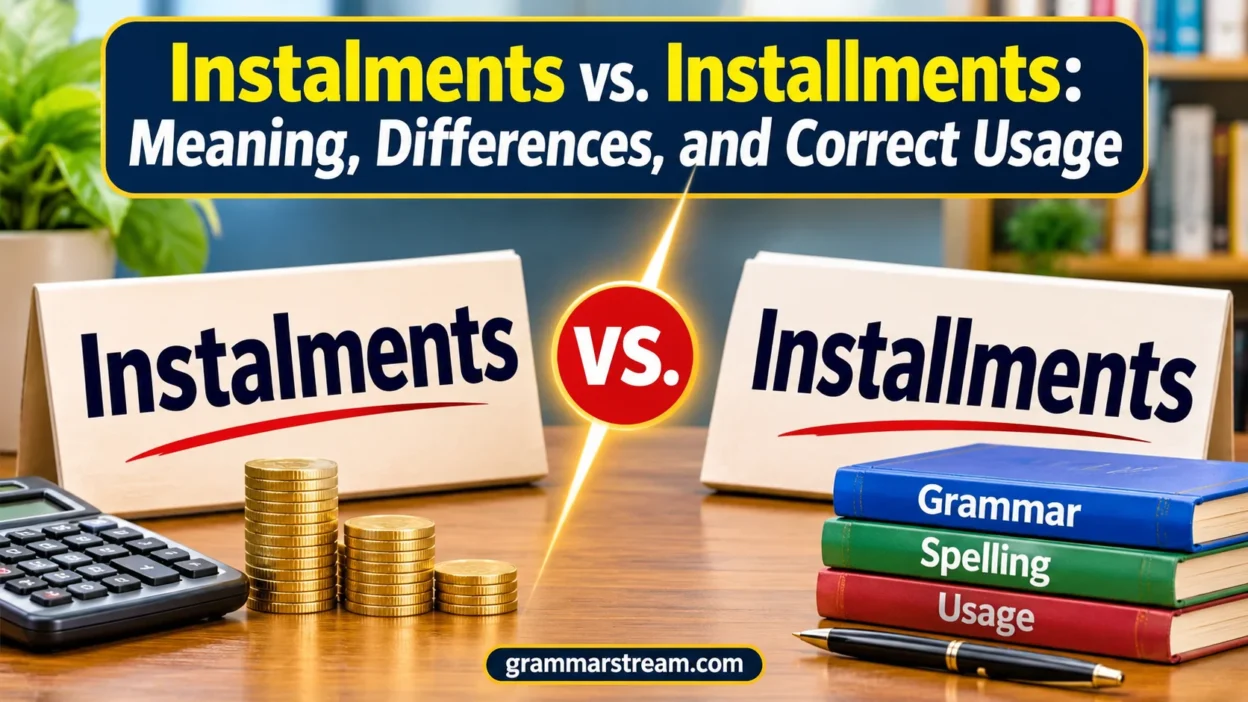
Have you ever wondered whether to write instalments or installments? Both spellings look almost identical, yet one extra letter can make a difference depending on your audience. If you’re writing for American readers, you might prefer one spelling. British readers, however, generally expect the other.
The good news is that neither spelling is incorrect. Both words have the same meaning and refer to payments or portions divided over time. The difference comes down to regional spelling conventions rather than grammar, pronunciation, or meaning.
Understanding this distinction helps you write more clearly, especially when discussing loans, purchases, payment plans, books, or movie series. Let’s explore how each spelling works and when you should use it.
Quick Answer
Instalments is the preferred British English spelling, while installments is the standard American English spelling. Both words mean separate payments or portions of a larger amount or whole, usually delivered or paid over time.
For example:
- British English: She paid for her new furniture in monthly instalments.
- American English: She paid for her new furniture in monthly installments.
Neither spelling changes the meaning or pronunciation. Choose the version that matches your audience and use it consistently throughout your writing.
Comparison Overview
The easiest way to understand instalments vs. installments is to compare their spelling, regional usage, and meanings.
| Feature | Instalments | Installments |
| Spelling | One L after the first syllable | Two Ls after the first syllable |
| English variety | British English | American English |
| Meaning | Scheduled payments or separate portions | Scheduled payments or separate portions |
| Part of speech | Noun | Noun |
| Singular form | Instalment | Installment |
| Plural form | Instalments | Installments |
| Pronunciation | Same | Same |
| Example | Monthly instalments | Monthly installments |
| Common usage | UK, British-style publications | US, American-style publications |
Both versions describe the same concept. Someone paying for a car over twelve months makes payments in instalments or installments, depending on the spelling convention they follow.
The difference is purely regional. You don’t need to learn separate definitions or grammar rules for these words.
What Does Instalments Mean?
Definition of Instalments
Instalments is the plural form of instalment. It refers to separate payments or portions of a larger amount that someone pays, receives, or completes over an agreed period.
This spelling is commonly used in British English. You’ll often encounter it in financial documents, business agreements, payment schedules, and everyday conversations in the United Kingdom.
For example, imagine purchasing a refrigerator that costs £900. Instead of paying the entire amount immediately, the seller allows you to divide the price into nine monthly payments of £100.
Each £100 payment represents an instalment.
The same word can also describe separate parts of something released or presented in stages. A novelist might publish a story in several instalments rather than releasing the entire work at once.
Here are some common situations where people use this spelling:
- Personal loans: Borrowers repay their loans through scheduled instalments.
- Car purchases: Buyers divide the purchase price into monthly instalments.
- Household expenses: Customers spread certain costs across several payments.
- Books and stories: Writers release individual instalments of a longer story.
- Entertainment: Movie franchises contain multiple instalments released over several years.
The spelling doesn’t suggest anything different about the payment amount, schedule, or agreement. It simply follows British English conventions.
Examples of Instalments in Sentences
Seeing the word in context makes its meaning easier to understand. These examples demonstrate how British English speakers commonly use instalments.
- She purchased her new laptop through six monthly instalments.
- The borrower must repay the loan in twelve equal instalments.
- We agreed to divide the total cost into three instalments.
- The first instalment is due next Monday.
- He missed two instalments because of unexpected expenses.
- The company offers interest-free instalments on selected products.
- Customers can pay their annual membership fees in quarterly instalments.
- The final instalment will complete the outstanding balance.
- The author published the novel in weekly instalments.
- The latest instalment of the popular film series attracted millions of viewers.
Notice how the spelling stays the same regardless of the context. Whether you’re discussing money or entertainment, instalments remains the correct British English form.
When to Use Instalments
Use instalments when writing for readers who follow British English spelling conventions.
This spelling is particularly appropriate in:
British publications: Newspapers, magazines, educational materials, and websites aimed at UK readers generally use instalments.
Financial documents: British loan agreements, repayment schedules, and payment instructions commonly follow this spelling.
Business communication: Companies operating in the UK often use instalments in customer agreements and invoices.
Academic writing: Students and researchers following British English style guides should maintain the British spelling throughout their work.
However, British English isn’t limited to the United Kingdom. Other English-speaking regions also follow British spelling conventions, although individual preferences can vary.
The most important rule is to follow your intended audience’s established spelling style.
What Does Installments Mean?
Definition of Installments
Installments is the plural form of installment. It describes separate payments or portions of a larger amount that someone pays or receives over a specified period.
This is the standard American English spelling.
In the United States, you’ll commonly see installments in banking documents, retail advertisements, loan agreements, credit arrangements, and everyday conversations.
Consider a customer purchasing a $1,200 television. The retailer offers a twelve-month payment plan with equal monthly payments of $100.
Each $100 payment is an installment.
The word also applies outside financial situations. For example, a television series might release its story in several installments. A publisher could also distribute a long novel in separate installments.
Common situations include:
- Mortgage payments: Homeowners make regular installments toward their mortgage balances.
- Auto financing: Car buyers repay the financed amount through scheduled installments.
- Retail purchases: Customers divide the cost of expensive products into smaller payments.
- Credit agreements: Borrowers repay outstanding balances through agreed installments.
- Entertainment: Movie franchises release successive installments.
- Publishing: Authors publish longer stories in separate installments.
In each situation, the word describes a portion of a larger whole. Its spelling simply reflects American English usage.
Examples of Installments in Sentences
Here are practical examples showing how Americans use installments in everyday writing.
- I purchased my new computer in six monthly installments.
- The borrower missed two loan installments last year.
- You can buy the furniture through interest-free installments.
- The final installment is due in December.
- We divided the total payment into four equal installments.
- The bank requires monthly installments from every borrower.
- Customers can pay their membership fees in quarterly installments.
- The company introduced a flexible installment payment plan.
- The latest installment of the movie franchise received positive reviews.
- The author released the final installment of the novel last week.
These examples show that installments works in both financial and nonfinancial contexts.
When to Use Installments
Choose installments when writing for an American audience or following American English conventions.
You’ll commonly encounter this spelling in:
American financial services: Banks, lenders, and credit companies use installments when describing scheduled repayments.
Retail businesses: American stores often advertise installment plans for electronics, furniture, appliances, and other expensive products.
Business communication: US companies generally use this spelling in invoices, payment agreements, and customer information.
American publications: Newspapers, magazines, blogs, and educational websites typically follow American spelling conventions.
Academic writing: Students following American English style guides should write installments rather than instalments.
For American readers, the double-L spelling looks familiar and natural. Using it consistently also helps maintain a professional writing style.
Main Differences Between Instalments and Installments
Although instalments and installments have identical meanings, several spelling and usage details distinguish them.
British English vs. American English
The biggest difference between these words is their regional spelling preference.
British English generally uses instalment, while American English uses installment. This difference follows broader spelling patterns found across both varieties of English.
For example, British English often uses spellings such as:
- Colour
- Favour
- Honour
- Travelling
- Cancelled
American English commonly uses:
- Color
- Favor
- Honor
- Traveling
- Canceled
However, not every spelling difference follows the same pattern. That’s why it’s better to learn each word’s accepted regional spelling rather than rely on a universal rule.
Here’s how the two forms appear in different contexts:
| British English | American English |
| Instalment plan | Installment plan |
| Monthly instalments | Monthly installments |
| Loan instalments | Loan installments |
| Equal instalments | Equal installments |
| Final instalment | Final installment |
| Instalment agreement | Installment agreement |
The meaning stays unchanged. Only the spelling convention differs.
Spelling Difference: One L vs. Two Ls
The most noticeable difference is the additional letter L in the American spelling.
- Instalment: I-N-S-T-A-L-M-E-N-T
- Installment: I-N-S-T-A-L-L-M-E-N-T
The British version contains one L after the first part of the word. The American version contains two.
This difference doesn’t create a new word or change its meaning. Both spellings belong to the same English vocabulary.
You might also notice similar differences in other words across British and American English. However, instalment and installment are best remembered as a regional spelling pair.
A simple memory trick can help:
- One L: Instalment = British English.
- Two Ls: Installment = American English.
If you write for a US audience, remember the double L. For British readers, use the single-L version.
Read More: Sneek vs. Sneak: Meaning, Differences, and Examples
Meaning and Usage Differences
Do instalments and installments describe different things? No. Both words carry the same meanings.
They generally describe two related concepts.
Scheduled financial payments
This is the most common meaning. Someone divides a total amount into smaller payments and pays them according to an agreed schedule.
For example:
- British: The customer pays the balance in monthly instalments.
- American: The customer pays the balance in monthly installments.
Both sentences communicate exactly the same information.
Separate parts of a larger work
The words can also describe individual sections or releases of a larger project.
For example:
- British: The next instalment of the novel arrives next month.
- American: The next installment of the novel arrives next month.
This usage appears in books, television programs, movies, and serialized stories.
The important point is that regional spelling doesn’t restrict the word to a particular subject. Both versions work in financial and nonfinancial contexts.
Singular and Plural Forms
Another useful distinction involves singular and plural forms.
Both words follow regular English pluralization rules. You simply add an S to the singular noun.
| Singular | Plural |
| Instalment | Instalments |
| Installment | Installments |
Consider these examples:
British English:
- The first instalment is due tomorrow.
- Three instalments remain unpaid.
- Each instalment costs £150.
American English:
- The first installment is due tomorrow.
- Three installments remain unpaid.
- Each installment costs $150.
Remember that singular and plural forms should follow the same regional spelling convention.
If you begin an American article with installment, don’t switch to instalments later. Consistency makes your writing easier to read.
Instalments vs. Installments in Different Contexts
The spelling distinction becomes easier to understand when you examine real-world situations.
Financial Payments and Loans
Financial agreements are among the most common places where these words appear.
Banks, lenders, and retailers often allow customers to divide large payments into smaller amounts. These payments may follow a monthly, quarterly, or another agreed schedule.
For example, suppose someone borrows $6,000 and agrees to repay the principal over twelve months.
If the agreement requires equal principal payments without considering interest, each payment would represent $500 of the original principal.
However, actual loan payments can include interest and additional charges. Therefore, the total monthly payment may differ from a simple division of the original amount.
Both spellings describe these payments:
- British English: Monthly loan instalments.
- American English: Monthly loan installments.
You might also encounter these phrases:
- Car loan instalments/installments.
- Mortgage instalments/installments.
- Personal loan instalments/installments.
- Credit instalments/installments.
- Interest-free instalments/installments.
The financial meaning doesn’t change with the spelling.
Books, Movies, and Television Series
The word also has an established meaning in entertainment and publishing.
A long-running movie franchise usually contains several individual films. Each film can be described as an installment of the larger series.
For example, a fictional adventure franchise might release its first movie in 2018, its second in 2021, and its third in 2025.
Each movie represents another installment in the series.
The same idea applies to books. Some authors release serialized stories in separate sections rather than publishing the complete work at once.
Examples include:
- The final instalment of the fantasy series received excellent reviews.
- The next installment of the action franchise arrives next summer.
- Readers eagerly awaited the final instalment of the serialized novel.
- The latest installment introduced several new characters.
This meaning isn’t limited to entertainment. It can describe any larger work divided into separate parts.
Business and Commercial Writing
Businesses use installment terminology when explaining payment arrangements, customer financing, and commercial agreements.
For example, an electronics retailer might offer a customer the option to divide a $900 purchase into six payments.
A payment schedule could look like this:
| Payment | Amount | Due Date |
| First installment | $150 | January 1 |
| Second installment | $150 | February 1 |
| Third installment | $150 | March 1 |
| Fourth installment | $150 | April 1 |
| Fifth installment | $150 | May 1 |
| Final installment | $150 | June 1 |
| Total | $900 |
This table demonstrates how installment payments divide a purchase into smaller scheduled amounts.
A British business would generally describe the same arrangement using instalment.
When writing commercial content, also remember that an installment plan doesn’t automatically mean interest-free financing. Depending on the agreement, additional interest, service fees, or late-payment charges may apply.
Always distinguish the scheduled payment amount from the overall cost.
Frequently Asked Questions
Is It Instalments or Installments?
Both instalments and installments are correct spellings. The difference comes from regional English conventions. British English generally prefers instalments, while American English uses installments. Both words describe scheduled payments or separate portions of a larger whole.
Is Instalments British or American English?
Instalments is primarily the British English spelling. It’s commonly used in the United Kingdom and other places that follow British spelling conventions. American English generally uses installments with two Ls. Both forms have the same meaning and pronunciation.
Why Does American English Use Two Ls in Installments?
American English recognizes installment as the standard spelling of the word. The double L is an established part of its American spelling. British English uses the shorter spelling instalment. This is a regional spelling difference rather than a grammatical distinction.
Do Instalments and Installments Mean the Same Thing?
Yes, both words have exactly the same meaning. They describe payments divided into scheduled portions or individual parts of a larger work. For example, a customer might repay a loan through monthly installments or instalments. The spelling depends on the English variety being used.
Which Spelling Should I Use in Professional Writing?
Choose installments when writing for an American audience and instalments when writing for a British audience. If your company or publication follows a specific style guide, use its preferred spelling. Most importantly, avoid switching between the two versions within the same document.
Conclusion:
The difference between instalments and installments is simple: one L separates British English from American English in this particular word. Instalments is the preferred British English spelling, while installments is standard in American English. Both describe scheduled payments or separate portions of a larger work. Whether you’re discussing monthly loan payments, furniture purchases, or the latest movie in a franchise, the meaning stays exactly the same.