Have you ever wondered whether to write smoky or smokey? These two spellings look almost identical and usually sound the same, which makes them easy to confuse. However, American English generally favors one spelling when describing smoke, food flavors, colors, and appearances.
The difference becomes clearer when you understand how each form works in everyday writing. Smoky is the preferred spelling for the adjective, while smokey is an accepted alternative that also appears in proper names. For example, you would normally describe barbecue sauce as having a smoky flavor, but you would write Smokey Bear when referring to the famous wildfire-prevention mascot.
Although the extra letter might seem insignificant, choosing the appropriate spelling makes your writing clearer and more consistent. Whether you’re writing a school assignment, preparing a recipe, or editing a blog post, understanding the distinction will help you avoid common spelling mistakes.
Quick Answer
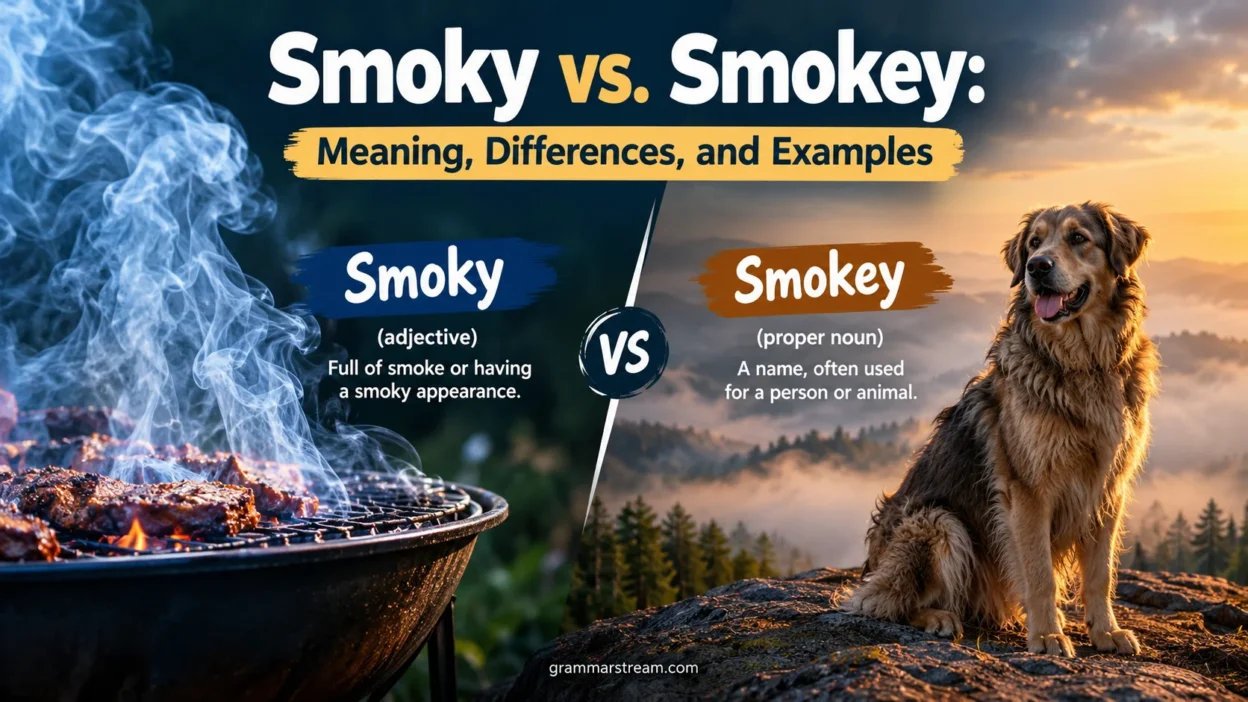
Smoky is the preferred American English spelling of the adjective describing something filled with smoke, resembling smoke, or having a smoke-like flavor. Smokey is an accepted alternative spelling, but it is less common in standard American English. It also appears in proper names, such as Smokey Bear.
- Smoky: The preferred spelling for ordinary descriptions of smoke, flavor, color, and appearance.
- Smokey: An alternative adjective spelling and a common spelling in established proper names.
- Pronunciation: Both forms are generally pronounced the same way in American English.
- Best choice: Use smoky in everyday American English writing unless a proper name or specific style calls for Smokey.
Example: The restaurant serves ribs with a rich, smoky flavor.
Proper name example: Smokey Bear teaches people how to prevent wildfires.
Comparison Overview
The easiest way to understand smoky vs. smokey is to compare their spelling, meaning, pronunciation, and typical usage. Both forms can describe the same qualities, but they don’t have equal standing in standard American English writing.
| Feature | Smoky | Smokey |
| Part of speech | Adjective | Adjective; also used in proper names |
| Basic meaning | Filled with smoke, resembling smoke, or having a smoke-like quality | Generally the same adjectival meaning |
| Preferred in American English | Yes | Less common as an adjective |
| Pronunciation | /ˈsmoʊki/ | /ˈsmoʊki/ |
| Describes smoke-filled air | Yes | Yes, as an alternative spelling |
| Describes food flavor | Yes | Yes, as an alternative spelling |
| Describes colors | Yes | Yes, as an alternative spelling |
| Describes a voice | Yes | Yes, as an alternative spelling |
| Used in proper names | Yes, depending on the name | Yes, as in Smokey Bear |
| Best choice for general writing | Yes | Use when the context supports it |
One important point stands out: the extra letter doesn’t normally change the adjective’s meaning or pronunciation. Instead, the main difference involves spelling preference and context.
For example, smoky barbecue sauce and smokey barbecue sauce generally communicate the same flavor. However, smoky barbecue sauce follows the preferred spelling in standard American English.
Proper names follow a different rule. If an established name uses Smokey, preserve that spelling rather than changing it to Smoky.
What Does Smoky Mean?
The word smoky is an adjective that describes something containing smoke, producing a smoke-like appearance, or having qualities associated with smoke. It can also describe flavors, colors, and certain sensory characteristics.
People use this word in everyday conversations, cooking instructions, product descriptions, literature, and scientific discussions about smoke.
Smoky as an Adjective
The most direct meaning of smoky relates to the presence or appearance of smoke. A room can become smoky when a fire burns nearby, while the air above a campfire often looks smoky as the flames release smoke particles.
The word doesn’t necessarily mean that something is completely covered in smoke. It can describe a faint haze, a strong smoky atmosphere, or anything that carries the noticeable smell of smoke.
Consider these examples:
- The kitchen became smoky after the toast burned.
- Firefighters entered the smoky building cautiously.
- A smoky haze drifted across the valley.
- The fireplace left a smoky smell in the living room.
- We watched the smoky clouds rise above the campfire.
In each sentence, smoky describes an observable quality associated with smoke.
The word can also suggest an atmosphere or mood. A writer might describe a smoky room in a mystery story to create a sense of tension or give a setting an old-fashioned character.
For instance, a sentence such as “The detective stepped into a smoky backroom” immediately creates a particular image. Readers can picture dim lighting, lingering smoke, and a potentially mysterious environment.
Read More: Treet vs. Treat: Meaning, Spelling, and Examples
Smoky as a Description of Flavor
Food writers frequently use smoky to describe flavors that resemble the taste of food exposed to smoke. This flavor can develop when ingredients are smoked directly or when cooking methods produce a similar taste.
Smoking food involves exposing it to smoke generated by burning or smoldering wood or other suitable materials. Depending on the wood, food, temperature, and smoking method, the finished product can develop different aromas and flavors.
Grilling can also produce smoky notes, especially when fat drips onto hot surfaces and creates smoke that surrounds the food.
Common examples include:
- Smoky barbecue sauce: A sauce with a deep, smoke-like flavor.
- Smoky bacon: Bacon with flavor developed through smoking.
- Smoky cheese: Cheese that has been exposed to smoke or flavored to resemble smoked cheese.
- Smoky salsa: Salsa with ingredients such as roasted peppers or tomatoes that contribute smoky notes.
- Smoky coffee: Coffee described as having a dark, roasted, smoke-like flavor.
Consider these sentences:
- The chef added smoked paprika for a smoky flavor.
- These grilled vegetables have a delicious smoky taste.
- The restaurant is famous for its smoky barbecue ribs.
- I prefer salsa with a slightly smoky finish.
Notice that smoky describes a sensory experience rather than necessarily indicating that visible smoke remains in the food.
A dish can taste smoky without producing smoke when you serve it. The word describes the flavor, not the food’s current physical condition.
Smoky as a Description of Color
The adjective smoky also describes colors that resemble smoke or appear muted, hazy, or subdued.
Designers, photographers, makeup artists, and clothing brands often use this meaning because it communicates a particular visual effect.
For example, smoky gray refers to a gray shade reminiscent of smoke. Depending on the product or design, it might appear cool, warm, dark, or slightly translucent.
Common expressions include:
- Smoky gray
- Smoky blue
- Smoky brown
- Smoky glass
- Smoky eye makeup
Here are some examples in context:
- She painted the bedroom walls a smoky gray.
- The sunglasses featured smoky lenses.
- He chose a smoky blue suit for the formal event.
- The makeup artist created a dramatic smoky eye.
The expression smoky eye is especially common in beauty writing. It describes an eye makeup technique that blends darker shades around the eyes to create a soft, shadowed appearance.
The makeup doesn’t need to contain smoke. Instead, the adjective describes the look created by the colors and blending.
Similarly, smoky glass can describe glass with a gray tint or a hazy appearance. The exact meaning depends on the product and surrounding context.
Smoky as a Description of a Voice
A less obvious use of smoky involves voices.
A smoky voice often sounds deep, husky, breathy, or slightly rough. The description is figurative because the voice doesn’t actually contain smoke.
Writers frequently use this adjective when describing singers, actors, or fictional characters. It can suggest warmth, intimacy, mystery, or a distinctive vocal texture.
For example:
- The singer’s smoky voice gave the ballad an intimate feeling.
- She spoke in a soft, smoky tone.
- The actor’s smoky voice suited the mysterious character.
This usage demonstrates how smoky extends beyond literal smoke. Like words such as silky and raspy, it can communicate a sensory impression that helps readers imagine how something sounds.
What Does Smokey Mean?
Smokey is a recognized alternative spelling of the adjective smoky. It can describe smoke-filled air, smoky flavors, and similar qualities.
However, American English generally favors smoky for ordinary descriptive writing. The spelling Smokey is particularly familiar in proper names, where the established spelling matters.
Understanding these two uses prevents a common mistake: assuming that smokey is always incorrect or that it should replace smoky in every sentence.
Smokey as an Alternative Spelling of Smoky
When used as an adjective, smokey generally carries the same meaning as smoky. Both forms can describe something filled with smoke or possessing a smoke-like quality.
For example:
- The room looked smokey after the fireplace burned all evening.
- The restaurant served ribs with a smokey flavor.
- The artist selected a smokey gray for the background.
- The singer had a deep, smokey voice.
These sentences are understandable, and the adjective spelling smokey is recognized as a variant. Nevertheless, writers following standard American English conventions will generally choose smoky instead.
Compare the following examples:
| Less preferred in standard American English | Preferred in standard American English |
| The kitchen became smokey. | The kitchen became smoky. |
| The sauce has a smokey flavor. | The sauce has a smoky flavor. |
| She chose a smokey gray dress. | She chose a smoky gray dress. |
| The singer had a smokey voice. | The singer had a smoky voice. |
The meaning remains essentially unchanged in each pair.
The distinction matters most when you’re editing formal documents, writing educational content, or trying to maintain consistent American English spelling.
If you encounter smokey in a published text, you don’t automatically need to treat it as a spelling error. The context may explain the writer’s choice, and the spelling is an established variant.
Smokey in Proper Names
One of the most familiar uses of Smokey appears in Smokey Bear, the well-known wildfire-prevention mascot associated with the U.S. Forest Service.
Smokey Bear appears in public education campaigns that encourage people to prevent human-caused wildfires. His name uses the spelling Smokey, which writers should preserve when referring to the official character.
For example:
- Smokey Bear encourages people to practice wildfire prevention.
- Children learned about wildfire safety through a Smokey Bear campaign.
- The classroom displayed a poster featuring Smokey Bear.
Writing Smoky Bear would change the established name.
This principle applies to other proper names, too. If someone’s name is Smokey, use that spelling when referring to the person. The same rule applies to pets, fictional characters, businesses, and other named entities.
Consider these examples:
- My neighbor named his dog Smokey.
- The character Smokey appears throughout the film.
- The band used Smokey as part of its official name.
In these cases, the spelling reflects the name itself. A writer shouldn’t automatically replace it with smoky simply because that form is the preferred adjective.
The key rule is simple: preserve proper names exactly as their owners or official sources spell them.
Is Smokey Incorrect?
No. Calling smokey universally incorrect would overlook its use as an accepted spelling variant.
However, recognizing a variant doesn’t mean both spellings are equally suitable in every setting. American English commonly prefers particular spellings even when dictionaries recognize alternatives.
For example, English speakers encounter variations such as color and colour. Both forms are established, but the appropriate choice depends on the variety of English and the style you’re following.
The smoky vs. smokey distinction works similarly, although the difference here concerns a preferred spelling and its less common alternative rather than the standard American and British forms of the same word.
Use these guidelines:
- For everyday American English: Prefer smoky.
- For formal writing: Use smoky unless a specific context requires otherwise.
- For proper names: Preserve Smokey when that is the established spelling.
- For quotations: Retain the original spelling when accuracy requires it.
- For published material: Follow the publication’s style guide consistently.
This approach avoids two extremes. You won’t incorrectly label every instance of smokey as wrong, and you won’t overlook the standard preference for smoky.
Main Differences Between Smoky and Smokey
Although smoky and smokey often mean the same thing, several distinctions help determine which form belongs in a particular sentence.
Difference in Spelling
The most visible difference is the extra letter e in smokey.
- Smoky: S-M-O-K-Y
- Smokey: S-M-O-K-E-Y
The preferred American English adjective uses the shorter spelling. The alternative adds an e before the final y.
This difference is easy to overlook because the two words look nearly identical. Spell-checking tools may also handle the variant differently depending on their dictionaries and language settings.
If you’re writing a sentence about food, smoke, or colors, the safest choice is generally smoky.
For example:
- Correct preferred spelling: The kitchen smelled smoky.
- Less common variant: The kitchen smelled smokey.
Both communicate the same idea, but the first follows standard American English preference.
Difference in Meaning
The two spellings generally share the same adjectival meaning.
Neither spelling automatically describes a different type of smoke, a stronger flavor, or a particular shade of gray. The extra e doesn’t create a separate standard definition.
For example, a smoky sauce and a smokey sauce generally describe sauce with a smoke-like flavor.
Likewise, smoky air and smokey air generally describe air containing smoke or appearing hazy because of it.
However, proper names introduce a meaningful contextual distinction. Smokey Bear refers to a specific mascot, not simply any bear associated with smoke.
In other words, the meaning comes from the name and context rather than from the additional letter alone.
FAQs:
Is Smoky or Smokey Correct?
Smoky is the preferred spelling in standard American English when the word functions as an adjective. It describes something filled with smoke, resembling smoke, or having a smoke-like flavor.
Smokey is also recognized as an alternative adjective spelling. It is especially familiar in proper names such as Smokey Bear.
For ordinary American English writing, choose smoky unless the context calls for another form.
Is Smokey a Real Word?
Yes. Smokey is a recognized alternative spelling of the adjective smoky.
It can describe smoke-filled air, smoky flavors, colors, and similar qualities. However, American English generally favors smoky in ordinary descriptive writing.
The spelling Smokey also appears in proper names, including Smokey Bear.
Why Is Smokey Bear Spelled With an E?
Smokey Bear is the established name of the wildfire-prevention mascot associated with the U.S. Forest Service.
Proper names retain their official spellings, even when those spellings differ from the most common form of a related word.
Therefore, write Smokey Bear, not Smoky Bear, when referring to the mascot.
Do Smoky and Smokey Sound the Same?
Yes. Both spellings are generally pronounced /ˈsmoʊki/ in standard American English.
The extra e in smokey doesn’t ordinarily change the pronunciation. Because the words sound alike, readers must rely on spelling and context to distinguish them in writing.
Should I Write Smoky Flavor or Smokey Flavor?
Use smoky flavor in standard American English writing.
The phrase describes food or drink with a smoke-like taste. Although smokey flavor is also understandable and uses a recognized spelling variant, smoky flavor is the preferred form.
For example, write, “The chef added smoked paprika to create a rich, smoky flavor.”
Conclusion:
The difference between smoky vs. smokey comes down to spelling preference and context. Both forms can describe smoke-related qualities, and they generally share the same pronunciation and meaning when used as adjectives. However, smoky is the preferred spelling in standard American English. Use it when describing smoky air, barbecue flavors, muted colors, or a husky voice.