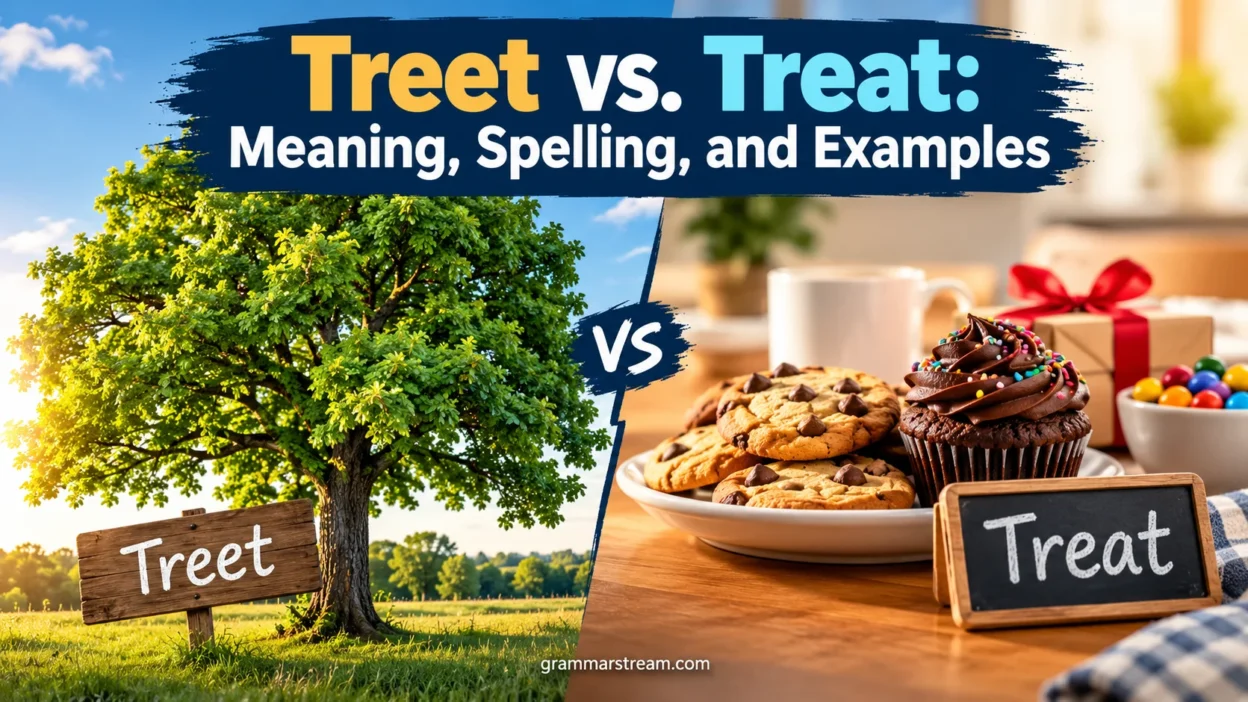
English spelling can be tricky, especially when two words look almost identical but contain different letter combinations. Treet vs. Treat is one such comparison that can confuse writers who rely on pronunciation rather than spelling. Although both forms look plausible at first glance, only one is the standard spelling of the everyday English word.
The word treat has several meanings. It can describe something enjoyable, such as a piece of chocolate, or explain how someone behaves toward another person. It also refers to providing medical care, paying for someone’s meal, or applying a process to a material. These different uses make treat a common and useful word in everyday conversations.
But what about treet? You might encounter this spelling in a name, brand, or specialized context. However, it isn’t the standard spelling when you mean a reward, an enjoyable experience, medical care, or the act of dealing with someone in a particular way.
Quick Answer
Treat is the correct standard spelling of the everyday English word. It can function as both a noun and a verb, depending on the sentence. Treet is generally a misspelling when someone intends to write treat.
Consider these examples:
- Correct: My grandmother gave me a special treat.
- Incorrect: My grandmother gave me a special treet.
- Correct: The doctor will treat the patient.
- Incorrect: The doctor will treet the patient.
The correct spelling is T-R-E-A-T. Remember this spelling whenever you discuss something enjoyable, medical care, someone’s behavior, or paying for another person’s experience.
Although treet may appear in proper names or specialized contexts, you shouldn’t use it as a substitute for treat in ordinary English writing.
Comparison Overview
The simplest way to understand treet vs. treat is to compare their spelling, meaning, and grammatical roles. The following table highlights the main distinctions.
| Feature | Treat | Treet |
| Standard English spelling | Yes | No, not as a standard spelling of treat |
| Commonly used word | Yes | Not in ordinary writing with the intended meaning of treat |
| Part of speech | Noun and verb | No standard noun or verb use equivalent to treat |
| Meaning as a noun | Something enjoyable, a reward, or a special experience | Does not carry the standard meaning of treat |
| Meaning as a verb | To care for, behave toward, provide medical care, or pay for something | Not the standard spelling of the verb treat |
| Pronunciation of the standard word | /triːt/ | No standard pronunciation as a substitute for treat |
| Example | The children received a sweet treat. | The children received a sweet treet. |
| Correct choice in ordinary writing | Yes | No |
The important point is that treat has established meanings and recognized grammatical forms. The spelling treet doesn’t serve as its standard alternative.
For example, if you write, “I’ll treat you to dinner,” your reader understands that you’re offering to pay. Replacing treat with treet creates a spelling error and may distract the reader from your message.
Main Differences Between Treet and Treat
The difference between these spellings involves more than one letter. It also concerns standard English usage, meaning, grammar, and word formation.
Meaning and Definition
The word treat has several established meanings in modern English. Its exact meaning depends on the surrounding words and the situation.
As a noun, treat usually describes something enjoyable, special, or rewarding. A favorite dessert, a surprise gift, or an exciting outing can all qualify as treats.
For example:
- The children received ice cream as a special treat.
- Watching the championship game with my friends was a real treat.
- Her parents planned a weekend trip as a birthday treat.
As a verb, treat can describe how someone behaves toward another person. It can also refer to providing medical care or paying for an enjoyable experience.
For example:
- Good managers treat their employees fairly.
- The veterinarian will treat the injured animal.
- My sister offered to treat me to lunch.
In each example, the spelling remains the same even though the meaning changes.
By contrast, treet isn’t the standard spelling for any of these meanings. If you want to describe a reward, explain someone’s behavior, or discuss medical care, use treat.
Spelling and Word Formation
The correct spelling of the word is T-R-E-A-T. The letter combination ea appears in the middle, followed by the final letter t.
The spelling treet replaces ea with ee. Although both letter combinations can represent the same long vowel sound in English, that similarity doesn’t make them interchangeable.
Consider these familiar words:
- Treat: A reward or an act of care.
- Beat: To strike repeatedly or defeat an opponent.
- Meat: Animal flesh used as food.
- Street: A public road in a town or city.
These words contain different spellings, even though their vowel patterns may produce the same sound. English spelling often reflects established word forms rather than a single, consistent sound-to-letter rule.
The word treat also has several related forms:
| Word Form | Grammatical Role | Example |
| Treat | Base verb or singular noun | I will treat you to dinner. |
| Treats | Plural noun or third-person singular verb | She treats her guests kindly. |
| Treated | Simple past or past participle | The doctor treated the patient. |
| Treating | Present participle or gerund | They are treating the infection. |
Notice that these forms retain the original spelling pattern t-r-e-a-t. The letters change only when English grammar requires a different ending.
For example, treating drops the final t before adding -ing. It doesn’t change the vowel combination to ee.
Pronunciation of Treet vs. Treat
In standard American English, treat is pronounced /triːt/. The word begins with the consonant cluster /tr/, followed by a long vowel sound and the final /t/.
The vowel sound resembles the one heard in meet, green, and sleep. However, the spelling differs from word to word.
This creates a common spelling challenge. Someone who knows how a word sounds might still choose the wrong letters when writing it.
For example, a person might hear the phrase “a special treat” and mistakenly write “a special treet.” The mistake comes from applying a familiar sound pattern without remembering the word’s accepted spelling.
To avoid this problem, connect the word’s spelling with a familiar expression, such as “treat yourself” or “trick or treat.” These expressions reinforce the correct letter sequence.
Read More: Tweek vs. Tweak: Meaning, Differences, Spelling, and Examples
What Does Treat Mean?
The word treat has several meanings that appear in everyday conversations, workplaces, medical settings, and written communication. Understanding these meanings helps you use the word accurately.
Treat as a Noun
As a noun, a treat is something enjoyable, special, or rewarding. It often describes an experience or item that someone receives for pleasure rather than necessity.
A treat doesn’t have to be expensive. Even a small surprise can feel special when it brings happiness or makes an ordinary day more enjoyable.
For example, a parent might give a child a cookie after dinner. A friend might buy coffee for someone who needs encouragement. A family might visit a favorite restaurant to celebrate an achievement.
All these situations involve treats because they offer something enjoyable beyond the ordinary routine.
Examples of treat as a noun:
- A piece of chocolate is a delicious treat.
- The concert was a wonderful treat for music lovers.
- My parents planned a beach vacation as a birthday treat.
- The dog received a crunchy biscuit as a training treat.
- A quiet afternoon with a good book can be a real treat.
The meaning can also extend beyond food or gifts. A beautiful performance, an unexpected opportunity, or a relaxing experience can qualify as a treat.
For instance, someone might say, “Seeing the northern lights was a rare treat.” The sentence describes an enjoyable experience rather than a physical object.
Treat as a Verb
As a verb, treat describes an action. The meaning changes according to the context, so understanding the sentence is essential.
Treat someone in a particular way
This meaning concerns behavior toward another person. You can treat someone kindly, unfairly, respectfully, or rudely.
Examples:
- Please treat your classmates with respect.
- She always treats her customers politely.
- Everyone deserves to be treated fairly.
- They treated their visitors with great kindness.
In these sentences, treat describes how someone acts toward another person.
Treat an illness or injury
In healthcare, treat means to provide care or take steps to manage a medical condition.
Examples:
- The doctor will treat the infection.
- The hospital treated several patients after the accident.
- Physical therapy can help treat certain movement problems.
The word doesn’t necessarily mean that a condition will disappear completely. Medical treatment may relieve symptoms, manage a condition, prevent complications, or help the body recover.
Treat someone to something
This expression means paying for something enjoyable that another person receives.
Examples:
- I’ll treat you to dinner tonight.
- Her brother treated the family to ice cream.
- We decided to treat our parents to a weekend getaway.
In this context, the person offering the treat usually pays for the experience.
Treat a material
The verb can also describe applying a substance or process to something to change or protect it.
Examples:
- Workers treat wooden furniture to protect it from moisture.
- The company treats drinking water before distribution.
- Manufacturers may treat fabrics to improve certain properties.
Here, the word refers to a process rather than a reward or social interaction.
Common Expressions With Treat
Several familiar expressions use treat in ways that are easy to recognize. Learning these phrases can help you remember the spelling and understand how the word works.
| Expression | Meaning | Example |
| Treat yourself | Enjoy something special or rewarding | I decided to treat myself to a new book. |
| My treat | An offer to pay for someone else’s purchase or experience | Don’t worry about the bill. It’s my treat. |
| Trick or treat | A traditional Halloween expression associated with collecting candy | The children went trick-or-treating after sunset. |
| A rare treat | An unusual or especially enjoyable experience | Hearing the band perform live was a rare treat. |
| Treat someone with respect | Behave toward someone respectfully | Good leaders treat their teams with respect. |
| Treat someone to lunch | Pay for another person’s lunch | I’ll treat you to lunch after the meeting. |
These expressions appear in conversations, messages, books, and everyday writing. Each one uses the standard spelling treat.
One useful detail is that treat appears in the compound expression trick-or-treat. When used as a verb in the activity’s name, the familiar expression is commonly written as trick-or-treating.
Is Treet a Real Word?
The answer depends on what you mean by a “real word.” A letter sequence can appear in a name, brand, or specialized source without becoming the standard spelling of another word.
Treet in Standard American English
In ordinary American English, treet isn’t the standard spelling of treat. If you’re writing about a reward, a medical procedure, or the way someone behaves, treat is the correct choice.
For example:
- Incorrect: The teacher gave the class a small treet.
- Correct: The teacher gave the class a small treat.
Another example:
- Incorrect: The nurse will treet the patient.
- Correct: The nurse will treat the patient.
The correction is straightforward. Replace treet with treat when you intend the familiar English word.
However, it’s better to avoid making an absolute claim that the letter sequence treet has never appeared in any language, historical record, or specialized context. Names and unusual spellings can exist outside standard everyday usage.
Treet in Names and Specialized Contexts
You might encounter Treet as a proper name, product name, brand, or other specialized label. In those cases, the spelling may be intentional.
Proper nouns follow their own naming conventions. A company might choose an unusual spelling for its brand, and a person’s name may differ from familiar dictionary words.
For example, if a fictional business were named Treet Foods, you would preserve that spelling when referring to the business. Changing its name to Treat Foods would be inaccurate if Treet Foods were the official name.
The same principle applies to historical documents and specialized terminology. A spelling may have a particular meaning in its original setting without serving as a standard substitute in modern American English.
Therefore, context matters. If you see treet in a name or historical source, examine how the source uses it before deciding what it means.
For ordinary writing, though, the rule remains simple: Use treat when you mean the standard English word.
Treet vs. Treat: Example Sentences
Examples make the spelling difference easier to recognize. The following sentences show how treat works as both a noun and a verb.
FAQs:
Is It Spelled Treet or Treat?
The standard spelling is treat. Use it when referring to a reward, an enjoyable experience, medical care, or the way someone behaves toward another person.
For example, “My friend treated me to dinner” is correct. Writing “My friend treeted me to dinner” is a spelling mistake.
Is Treet a Real English Word?
Treet is not the standard spelling of the everyday English word treat. However, the sequence may appear in proper names, brands, historical material, or specialized contexts.
If you encounter it in a specific source, examine the context before deciding what it means. In ordinary writing, use treat for the familiar word.
What Does Treat Mean?
As a noun, treat means something enjoyable, special, or rewarding. Examples include a favorite dessert, a surprise gift, or an exciting outing.
As a verb, it can mean behaving toward someone in a particular way, providing medical care, paying for another person’s experience, or applying a process to something.
Why Do People Spell Treat as Treet?
People may write treet because the vowel combinations ea and ee can represent the same long vowel sound. Typing quickly or relying on pronunciation may also contribute to the mistake.
The best solution is to memorize the spelling and recognize it in familiar phrases such as “trick or treat.”
How Do You Spell Treat Correctly?
The correct spelling is T-R-E-A-T. The middle letters are ea, not ee.
For example: “The children received a special treat after the game.”
Conclusion:
The difference between treet vs. treat comes down to standard spelling and correct usage. Treat is the accepted spelling of the everyday English word, whether you’re describing a reward, discussing medical care, explaining someone’s behavior, or offering to pay for an enjoyable experience. The word can function as both a noun and a verb. Its related forms include treats, treated, and treating. Learning these forms helps you avoid common spelling and grammar mistakes.