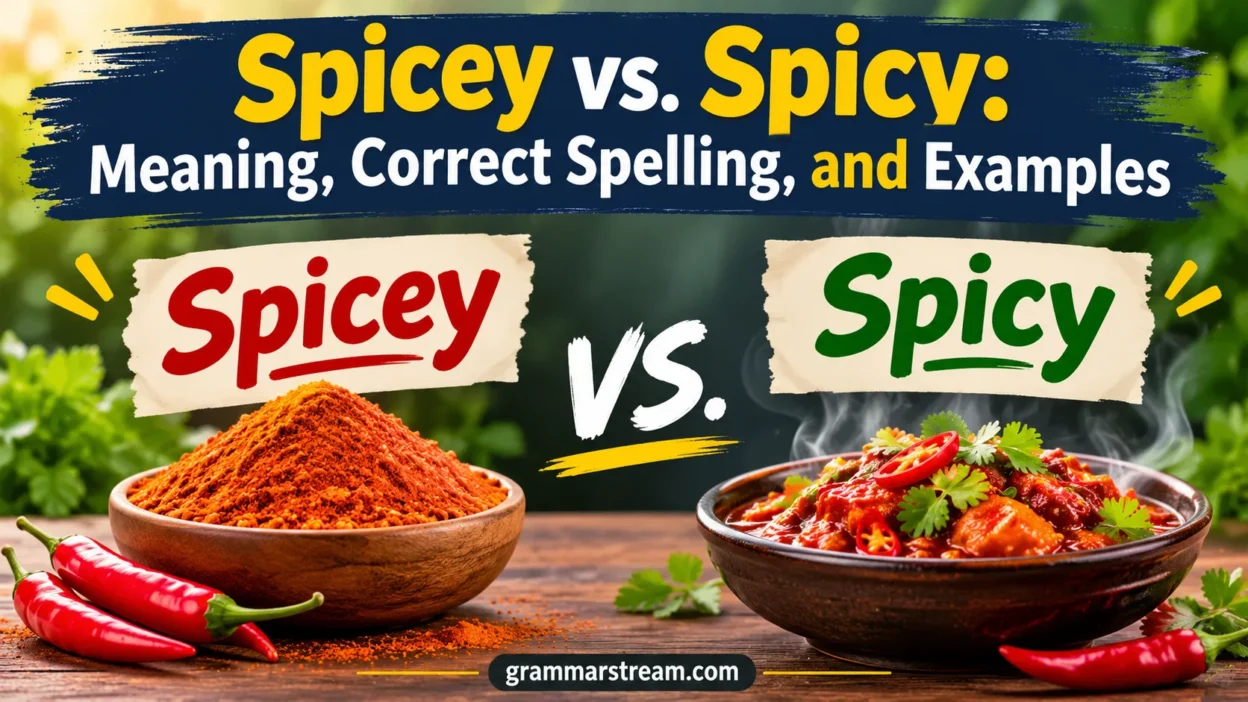
Have you ever wondered whether to write spicey or spicy when describing food with a strong, flavorful kick? The two spellings look almost identical, so it’s easy to see why people confuse them. However, only one follows standard English spelling rules.
The correct spelling is spicy. You should use it when describing food with a strong spice flavor, a hot sensation, or something figuratively exciting or provocative. The spelling spicey is a common misspelling and doesn’t serve as a standard alternative in modern English.
Although the difference comes down to one letter, understanding the spelling rule can help you avoid similar mistakes. It also helps to know how spicy works as an adjective and how it differs from related words such as spice and spiciness.
Quick Answer
Spicy is the correct spelling. Spicey is a misspelling in standard English. The word spicy describes food that contains spices or produces a strong, often hot flavor. It can also describe something lively, provocative, or exciting.
- Correct: This Mexican salsa is incredibly spicy.
- Incorrect: This Mexican salsa is incredibly spicey.
- Correct adjective: Spicy
- Related noun: Spice
- Related noun: Spiciness
Remember this simple spelling rule: Drop the silent e from spice before adding y to form spicy.
Comparison Overview
The following table highlights the main differences between spicey and spicy.
| Feature | Spicey | Spicy |
| Spelling status | Common misspelling | Correct standard spelling |
| Meaning | No standard adjective meaning | Having a strong spice flavor or figuratively exciting |
| Part of speech | Intended as an adjective but nonstandard | Adjective |
| Pronunciation | Intended pronunciation varies | /ˈspaɪ.si/ |
| Standard dictionary usage | Not accepted as the standard form | Accepted and widely used |
| Formal writing | Avoid | Correct |
| Informal writing | Avoid | Correct |
| Example | Incorrect: The sauce is spicey. | Correct: The sauce is spicy. |
The important distinction is straightforward: spicy belongs in standard English writing. The extra e in spicey doesn’t make it a different accepted adjective.
Main Differences Between Spicey and Spicy
Understanding the difference requires looking beyond the final letter. The correct spelling follows a regular English word-formation pattern. Its meaning and grammatical role also make it easy to recognize in sentences.
Spicey vs. Spicy: Which Spelling Is Correct?
Spicy is the correct spelling in American English and standard modern English usage. You should use it whenever you want to describe something containing spices or producing a strong flavor.
For example:
- The restaurant serves spicy chicken wings.
- I prefer spicy noodles over plain pasta.
- She added spicy sauce to her sandwich.
- This curry tastes spicy but delicious.
In each sentence, spicy describes a noun. It tells readers something about the flavor or character of the food.
On the other hand, spicey adds an unnecessary letter. English dictionaries and standard writing conventions recognize spicy as the established adjective derived from spice.
You might occasionally encounter spicey in usernames, product names, social media posts, or informal online writing. Someone might also use it intentionally as a creative spelling. However, that doesn’t make it the standard spelling.
The safest rule: Whenever you mean something has a strong spice flavor, write spicy.
Meaning and Definition of Spicy
The word spicy is an adjective that describes something with the flavor, aroma, or sensation associated with spices. Its meaning depends on the context.
It most commonly describes food. However, English speakers also use it figuratively to describe conversations, stories, entertainment, and situations.
Spicy Meaning in Food
When people describe food as spicy, they usually mean it contains ingredients that create a strong or sharp flavor. These ingredients may include chili peppers, black pepper, ginger, mustard, or other seasonings.
For example, a bowl of spicy ramen might contain chili oil, hot pepper paste, or fresh peppers. These ingredients give the dish a noticeable kick.
However, spicy doesn’t always mean extremely hot. Some dishes have a mild warmth while others create an intense burning sensation.
Consider these examples:
- This spicy chicken has a wonderful balance of heat and flavor.
- My mother makes spicy lentil soup with fresh green chilies.
- The restaurant’s spicy noodles are popular with customers.
- I ordered a mild curry because I can’t handle very spicy food.
The word can describe both the presence of spices and the sensation they create.
Spicy Meaning in Figurative Language
Beyond food, spicy can describe something exciting, provocative, controversial, or slightly shocking.
This informal meaning appears frequently in conversations and online discussions.
For example:
- That celebrity interview included some spicy comments.
- Their argument became spicy after the unexpected accusation.
- The television show features a few spicy scenes.
- She shared some spicy details about the surprise party.
In these examples, the word doesn’t describe physical heat or food ingredients. Instead, it suggests something interesting, bold, dramatic, or potentially controversial.
Context determines the intended meaning.
Spicy as a Description of Personality or Style
People sometimes use spicy to describe a bold personality, an energetic attitude, or a distinctive style.
For instance, someone might call a confident response a spicy comeback. Similarly, a colorful outfit with striking patterns might receive the same description.
This usage is informal and expressive. It adds personality to everyday communication.
Why Is Spicy Spelled Without an E?
The spelling of spicy follows a common English word-formation pattern. When you understand this pattern, the correct spelling becomes easier to remember.
The base word is spice, which functions as a noun. It refers to a substance used to add flavor, aroma, or color to food.
To turn spice into the adjective spicy, you remove the final silent e and add y.
The transformation looks like this:
Spice → Spicy
The final e disappears because English commonly drops a silent e when adding certain suffixes that begin with a vowel. Although y is technically a letter rather than a vowel, this particular word follows an established spelling pattern.
Here are some useful examples:
| Base Word | Correct Derived Word | Meaning |
| Spice | Spicy | Having a strong spice flavor |
| Ice | Icy | Covered with or resembling ice |
| Juice | Juicy | Containing plenty of juice |
| Grease | Greasy | Covered with or containing grease |
| Noise | Noisy | Making a lot of noise |
| Shine | Shiny | Reflecting light |
Notice how these words lose their final silent e before adding y.
This pattern explains why spicy is correct while spicey is not.
One important detail: English spelling rules have exceptions. You shouldn’t assume every word ending in silent e will follow precisely the same pattern. However, the examples above provide a helpful guide.
Pronunciation: Spicey vs. Spicy
Correct spelling matters, but pronunciation also helps you recognize a word in everyday conversation.
The standard pronunciation of spicy is:
- IPA: /ˈspaɪ.si/
- Syllables: Two
- Primary stress: First syllable
- Pronunciation: The first syllable rhymes with eye, followed by a short see sound.
You can hear the word naturally in sentences such as:
- This pizza is spicy.
- I don’t like spicy sauces.
- The chef prepared a spicy seafood dish.
The spelling spicey doesn’t represent a separate standard English pronunciation. Most people who write it intend to communicate the same word and pronunciation as spicy.
However, readers may interpret unusual spellings differently. That’s another reason to use the recognized form.
How to Use Spicy in Sentences
Once you know the correct spelling, using spicy becomes simple. It generally appears before a noun or after a linking verb.
Using Spicy Before a Noun
You can place spicy directly before a noun to describe its flavor or character.
Examples:
- We ordered spicy chicken for dinner.
- He enjoys spicy Mexican food.
- The chef prepared a spicy vegetable curry.
- She bought spicy chips from the grocery store.
- They served spicy seafood at the restaurant.
In these sentences, spicy works as an adjective that modifies the following noun.
Using Spicy After a Linking Verb
You can also place spicy after linking verbs such as is, looks, smells, tastes, and seems.
Examples:
- This soup is spicy.
- The homemade sauce tastes spicy.
- That curry smells spicy.
- The new restaurant’s food seems spicy.
- These chicken wings look spicy.
Here, spicy describes the subject rather than appearing directly before a noun.
Using Spicy in Casual Conversations
The figurative meaning makes spicy useful in everyday communication.
Examples:
- That was a spicy reply!
- The latest episode has some spicy moments.
- Their discussion became spicy very quickly.
- She always has a spicy opinion about celebrity news.
- That social media post contains some spicy details.
These examples show how the word adds emotion and personality to ordinary conversations.
Read More: Alot vs. A Lot vs. Allot: Meaning, Differences, and Correct Usage
Common Mistakes When Writing Spicy
Even familiar words can cause spelling problems, especially when their pronunciation doesn’t reveal their correct spelling.
The confusion between spicey and spicy usually comes from the original noun spice. Writers see the final e and assume it should remain when they add another ending.
Here are some mistakes worth avoiding.
Adding an Unnecessary E
The most common mistake involves writing spicey instead of spicy.
- Incorrect: I love eating spicey chicken.
- Correct: I love eating spicy chicken.
The adjective drops the final e. Keeping it creates a nonstandard spelling.
Confusing Spice With Spicy
Although these words share the same root, they serve different grammatical purposes.
- Spice: A substance used to flavor food.
- Spicy: An adjective describing something with a strong spice flavor.
For example:
- Correct: Black pepper is a common spice.
- Correct: Black pepper gives food a spicy flavor.
Using one word in place of the other can make a sentence grammatically incorrect.
Assuming Spicy Always Means Extremely Hot
Another common mistake involves confusing spiciness with heat intensity.
A dish can contain several aromatic spices without producing an intense burning sensation. For example, cinnamon and cardamom add distinctive flavors without necessarily making food hot.
Likewise, chili peppers can create a burning sensation even when a dish has relatively few other spices.
Therefore, spicy can describe a broad flavor experience rather than a specific level of heat.
Using Spicy When Another Word Is More Accurate
Sometimes, spicy isn’t the most precise adjective.
Consider these alternatives:
- Peppery: Having a flavor similar to black pepper.
- Fiery: Producing an intense burning sensation.
- Zesty: Having a lively, sharp, or refreshing flavor.
- Piquant: Having a pleasantly sharp or stimulating taste.
- Aromatic: Having a noticeable and pleasant smell.
Choosing the right adjective helps readers understand exactly what you mean.
Spice, Spicy, and Spiciness: Understanding the Related Words
English contains several related words that come from the same root. Although their meanings overlap, their grammatical functions differ.
Understanding these forms will help you use them correctly in different sentences.
Spice: A Noun
Spice refers to a substance used to add flavor, aroma, or color to food.
Common examples include:
- Cinnamon
- Black pepper
- Turmeric
- Cardamom
- Cloves
- Nutmeg
- Cumin
- Ginger
Spices come from different parts of plants, including seeds, bark, roots, flowers, and fruits.
For example:
- Cinnamon is my favorite baking spice.
- Add a little spice to the vegetable soup.
- Turmeric is a popular spice in South Asian cooking.
The word can also describe something that adds excitement or interest to an experience.
For example, “A little humor adds spice to the conversation.”
Spicy: An Adjective
Spicy describes something that contains spices or has a strong, stimulating flavor.
It can also describe something exciting or provocative in informal language.
Examples:
- This spicy curry tastes delicious.
- I ordered a spicy chicken sandwich.
- The comedian made a few spicy jokes.
- That conversation became surprisingly spicy.
Remember that spicy modifies nouns or describes subjects through linking verbs.
Spiciness: A Noun
Spiciness refers to the quality, degree, or sensation of being spicy.
It often describes how strongly a food affects your taste buds and mouth.
Examples:
- I enjoy the spiciness of homemade chili.
- The restaurant allows customers to choose their preferred spiciness.
- The spiciness of the sauce comes from fresh peppers.
- Everyone has a different tolerance for spiciness.
The distinction is easy to remember:
| Word | Part of Speech | Meaning | Example |
| Spice | Noun | A flavoring ingredient | Cinnamon is a spice. |
| Spicy | Adjective | Having a strong spice flavor | This curry is spicy. |
| Spiciness | Noun | The quality or degree of being spicy | I enjoy its spiciness. |
These three words belong to the same word family. However, each performs a different job in a sentence.
Synonyms and Related Words for Spicy
English offers several alternatives to spicy. However, not every synonym communicates exactly the same flavor or sensation.
Understanding their differences helps you choose more precise descriptions.
| Synonym | Meaning | Example |
| Hot | Producing a strong burning sensation | This hot sauce is powerful. |
| Piquant | Having a pleasantly sharp flavor | The dressing has a piquant taste. |
| Peppery | Having a pepper-like flavor | The soup tastes peppery. |
| Zesty | Having a lively, sharp flavor | The lemon dressing is zesty. |
| Fiery | Extremely hot or intense | The restaurant serves fiery wings. |
| Flavorful | Having a rich or noticeable taste | The flavorful curry contains several spices. |
| Seasoned | Containing added flavorings | The chef prepared well-seasoned vegetables. |
Frequently Asked Questions
Is It Spicy or Spicey?
Spicy is the correct spelling in standard English. It describes food with a strong spice flavor or something figuratively exciting or provocative. Spicey is a common misspelling and should be avoided in formal and everyday writing.
Why Is Spicy Spelled Without an E?
The word spicy comes from the noun spice. English forms the adjective by dropping the final silent e and adding y. Therefore, the correct transformation is spice → spicy, not spice → spicey.
Is Spicey Ever Considered a Correct Spelling?
Spicey isn’t an accepted standard spelling of the adjective in modern English. You might encounter it in usernames, creative branding, or informal online writing. However, these uses don’t establish it as a standard dictionary alternative. Use spicy in regular writing.
What Is the Difference Between Spice and Spicy?
Spice is a noun referring to an ingredient that adds flavor or aroma to food. Spicy is an adjective describing something with a strong spice flavor or stimulating sensation.
For example, “Black pepper is a spice” identifies an ingredient. “Black pepper makes the soup spicy” describes its effect on the food.
Does Spicy Mean Hot or Flavorful?
Spicy can describe both a strong spice flavor and a sensation of heat. However, these meanings aren’t always identical. A dish containing aromatic spices might taste flavorful without creating a burning sensation. Chili peppers, on the other hand, can produce significant heat because of capsaicin.
Conclusion:
The difference between spicey vs. spicy comes down to one unnecessary letter. Spicy is the correct standard spelling while spicey is a common spelling mistake. Remember the simple transformation: spice becomes spicy when you remove the final e and add y. Also, keep the related words spice, spicy, and spiciness separate. Each has its own grammatical purpose and belongs in different sentence structures.