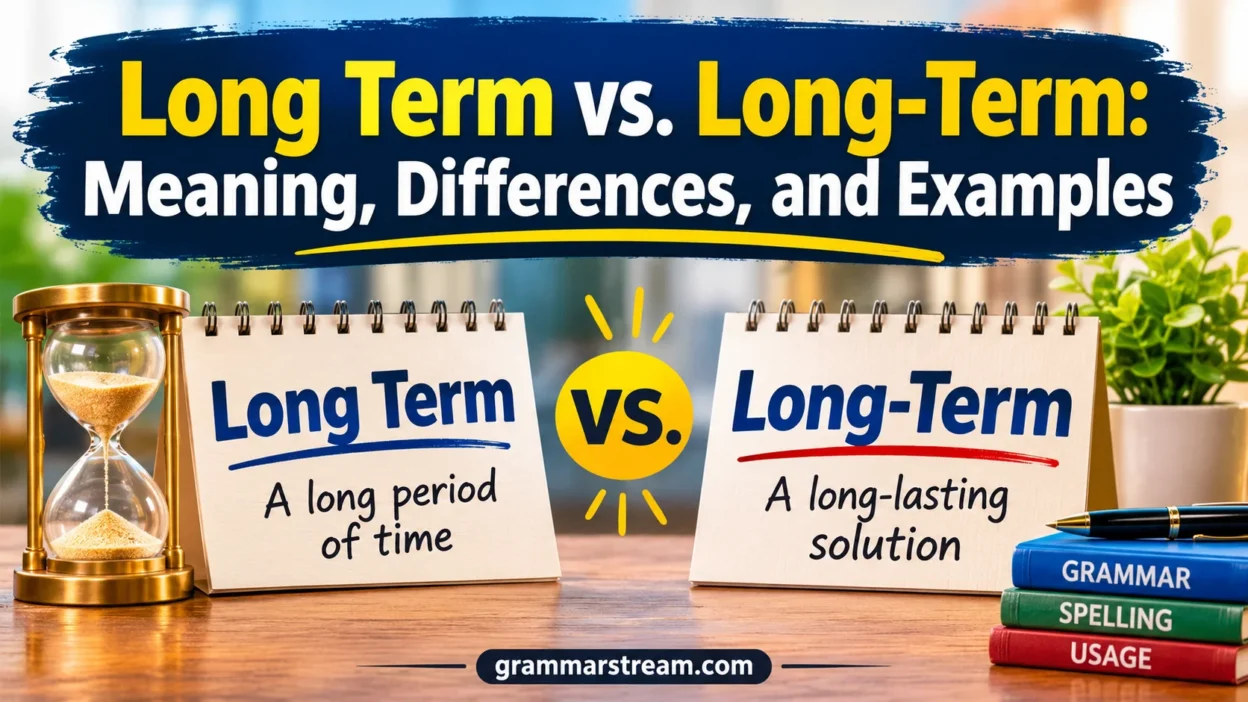
The difference between long term vs. long-term may seem small, but that tiny hyphen can change how a sentence works. Both forms describe something that continues over an extended period. However, they don’t serve exactly the same grammatical purpose.
You’ll often encounter these expressions in business plans, financial reports, educational discussions, medical writing, and everyday conversations. For example, you might discuss the benefits of a decision in the long term or describe a long-term investment. Both expressions are correct, but their grammatical structures differ.
Understanding this distinction helps you write more clearly and avoid unnecessary hyphenation mistakes. Once you recognize how each expression functions, choosing the correct form becomes much easier.
In this guide, you’ll learn what long term and long-term mean, when to use each form, how hyphenation works, and which common mistakes to avoid. You’ll also find practical examples from different writing situations.
Quick Answer
Long term is generally a noun phrase that refers to an extended period. Use it when discussing something over time or treating that period as a concept.
Long-term is a hyphenated compound adjective. Use it when two words work together to describe a noun.
Consider these examples:
- Long term: We should think about the consequences in the long term.
- Long-term: The company needs a long-term growth strategy.
The easiest way to remember the difference is to examine what follows the expression. When it modifies a noun, use the hyphenated form. When it refers to an extended period itself, the open form is generally appropriate.
Comparison Overview
Although long term and long-term share the same basic meaning, their grammatical functions determine their spelling. One refers to an extended period as a noun phrase. The other describes something associated with an extended period.
| Comparison Point | Long Term | Long-Term |
| Spelling | Two separate words | Two words joined by a hyphen |
| Grammatical function | Noun phrase | Compound adjective |
| Main purpose | Refers to an extended period | Describes something lasting or relating to an extended period |
| Typical position | After prepositions or as a noun phrase | Usually before a noun |
| Example | In the long term | Long-term investment |
| Correct usage | Think about the long term. | We need a long-term plan. |
| Hyphen | Not required | Required in the standard compound-adjective form |
Both expressions communicate an idea of extended duration. The difference comes from how you use them in a sentence rather than a completely different definition.
For instance, compare these sentences:
- A long-term relationship requires commitment.
- A relationship requires commitment over the long term.
The first sentence uses a compound adjective to describe the relationship. The second uses a noun phrase to identify the period during which commitment matters.
This distinction applies across many subjects, including finance, education, healthcare, and business planning.
Main Differences Between Long Term and Long-Term
The most important difference between these expressions involves their grammatical roles. Understanding that distinction will help you choose the correct spelling without memorizing dozens of unrelated rules.
Meaning and Definition of Long Term
Long term refers to an extended period rather than a short or immediate period. It commonly appears when discussing future consequences, lasting results, gradual changes, or extended plans.
The expression treats time as the subject of discussion. It doesn’t directly modify a noun through a compound adjective.
For example:
- We need to consider the long term before making this decision.
- Regular exercise can improve your health over the long term.
- The business expects stronger results in the long term.
- Saving small amounts consistently can make a difference over the long term.
In each sentence, long term refers to an extended period. The phrase functions as a noun phrase rather than an adjective placed before another noun.
You’ll frequently see it in expressions such as:
- In the long term
- Over the long term
- For the long term
- The long term
- Thinking about the long term
These expressions help readers understand that an outcome or situation extends beyond the immediate future.
Example in context:
Imagine a company deciding whether to invest in new equipment. The equipment costs more initially but reduces operating expenses over several years. Someone might say, “This investment will save money in the long term.”
Here, long term refers to the extended period during which the savings become noticeable.
Meaning and Definition of Long-Term
Long-term is a compound adjective that describes something connected with an extended period.
The hyphen joins long and term so readers understand that both words work together as one modifier. This structure commonly appears before a noun.
For example:
- The organization introduced a long-term development plan.
- She wants to build a long-term career in medicine.
- The treatment may produce long-term benefits.
- They established a long-term business partnership.
In these examples, long-term describes the nouns that follow it.
A development plan covers an extended period. A career involves lasting professional activity. Benefits may continue for years. A partnership may remain active over an extended period.
The hyphen makes the relationship between the two words clear.
You’ll commonly encounter long-term in expressions such as:
- Long-term goals
- Long-term effects
- Long-term relationships
- Long-term planning
- Long-term investments
- Long-term solutions
- Long-term commitments
Example in context:
Suppose a student wants to become a doctor. Instead of focusing only on passing the next examination, the student creates a long-term educational plan covering university, medical training, and professional development.
In this sentence, long-term describes the educational plan. That’s why the hyphenated form works.
Long Term vs. Long-Term: Part of Speech and Grammatical Function
The grammatical function provides the clearest way to distinguish these expressions. Although they contain identical words, they perform different jobs.
Long term functions as a noun phrase. It identifies an extended period as something being discussed.
Examples:
- The long term matters more than immediate convenience.
- We should evaluate these changes over the long term.
- Their decision could create problems in the long term.
Long-term functions as a compound adjective. It describes a noun by explaining its relationship with an extended period.
Examples:
- They developed a long-term business strategy.
- The patient requires long-term care.
- The company established long-term objectives.
Notice how the words surrounding each expression determine its grammatical function.
| Sentence | Grammatical Function |
| We considered the long term. | Noun phrase |
| We created a long-term strategy. | Compound adjective |
| Results improved over the long term. | Noun phrase |
| The project requires long-term planning. | Compound adjective |
| She thinks about the long term. | Noun phrase |
| They expect long-term benefits. | Compound adjective |
A useful trick is to ask yourself one question: Am I naming a period or describing something?
If you’re naming or discussing the period, use long term. If you’re describing a noun, use long-term.
When to Use Long Term
Use long term when the expression refers to an extended period as a noun phrase. This form frequently appears after prepositions or in sentences discussing future outcomes.
Using Long Term With Prepositions
Prepositions help establish the relationship between an action and an extended period.
The most common combinations include:
In the long term
This expression describes the eventual results or consequences of something.
Examples:
- Eating balanced meals can benefit your health in the long term.
- The new policy may reduce expenses in the long term.
- Investing in employee training can strengthen the company in the long term.
Over the long term
This expression emphasizes how something develops or changes throughout an extended period.
Examples:
- Regular practice improves writing skills over the long term.
- The investment generated steady returns over the long term.
- Small improvements can produce meaningful results over the long term.
For the long term
This expression generally refers to an extended period of intended commitment, planning, or usefulness.
Examples:
- The company purchased new equipment for the long term.
- They want to establish a reliable system for the long term.
- She plans to stay with the organization for the long term.
Using Long Term as the Subject or Object
Long term can also appear as the subject or object of a sentence.
Examples:
- The long term requires patience and consistent effort.
- We must consider the long term before changing our strategy.
- He prefers solutions that benefit the long term.
- Planning for the long term can prevent unnecessary expenses.
These examples demonstrate that the phrase doesn’t need a hyphen when it functions as a noun phrase.
When to Use Long-Term
Use long-term when the expression describes a noun. The hyphen connects both words and shows that they form a single descriptive unit.
This usage is especially common in professional, academic, financial, and medical writing.
Long-Term Before a Noun
When long-term appears directly before a noun, it usually acts as a compound adjective.
Examples:
- Long-term investment
- Long-term employment
- Long-term relationship
- Long-term planning
- Long-term strategy
Consider this sentence:
“The organization introduced a long-term plan to improve customer satisfaction.”
Here, long-term describes the plan. It tells readers that the strategy extends beyond immediate improvements.
Long-Term Goals and Objectives
People frequently use long-term when discussing ambitions that require sustained effort.
Examples:
- Her long-term goal is to become a university professor.
- The business established long-term objectives for expansion.
- Developing strong communication skills is a long-term priority.
- Their long-term vision includes entering international markets.
A long-term goal usually requires several smaller actions. Unlike a short-term target, it focuses on a broader outcome that takes considerable time to achieve.
Long-Term Effects and Benefits
The expression also describes consequences that continue or become noticeable over an extended period.
Examples:
- Researchers examined the long-term effects of the treatment.
- The program offers long-term benefits to participating students.
- Poor financial decisions can create long-term problems.
- Regular maintenance can improve the long-term performance of machinery.
In each example, the hyphenated expression modifies a noun.
Read More: Cancellation vs. Cancelation: Meaning, Differences, and Examples
Long Term vs. Long-Term: Hyphenation Rules
Hyphenation can seem confusing because English doesn’t use hyphens randomly. They help connect words that work together to communicate one meaning.
In this case, the hyphen signals that long and term form a compound adjective.
Why Does Long-Term Have a Hyphen?
The hyphen connects two words that jointly describe another word.
Without the hyphen, readers might briefly interpret the words separately. Although context usually resolves the meaning, the hyphen makes the intended relationship clearer.
Compare these examples:
- Long-term investment: The hyphenated expression describes the type of investment.
- Investment over the long term: The open expression refers to the period during which the investment operates.
The hyphen doesn’t create a completely different meaning. Instead, it helps communicate the grammatical relationship between the words.
When Is the Hyphen Necessary?
Use the hyphen when long-term functions as a compound adjective before a noun.
Correct examples:
- Long-term planning
- Long-term employment
- Long-term consequences
- Long-term research
- Long-term financial goals
Incorrect standard forms in these contexts:
- Long term planning
- Long term employment
- Long term consequences
- Long term research
- Long term financial goals
The open versions don’t follow the standard compound-adjective spelling.
What Happens When Long-Term Appears After a Noun?
The hyphenation of compound adjectives after linking verbs can depend on dictionary and style-guide conventions.
For example:
- The investment is long-term.
- The effects were long-term.
- Their commitment remains long-term.
Some editorial styles retain the hyphen because the expression remains a compound adjective. Others may prefer an open form in certain established constructions.
For consistency, follow your chosen dictionary or publication style guide. When the expression appears before a noun, the hyphenated spelling is the clearest standard choice.
Does a Hyphen Change the Meaning?
Generally, no. Both forms communicate the same underlying idea of extended duration.
The difference is grammatical rather than semantic.
For example:
- The company developed a long-term strategy.
- The company expects better results in the long term.
Both sentences discuss an extended period. However, the first describes a strategy while the second refers to a period of time.
Long Term vs. Long-Term in Different Contexts
These expressions appear in many areas of life. Their grammatical distinction stays consistent even when the subject changes.
Understanding how professionals use them can make your writing more accurate and natural.
Frequently Asked Questions
Is Long Term One Word or Two Words?
Long term is written as two separate words without a hyphen when it functions as a noun phrase. However, long-term uses a hyphen when the expression works as a compound adjective.
Examples include in the long term and long-term planning. Neither form is written as one word.
Is Long-Term Always Hyphenated?
Long-term is the standard hyphenated form when it functions as a compound adjective before a noun.
For example, write “long-term investment” rather than “long term investment.”
However, when the expression refers to an extended period as a noun phrase, use the open form without a hyphen. For example, “The benefits will appear in the long term.”
Is It Correct to Say In the Long Term?
Yes, in the long term is grammatically correct and widely used in American English.
It describes the eventual consequences or results of an action over an extended period.
For example:
“Investing in quality equipment can reduce maintenance expenses in the long term.”
The phrase doesn’t need a hyphen because it functions as a noun phrase within a prepositional expression.
Should I Write Long-Term Goals or Long Term Goals?
The correct standard spelling is long-term goals.
Here, long-term describes the noun goals. The hyphen connects both words into one compound adjective.
For example:
- Correct: She established long-term goals for her business.
- Incorrect: She established long term goals for her business.
What Is the Difference Between Long-Term and Long-Range?
Long-term emphasizes duration, while long-range generally emphasizes distant future objectives or broader planning.
For example, a long-term investment involves an extended holding period. A long-range business plan may outline objectives for future expansion.
Both expressions can describe future-oriented decisions, but their emphasis differs.
Conclusion:
The difference between long term vs. long-term comes down to grammar and hyphenation. Both expressions describe an extended period, but they serve different purposes within a sentence. Use long term when referring to an extended period as a noun phrase. For example, “The decision will benefit the company in the long term.”