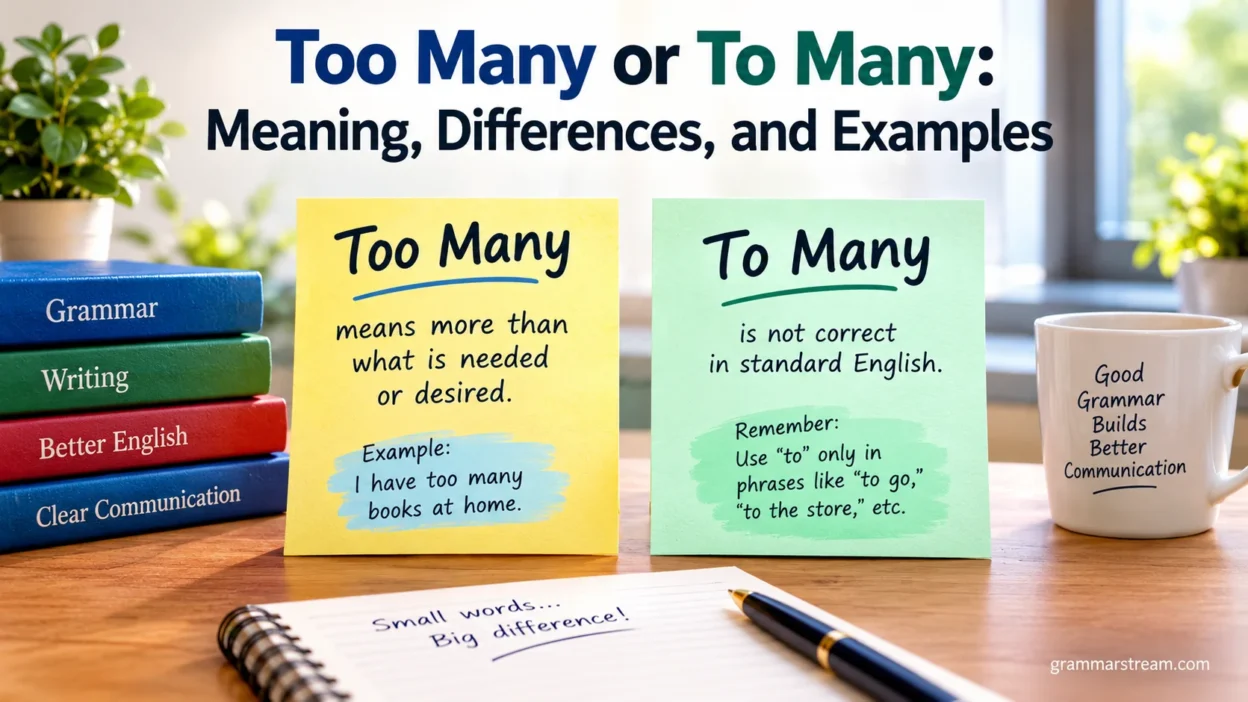
Have you ever paused while writing an email or text message because you weren’t sure whether to write “too many” or “to many”? These expressions look almost identical, but they don’t serve the same purpose in a sentence. Choosing the wrong one can change your meaning or make your writing grammatically incorrect.
The good news is that the difference becomes simple once you understand how “too” and “to” work. The phrase “too many” describes an excessive number of people or things. In contrast, “to many” can be correct when the word “to” connects an idea, action, or reaction to a group.
For example, you might write, “There are too many emails in my inbox.” However, you could also say, “This problem seems complicated to many people.” Both sentences are correct, but each phrase serves a different grammatical purpose.
Understanding these expressions will help you write clearer sentences, avoid common spelling mistakes, and communicate more confidently in everyday conversations, school assignments, and professional documents.
Quick Answer:
“Too many” is correct when you mean an excessive number of something. “To many” is also grammatically correct in certain sentences, but it doesn’t express excess by itself.
Use “too many” when the quantity exceeds what you need, want, expect, or can reasonably manage. Use “to many” when “to” functions as a preposition connecting an idea or action to a group of people or things.
Consider these examples:
- Too many: There are too many people waiting outside the store.
- To many: The new policy seems unfair to many employees.
- Too many: I made too many mistakes on the test.
- To many: The announcement came as a surprise to many families.
A helpful trick is to ask yourself what you want to express. If you mean “more than necessary” or “an excessive number,” choose “too many.” If you’re connecting a statement or reaction to a group, “to many” may be the right choice.
Remember that “to many” isn’t automatically incorrect. Its correctness depends on the sentence surrounding it.
Comparison Overview
The following table summarizes the difference between “too many” and “to many.”
| Feature | Too Many | To Many |
| Main purpose | Expresses an excessive quantity | Connects an idea or action to a group |
| Meaning | More than needed, wanted, or manageable | In relation to or directed toward many people or things |
| Grammatical structure | Adverb “too” + determiner “many” | Preposition “to” + “many” |
| Typical use | Countable plural nouns | Sentences involving recipients, reactions, or relationships |
| Example | There are too many cars on this street. | This road seems dangerous to many drivers. |
| Can it express excess? | Yes | Not by itself |
| Is it grammatically correct? | Yes, when used appropriately | Yes, when the sentence structure supports it |
The central difference comes down to meaning. “Too” expresses excess, while “to” usually indicates a relationship, direction, recipient, or connection.
For instance, “too many students” suggests that the number of students is excessive in a particular situation. Meanwhile, “to many students” can identify the people who receive an explanation, experience a reaction, or hold a particular view.
The word “many” appears in both expressions, but the word before it determines how the phrase works.
What Does Too Many Mean?
Definition of Too Many
“Too many” means more people or things than are wanted, needed, expected, or manageable. It generally refers to countable nouns, which are nouns you can count individually.
The phrase contains two words with different grammatical roles:
- Too: An adverb that expresses excess or an undesirable degree.
- Many: A determiner that indicates a large number of countable people or things.
Together, they describe a quantity that exceeds an appropriate limit.
For example, “There are too many chairs in this room” means the room contains more chairs than necessary or convenient. The sentence doesn’t merely say that the room has a large number of chairs. It suggests that the number creates a problem or exceeds expectations.
However, what counts as “too many” depends on the situation. Twenty people might be too many for a small car, but twenty people could be a perfectly reasonable number for a classroom discussion.
The phrase expresses excess relative to a purpose, expectation, or limit.
When to Use Too Many
Use “too many” when you want to describe an excessive number of countable items, people, events, or responsibilities.
Here are several common situations:
When describing objects: You can use the phrase to explain that you have more items than you need or can accommodate.
- I bought too many groceries for a single week.
- There are too many books on my desk.
- We ordered too many chairs for the meeting room.
When discussing people: The phrase can describe a crowd or a number of people that exceeds a particular limit.
- Too many people entered the building at once.
- There were too many guests for the small dining room.
- Too many students signed up for the limited number of seats.
When talking about responsibilities: You can also use “too many” for countable duties, assignments, and tasks.
- I have too many assignments to finish tonight.
- She accepted too many responsibilities at work.
- We have too many meetings scheduled for Friday.
When describing problems or mistakes: The phrase often communicates frustration when several issues occur together.
- The report contains too many errors.
- We experienced too many delays during the project.
- He made too many mistakes to ignore.
In each example, “too many” signals that the number has exceeded a reasonable or desirable amount.
Read More: Flyer or Flier: Which Spelling Is Correct?
Examples of Too Many in Sentences
The best way to understand the phrase is to see how it works in different contexts.
| Sentence | Explanation |
| There are too many cars on the road. | The number of cars creates congestion or exceeds a desired level. |
| She received too many messages yesterday. | The number of messages was excessive for her situation. |
| We invited too many guests to the party. | The guest list exceeded the available space or preferred number. |
| He asked too many questions during the presentation. | The number of questions became excessive in context. |
| I made too many changes to the original document. | The changes were more numerous than necessary. |
| They purchased too many tickets. | They bought more tickets than they needed. |
| There are too many options to choose from. | The number of choices feels excessive or difficult to manage. |
Notice that the phrase doesn’t always describe something objectively bad. Sometimes the speaker simply feels overwhelmed by the quantity.
For example, “There are too many desserts on the table” might express a practical concern about space. In another situation, it could be a playful comment about having more treats than anyone could eat.
Context gives the phrase its precise meaning.
What Does To Many Mean?
Definition of To Many
“To many” is a grammatically valid combination when “to” connects an action, statement, feeling, or relationship to many people or things. It doesn’t function as a direct replacement for “too many.”
The phrase usually appears as part of a larger sentence. The word “to” acts as a preposition, while “many” refers to a large number of people or things.
Consider this example:
“The sudden announcement was surprising to many employees.”
Here, “to many employees” identifies the people who found the announcement surprising. The sentence doesn’t say that the employees were excessive in number. Instead, it explains how a group of employees reacted to the announcement.
Compare that sentence with this one:
“There were too many employees in the meeting room.”
This example describes a number that exceeded the room’s capacity or the number considered appropriate.
The difference becomes clear when you examine the entire sentence rather than judging the two words in isolation.
When To Many Is Grammatically Correct
The phrase “to many” can appear in several common sentence structures.
When describing how people react to something
You can use “to many” when explaining how a group perceives an event, decision, or situation.
Examples:
- The decision seemed unfair to many workers.
- The news came as a shock to many residents.
- The proposal appeared reasonable to many voters.
- The explanation was confusing to many students.
In each sentence, “to” connects the reaction or judgment to the people experiencing it.
When explaining the importance of something to a group
The phrase can also identify the people for whom something matters.
Examples:
- Education is important to many families.
- The tradition means a great deal to many people.
- This issue matters to many local residents.
- The final result was disappointing to many fans.
These sentences express relationships between ideas and groups. They don’t describe excessive quantities.
When discussing how something appears to a group
Certain adjectives naturally occur in constructions that use “to.”
Examples:
- The instructions seem complicated to many beginners.
- The rule appears unnecessary to many teachers.
- The solution looks simple to many experienced programmers.
The word “many” identifies the group sharing the perception. The phrase works because the surrounding sentence supports this grammatical relationship.
Examples of To Many in Sentences
Here are additional examples showing how “to many” works naturally.
| Sentence | Why It Is Correct |
| The new schedule seems inconvenient to many employees. | “To” connects the judgment to the employees. |
| The discovery was exciting to many researchers. | “To many researchers” identifies the people who felt excited. |
| The decision appeared reasonable to many observers. | The phrase identifies the people who considered the decision reasonable. |
| The announcement came as a surprise to many families. | “To” connects the announcement’s effect to its recipients. |
| The painting looks unusual to many visitors. | The phrase identifies the people who perceive the painting that way. |
| This subject is difficult to many students. | The intended meaning is understandable, although “difficult for many students” is generally more natural in standard American English. |
The last example highlights an important point: a phrase can be grammatically possible without being the most natural wording. Depending on the adjective or verb, English may favor “for many” rather than “to many.”
For example, “Math is difficult for many students” is more idiomatic than “Math is difficult to many students.” Good writing requires attention to both grammar and natural usage.
Main Differences Between Too Many and To Many
Difference in Meaning
The clearest difference is what each expression communicates.
“Too many” expresses excess. It tells the reader that a quantity is greater than an appropriate or desired amount.
“To many” connects an idea or action to a group. It identifies people or things in relation to a statement, reaction, or other grammatical construction.
Compare these sentences:
- There are too many complaints about the service.
- The service seems unreliable to many customers.
The first sentence describes the number of complaints. The second describes how customers perceive the service.
Both sentences could appear in a report about customer satisfaction, but they communicate different information.
Difference in Grammar
Although the phrases look similar, their first words perform different grammatical jobs.
Too is an adverb in “too many.” It modifies the quantity expressed by “many” and indicates that the amount exceeds a relevant limit.
Examples:
- too many cars
- too many questions
- too many appointments
- too many mistakes
In each example, “too” adds the idea of excess.
To is a preposition in constructions such as “surprising to many people.” It connects the preceding word or expression to the group that experiences or receives something.
Examples:
- surprising to many people
- important to many families
- confusing to many readers
- meaningful to many communities
The word “many” can function as a determiner before a plural noun or as a pronoun when the noun is understood from context.
For example:
- Many students attended the lecture. (“Many” determines the noun “students.”)
- Many attended the lecture. (“Many” stands alone as a pronoun.)
This flexibility helps explain why “to many” can occur without a noun immediately following it.
FAQs:
Is Too Many or To Many Correct?
Both expressions can be correct, but they have different grammatical functions. Use “too many” to describe an excessive number of countable people or things. Use “to many” when “to” connects a statement, action, or reaction to a group.
For example, “There are too many cars” describes an excessive quantity. “The road seems dangerous to many drivers” describes how a group perceives the road.
Is To Many Ever Grammatically Correct?
Yes. “To many” is correct in sentences such as “The decision was surprising to many people” and “Education is important to many families.”
In these examples, “to” is a preposition that connects the preceding idea to a group. The phrase doesn’t mean “an excessive number.”
Why Do People Confuse Too and To?
People often confuse “too” and “to” because the words sound alike in standard American English. This type of word pair is called a homophone when the words share a pronunciation but have different meanings and spellings.
Fast typing, autocorrect, and a lack of proofreading can also cause mistakes. Remembering that “too” expresses excess can help you avoid the most common error.
Should I Use Too Many or Too Much?
Use “too many” with countable plural nouns and “too much” with uncountable nouns.
For example, write “too many books” because you can count individual books. Write “too much information” because “information” is generally uncountable in English.
The intended meaning and the noun’s grammatical behavior determine which expression you need.
How Can I Remember When to Use Too Many?
Think of “too” as a warning sign that a quantity has exceeded a limit.
If you have too many assignments, you have more assignments than you can reasonably manage. If a decision seems unfair to many students, “to many” identifies the students who share that reaction.
This simple distinction will help you choose the right phrase in most everyday situations.
Conclusion:
Choosing between “too many” and “to many” becomes easy when you focus on meaning and grammar rather than appearance. Use “too many” when you mean an excessive number of countable people or things. For example, you might have too many emails, too many responsibilities, or too many appointments. Use “to many” when “to” connects a statement, reaction, or action to a group. For example, a new rule might seem unfair to many employees, or an announcement might come as a surprise to many families.