Choosing between whoever and whomever can feel tricky, especially when both words seem to fit the same sentence. You might hear one form in everyday conversation and see the other in formal writing. So, how do you know which one is correct?
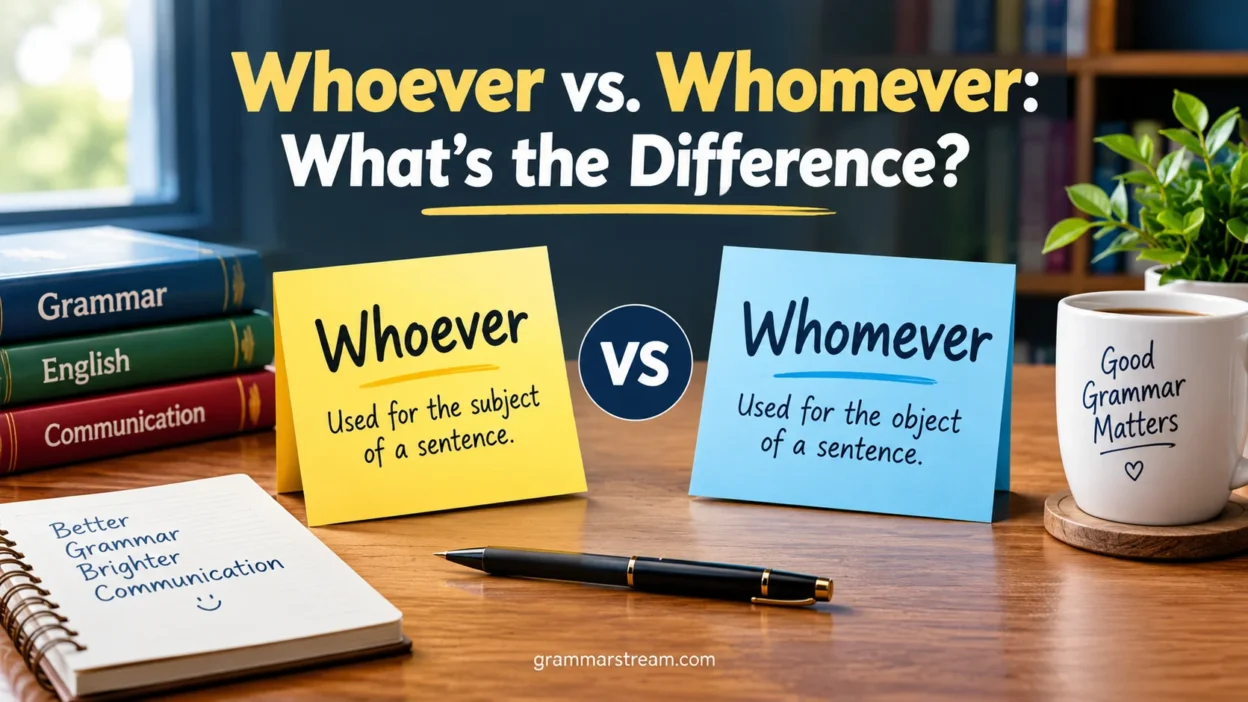
The answer comes down to grammar. Whoever functions as the subject of its own clause, while whomever functions as an object within its clause. The difference becomes much easier to understand when you identify who performs the action and who receives it.
For example, consider these two sentences: “Whoever arrives first gets the best seat” and “Invite whomever you trust.” The first sentence uses whoever because the person arrives. The second uses whomever because the person receives the invitation.
Although the distinction sounds simple, longer sentences can make the choice less obvious. A word might follow a preposition in the main sentence while serving as the subject of a verb in a smaller clause. Understanding that difference will help you choose the right word with confidence.
Quick Answer:
Whoever refers to a person who performs an action or serves as the subject of a clause. Whomever refers to a person who receives an action or serves as the object of a verb or preposition.
Here is the simplest way to remember the difference:
- Whoever = he or she. Use it when the pronoun functions as a subject.
- Whomever = him or her. Use it when the pronoun functions as an object.
Consider these examples:
- Whoever finishes the assignment first can leave early.
- You may invite whomever you want.
- Give the package to whoever answers the door.
- The manager will interview whomever the committee recommends.
The third example deserves special attention. Although whoever follows the preposition to, it serves as the subject of the verb answers. That internal role makes whoever correct in traditional standard grammar.
The main rule is straightforward: Look at the grammatical role of the pronoun inside its own clause rather than relying only on its position in the full sentence.
Comparison Overview: Whoever vs. Whomever
Although whoever and whomever refer to people, they serve different grammatical functions. Understanding their differences helps you avoid mistakes in conversations, emails, academic writing, and professional documents.
| Feature | Whoever | Whomever |
| Meaning | Any person who | Any person whom |
| Grammatical role | Subject within its clause | Object within its clause |
| Related pronoun | Who | Whom |
| Subject example | Whoever calls first wins. | Not appropriate as the subject here |
| Object example | Not appropriate as the direct object in formal grammar | Choose whomever you prefer. |
| After a preposition | Correct when the pronoun is the subject of its clause | Correct when the pronoun is the object of its clause |
| Everyday usage | Very common | Less common |
| Formal writing | Correct when used as a subject | Correct when used as an object |
| Memory trick | He or she | Him or her |
One important detail makes this comparison easier to apply: the entire clause can serve one purpose in a sentence while the pronoun inside it serves another.
For example, in “Give the award to whoever wins,” the entire clause whoever wins follows the preposition to. However, whoever is the subject of wins. You should therefore use whoever, not whomever.
Read More: What Is a Bop Girl? Slang Meaning, and Examples
Main Differences Between Whoever and Whomever
Whoever Functions as a Subject
The word whoever acts as a subject when it identifies the person performing an action or experiencing a state. A subject usually answers the question who? or what? in relation to the verb.
For example:
- Whoever arrives first can choose a seat.
- Whoever broke the window should report it.
- Whoever understands the instructions can help the others.
- Whoever is responsible must explain what happened.
In each sentence, whoever identifies the person performing the action or occupying the subject position. The verbs arrives, broke, understands, and is connect directly to that subject.
You can often check the grammar by replacing the word with he or she. If the replacement makes sense within the clause, whoever is generally the correct choice.
For instance, “Whoever arrives first can choose a seat” can be tested with “He arrives first.” Since he works as the subject of arrives, whoever fits the sentence.
However, the word does not have to appear at the beginning of a sentence to function as a subject. Its grammatical role depends on the clause, not its position on the page.
Consider this example:
“Give the documents to whoever requests them.”
The word whoever appears after to, but it remains the subject of requests. The person makes the request rather than receiving it.
Whomever Functions as an Object
The word whomever functions as an object when it refers to the person receiving an action or serving as the object of a verb or preposition.
An object typically answers questions such as whom? or to whom? It does not perform the action expressed by the verb in the relevant clause.
Consider these examples:
- Invite whomever you trust.
- The company will hire whomever the director recommends.
- Give the prize to whomever you choose.
- The invitation is for whomever you wish to bring.
In the first sentence, the pronoun serves as the object of trust. Someone performs the action of trusting, and the person referred to by whomever receives that action.
The same pattern appears in the second sentence. The director recommends someone, and that person becomes the object of recommends. Therefore, whomever is the traditional formal choice.
Try the personal-pronoun test: “You trust him.” The word him works as an object, so whomever is appropriate.
Remember that whomever does not simply mean a person who receives a physical object. Someone can receive attention, advice, support, an invitation, or another action. The grammatical relationship determines the correct form.
The Role of the Clause Matters More Than Its Position
One of the biggest sources of confusion is the difference between a complete sentence and a clause inside that sentence.
A clause contains a subject and a verb. A larger sentence can contain several clauses, each with its own grammatical structure. The role of whoever or whomever depends on the clause in which it appears.
Compare these examples:
Example 1: “Whoever wins will receive the trophy.”
Here, whoever is the subject of wins. The entire clause whoever wins serves as the subject of the main verb will receive.
Example 2: “The trophy will go to whomever the judges select.”
Here, whomever is the object of select. The judges perform the action, and the selected person receives it.
Example 3: “Give the trophy to whoever wins.”
Although the pronoun follows to, it remains the subject of wins. The correct form is whoever.
These examples reveal an essential distinction: the grammatical function of the whole clause does not automatically determine the form of the pronoun inside it.
When a sentence feels confusing, isolate the clause containing the word. Then identify its subject and object. This simple step often resolves the problem immediately.
How to Choose Between Whoever and Whomever
You don’t need to memorize dozens of complicated grammar rules to choose correctly. Three practical steps will help you identify the right word in most situations.
Use the He/She or Him/Her Test
The personal-pronoun substitution test offers one of the easiest ways to distinguish whoever from whomever.
Replace the word with a personal pronoun that fits the clause:
- If he or she works, choose whoever.
- If him or her works, choose whomever.
For example:
“Whoever is ready can begin.”
Test it by saying, “He is ready.” The replacement works because he serves as the subject of is. Therefore, whoever is correct.
Now consider this sentence:
“Choose whomever you prefer.”
The relevant clause is you prefer him. The word him functions as the object of prefer, so whomever is correct in formal standard grammar.
Here is another comparison:
| Sentence | Pronoun test | Correct choice |
| Whoever called left a message. | He called. | Whoever |
| Contact whomever you know. | You know him. | Whomever |
| Give the keys to whoever answers. | He answers. | Whoever |
| The panel will select whomever it considers qualified. | It considers him qualified. | Whomever |
Important: Apply the test to the clause containing the pronoun. Don’t replace the entire clause with he or him without checking how the verb works.
Find the Verb Inside the Clause
Another reliable method is to locate the verb and determine who performs its action.
Start by identifying the clause that contains whoever or whomever. Then ask whether the pronoun acts as the subject or object of that clause.
Consider these examples:
- Whoever broke the vase must tell the truth.
- The teacher will reward whomever she selects.
- Whoever finishes the project can submit it.
- We will hire whomever the manager recommends.
In the first sentence, whoever performs the action of breaking. In the second, she performs the action of selecting, so whomever receives it.
The third sentence follows the same subject pattern as the first. The fourth follows the same object pattern as the second.
This method becomes especially useful in long sentences. Instead of analyzing every word at once, focus on the small clause where the pronoun appears.
Check Whether the Pronoun Follows a Preposition
Prepositions such as to, with, for, and by can make these words confusing. Traditional grammar uses whomever when the pronoun itself is the object of a preposition.
For example:
- Give the documents to whomever you choose.
- The invitation is for whomever you select.
- The decision rests with whomever the board appoints.
In each example, whomever serves as the object of the verb inside the clause as well as participating in a larger phrase.
However, a preposition does not automatically require whomever when a full clause follows it.
Consider these sentences:
- Speak to whoever handles customer service.
- Work with whoever understands the assignment.
- Give the parcel to whoever answers the door.
In the first sentence, whoever is the subject of handles. In the second, it is the subject of understands. In the third, it is the subject of answers.
The prepositions introduce the clauses, but they do not change the grammatical role of whoever inside those clauses.
A useful rule to remember is this: Don’t choose whomever merely because the word follows a preposition. Check the clause first.
Whoever vs. Whomever in Complex Sentences
Longer sentences often contain multiple verbs and clauses. When that happens, the grammatical role of the pronoun can be less obvious.
The following patterns show how to handle these situations.
Whoever or Whomever as the Subject of a Sentence
A clause beginning with whoever can act as the subject of an entire sentence. In these cases, the clause identifies the person responsible for the action described by the main verb.
Examples include:
- Whoever breaks the rules will face the consequences.
- Whoever arrives before noon can join the meeting.
- Whoever wins the election will take office after the required process.
- Whoever left the lights on should turn them off.
Notice that each sentence begins with a clause containing whoever. Within that clause, the pronoun serves as the subject of its own verb.
The whole clause then performs a separate role in the larger sentence. For example, whoever breaks the rules acts as the subject of will face.
This is why whoever remains correct even when the clause itself functions as a larger sentence element.
Whoever or Whomever as the Object of a Verb
A clause beginning with either word can also function as the object of a main verb. The important point is that the pronoun’s role inside the clause still determines its form.
Compare these sentences:
- We will help whoever needs assistance.
- The company will hire whomever the director recommends.
- She will support whoever deserves the opportunity.
- The school will interview whomever the committee nominates.
In the first sentence, the clause whoever needs assistance acts as the object of help. However, whoever is the subject of needs.
The third sentence follows the same pattern. Although the whole clause receives the action of support, whoever performs the action expressed by deserves.
By contrast, whomever functions as the object of recommends in the second sentence and nominates in the fourth.
This distinction is easy to overlook because the main verbs are help, hire, support, and interview. Yet those verbs don’t independently determine whether the pronoun inside the clause should be whoever or whomever.
FAQs:
Is Whoever or Whomever Grammatically Correct?
Both words are grammatically correct when you use them in the appropriate context. Whoever functions as a subject, while whomever functions as an object in traditional standard grammar.
For example, “Whoever calls first wins” uses whoever as the subject of calls. By contrast, “Choose whomever you trust” uses whomever as the object of trust.
The right choice depends on the structure of the clause, not on which word sounds more formal.
Is It Whoever or Whomever After “To”?
Either word can be correct after to, depending on the clause that follows.
Use whoever when the pronoun serves as the subject of that clause: “Give the keys to whoever answers the door.”
Use whomever when it functions as an object: “Give the keys to whomever you choose.”
The preposition alone doesn’t settle the question. You must examine the pronoun’s role inside the clause.
Can I Use Whoever Instead of Whomever?
In everyday American English, many speakers use whoever in places where traditional formal grammar calls for whomever. This usage is common in conversation and informal writing.
However, if you’re following traditional standard grammar in a formal document, distinguish between the subject and object forms. Use whoever for a subject and whomever for an object.
You can also rewrite a sentence to avoid the issue. For example, “Choose the person you trust” is a straightforward alternative to “Choose whomever you trust.”
Which Is More Common in American English: Whoever or Whomever?
Whoever is much more common in everyday American English. Speakers often avoid whomever because the distinction between who and whom can sound formal or unnatural in casual conversation.
Nevertheless, whomever remains useful in formal writing when the pronoun functions as an object. Both words remain part of standard English.
How Can I Remember the Difference Between Whoever and Whomever?
Use the personal-pronoun test:
- If he or she fits the clause, choose whoever.
- If him or her fits the clause, choose whomever.
For example, “Whoever answers can help” becomes “He answers.” The subject form fits.
In “Invite whomever you prefer,” the clause becomes “You prefer him.” The object form fits.
Remember to apply this test to the clause containing the pronoun, especially when the sentence includes a preposition or multiple verbs.
Conclusion:
The difference between whoever and whomever comes down to grammatical function. Use whoever when the pronoun serves as the subject of its clause. Use whomever when it serves as an object in traditional standard grammar. The easiest way to check your choice is to substitute he or she for whoever and him or her for whomever. If the replacement fits the clause, you’ve probably found the correct form.