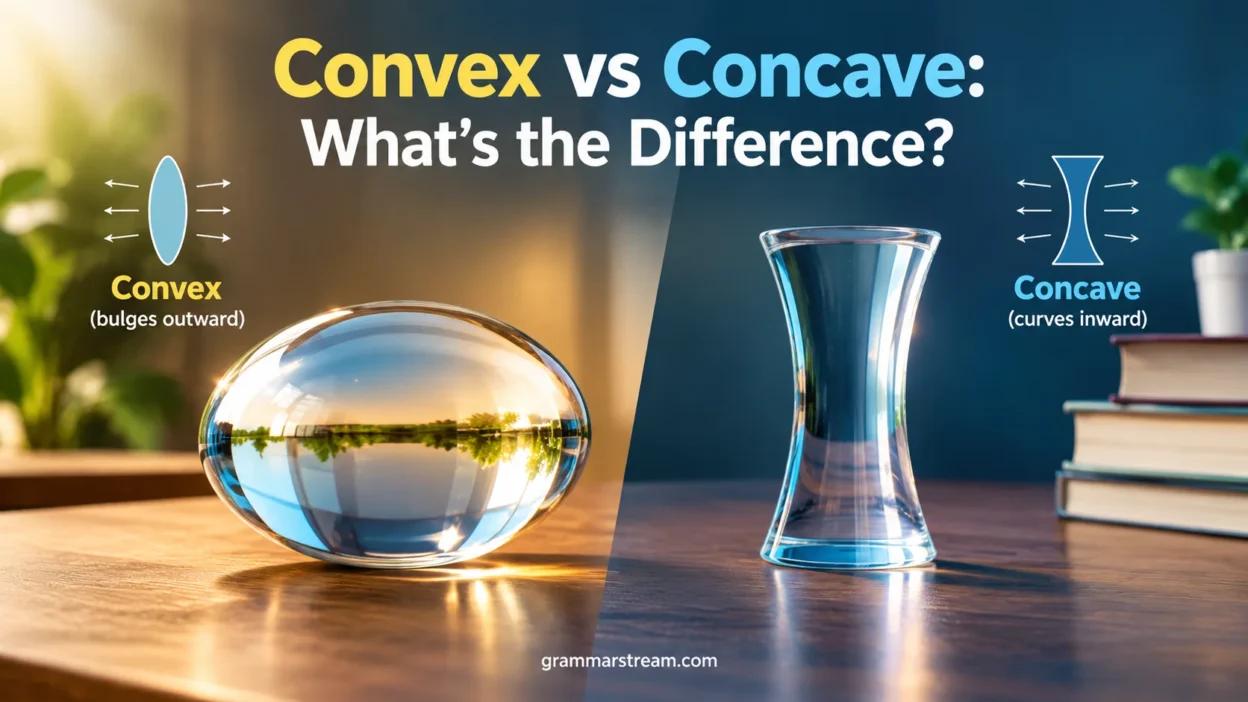
Have you ever looked at a spoon and wondered why its two sides have different shapes? One side bulges outward while the other curves inward. These simple curves illustrate the difference between convex vs concave, two terms used in geometry, science, optics, and everyday life.
Although convex and concave may sound like complicated scientific words, their basic meanings are easy to understand. A convex shape generally bulges outward, while a concave shape curves inward or forms a hollow. You can see these shapes in bowls, mirrors, lenses, buildings, and many other objects around you.
However, the difference goes beyond appearance. In geometry, convex and concave shapes follow specific mathematical rules. In optics, convex and concave lenses affect light differently, and curved mirrors produce different types of images depending on their surfaces.
Quick Answer
Convex describes a shape or surface that bulges outward. Concave describes a shape or surface that curves inward or forms a hollow.
For example, the outside of a spoon is convex, while its hollow inside is concave. In geometry, a convex polygon has no inward indentation, whereas a concave polygon has at least one inward indentation.
The terms also describe lenses and mirrors, but their effects on light depend on whether the object refracts or reflects light.
Comparison Overview
| Feature | Convex | Concave |
| Basic meaning | Bulging outward | Curving inward |
| Appearance | Rounded or outward-curving | Hollow or inward-curving |
| Spoon example | Outer surface | Hollow inner surface |
| Geometry | No inward indentation in a convex polygon | Has an inward indentation in a concave polygon |
| Typical lens shape | Thicker in the middle | Thinner in the middle |
| Lens effect on parallel light | Converges light | Diverges light |
| Mirror surface | Reflecting surface bulges outward | Reflecting surface curves inward |
| Mirror effect on parallel light | Diverges reflected rays | Converges reflected rays |
| Common application | Vehicle side mirrors | Makeup mirrors and reflecting telescopes |
The table summarizes the usual differences, but context matters. For example, a convex lens converges parallel light rays, while a convex mirror diverges reflected rays. The same shape term doesn’t mean both optical devices behave identically.
Main Differences Between Convex and Concave
The easiest way to distinguish convex vs concave is to look at the direction of the curve. A convex shape bulges outward, whereas a concave shape curves inward. Once you understand this basic idea, you can apply it to geometry, lenses, mirrors, and familiar objects.
Shape and Curvature
A convex surface usually looks rounded outward, similar to the outside of a ball. A concave surface looks hollow or indented, like the inside of a bowl.
Imagine running your finger along both sides of a spoon. The back rises outward, while the bowl-shaped side dips inward. That contrast makes the difference easy to remember.
However, not every object with a curved outline is automatically convex or concave in every sense. Some objects have both types of surfaces, and mathematical definitions depend on the particular shape being examined.
Differences in Geometry
In geometry, convex and concave have precise meanings. These definitions help mathematicians classify shapes and determine their properties.
A convex polygon has no inward indentation. Every interior angle is less than 180 degrees, and a straight line joining any two points inside the polygon stays within its boundaries.
A concave polygon has at least one interior angle greater than 180 degrees. It contains an inward indentation, and a line segment connecting two points inside the polygon can pass outside its boundaries.
For example:
- A triangle is always convex.
- A square is convex.
- A regular pentagon is convex.
- An arrow-shaped polygon with an inward notch can be concave.
- A star-shaped outline may be concave if its boundary forms inward indentations.
These rules are particularly useful when identifying irregular polygons that don’t resemble familiar objects.
Read More: Arial vs Helvetica: Key Differences, and Examples
Differences in Lenses
Convex and concave lenses bend light through refraction, but they usually produce opposite effects on parallel light rays.
A convex lens is typically thicker in the middle than at the edges. It brings parallel rays together at a focal point after they pass through the lens.
A concave lens is typically thinner in the middle than at the edges. It spreads parallel rays apart, making them appear to come from a focal point on the same side as the incoming light.
The surrounding material matters, too. These familiar rules describe ordinary lenses used in air under normal optical conditions.
Differences in Mirrors
Mirrors work through reflection rather than refraction. Their curved reflecting surfaces determine how light rays behave after bouncing off them.
A concave mirror curves inward, like the inside of a polished spoon. It can bring parallel reflected rays together near a focal point.
A convex mirror bulges outward. It spreads parallel reflected rays apart and provides a wider field of view than a comparable flat mirror.
These differences explain why concave mirrors appear in some telescopes and makeup mirrors, while convex mirrors are common in vehicle side mirrors and security systems.
What Does Convex Mean?
The word convex describes a surface or shape that curves or bulges outward. You can use it to discuss everyday objects, mathematical figures, and optical devices.
In simple terms, a convex shape usually has an outward-facing curve rather than an inward hollow. A rounded hill, the outside of a spoon, and a typical convex lens illustrate this general idea.
However, the exact definition depends on the subject. Geometry uses a formal mathematical test, while everyday descriptions focus more on a shape’s visible appearance.
Definition of Convex
In everyday language, convex means curving outward. A convex surface rises outward rather than dipping inward.
In mathematics, a set is convex when the straight line segment connecting any two points within the set lies entirely inside it. This definition applies to many shapes, including circles, triangles, rectangles, and three-dimensional solids such as cubes and spheres.
For example, choose any two points inside a solid ball. The straight line connecting them remains inside the ball. That makes the ball a convex solid.
A convex shape doesn’t need to be circular or perfectly rounded. A square is just as convex as a circle because it satisfies the mathematical rule.
Examples of Convex Shapes in Everyday Life
Convex shapes appear in many ordinary objects. Some examples are easy to recognize because their surfaces bulge outward.
- Outside of a spoon: The back of the spoon curves outward.
- Ball: Its outer surface bulges in every direction.
- Vehicle side mirror: The reflecting surface curves outward to show a wider area.
- Magnifying glass: A common convex lens has a thicker center and thinner edges.
- Dome: A rounded dome often has a convex outer surface.
- Rounded mound: A hill or mound can have an outward-curving profile.
Remember that an object can contain both convex and concave surfaces. A spoon is a perfect example because its two sides curve in opposite directions.
What Is a Convex Shape in Geometry?
A convex shape has no inward indentation that violates the mathematical definition of convexity.
For a two-dimensional shape, select any two points inside its boundary. If the complete line segment between those points stays inside the shape, the shape is convex.
Consider a rectangle. No matter which two interior points you choose, the line connecting them remains inside the rectangle. The same rule works for triangles, circles, and regular polygons.
A convex polygon also has interior angles smaller than 180 degrees. For example, each interior angle of a square measures 90 degrees, while each interior angle of a regular hexagon measures 120 degrees.
This mathematical definition is more reliable than simply asking whether a shape looks rounded. A square has straight edges, yet it remains convex.
What Does Concave Mean?
The word concave describes a surface or shape that curves inward or contains a hollow. Think of a cave entrance, a bowl’s interior, or a shallow crater. Each has a region that dips inward rather than bulging outward.
Concave shapes also appear in geometry, where an inward indentation can change the shape’s angles and the behavior of line segments drawn through it.
In optics, the term describes lenses and mirrors with particular curved surfaces. Their shapes influence how light rays refract or reflect.
Definition of Concave
In everyday language, concave means curving inward. A concave surface forms a hollow or depression instead of an outward bulge.
A bowl provides a familiar example. Its inside curves inward to hold food or liquid, making the inner surface concave. The outer surface may be convex at the same time.
In geometry, a polygon is concave when at least one interior angle exceeds 180 degrees. This inward indentation means that some line segments connecting points inside the polygon may leave the shape’s boundaries.
The term doesn’t necessarily describe an entire object as hollow. It can refer to one surface or to the mathematical structure of a two-dimensional figure.
Examples of Concave Shapes in Everyday Life
Concave shapes serve practical purposes in homes, vehicles, laboratories, and optical equipment.
- Inside of a spoon: The bowl-shaped surface curves inward.
- Bowl: Its inner surface forms a hollow that holds food.
- Crater: A crater dips below the surrounding surface.
- Concave lens: A common concave lens is thinner at its center than at its edges.
- Makeup mirror: A concave mirror can magnify a face when it is positioned within the mirror’s focal length.
- Reflecting telescope: A concave primary mirror gathers and focuses incoming light.
These examples show that concavity can be useful rather than merely decorative. An inward curve may collect light, hold liquid, or create a magnified image.
What Is a Concave Shape in Geometry?
A concave polygon has at least one inward indentation. That feature distinguishes it from a convex polygon.
One reliable test is to examine its interior angles. If at least one interior angle exceeds 180 degrees, the polygon is concave.
Imagine drawing an arrow-shaped polygon with a notch between its tail and tip. Some of its interior angles may be smaller than 180 degrees, but the angle at the inward notch exceeds 180 degrees. That makes the polygon concave.
Another test involves straight lines. Draw a line segment between two points inside the polygon. If part of that segment travels outside the polygon, the shape is concave.
These tests work even when a shape looks unusual or has several straight edges. You don’t need a curved boundary for a polygon to be concave.
Convex vs Concave Lenses
Lenses are transparent optical components that refract light. Their curved surfaces change the direction of light rays, allowing them to focus light, spread it apart, or form images.
Convex and concave lenses have different shapes and typical optical effects. Understanding these differences helps explain how glasses, cameras, magnifying glasses, and other optical instruments work.
What Is a Convex Lens?
A convex lens is typically thicker in the middle than at the edges. It is also called a converging lens because it brings parallel incoming light rays together at a focal point after refraction.
A magnifying glass is a familiar example. When you hold it over a small object at the correct distance, the object appears larger and upright.
Convex lenses also play important roles in cameras, microscopes, telescopes, projectors, and other optical devices. Designers use them to focus light and create images.
The image a convex lens produces depends on the object’s distance from the lens. If a real object sits beyond the focal length of a simple converging lens, the lens generally produces a real, inverted image. If the object sits closer to the lens than its focal length, the lens produces a virtual, upright, magnified image.
This explains why a magnifying glass can enlarge printed letters without projecting an inverted image onto a screen.
What Is a Concave Lens?
A concave lens is typically thinner in the middle than at the edges. It is known as a diverging lens because it spreads parallel incoming light rays apart.
After passing through a concave lens, the rays diverge as though they originated from a virtual focal point on the incoming-light side of the lens.
Concave lenses are used in eyeglasses to help correct nearsightedness, also called myopia. In a nearsighted eye, light from distant objects focuses in front of the retina. A suitable diverging lens helps move the focus back toward the retina.
These lenses also appear in optical instruments, often alongside convex lenses. Combining different lens types helps designers control focus, image size, and optical distortions.
For a simple concave lens viewing a real object, the image is generally virtual, upright, and smaller than the object. It cannot be projected onto a screen because the light rays don’t actually meet at the image location.
FAQs:
What Is the Main Difference Between Convex and Concave?
The main difference is the direction of the curve. A convex surface bulges outward, while a concave surface curves inward or forms a hollow. In geometry, convex shapes contain every line segment connecting two points within the shape, while concave polygons fail this test for at least one pair of interior points.
Is a Spoon Convex or Concave?
A spoon has both a convex and a concave surface. Its rounded outer side is convex, while its hollow inner side is concave. This makes a spoon one of the easiest everyday examples for remembering the difference.
Which Lens Is Thicker in the Middle, Convex or Concave?
A typical convex lens is thicker in the middle than at the edges. A typical concave lens is thinner in the middle and thicker near the edges. Convex lenses usually converge parallel light rays, while concave lenses diverge them.
Which Mirror Gives a Wider Field of View?
A convex mirror generally provides a wider field of view than a comparable flat mirror. It forms upright, reduced images, allowing more of the surrounding area to fit into the reflection. This makes convex mirrors useful for vehicle side mirrors, security systems, and blind corners.
How Can You Tell Whether a Shape Is Convex or Concave?
Start by examining the shape’s outline or surface. An outward bulge usually indicates convexity, while an inward hollow suggests concavity. For a polygon, use the mathematical tests: a concave polygon has at least one interior angle greater than 180 degrees, and a line segment connecting certain interior points can extend outside the polygon.
Conclusion:
Understanding convex vs concave becomes much easier when you focus on the direction of the curve. Convex shapes bulge outward, while concave shapes curve inward or form a hollow. The difference appears in everyday objects, mathematical figures, lenses, and mirrors. In geometry, convexity depends on whether line segments between points remain inside a shape. In optics, lenses refract light and mirrors reflect it, so their effects depend on both the surface shape and the type of optical device.