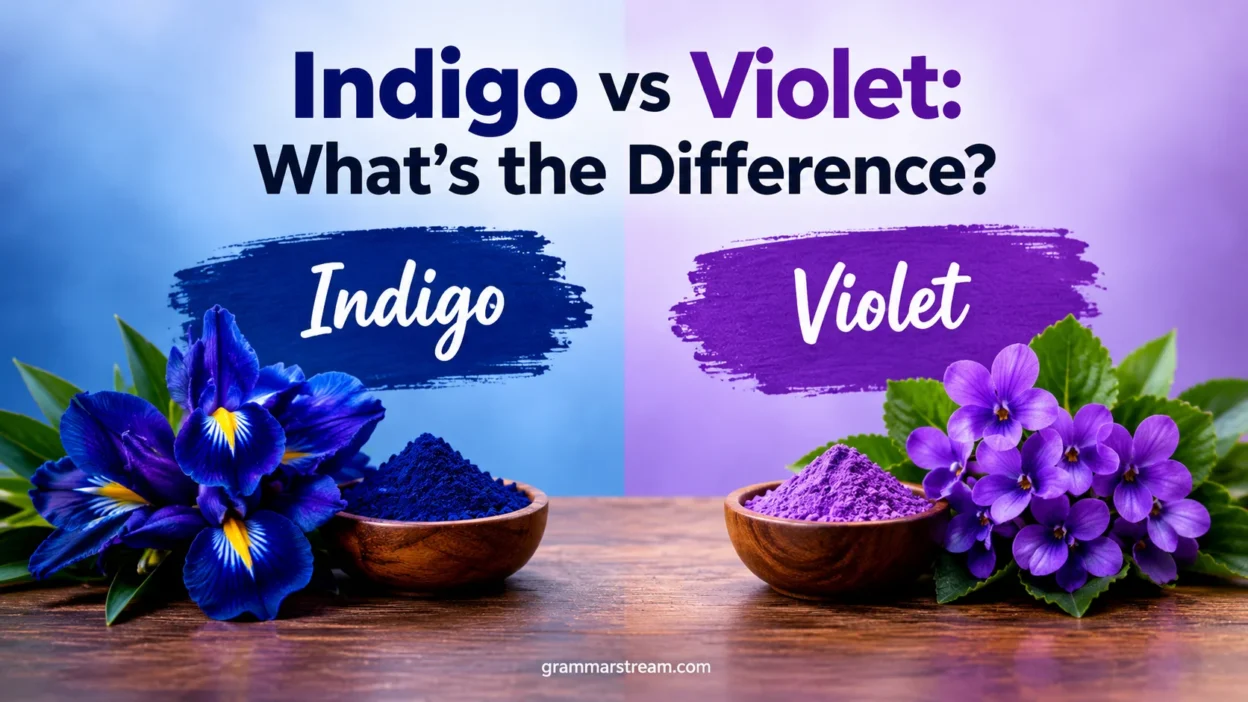
Indigo vs Violet compares two colors that may look close, but their identities, wavelengths, visual appearance, and everyday usage are different. Indigo is commonly described as a deep blue-violet color, while violet appears closer to the short-wavelength end of the visible light spectrum.
In a rainbow, the spectrum changes gradually between different colors, which can create confusion when people use these names interchangeably. This difference is useful in science, art, design, and academic writing, where accurate usage, classification, and context improve clarity and communication.
A simple guide is to consider both the term being used and how the color appears visually in nature.The Violet vs Indigo vs Purple comparison becomes more detailed when viewed through color theory and human color perception. Violet is a true spectral color associated with the visible light spectrum, while purple is a non-spectral color that can result from the perception or mixing of red light and blue light.
Quick Answer
Indigo is generally darker and bluer, while violet is generally closer to the short-wavelength end of visible light and often appears more purple.
In the traditional rainbow sequence, the order is:
Red → Orange → Yellow → Green → Blue → Indigo → Violet
Indigo therefore appears between blue and violet in the familiar ROYGBIV mnemonic.
However, modern explanations of visible light often focus on six broad color names rather than treating indigo as a sharply separate spectral band. The Physics Classroom notes that indigo isn’t actually observed as a distinct band in the spectrum and is traditionally included in the ROYGBIV naming system.
Here is the simplest way to tell them apart:
- Indigo: deep, blue-heavy, blue-violet
- Violet: shorter-wavelength spectral color, often perceived as more purple
- Indigo: commonly associated with denim and traditional indigo dye
- Violet: commonly associated with violet flowers and the short-wavelength end of the visible spectrum
- Indigo: doesn’t have one universally accepted wavelength range
- Violet: is commonly assigned an approximate range around 380–450 nm, depending on the classification
So, if two shades are sitting beside each other and one looks noticeably bluer and deeper, it will usually be called indigo. If the other looks more violet or purple, it will usually be called violet.
Comparison Overview
| Feature | Indigo | Violet |
| General appearance | Deep blue-violet | Blue-purple or violet |
| Traditional rainbow position | Between blue and violet | End of the visible spectrum |
| Relationship to blue | More strongly blue | Less blue-looking |
| Relationship to purple | Often appears bluer | Often appears more purple |
| Spectral status | Traditional color label with fuzzy boundaries | Spectral color |
| Approximate wavelength | No universally fixed range | About 380–450 nm in NASA’s classification |
| Common natural example | Indigo plant dye | Violet flowers |
| Common manufactured example | Denim | Violet pigments and dyes |
| Digital color | Depends on chosen RGB/hex definition | Depends on chosen RGB/hex definition |
| Scientific distinction | Mainly a naming convention in spectrum descriptions | Corresponds to the short-wavelength region of visible light |
| Main source of confusion | Very close to violet | Very close to indigo and purple |
The most important point is that color names don’t always have hard scientific borders. The CIE explains that perceived color depends on the spectral distribution of the stimulus, the surrounding area, adaptation of the observer, and other viewing conditions.
Main Differences Between Indigo vs Violet
The difference between indigo and violet becomes much easier to understand once you separate physical light from the names people give to colors.
Indigo Is Generally Bluer
Indigo usually has a strong blue character. Think about a very deep blue that starts drifting toward violet. That’s the basic visual territory of indigo.
A classic example is indigo denim. Blue jeans don’t normally look like bright royal blue. Their darker blue appearance often falls into the broad visual territory associated with indigo.
Violet usually pushes farther away from ordinary blue. It can look more purple, especially when the shade is saturated.
That doesn’t mean every indigo shade must look darker than every violet shade. Brightness depends on the particular color, lighting conditions, pigment, or digital representation.
Violet Sits at the Short-Wavelength End
Violet occupies the short-wavelength side of visible light.
NASA describes visible light as a portion of the electromagnetic spectrum that humans can see. Its commonly cited range is roughly 380–700 nm, with violet around 380 nm at the shortest-wavelength end and red around 700 nm at the longest.
A separate NASA educational table places violet at approximately 380–450 nm.
That doesn’t mean every violet-looking object emits light at exactly those wavelengths. A physical object can appear violet because of a mixture of reflected or emitted wavelengths.
Indigo Doesn’t Have One Universal Wavelength Range
This is one of the most important differences.
People sometimes see a rainbow chart and assume that every named color has an exact wavelength boundary. Real light doesn’t behave that neatly.
The visible spectrum changes continuously as wavelength changes. The color names are human descriptions placed on that continuum.
That’s why one source might show indigo between blue and violet while another scientific chart leaves it out entirely. The Physics Classroom explicitly explains that indigo isn’t actually observed as a distinct band in the spectrum even though it appears in the traditional ROYGBIV mnemonic.
Violet Is a Spectral Color
Violet has a clearer physical meaning in the context of visible light.
Light around the short-wavelength end of human vision produces a violet appearance. As wavelength becomes shorter than visible violet, the radiation moves into the ultraviolet region, which human eyes can’t see.
This is why violet occupies an interesting boundary in the electromagnetic spectrum. It is visible, while the neighboring ultraviolet region isn’t visible to ordinary human vision.
Indigo Often Looks Darker
In everyday color descriptions, indigo commonly appears darker than violet.
But “darker” isn’t a scientific definition of indigo. It’s a common visual characteristic.
Brightness and lightness can change dramatically depending on the material and viewing conditions. A bright digital indigo can look lighter than a dark violet fabric.
So it’s better to use blue-heavy versus violet-heavy as the primary visual distinction rather than relying only on darkness.
Violet Often Looks More Purple
Violet frequently has a stronger purple impression than indigo.
This can create another source of confusion because violet and purple are related but aren’t identical concepts.
Violet occurs within the visible spectrum as a spectral color. Purple, in the technical color-science sense, isn’t represented by a single wavelength in the spectrum. The CIE describes purple stimuli using the region between the ends of the spectral locus rather than treating purple as a single spectral wavelength.
That distinction sounds technical, but the practical lesson is simple: not every purple-looking color comes from one wavelength of light.
What Is Indigo?
Indigo is a deep color that sits visually between blue and violet.
The name has a long association with indigo dye, which has been used to color textiles. Today, the word commonly describes a dark blue-violet shade in fashion, art, graphic design, and color systems.
Indigo is also part of the familiar ROYGBIV sequence:
Red → Orange → Yellow → Green → Blue → Indigo → Violet
However, the inclusion of indigo in that sequence can create a misleading impression. The spectrum doesn’t contain a neat stripe labeled “indigo.”
Instead, wavelengths change continuously. Human observers then divide that continuous range into familiar color categories.
Indigo in the Visible Spectrum
Traditional diagrams place indigo between blue and violet.
That position makes sense as a descriptive label. As you move from longer wavelengths toward shorter wavelengths, visible colors transition from blue toward violet.
The problem appears when the traditional labels are treated as exact scientific boundaries.
There is no universally accepted point where blue suddenly becomes indigo. There is also no universal wavelength at which indigo suddenly becomes violet.
The Physics Classroom makes this point particularly clearly by noting that indigo is traditionally included in ROYGBIV even though it isn’t actually observed as a distinct band in the spectrum.
Indigo in Everyday Life
Indigo is especially recognizable in materials rather than isolated light.
Common examples include:
- Indigo denim
- Indigo-dyed fabrics
- Dark blue-violet clothing
- Textile dyes
- Paint and illustration colors
- Graphic design palettes
- Decorative color schemes
Denim provides an easy mental picture. When someone says “indigo,” many people imagine a deep, slightly violet blue rather than a bright blue or purple.
What Is Violet?
Violet is the visible color associated with the shortest wavelengths humans can normally see.
NASA identifies violet at roughly 380 nm at the short-wavelength edge of visible light. Another NASA educational table gives violet a broader approximate range of 380–450 nm.
The exact boundary depends on the classification system. Human color perception doesn’t operate like a ruler with perfectly marked intervals.
Read More: Simpler or More Simple: Which Is Correct?
Violet in the Visible Spectrum
When white sunlight passes through a prism, different wavelengths separate according to their physical properties. The result is a spectrum containing the familiar progression from red through violet.
NASA describes red as having the longest wavelengths in the visible spectrum and violet as having the shortest.
This is why violet sits on the opposite side of the visible spectrum from red.
Beyond violet lies ultraviolet radiation. The ultraviolet region has shorter wavelengths than visible violet and cannot be seen by the human eye.
Violet in Everyday Life
You can encounter violet in many places:
- Violet flowers
- Violet-colored fabrics
- Art pigments
- Cosmetics
- Decorative lighting
- Digital graphics
- Color photography
- Some natural minerals
A violet flower doesn’t necessarily produce one pure wavelength of violet light. Its pigments absorb some wavelengths and reflect others toward your eyes.
That’s an important distinction.
Indigo vs Violet in the Rainbow
The traditional rainbow sequence puts indigo immediately before violet.
The sequence is:
Red → Orange → Yellow → Green → Blue → Indigo → Violet
This sequence is useful for learning the broad order of visible colors. Yet it shouldn’t be interpreted as seven perfectly separated physical bands.
Where Does Indigo Appear?
In traditional ROYGBIV diagrams, indigo comes after blue and before violet.
That makes indigo the bridge between the two visually.
As the color moves from blue toward violet, the hue becomes increasingly violet-looking. The word “indigo” gives people a convenient name for part of that transition.
Where Does Violet Appear?
Violet appears at the short-wavelength end of the traditional visible spectrum.
NASA’s educational material places violet at about 380–450 nm, while its broader visible-light explanation identifies violet near 380 nm and red near 700 nm.
Does Every Rainbow Clearly Show Indigo?
Not necessarily.
A rainbow is produced by a continuous range of wavelengths. Human observers then perceive that range as different colors.
The boundaries between named colors can be subtle. Lighting conditions, atmospheric conditions, contrast, and individual perception can affect how clearly a person sees different portions of a rainbow.
So a rainbow doesn’t contain seven separate painted stripes.
It contains a continuous spectrum.
The labels are useful descriptions of that spectrum.
Indigo vs Violet Wavelength
Wavelength is where the scientific comparison becomes more precise.
A wavelength measures the distance between corresponding points on a wave. Visible light occupies a tiny part of the electromagnetic spectrum.
NASA gives the typical visible-light range as approximately 380–700 nm.
Violet Wavelength
NASA’s wavelength table gives violet a range of approximately:
380–450 nm
The same table places blue at approximately 450–495 nm.
These values are useful for education, but they aren’t universal color boundaries.
Different references may use slightly different limits because visible color categories don’t have perfectly fixed edges.
Indigo Wavelength
Indigo is harder to assign a precise wavelength range.
That’s because indigo is primarily a color-name category rather than a universally standardized spectral interval.
Some traditional charts assign indigo a narrow region between blue and violet. Other scientific presentations don’t list indigo separately.
That difference doesn’t mean one chart is automatically wrong. It reflects the fact that the visible spectrum is continuous while color names are categorical.
Why Wavelength Ranges Vary
There are several reasons:
- The spectrum has no natural hard boundaries between named colors.
- Human color perception involves the eye and brain.
- Color names differ between classification systems.
- A color can result from one wavelength or multiple wavelengths.
- The appearance of a surface also depends on lighting and surrounding colors.
The CIE specifically notes that perceived color depends on the spectral distribution of the stimulus and viewing conditions.
Indigo vs Violet and Light Energy
The wavelength difference also affects energy.
For electromagnetic radiation, shorter wavelength corresponds to higher frequency, and higher frequency means greater energy per photon.
This relationship is expressed by:
E = hf
where E is photon energy, h is Planck’s constant, and f is frequency.
Because wavelength and frequency are inversely related, shorter wavelengths carry more energy per photon.
Which Has More Energy?
Violet occupies shorter wavelengths than blue and red within the visible spectrum.
So violet light has higher photon energy than longer-wavelength visible light.
The situation is less straightforward when someone asks whether “indigo” has a specific energy. Since indigo doesn’t have one universally fixed wavelength range, there isn’t one single energy value that represents every color called indigo.
The Physics Classroom likewise identifies violet as having the highest frequency among the traditional visible-spectrum colors.
Why Shorter Wavelength Means Higher Energy
Imagine waves packed closer together.
A shorter wavelength means the distance from one wave peak to the next is smaller. At the same propagation speed in a vacuum, that means more cycles occur each second.
More cycles per second means higher frequency.
Higher frequency means more energy per photon.
That is why the short-wavelength end of the visible spectrum connects naturally with the higher-energy side of visible light.
Indigo vs Violet in RGB and Digital Color
Digital screens introduce another layer of confusion.
A computer doesn’t need to produce one pure wavelength to make you perceive indigo or violet. Instead, a display uses combinations of red, green, and blue light to stimulate your visual system.
How Indigo Appears on Screens
There isn’t one universal digital value called “indigo.”
Different design systems may use different RGB or hexadecimal values while still labeling the color indigo.
That means two websites can display slightly different indigo shades.
Both may use the same name.
Neither necessarily represents a single wavelength of light.
How Violet Appears on Screens
Violet also has many digital representations.
A screen can create a violet appearance through a mixture of display primaries. The resulting color is perceived by your visual system rather than being a single monochromatic violet wavelength.
This is one reason a digital color picker shouldn’t be treated as a scientific wavelength chart.
FAQs:
Is indigo darker than violet?
Yes, indigo is generally described as a darker, deeper blue-violet color, while violet usually has a brighter and more bluish-purple appearance. However, the exact appearance can change depending on lighting, pigments, digital displays, and individual color perception.
Is violet a real color in the rainbow?
Yes. Violet is a spectral color found at the short-wavelength end of the visible spectrum. It has a shorter wavelength than blue and is traditionally shown as the final color in the familiar rainbow sequence.
What is the main difference between indigo and violet?
The main difference is their position and definition in color classification. Violet has a recognized place in the visible light spectrum, while indigo has a less clearly defined scientific range. Indigo is commonly understood as a deep blue-violet shade.
Are indigo and violet the same color?
No, they are not exactly the same color, although they can look similar. Indigo generally appears closer to deep blue, while violet is closer to the violet end of the visible spectrum. The distinction can become less obvious when colors are displayed digitally or represented with different pigments.
Why are indigo and violet sometimes confused?
They are often confused because the transition between blue, indigo, and violet is gradual rather than sharply divided. Different color systems, artistic traditions, displays, and cultural naming conventions can also use slightly different definitions for these shades.
Conclusion:
Indigo vs Violet describes two closely related but distinct color terms. Violet has a clearer scientific connection to the visible light spectrum, while indigo is commonly used to describe a deep blue-violet shade and has a more debated status as a separate spectral category. Understanding this difference makes it easier to use these colors accurately in science, art, design, fashion, and everyday language.
The easiest way to remember the distinction is that violet is associated with the short-wavelength end of visible light, while indigo is generally used for a darker color between blue and violet. Because color perception and color naming can vary, the exact boundary between these shades is not always absolute.