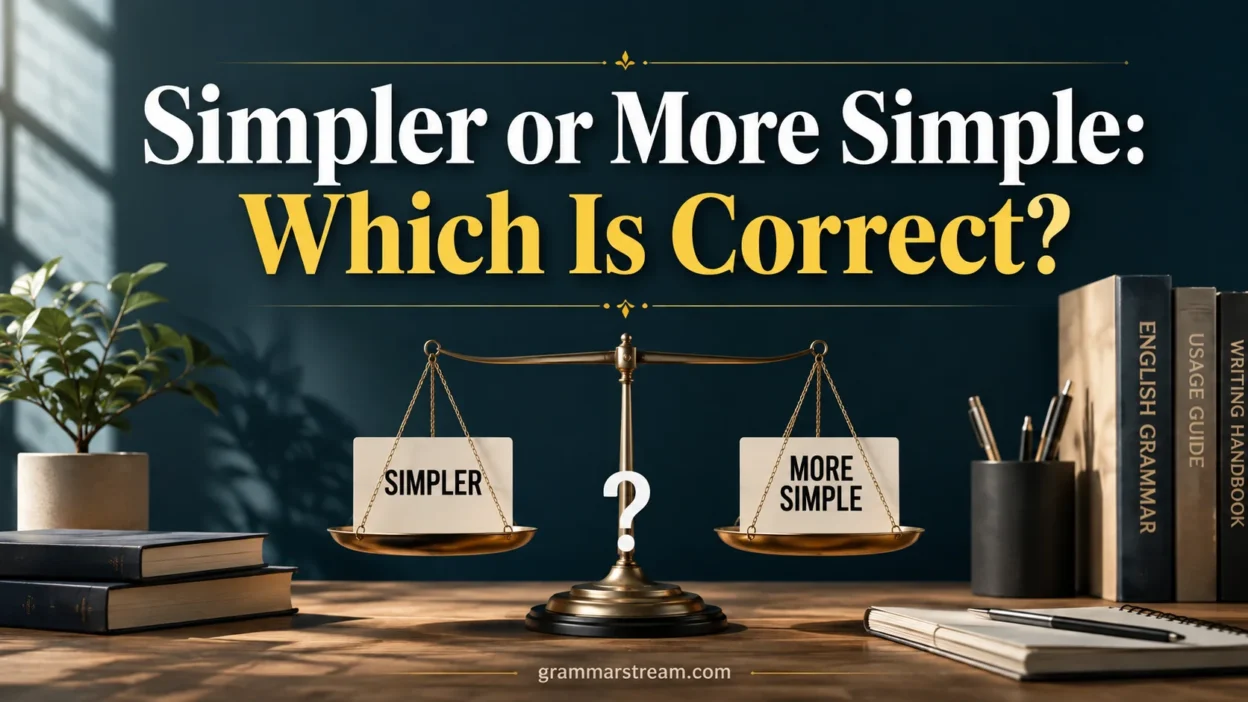
Simpler or More Simple can confuse English learners because both forms are technically correct, but one sounds more natural in everyday English usage and conversations. English learners who are learning the language may find this debate difficult, especially when English grammar shows both forms as technically correct rather than completely wrong.
Simpler is the preferred form in almost all situations because simple is a short adjective that normally uses the comparative form with -er, following standard English grammar rules. Native English speakers, including those who learned English as a first language, commonly use it in speaking and writing. It is the standard comparative form and a natural choice when you compare things or describe something with fewer complications.
For example, “This explanation is simpler than the old one” sounds completely natural in ordinary American English. Native speakers use simpler with explanations, methods, systems, designs, ideas, solutions, processes, and instructions, making it a reliable choice for language learners who want to sound fluent, clear, and natural in American English.
Quick Answer
Simpler is the usual comparative form of simple and is generally preferred in American English.
Use simpler when you want to say that one thing has fewer complications or is easier to understand, use, or manage than another.
“This method is simpler than the previous one.”
More simple can also occur in English. It isn’t automatically grammatically incorrect. However, it is less common in many ordinary sentences and can sound awkward when simpler would work naturally.
The basic forms are:
| Form | Example |
| Positive | simple |
| Comparative | simpler |
| Superlative | simplest |
You can also encounter more simple and most simple, particularly in specific stylistic or contextual situations. Still, simpler and simplest are normally the more natural choices.
One form should be avoided in careful standard English:
more simpler
This construction combines two comparative markers. Choose simpler or more simple, not both together.
Comparison Overview
| Feature | Simpler | More Simple |
| Grammatical use | Standard comparative form | Possible comparative construction |
| Everyday American English | Very common | Less common |
| Naturalness | Usually more natural | Can sound marked |
| Meaning | More simple or less complicated | More simple or less complicated |
| Best general choice | Yes | Usually not |
| Example | “This solution is simpler.” | “This solution is more simple.” |
The key difference isn’t usually meaning. Both forms can communicate a comparison involving simplicity.
The bigger difference is usage.
When English speakers compare two things with simple, simpler usually rolls off the tongue more easily. It also follows the familiar pattern used with many short adjectives.
For most writing, especially general-purpose American English, simpler is the form to reach for first.
Main Differences Between Simpler or More Simple
The distinction between simpler and more simple involves more than simply adding -er or more. The two constructions differ in frequency, rhythm, style, and naturalness.
Simpler Uses the -er Comparative Form
Simpler is formed by adding -er to simple.
The basic pattern is:
simple → simpler
For example:
“This explanation is simpler than the one in the textbook.”
Here, simpler compares two explanations. The newer explanation requires less effort to understand.
Other examples include:
- “The new design is simpler.”
- “Her instructions were simpler.”
- “This version is simpler than the original.”
- “We need a simpler way to solve the problem.”
- “The updated form makes the application process simpler.”
This construction feels natural because English commonly uses -er with many relatively short adjectives.
Compare:
- fast → faster
- small → smaller
- clean → cleaner
- bright → brighter
- simple → simpler
The pattern isn’t completely mechanical across all English adjectives. However, simple comfortably takes -er in standard usage.
More Simple Uses More Before the Adjective
More simple uses a different comparative structure:
more + simple
For example:
“The second explanation is more simple than the first.”
The construction communicates a comparative idea, but many American English speakers would naturally replace it with:
“The second explanation is simpler than the first.”
That preference matters because grammar isn’t only about whether a construction can be understood. Natural usage matters too.
A sentence can be technically possible while another version sounds much more idiomatic.
Simpler Is Usually the Natural Choice
If you’re unsure which form to use, simpler will usually be the safest choice.
For example:
“Which design is simpler?”
sounds more natural than:
“Which design is more simple?”
Likewise:
“The instructions are simpler now.”
sounds more natural in ordinary conversation than:
“The instructions are more simple now.”
The difference becomes especially noticeable when the sentence is short. In a longer sentence, more simple can occasionally fit a particular rhythm or contrast.
Is “Simpler” or “More Simple” Correct?
Both forms can occur in English, but they don’t have equal status in everyday usage.
Simpler is the established comparative form most writers and speakers use when comparing things according to simplicity.
For example:
“The new software has a simpler interface.”
Here, simpler directly compares the new interface with the previous one. It means the new interface has fewer complications or is easier to navigate.
More simple can also function as a comparative phrase:
“The process became more simple after unnecessary steps were removed.”
This sentence can be understood clearly. Yet many readers would still find simpler more natural:
“The process became simpler after unnecessary steps were removed.”
So the practical answer is straightforward: simpler is usually preferred, while more simple can be acceptable in certain contexts.
Why Is “Simpler” More Common?
English has several ways to create comparative adjectives. One common method uses -er, while another uses more.
Short adjectives often take -er:
- tall → taller
- quick → quicker
- bright → brighter
- small → smaller
Longer adjectives commonly use more:
- useful → more useful
- complicated → more complicated
- expensive → more expensive
- effective → more effective
The adjective simple sits in a useful middle area. It can naturally take -er, so simpler has become the normal comparative form.
The Comparative Form of “Simple”
The traditional comparative sequence is:
simple → simpler → simplest
Examples:
“This explanation is simple.”
“This explanation is simpler.”
“This is the simplest explanation.”
Each form serves a different grammatical purpose.
Simple describes one thing without making a comparison.
Simpler compares two or more possibilities.
Simplest identifies the thing with the greatest degree of simplicity within a relevant group.
For example:
“This method is simple.”
Then:
“This method is simpler than the old method.”
And finally:
“This is the simplest method available.”
That progression is clear and natural in American English.
Why English Sometimes Uses More + Adjective
English doesn’t have one universal rule that works perfectly for every adjective.
Some adjectives strongly prefer -er:
- easier
- faster
- smaller
- cleaner
Others strongly prefer more:
- more complicated
- more expensive
- more reliable
- more interesting
Some adjectives can appear with either structure depending on usage and context.
That’s why simply memorizing a single rule such as “short adjectives always use -er” can create problems. English contains many established patterns that developed through actual usage.
The important point for simple is that simpler is well established and highly natural.
Read More: RCS Meaning in Text: What Does RCS Mean in Texting?
Simpler vs. More Simple in American English
In American English, simpler is the form most readers will expect in ordinary comparisons.
You’ll commonly see it in:
- everyday conversation
- business writing
- educational material
- technical explanations
- product descriptions
- instructions
- general nonfiction
- professional communication
For example:
“The company introduced a simpler checkout process.”
The sentence sounds direct and polished.
Another example:
“Students need simpler explanations when they first encounter difficult concepts.”
Again, simpler fits naturally.
By contrast, more simple isn’t necessarily impossible. It simply isn’t the normal first choice in many comparable sentences.
Everyday American English Examples
Here are some natural examples:
“This recipe is simpler than the one we used last week.”
“Can you give me a simpler explanation?”
“The new controls are simpler to use.”
“Her instructions were much simpler.”
“We found a simpler way to organize the files.”
Notice how easily simpler fits into each sentence. Nothing feels forced.
That’s a strong clue when you’re deciding between the two forms.
Simpler vs. More Simple With Examples
Seeing the two constructions side by side makes the difference easier to understand.
Everyday Examples
| Less Natural Choice | More Natural Choice |
| “This way is more simple.” | “This way is simpler.” |
| “Give me a more simple answer.” | “Give me a simpler answer.” |
| “The new rule is more simple.” | “The new rule is simpler.” |
| “This recipe is more simple.” | “This recipe is simpler.” |
| “Her explanation was more simple.” | “Her explanation was simpler.” |
The left-hand examples aren’t necessarily impossible to interpret. However, the right-hand versions are generally more idiomatic.
Professional Examples
Professional writing also commonly favors simpler.
“The company developed a simpler process for handling customer requests.”
“The revised policy uses simpler language.”
“The new software offers a simpler way to manage invoices.”
“The team created a simpler reporting system.”
These sentences work because simpler efficiently communicates the comparison without adding unnecessary words.
Academic Examples
Academic writing frequently uses simpler when comparing models, explanations, assumptions, or methods.
“The researchers used a simpler model to explain the results.”
“This approach provides a simpler interpretation of the data.”
“The second theory offers a simpler explanation.”
However, academic writing can also contain more simple when a particular author or construction calls for it. Frequency and context matter more than an absolute prohibition.
When “More Simple” Can Be Correct
The phrase more simple deserves a little nuance.
It shouldn’t be treated as an outright grammatical error. English speakers and writers do use it.
One reason involves contrast.
Consider:
“The design is more simple than sophisticated.”
Here, the writer isn’t merely comparing two designs. The sentence contrasts simple with sophisticated.
Another possible context involves deliberate emphasis:
“The revised explanation is more simple and direct.”
A writer may choose this construction because it fits the rhythm or structure of the surrounding sentence.
Still, these examples don’t mean that more simple should replace simpler everywhere. In many sentences, simpler remains the more natural option.
A Useful Practical Test
Read the sentence aloud.
If simpler sounds smooth, use it.
For example:
“We need a simpler solution.”
There’s little reason to replace it with:
“We need a more simple solution.”
The second version adds a word without adding useful meaning.
When more simple provides a specific stylistic or grammatical benefit, it can make sense. Otherwise, simpler usually does the job better.
Can You Say “More Simpler”?
No. In careful standard English, more simpler should be avoided.
The problem is that both parts mark comparison:
- -er in simpler
- more in more simpler
Using both creates a double comparative.
Instead, choose one:
“This explanation is simpler.”
or:
“This explanation is more simple.”
Never combine them as:
“This explanation is more simpler.”
The same principle appears with other comparative forms.
You wouldn’t normally write:
- more faster
- more smaller
- more easier
- more cleaner
Instead, use:
- faster
- smaller
- easier
- cleaner
The same logic applies to simpler.
Simpler, Simplest, More Simple, and Most Simple
The comparative and superlative forms deserve separate attention because they’re often mixed up.
Comparative: Simpler
Use simpler when comparing two things or alternatives.
“This explanation is simpler than the first one.”
The comparison focuses on relative simplicity.
Comparative: More Simple
More simple can also express comparison.
“This explanation is more simple than the first one.”
Although grammatical in certain contexts, this version is less natural for many speakers than simpler.
Superlative: Simplest
Use simplest when identifying the greatest degree of simplicity within a group.
“This is the simplest solution.”
This is the standard and natural superlative form.
Superlative: Most Simple
Most simple can appear in English, particularly in formal, technical, or stylistically marked contexts.
However, simplest is normally the more natural choice.
Compare:
“This is the simplest explanation.”
with:
“This is the most simple explanation.”
The first sentence is the standard choice for ordinary American English.
Main Differences Between “Simpler” and “More Simple” in Context
The practical distinction becomes clearer when you look at real-world writing situations.
| Situation | Natural Choice | Example |
| Comparing two methods | Simpler | “Method B is simpler.” |
| Asking for easier wording | Simpler | “Can you make this simpler?” |
| Describing a design | Simpler | “The new design is simpler.” |
| Comparing explanations | Simpler | “Her explanation was simpler.” |
| Strong stylistic contrast | More simple may occur | “More simple than sophisticated.” |
| Ordinary US conversation | Simpler | “This is much simpler.” |
| General web writing | Simpler | “Here is a simpler way.” |
The pattern is consistent: simpler handles most ordinary comparisons naturally.
FAQs:
Is “simpler” or “more simple” correct?
Simpler is the usual and more natural comparative form of simple. More simple is also grammatically correct, but it is less common in everyday English.
Why is “simpler” more common than “more simple”?
Simpler follows the common pattern of forming comparatives with short adjectives by adding -er. Native speakers generally use it because it sounds more natural and direct.
Can I use “more simple” in formal writing?
Yes. More simple is not grammatically wrong, and it can be appropriate in certain contexts. However, simpler will usually sound more natural in most formal and everyday writing.
Is “simpler than” grammatically correct?
Yes. Simpler than is the standard comparative structure when comparing two things. For example, “This method is simpler than the previous method.”
Which should English learners use: “simpler” or “more simple”?
For most situations, simpler is the easier and more natural choice. Using simpler will help your writing and speaking sound clear and natural.
Conclusion:
Simpler is the preferred comparative form of simple in most situations. While more simple is grammatically correct, it appears less often and can sound less natural in everyday English. If you are unsure which form to choose, simpler is generally the natural option for speaking, writing, and formal communication.