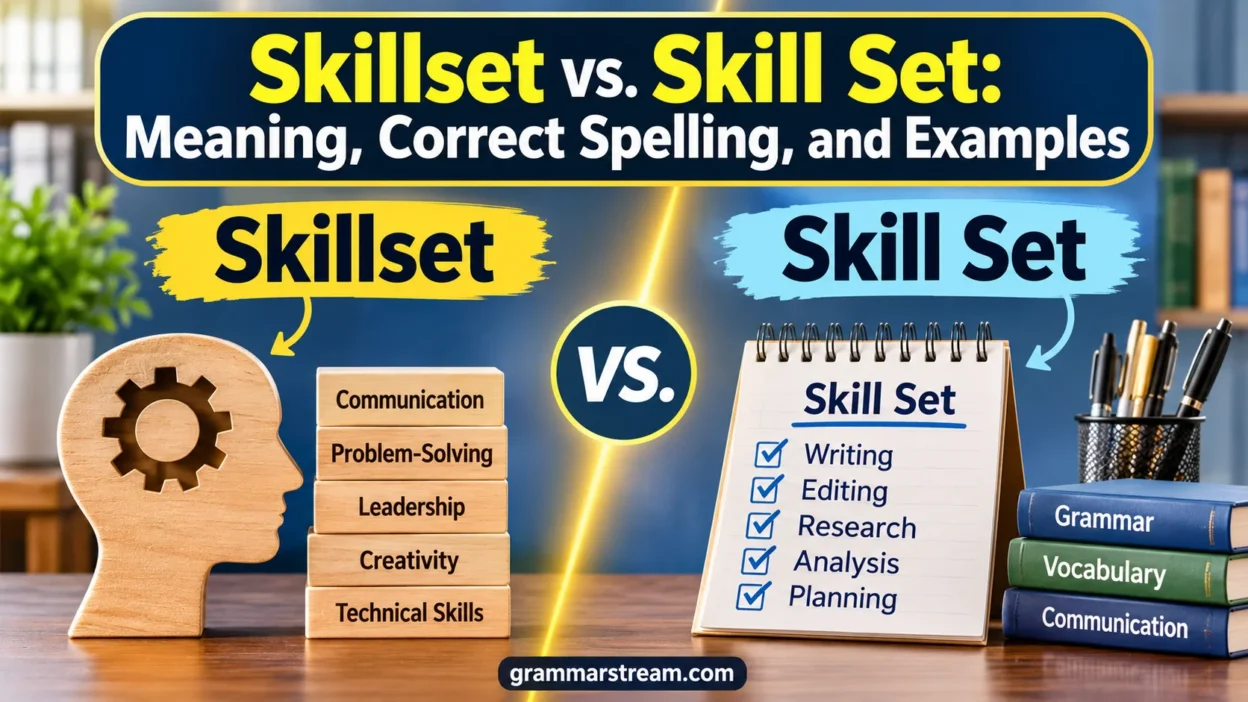
Have you ever wondered whether to write skillset as one word or skill set as two? You’re not alone. Both spellings appear in professional documents, job descriptions, business articles, and everyday conversations. This similarity often leaves writers unsure which version they should choose.
The good news is that both forms communicate the same basic idea: a combination of abilities, knowledge, and competencies that someone possesses. However, their spelling conventions and acceptance in formal writing aren’t exactly the same. Understanding this distinction can help you write more confidently.
The two-word spelling, skill set, remains the more established choice in standard English. Meanwhile, skillset has gained recognition as a closed compound in modern usage. Although readers generally understand both forms, choosing the appropriate version matters when writing resumes, academic papers, professional emails, or business documents.
Let’s explore their meanings, grammatical functions, spelling differences, and practical examples so you can use each form correctly.
Quick Answer
Skill set is the traditional and generally preferred spelling in standard English. It describes a collection of abilities, knowledge, and competencies that someone uses to complete tasks or perform a particular job.
Skillset is an alternative closed-compound spelling that carries the same meaning. Some writers, businesses, and publications use it, particularly in modern professional communication.
Here are two examples:
- Skill set: The position requires a diverse skill set in communication and project management.
- Skillset: The company wants employees with a strong technical skillset.
Both sentences communicate the same message. However, if you’re unsure which spelling to choose, use skill set in formal and professional writing.
Comparison Overview
The following table highlights the main differences between skillset and skill set.
| Feature | Skillset | Skill Set |
| Spelling | One word | Two words |
| Meaning | A collection of abilities | A collection of abilities |
| Word formation | Closed compound | Open compound |
| Part of speech | Noun | Noun |
| General acceptance | Used in modern English | Established standard form |
| Formal writing | Accepted in some contexts | Generally preferred |
| Professional writing | Used by some organizations | Widely suitable |
| Resume usage | Acceptable | Recommended |
| Plural form | Skillsets | Skill sets |
| Meaning difference | No significant difference | No significant difference |
The biggest distinction involves spelling rather than meaning. Both expressions describe the combination of abilities someone brings to a particular activity, responsibility, or profession.
For example, a graphic designer might have a skill set that includes illustration, typography, photo editing, and visual communication. Another writer might call the same combination a skillset.
The meaning remains unchanged.
Main Differences Between Skillset vs. Skill Set
Although skillset and skill set look different, they serve the same grammatical purpose. Both describe a group of abilities that helps someone accomplish a task, handle responsibilities, or succeed in a particular field.
However, several details explain why writers encounter both versions.
Meaning of Skillset and Skill Set
The meaning of these expressions is almost identical. Both refer to the combination of skills, knowledge, experience, and practical abilities a person develops or uses.
Think of a toolbox. A carpenter doesn’t rely on one tool for every project. Instead, the carpenter combines different tools to complete different jobs. A person’s skill set works in much the same way.
For example, a digital marketer might possess these abilities:
- Search engine optimization (SEO)
- Content writing
- Keyword research
- Social media management
- Email marketing
- Website analytics
Together, these abilities form a professional skill set.
Similarly, a teacher might combine classroom management, lesson planning, communication, subject knowledge, and student assessment skills.
The important point is that neither spelling suggests a different level of expertise or a different type of ability.
Skillset and skill set describe the same general concept. The difference concerns how writers combine the words.
Spelling and Word Formation
English contains many compound words. These words develop when two or more individual words combine to express one related concept.
Writers generally use three forms of compound words:
- Open compounds: Two words remain separate, such as ice cream and high school.
- Closed compounds: Two words combine into one, such as notebook and bedroom.
- Hyphenated compounds: Words connect with a hyphen, such as well-being and mother-in-law.
The expression skill set follows the open-compound pattern. Both words remain separate even though they work together as one noun phrase.
On the other hand, skillset follows the closed-compound pattern. The same two elements combine into a single written word.
This process isn’t unusual in English. Some compounds gradually change their spelling as people adopt them in everyday communication. However, not every open compound eventually becomes a closed compound.
The established spelling of a particular expression depends on convention, dictionary recognition, and editorial preferences.
Dictionary Recognition and Standard Usage
Dictionaries help writers determine whether a word or expression has an established spelling. However, different dictionaries sometimes record variations differently.
The two-word form, skill set, has a long-established place in standard English. It appears in general writing, professional communication, educational materials, and employment-related documents.
The closed form, skillset, also appears in contemporary English. Its use reflects a broader tendency to combine frequently used expressions into single words.
However, widespread use doesn’t automatically make every alternative spelling equally suitable for every situation.
When writing something important, consider these points:
- Check the dictionary preferred by your organization or publication.
- Follow the spelling conventions of your selected style guide.
- Use the same form throughout your document.
- Prefer skill set when you need a conventional spelling that most professional readers recognize.
A useful distinction is between common usage and preferred editorial style. Readers may understand both forms, but an editor might still prefer one over the other.
Grammar and Parts of Speech
Both skillset and skill set function as nouns. They describe a collection of abilities rather than an action or personal quality by themselves.
For example:
- Her skill set includes financial planning and data analysis.
- The organization values his technical skillset.
- We need employees with specialized skill sets.
- The company evaluates each applicant’s skillset.
Both forms can appear in singular and plural constructions.
Singular forms:
- A strong skill set
- One technical skillset
- Her professional skill set
- An impressive skillset
Plural forms:
- Several skill sets
- Different technical skillsets
- Employees with diverse skill sets
- Candidates with specialized skillsets
Notice that the plural form changes according to the spelling.
The open compound becomes skill sets. The closed compound becomes skillsets.
Possessive constructions work similarly:
- Sarah’s skill set helped her secure the position.
- The employee’s skillset includes advanced programming abilities.
- The candidates’ skill sets differ considerably.
Both expressions can also appear before other nouns as modifiers.
For example:
- Skill-set development
- Skillset assessment
- Skill-set requirements
Hyphenation in these constructions may depend on the publication’s style guide. You don’t need to force a hyphen into every expression. The noun phrase skill set development is also commonly understandable.
Read More: Long Term vs. Long-Term: Meaning, Differences, and Examples
Skillset vs. Skill Set in American and British English
American and British English sometimes use different spelling conventions. Examples include color and colour, organize and organise, and center and centre.
However, the difference between skillset and skill set doesn’t represent a simple American-versus-British spelling distinction.
Both forms can appear in English-language writing across different regions. The two-word form remains the more conventional choice in standard professional communication.
Regional usage may influence which version a particular writer or publication prefers. Nevertheless, neither spelling should be treated as exclusively American or British.
If you’re writing for an American audience, skill set is a reliable choice. The same recommendation works for British English unless a publication follows a different house style.
Formal vs. Informal Writing
Your writing situation can influence which spelling makes the most sense.
Although both forms communicate the same meaning, formal documents usually benefit from conventional spelling choices.
Consider the following situations:
| Writing situation | Recommended form | Reason |
| Academic essays | Skill set | Established spelling |
| Professional resumes | Skill set | Clear and conventional |
| Cover letters | Skill set | Suitable for formal communication |
| Business reports | Skill set | Consistent editorial style |
| Job descriptions | Skill set | Widely recognizable |
| Casual blog posts | Either | Both forms are understandable |
| Social media posts | Either | Informal usage allows flexibility |
| Company documents | Follow house style | Organizational consistency |
For instance, imagine applying for a marketing position. You want your resume to communicate your abilities clearly without distracting the hiring manager with unusual spelling choices.
Writing My skill set includes SEO, content strategy, and analytics is a straightforward option.
However, if a company consistently uses skillset in its published materials, matching that spelling may also make sense.
The goal isn’t to make one spelling look more impressive. It’s to communicate professionally and consistently.
When to Use Skill Set
The two-word spelling is the safest option when you want conventional, widely accepted English.
It works naturally in academic writing, business communication, employment documents, and everyday sentences. Most readers immediately understand the expression without needing additional explanation.
Here are several situations where skill set works particularly well.
Academic and Educational Writing
Students, teachers, researchers, and educational institutions frequently discuss the abilities people develop through learning.
For example, an academic paper might examine the relationship between communication skills and career readiness.
You could write:
Higher education helps students develop a diverse skill set that prepares them for professional responsibilities.
This sentence uses the conventional spelling and communicates the idea clearly.
Other examples include:
- Students develop a valuable skill set through practical assignments.
- The training program strengthens each participant’s technical skill set.
- Employers increasingly value a broad skill set among graduates.
Professional Resumes and Cover Letters
A resume should highlight your strongest abilities without making your qualifications difficult to understand.
The phrase skill set fits naturally into professional summaries, experience descriptions, and application documents.
For example:
My skill set includes project management, customer communication, and business analysis.
You can also use it when describing how your abilities match a job’s requirements.
Consider these examples:
- I developed a strong skill set through five years of customer service experience.
- My technical skill set includes Python, SQL, and database management.
- This position matches my existing skill set and professional experience.
Business and Workplace Communication
Businesses often evaluate employees based on their abilities and professional development.
Managers may discuss an employee’s current skill set when assigning projects or identifying training opportunities.
For example:
The department needs to expand its skill set to manage upcoming technology projects.
In this context, the phrase describes the collective capabilities available within a team or department.
Other useful expressions include:
- Employee skill set
- Management skill set
- Business skill set
- Leadership skill set
- Specialized skill set
Common Expressions Using Skill Set
Certain combinations appear frequently in professional and educational writing.
| Expression | Meaning | Example |
| Technical skill set | Technology-related abilities | Her technical skill set includes software development. |
| Professional skill set | Abilities used in a career | He has an impressive professional skill set. |
| Diverse skill set | Abilities from different areas | The candidate brings a diverse skill set. |
| Transferable skill set | Abilities useful across different jobs | Communication forms part of her transferable skill set. |
| Core skill set | Essential abilities for a role | Problem-solving belongs to the core skill set. |
| Leadership skill set | Abilities needed to lead others | The program develops a strong leadership skill set. |
These expressions work with the same two-word spelling convention.
When to Use Skillset
Although skill set remains the conventional choice, skillset appears in modern English writing.
Some businesses, writers, and online publications prefer the closed spelling. They may consider it visually compact or consistent with other compound words.
You can encounter skillset in professional discussions, marketing materials, technology-related content, and informal business communication.
However, its use doesn’t create a different meaning.
Modern Business Communication
Some organizations use skillset when discussing employee qualifications, recruitment, or professional development.
For example:
Our company looks for candidates with a strong digital marketing skillset.
The sentence communicates the same idea as its two-word alternative.
You might also encounter these constructions:
- Technical skillset
- Creative skillset
- Leadership skillset
- Digital skillset
- Management skillset
If your organization consistently uses the closed spelling, maintaining that convention throughout its documents makes sense.
Online Content and Digital Publications
Online publishers sometimes favor compact expressions because they fit naturally into headlines, promotional materials, and short descriptions.
For example:
Build Your Skillset With Practical Digital Marketing Training
The wording is easy to understand. However, writers should avoid assuming that the shorter spelling automatically improves SEO performance.
Search engines generally focus on understanding content and matching user intent. Repeating skillset instead of skill set won’t automatically improve a page’s rankings.
A better approach is to use natural language and select the spelling that matches your publication’s editorial standards.
Company-Specific Writing Preferences
Businesses sometimes establish their own writing rules.
One company might use skill set throughout its employee handbook. Another might prefer skillset in internal training materials.
Neither choice changes the underlying meaning.
If you’re creating content for a client, organization, or publication, check its existing documents before choosing a spelling.
Consistency creates a more polished reading experience.
Frequently Asked Questions
Is Skillset One Word or Two?
Skillset is written as one word, while skill set consists of two separate words. Both forms appear in modern English and communicate the same general meaning. However, skill set is the more established spelling and generally works better in formal writing.
Is Skill Set or Skillset Correct?
Both spellings are used in contemporary English. Nevertheless, skill set is the traditional and more widely established form. Choose it when writing academic papers, resumes, business documents, or professional correspondence unless your style guide specifies otherwise.
Do Skillset and Skill Set Mean the Same Thing?
Yes. Both expressions describe a collection of abilities, knowledge, and competencies that someone possesses. Neither spelling indicates a different level of experience or professional expertise. The distinction concerns word formation rather than meaning.
Is Skillset One Word in American English?
Yes, the closed form skillset appears in American English. However, the two-word spelling skill set remains the more conventional choice. American writers can encounter both forms depending on the publication or organization.
Should I Write Skill Set or Skillset on My Resume?
Use skill set on your resume. It is a familiar spelling that works well in professional documents. For example, you could write, “My skill set includes project management, communication, and data analysis.” This wording presents your abilities clearly and professionally.
Conclusion:
The difference between skillset vs. skill set comes down to spelling rather than meaning. Both expressions describe a combination of abilities, knowledge, and competencies that someone uses in professional or everyday situations.
Skill set remains the more established and conventional spelling. It works particularly well in academic writing, resumes, business reports, and professional communication. Meanwhile, skillset appears in modern English and may suit publications or organizations that prefer closed compounds.