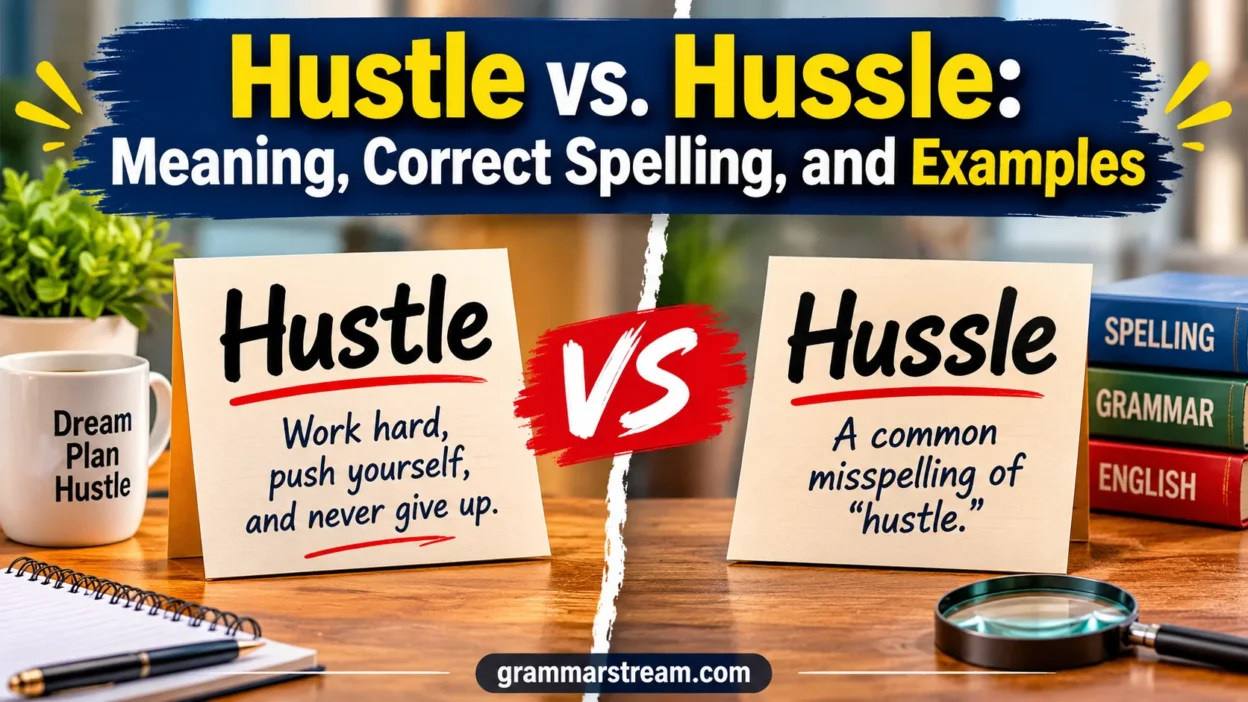
Have you ever wondered whether the correct spelling is hustle or hussle? You’re not alone. Many English speakers confuse these two spellings because they look almost identical. However, only one represents the standard English word.
The confusion often appears in social media posts, text messages, business conversations, and discussions about hard work. You’ll also encounter the spelling Hussle in proper names, most notably the stage name of rapper Nipsey Hussle. That makes the distinction even more interesting.
Although both spellings appear online, they don’t serve the same purpose. Hustle is the accepted English spelling used as both a noun and a verb. Meanwhile, hussle is generally a misspelling unless someone intentionally uses it as a name or brand.
Understanding this difference helps you write confidently and avoid unnecessary spelling mistakes. Let’s explore their meanings, pronunciation, grammatical uses, and everyday examples.
Quick Answer
Hustle is the correct standard English spelling. It describes working hard, moving quickly, showing determination, or sometimes using dishonest methods to make money.
Hussle is not a standard alternative spelling of hustle. People sometimes use it accidentally in informal writing or intentionally in proper names and creative branding.
| Word | Correctness | Meaning | Usage |
| Hustle | Correct standard spelling | Work energetically, move quickly, or deceive someone | Everyday and professional English |
| Hussle | Nonstandard spelling | Usually intended to mean hustle | Intentional names, branding, or spelling mistakes |
Examples:
- Correct: She continues to hustle to build her own business.
- Incorrect: She continues to hussle to build her own business.
- Proper name: Nipsey Hussle was the professional name of an American rapper.
The easiest rule to remember is simple: Use hustle in ordinary English writing and preserve Hussle when it belongs to an actual name.
Comparison Overview
Although hustle and hussle look similar, their spelling and linguistic status differ. Understanding their individual characteristics makes choosing the right form much easier.
| Feature | Hustle | Hussle |
| Standard English spelling | Yes | No |
| Dictionary word | Yes | Not as a standard spelling variant |
| Part of speech | Noun and verb | No standard grammatical role as an alternative |
| Pronunciation | Commonly /ˈhʌs.əl/ | No established standard pronunciation as a variant |
| Meaning | Hard work, urgency, movement, or deception | Usually intended to represent hustle |
| Formal writing | Accepted | Generally incorrect |
| Informal writing | Accepted | Sometimes appears as a typo |
| Proper names | Can appear | Can appear intentionally |
| Common expression | Side hustle | Side hussle is a misspelling |
The main difference isn’t about two competing English words with separate definitions. Instead, it’s about standard spelling versus a nonstandard spelling.
For example, someone might write, “I need to hustle to finish this project.” That sentence follows standard English spelling. Writing “I need to hussle” introduces a spelling error.
However, proper names follow their own conventions. You shouldn’t change someone’s chosen name simply because it differs from an ordinary dictionary spelling.
Main Differences Between Hustle and Hussle
Hustle Is the Correct Standard Spelling
Hustle is the accepted spelling in modern English. It has several related meanings and works as both a noun and a verb.
As a verb, hustle can describe working energetically toward a goal. It can also mean moving quickly or encouraging someone to hurry. As a noun, it often describes determination, effort, or a way of earning money.
Consider these examples:
- She hustles every morning to grow her online business.
- The players showed incredible hustle throughout the match.
- We need to hustle if we want to catch the last train.
- His weekend photography work became a successful side hustle.
Notice that every sentence uses the same spelling. The meaning changes according to the surrounding words, but the spelling stays consistent.
In American English, hustle is particularly common in conversations about entrepreneurship, sports, employment, and personal ambition. You’ll frequently hear expressions such as hustle harder, keep hustling, and side hustle.
Hussle Is Generally a Misspelling
Hussle is generally an incorrect spelling when someone intends to write the ordinary English word hustle.
The mistake usually happens because people add an extra S. Since English contains many words with doubled consonants, the alternative spelling may look believable at first glance.
However, standard spelling doesn’t support that change.
Here are some examples:
| Incorrect | Correct |
| Hussle every day | Hustle every day |
| Side hussle | Side hustle |
| Keep hussling | Keep hustling |
| Daily hussle | Daily hustle |
| Hussled all night | Hustled all night |
The spelling hussle can still appear in usernames, artistic identities, business names, and other creative settings. That doesn’t make it a standard spelling variation.
For example, if a company intentionally uses Hussle in its registered brand name, you should preserve that spelling when referring to the company.
Meaning and Definition of Hustle
The word hustle has several meanings depending on its grammatical role and context. Its central ideas often involve energy, movement, effort, or persuasion.
Here are its most common meanings.
Working hard toward a goal: Hustle can describe putting consistent effort into something you want to achieve.
Example: “She continues to hustle because she wants to become a successful entrepreneur.”
Moving quickly: The word can describe moving with speed or urgency.
Example: “We had to hustle across the airport to reach our gate.”
Earning money: In informal conversations, hustle can describe an activity that generates income.
Example: “His weekend delivery work provides an additional source of income.”
Pushing or moving someone: Hustle can describe physically moving or urging someone along.
Example: “The security guards hustled the crowd toward the exit.”
Deceiving someone: In certain contexts, hustle can describe tricking or pressuring someone to obtain money or another advantage.
Example: “The salesperson tried to hustle tourists into buying overpriced souvenirs.”
These meanings share a connection with activity and effort. However, context determines whether the word carries a positive, neutral, or negative meaning.
Is Hussle Ever Correct?
Although hussle isn’t the standard spelling of the ordinary English word, it can be correct as an intentional proper name.
Names don’t always follow conventional dictionary spelling. People, musicians, businesses, and creative brands sometimes choose unusual letter combinations to establish a recognizable identity.
One famous example is Nipsey Hussle, the stage name of American rapper and entrepreneur Ermias Joseph Asghedom.
He deliberately used the spelling Hussle as part of his professional identity. Therefore, writing his name as Nipsey Hustle would be incorrect.
This distinction matters because proper names and ordinary vocabulary follow different conventions.
Consider these situations:
- Personal names: Preserve the spelling chosen by the individual.
- Stage names: Use the artist’s established professional spelling.
- Brand names: Follow the official spelling used by the business.
- Ordinary sentences: Use hustle when referring to work, effort, movement, or deception.
For instance, “I admire Nipsey Hussle’s music” uses the proper name correctly. However, “I admire his work ethic and hustle” uses the standard English word.
The two spellings can appear in the same paragraph without serving the same purpose.
Hustle as a Noun
As a noun, hustle describes an activity, quality, or situation involving effort, energy, or determination.
People often use it when discussing careers, personal goals, sports, and additional income.
Here are its main noun meanings.
Hard work and determination
This meaning describes someone’s willingness to put in effort and keep moving toward a goal.
Example: “Her hustle helped her establish a successful clothing business.”
A way to earn money
Hustle can refer to an activity someone performs to generate income. This meaning frequently appears in discussions about freelance work and entrepreneurship.
Example: “His weekend photography hustle pays for his college expenses.”
Busy activity
The word can also describe energetic movement and activity in a particular environment.
Example: “The morning hustle at the train station made it difficult to find a quiet place.”
A dishonest scheme
Sometimes hustle refers to an activity involving deception or manipulation.
Example: “The street game turned out to be a hustle designed to take people’s money.”
The surrounding sentence usually makes the intended meaning clear.
Read More: Skillset vs. Skill Set: Meaning, Correct Spelling, and Examples
Hustle as a Verb
As a verb, hustle describes an action rather than a quality or activity.
It can refer to working hard, moving quickly, pushing someone, or persuading someone through pressure.
Working hard: “He hustles every evening to support his family.”
Moving quickly: “We need to hustle before the store closes.”
Encouraging urgency: “The coach told the players to hustle during practice.”
Physically moving someone: “The officers hustled the visitors outside.”
Deceiving someone: “The stranger tried to hustle him out of his savings.”
The verb also changes according to standard English grammar rules.
| Verb Form | Correct Spelling | Example |
| Base form | Hustle | I hustle every day. |
| Third-person singular | Hustles | She hustles after work. |
| Past tense | Hustled | They hustled to finish. |
| Present participle | Hustling | He is hustling today. |
| Past participle | Hustled | She has hustled for years. |
One important detail is that the final E disappears before adding ING. That’s why the correct form is hustling, not hustleing.
Hustle vs. Hussle: Pronunciation
The standard English word hustle has two syllables. Its commonly given American English IPA pronunciation is /ˈhʌs.əl/.
The first syllable carries the main stress. The second syllable contains a reduced vowel sound.
The pronunciation can be understood through these elements:
- First syllable: Begins with an H sound and contains the short U sound heard in words such as cup.
- Middle sound: Contains an S sound followed by a T sound.
- Final syllable: Ends with a reduced vowel sound and an L.
The T may be less noticeable in some American accents because speakers often pronounce it quickly.
What about hussle? Since it isn’t a standard spelling variant, it doesn’t have a separate established dictionary pronunciation. Someone using it as a name may choose a particular pronunciation.
For ordinary English writing, remember the standard spelling and pronunciation of hustle.
Why Do People Confuse Hustle and Hussle?
The confusion between hustle and hussle usually comes from spelling habits, pronunciation, and repeated exposure to informal writing.
Although the difference involves only one letter, that small change can make the entire word incorrect. Several factors contribute to this mistake.
Similar-Looking Letter Combinations
English spelling contains plenty of words with doubled consonants. For example, little, bottle, puzzle, and misspell all contain repeated letters.
Because of these familiar patterns, some writers assume that hustle might also require two S’s.
However, English spelling doesn’t follow one universal doubling rule. Each word has its own established spelling.
Compare these examples:
- Hustle — one S.
- Misspell — two S’s.
- Message — two S’s.
- Muscle — one S.
The correct approach is to learn the spelling of each word rather than apply a doubling pattern automatically.
Pronunciation and Spelling Confusion
Pronunciation doesn’t always reveal the correct spelling of an English word. Several English words contain sounds that can lead to spelling mistakes.
When people hear hustle in casual conversation, they might focus on its S sound and overlook the T. This can make the spelling less obvious to someone unfamiliar with the word.
However, the standard spelling remains H-U-S-T-L-E.
Listening carefully can help with pronunciation, but checking the written form provides greater certainty.
Fast Typing and Autocorrect
Typing quickly creates opportunities for accidental spelling mistakes. Someone writing a social media caption might type hussle without noticing the extra letter.
Autocorrect doesn’t always solve the problem. Depending on the keyboard or application, a nonstandard spelling might remain unchanged.
For example:
- A person types “Keep the hussle going.”
- The sentence gets published without proofreading.
- Other users see the same spelling and may repeat it.
Over time, repeated mistakes can make an incorrect form look familiar. Familiarity, however, doesn’t establish correctness.
Social Media and Internet Usage
Social media encourages creative spelling, abbreviations, usernames, and unconventional expressions.
People sometimes use hussle deliberately because they like its appearance or want a distinctive username. Others simply copy what they see in comments and captions.
This doesn’t mean every online spelling represents standard English.
A useful distinction is:
- Casual creativity: Unconventional spelling used intentionally for style.
- Accidental spelling: An unintended mistake while typing.
- Standard writing: The accepted spelling used in articles, schoolwork, business documents, and professional communication.
Understanding these categories helps you recognize when an unusual spelling is intentional and when it needs correction.
Correct Examples of Hustle in Sentences
Examples make spelling rules easier to remember because they show how words function in everyday situations.
The following sentences demonstrate the different meanings of hustle.
Hustle Meaning Hard Work
When hustle describes hard work, it usually communicates determination, persistence, and a willingness to make progress.
- She continues to hustle because she wants to build a successful career.
- His daily hustle helped him turn a small idea into a profitable business.
- You need dedication and hustle to achieve challenging goals.
- Their hustle and teamwork helped the company survive its difficult first year.
- She never stopped hustling even when progress seemed slow.
In these examples, hustle carries a positive meaning. It represents effort and determination rather than dishonesty.
Frequently Asked Questions
Is It Hustle or Hussle?
Hustle is the correct standard English spelling. It can function as a noun or verb and describes hard work, determination, quick movement, or sometimes dishonest behavior. Hussle is generally a misspelling when used in place of this word.
Is Hussle a Real Word?
Hussle isn’t recognized as a standard alternative spelling of hustle. However, people can intentionally use it in personal names, stage names, usernames, and creative branding.
For example, Nipsey Hussle used this spelling as his professional name. That doesn’t make hussle correct in ordinary English sentences.
What Does Hustle Mean in Slang?
In slang, hustle often describes working hard, earning money, pursuing opportunities, or showing determination.
For example, someone might say, “I’m on my hustle” to express dedication toward personal or financial goals.
However, hustle can also describe dishonest activities, depending on the situation.
Is It Side Hustle or Side Hussle?
Side hustle is the correct expression.
It describes additional work someone performs outside their primary employment or regular responsibilities to earn extra income.
Examples include freelancing, tutoring, selling products, and offering photography services. Writing side hussle is a spelling mistake.
Why Is Nipsey Hussle Spelled With Two S’s?
Nipsey Hussle intentionally used that spelling as his professional stage name.
His birth name was Ermias Joseph Asghedom. He became widely recognized as an American rapper and entrepreneur under the name Nipsey Hussle.
His chosen spelling is a proper-name convention. It doesn’t represent an alternative standard spelling of the English word hustle.
Conclusion:
The difference between hustle and hussle comes down to standard spelling and intentional naming. Hustle is the correct English word. It describes hard work, determination, quick movement, earning money, and sometimes dishonest behavior. It works naturally as both a noun and a verb. On the other hand, hussle is generally a misspelling when someone intends to use the ordinary English word. It can still appear intentionally in personal names, stage names, and creative branding.