Have you ever wondered whether the plural of goose is gooses or something completely different? You’re not alone. English has plenty of nouns that form their plurals in unexpected ways, and goose is one of the classic examples.
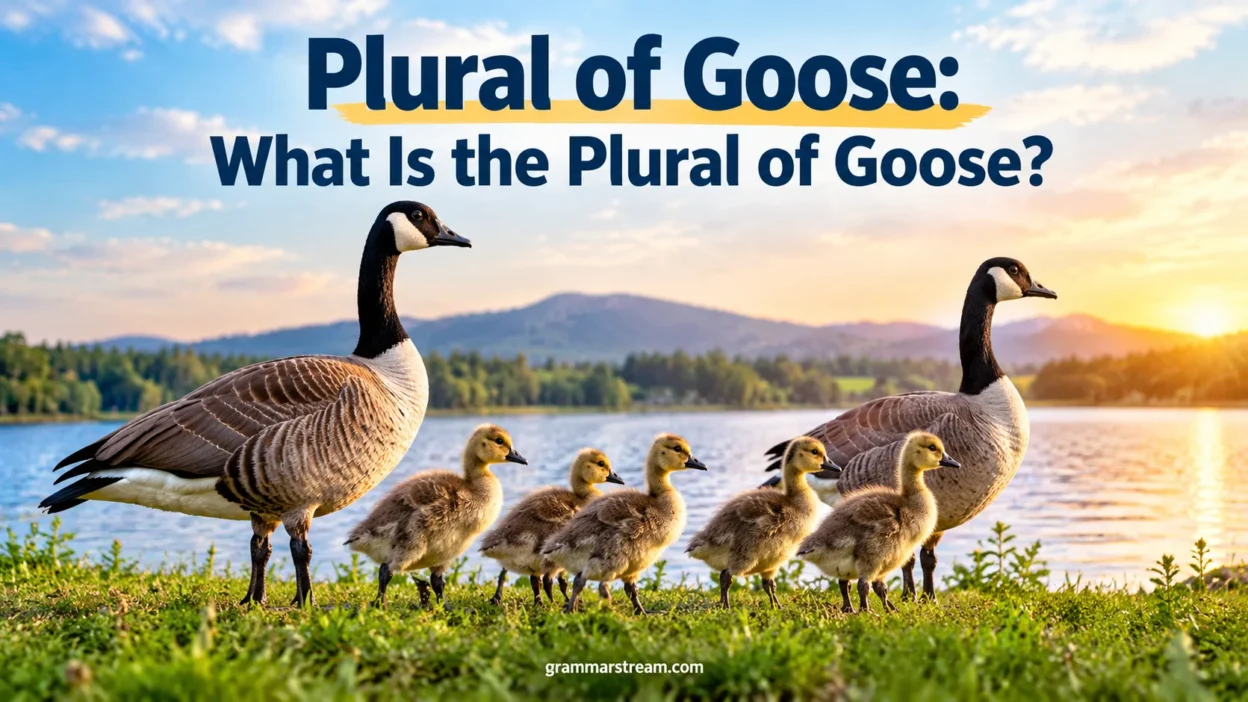
The correct plural of goose is geese. You use goose when you’re talking about one bird and geese when you’re talking about two or more. The word doesn’t follow the usual pattern of simply adding -s or -es.
For example, you can say, “A goose is standing near the pond,” but you should say, “Three geese are swimming in the pond.” The change from goose to geese might seem strange at first, yet it follows an old English pattern that has survived for centuries.
Understanding the plural of goose becomes much easier once you see how the two forms work in real sentences. You’ll also learn why geese is correct, whether gooses can ever be used, how to form possessives, and how goose, gander, and gosling differ.
Quick Answer
The plural of goose is geese.
- One goose = singular
- Two geese = plural
- Several geese = plural
- A flock of geese = a group of multiple geese
Here are two simple examples:
- Singular: “A goose walked across the field.”
- Plural: “Five geese walked across the field.”
The word goose doesn’t become gooses when you mean more than one bird. Instead, its internal vowel changes from oo to ee.
So, if you’re writing an essay, email, article, school assignment, or everyday message, remember this simple rule:
Goose → Geese
Comparison Overview
The easiest way to understand the plural of goose is to compare the singular and plural forms directly.
| Form | Number | Example |
| goose | Singular | One goose is near the lake. |
| geese | Plural | Several geese are near the lake. |
| goose’s | Singular possessive | The goose’s feathers are wet. |
| geese’s | Plural possessive | The geese’s migration pattern was studied. |
The biggest point to remember is that goose and geese don’t simply differ by an ending. The spelling of the main vowel changes.
This makes goose an irregular noun. An irregular noun forms its plural in a way that doesn’t follow the standard -s or -es pattern.
For instance, cat becomes cats, and box becomes boxes. However, goose becomes geese. English has many irregular nouns like this.
Main Differences Between Plural of Goose
The main difference is grammatical number. Goose refers to one bird, while geese refers to more than one.
| Feature | Goose | Geese |
| Number | Singular | Plural |
| Meaning | One goose | Two or more geese |
| Article | a goose | Usually no “a” |
| Example | A goose is outside. | Geese are outside. |
| Verb | is | are |
| Plural type | Irregular | Irregular |
Notice the verb in each sentence. You say “The goose is” because goose is singular. You say “The geese are” because geese is plural.
That small verb change can help you identify the correct form when you’re writing quickly.
Why Is the Plural of Goose “Geese”?
The plural geese comes from an old pattern in the history of the English language. It wasn’t created by modern speakers simply deciding to replace oo with ee.
The change developed from an older Germanic plural pattern called i-mutation, also known as umlaut. In simple terms, a vowel in an older singular word changed because of a sound that appeared in the following syllable.
Over many generations, the ending that caused the vowel change disappeared from the word. The changed vowel remained.
That’s why English has several unusual pairs that look unrelated at first glance:
- goose → geese
- foot → feet
- tooth → teeth
- man → men
- mouse → mice
These words preserve traces of much older English grammar.
The Historical Vowel Change
Modern English speakers don’t normally think about historical sound changes when they say geese. They simply learn it as the plural of goose.
However, the relationship becomes clearer when you look at older forms of English.
The singular and plural once had different vowel patterns because of changes that took place in early Germanic languages. As English evolved, those patterns became fixed forms.
In other words, geese isn’t an arbitrary spelling. It represents a historical plural pattern that survived while many other old patterns disappeared.
That’s one reason English can feel unpredictable. Modern English contains pieces of several different historical systems.
Is “Gooses” a Correct Plural?
For ordinary English, gooses is not the standard plural of goose.
If you’re talking about several birds, use geese.
Incorrect in standard usage:
- “There are three gooses near the pond.”
Correct:
- “There are three geese near the pond.”
The mistake happens because most English nouns form plurals by adding -s. For example:
- bird → birds
- dog → dogs
- lake → lakes
- tree → trees
It’s natural to assume that goose should work the same way. English, however, doesn’t always play by that particular rule.
Can “Gooses” Ever Appear?
You may occasionally encounter gooses in specialized contexts, especially when someone treats goose as a verb or discusses unusual uses of the word.
As a noun referring to multiple birds, however, geese is the standard plural.
For normal writing, there’s no reason to choose gooses when you mean multiple birds.
Goose vs. Geese in Sentences
Seeing the two forms in complete sentences makes the distinction much easier.
Examples With “Goose”
Use goose when you’re referring to one bird.
- A goose is standing beside the pond.
- I saw a goose near the fence.
- The goose flew across the field.
- One goose stayed behind the group.
- That goose is eating grass.
Because goose is singular, it commonly works with a, an, one, this, or that.
Examples With “Geese”
Use geese when you’re referring to two or more birds.
- Two geese are swimming in the lake.
- Several geese crossed the road.
- The geese flew south for the winter.
- Many geese gathered near the shoreline.
- Those geese are making a lot of noise.
The plural form normally doesn’t need an indefinite article such as a.
You wouldn’t say “a geese.” Instead, you’d say a goose for one bird or some geese for multiple birds.
Goose’s vs. Geese’s: Understanding Possessives
Possessive forms can create another layer of confusion.
The singular possessive is goose’s.
For example:
The goose’s feathers were covered in water.
This means the feathers belonged to one goose.
The plural possessive can be geese’s when you need to show that something belongs to or relates to multiple geese.
For example:
The geese’s migration route changed this year.
The apostrophe comes after geese only when you’re forming a possessive.
Singular Possessive
Goose’s means something belongs to one goose.
- The goose’s wing was injured.
- The goose’s feathers were white.
- The goose’s nest was nearby.
Plural Possessive
Geese’s can show possession or association involving multiple geese.
- The geese’s behavior attracted attention.
- The geese’s nests were scattered across the island.
The important distinction is simple:
goose → goose’s
geese → geese’s
Don’t confuse geese with geese’s. The first is simply plural. The second expresses possession.
What Is a Group of Geese Called?
A group of geese can be called a flock. That’s the ordinary term you’ll encounter in everyday speech and general writing.
You can say:
- a flock of geese
- several flocks of geese
- a large flock of geese
The word gaggle is another well-known collective term associated with geese, especially geese on the ground.
For example:
A gaggle of geese gathered around the pond.
The word gaggle has a more colorful feel than flock. It often appears in traditional descriptions and informal writing.
Flock vs. Gaggle
| Term | Meaning | Typical Use |
| flock | A group of birds | General and widely used |
| gaggle | A group of geese | Traditional term, especially on land |
There’s no need to force the word gaggle into every sentence. Flock of geese is perfectly natural and widely understood.
Goose and Geese Pronunciation
The spelling difference between goose and geese comes with a clear vowel difference in American English.
How to Pronounce Goose
Goose has a long oo sound, similar to the vowel in food and moon.
The American English pronunciation is commonly represented as:
/ɡuːs/
The word has one syllable.
How to Pronounce Geese
Geese has a long ee sound, similar to the vowel in see and green.
Its American English pronunciation is commonly represented as:
/ɡiːs/
It also has one syllable.
The difference is therefore not only visual. The vowel sound changes too.
Read More: Chud Meaning: What Does Chud Mean in Slang?
Goose vs. Geese: Meaning and Usage
The words goose and geese describe the same type of bird, but they indicate different numbers.
Goose is singular.
Geese is plural.
Consider this example:
One goose is standing near the water.
Now increase the number:
Four geese are standing near the water.
The noun changes from goose to geese. The verb changes from is to are as well.
Singular Determiners
Common words that work with singular goose include:
- a goose
- one goose
- this goose
- that goose
- each goose
- every goose
Plural Determiners
Common words that work with plural geese include:
- two geese
- several geese
- many geese
- these geese
- those geese
- some geese
- a few geese
This distinction is useful because determiners often give you an immediate clue about whether you need goose or geese.
Common Mistakes With the Plural of Goose
The plural of goose causes several predictable mistakes. Once you recognize them, they’re easy to avoid.
“Gooses”
The most common mistake is writing gooses when referring to multiple birds.
Incorrect:
We saw six gooses by the lake.
Correct:
We saw six geese by the lake.
Remember that goose is an irregular noun.
Using “Goose” for Multiple Birds
Another error occurs when writers leave the noun unchanged.
Incorrect:
There were five goose near the river.
Correct:
There were five geese near the river.
A number greater than one normally requires the plural form.
Using “Geese” as Singular
The opposite mistake is treating geese as one bird.
Incorrect:
A geese was standing in the yard.
Correct:
A goose was standing in the yard.
The article a tells you that the noun must be singular.
Using the Wrong Verb
Because geese is plural, it takes plural verbs in standard English.
Incorrect:
The geese is swimming.
Correct:
The geese are swimming.
Similarly:
- The goose is swimming.
- The geese are swimming.
- The goose was near the pond.
- The geese were near the pond.
These small agreements make your writing grammatically sound.
Other Irregular Plural Nouns Like Goose
The plural of goose belongs to a larger family of irregular English plurals.
| Singular | Plural |
| goose | geese |
| foot | feet |
| tooth | teeth |
| man | men |
| woman | women |
| mouse | mice |
| ox | oxen |
| child | children |
These words don’t follow the most common modern plural pattern.
For example, you wouldn’t write foots when you mean multiple feet. You wouldn’t normally write tooths when you mean several teeth. Likewise, goose becomes geese.
Why These Forms Matter
English learners often expect every plural to follow a predictable formula.
The most common pattern is:
singular noun + s = plural noun
Examples include:
- book → books
- car → cars
- house → houses
- bird → birds
Irregular nouns break that expectation.
That’s why memorizing common irregular pairs can save time. You don’t need to analyze their history every time you use them. You simply need to recognize the standard form.
Goose, Geese, and Related Words
The word goose has several related terms that describe age, sex, or number.
Gosling
A gosling is a young goose.
It isn’t another plural form of goose. Instead, it identifies the bird’s age.
For example:
The mother goose stayed close to her goslings.
The plural of gosling is the regular form goslings.
Gander
A gander is an adult male goose.
The term gives you information about sex rather than number.
For example:
The gander remained near the nest.
A group containing male and female birds can still be called geese.
Goose vs. Gander vs. Gosling
| Term | Meaning |
| goose | A goose, especially when sex isn’t specified |
| gander | An adult male goose |
| gosling | A young goose |
| geese | More than one goose |
These terms answer different questions. Goose and geese primarily concern the noun’s number. Gander identifies an adult male. Gosling identifies a young bird.
Goose Plural in Different Contexts
The correct plural doesn’t change just because the writing situation changes.
Whether you’re talking about wildlife, farming, schoolwork, or everyday conversation, geese remains the standard plural.
Everyday Conversation
You might say:
There are geese in the park.
This is simple and natural.
Wildlife Writing
A wildlife article might say:
Large groups of geese gather in wetland habitats during migration.
The same plural form applies.
Farming and Agriculture
You could write:
The farmer keeps several geese on the property.
Again, geese is the correct plural.
Educational Writing
A textbook might explain:
Geese are birds belonging to the family Anatidae.
The plural form remains unchanged across formal and informal contexts.
FAQs:
What is the plural of goose?
The plural of goose is geese. For example, “One goose is swimming” becomes “Two geese are swimming.”
Is “gooses” the plural of goose?
No. Gooses isn’t the standard plural when you’re referring to multiple birds. The correct plural is geese.
Why does goose change to geese?
The form geese comes from an old Germanic vowel-changing pattern known as i-mutation or umlaut. The historical pattern survived in modern English even though the original grammatical process is no longer productive.
What is a group of geese called?
A group of geese can be called a flock. Gaggle is also a traditional collective term for geese, particularly when they’re gathered on land.
What is the difference between goose and geese?
Goose is singular and refers to one bird. Geese is plural and refers to two or more birds.
Conclusion:
The plural of goose is geese, not gooses. That’s the one rule worth remembering. The unusual spelling comes from the long history of the English language. Unlike regular nouns such as bird → birds, goose → geese preserves an older vowel-changing pattern. Once you connect the pair in your mind, the distinction becomes easy: one goose, two geese. Keep that phrase handy and you’ll rarely second-guess the correct plural again.