Have you ever written oversight or oversite and wondered which spelling actually belongs in your sentence? These two words look almost identical, yet their meanings and uses differ considerably. One appears regularly in everyday English while the other belongs mainly to specialized construction terminology.
The confusion makes sense. Both words contain nearly the same letters and share a similar pronunciation in many English accents. However, choosing the wrong spelling can change your sentence’s meaning entirely.
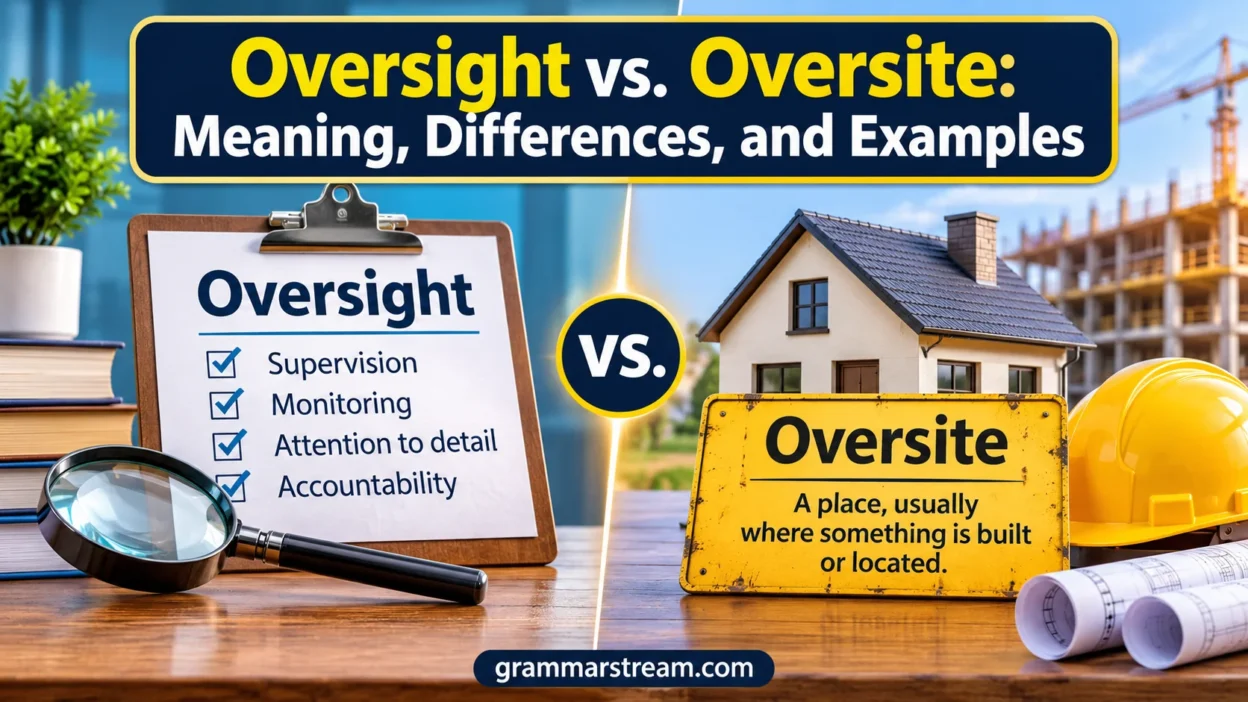
Oversight is the standard English word for supervision, monitoring, or an accidental mistake. Oversite, on the other hand, is a specialized construction term associated with a concrete layer used in certain building projects.
Understanding this distinction helps you avoid spelling mistakes in professional documents, academic writing, business communication, and construction specifications. Let’s examine both terms, their definitions, grammatical roles, and practical examples.
Quick Answer
Oversight is the correct spelling when you mean supervision, management, or an accidental omission. For example, a manager provides oversight of a project, while an employee might make an oversight by forgetting an important detail.
Oversite is a specialized construction term. It generally refers to an oversite concrete layer associated with preparing a ground-level building floor.
Here is the simplest way to distinguish them:
- Oversight: Supervision, monitoring, or an unintentional mistake.
- Oversite: A construction-related concrete layer or floor preparation.
- Most common choice: Oversight is the word you need in ordinary English.
- Important distinction: Never use oversite as a replacement for oversight in general writing.
Comparison Overview
Although oversight and oversite differ by only one letter, their meanings are not interchangeable. Their contexts provide the clearest way to understand the distinction.
| Feature | Oversight | Oversite |
| Spelling | Oversight | Oversite |
| Part of speech | Noun | Noun |
| Main meaning | Supervision or accidental omission | Specialized construction term |
| General English usage | Common | Limited |
| Professional context | Business, government, management, education | Building and construction |
| Everyday application | Monitoring work or missing a detail | Describing ground-floor construction |
| Example | The director provides oversight of the project. | Workers prepared the oversite concrete. |
| Standard spelling | Yes | Specialized technical spelling |
The biggest difference concerns meaning rather than spelling. Oversight describes an activity or an error, depending on context. Oversite refers to a specific construction-related concept.
For example, consider these two sentences:
- The supervisor noticed an oversight in the construction report.
- The contractor installed the oversite concrete before proceeding with the floor.
The first sentence describes an unnoticed mistake. The second refers to building work. Neither word can replace the other without changing the intended meaning.
What Does Oversight Mean?
Oversight is a noun with two established meanings. It can describe the act of supervising something or an accidental failure to notice something important.
Although these meanings might initially seem unrelated, both involve the idea of looking after or paying attention to something.
Oversight as Supervision or Management
The first meaning of oversight involves supervising, monitoring, or directing an activity. When someone provides oversight, they make sure that a person, team, organization, or process operates properly.
Oversight doesn’t always mean performing the actual work. Instead, it often involves checking progress, reviewing decisions, identifying problems, and maintaining accountability.
For example, a company director might provide oversight of several departments without personally completing their daily tasks. The director monitors performance and makes sure employees follow organizational policies.
You will frequently encounter this meaning in professional and institutional settings.
Common examples include:
- Business oversight: Monitoring company operations, employee performance, and organizational decisions.
- Government oversight: Reviewing public agencies, government spending, and administrative activities.
- Financial oversight: Monitoring budgets, transactions, investments, and financial reporting.
- Regulatory oversight: Ensuring organizations follow applicable laws, rules, and industry standards.
- Educational oversight: Supervising school operations, academic policies, and institutional performance.
- Project oversight: Tracking deadlines, budgets, responsibilities, and project quality.
Consider a hospital administrator responsible for overseeing patient services. The administrator may review safety procedures, staffing arrangements, and operational performance. This responsibility represents organizational oversight.
Oversight as an Unintentional Mistake
Oversight has another common meaning: an accidental omission or failure to notice something.
In this context, the word describes something that someone should have noticed but unintentionally missed. It might involve a forgotten detail, an overlooked requirement, or a small error in an important document.
For example:
- An oversight in the contract left out an important payment condition.
- The editor corrected an oversight before publishing the article.
- A small oversight caused the team to miss an important deadline.
- The employee apologized for the oversight in the final report.
- The application was rejected because of an oversight during submission.
Notice that oversight doesn’t automatically mean someone acted carelessly or deliberately ignored a responsibility.
A person might review a document carefully and still miss one sentence. That forgotten detail can reasonably be described as an oversight.
However, context matters. Repeated failures to follow procedures may indicate negligence rather than an isolated oversight.
Common Uses of Oversight
Oversight appears in many areas because supervision and accidental omissions happen in everyday and professional life.
| Expression | Meaning | Example |
| Government oversight | Monitoring government activities | Government oversight protects public accountability. |
| Financial oversight | Supervising financial activities | The board strengthened financial oversight. |
| Management oversight | Supervising organizational operations | Management oversight improved workplace performance. |
| Regulatory oversight | Monitoring compliance with regulations | Regulatory oversight protects consumers. |
| Administrative oversight | Supervising administrative responsibilities | Administrative oversight helped prevent procedural errors. |
| Accidental oversight | An unintentional mistake or omission | A missing signature was an oversight. |
One important detail is that the meaning depends on how the word functions in the sentence.
When someone provides oversight, they supervise something. When someone makes an oversight, they overlook something unintentionally.
Both expressions are grammatically correct.
What Does Oversite Mean?
Oversite is a specialized term used in building and construction. It generally refers to a concrete layer laid over prepared ground or hardcore filling as part of ground-floor construction.
You are more likely to encounter this word in British construction terminology, architectural specifications, and building documents than in everyday American English.
An oversite concrete layer helps create a firm, relatively even surface during the preparation of a building’s ground floor. Its exact construction and position depend on the building design and the specified floor system.
Definition of Oversite
In construction, oversite commonly describes concrete laid over prepared ground within a building’s footprint. Builders may use it as part of the ground-floor preparation process.
A typical ground-floor construction arrangement may include several components:
- Prepared ground: Workers clear and prepare the underlying soil.
- Hardcore filling: Compacted granular material provides a stable base where specified.
- Oversite concrete: A concrete layer creates a firm surface over the prepared filling.
- Damp-proof protection: A damp-proof membrane may help prevent moisture from entering the building.
- Insulation: Specified insulation improves the floor’s thermal performance.
- Floor screed: A finishing layer creates a suitable surface for the final floor covering.
These components don’t always appear in precisely the same order. Modern floor designs vary according to structural requirements, moisture conditions, insulation needs, and local building regulations.
The term oversite concrete describes the construction layer rather than the entire foundation or finished floor.
Example: The contractor specified an oversite concrete layer over the compacted hardcore before completing the ground-floor construction.
Where Is Oversite Used?
Oversite appears in specific construction situations, particularly when contractors prepare the ground beneath a building’s floor.
Its use depends on the project’s design and the construction methods selected by the architect or engineer.
Common applications include:
- Residential construction: Preparing the ground beneath ground-floor rooms in houses.
- Building extensions: Creating suitable ground-floor surfaces during extension work.
- Commercial buildings: Following specified ground-floor preparation details.
- Floor construction: Providing a concrete layer over prepared ground.
- Construction specifications: Identifying concrete work required within a building’s footprint.
For example, imagine a contractor building a small residential property. Before installing the finished floor, the construction team prepares the ground and compacts suitable filling material.
The project specification may require an oversite concrete layer as part of that preparation. The contractor follows the approved drawings and technical requirements to complete the work.
Construction note: The required concrete thickness, reinforcement, membrane position, and material specifications must come from the project design. There is no single universal oversite specification for every building.
Is Oversite a Standard English Word?
Oversite is a recognized specialized term, but it isn’t commonly used in general English.
Most everyday dictionaries and spelling references focus on oversight because it has established meanings in ordinary communication. Oversite appears primarily in construction-related vocabulary.
This distinction explains why many spellcheckers flag oversite or suggest replacing it with oversight. General-purpose spelling software may not recognize specialized technical terminology.
However, a spelling suggestion doesn’t automatically make a construction term incorrect.
Consider these situations:
- Writing a business report? Use oversight when discussing supervision.
- Describing an accidental omission? Use oversight.
- Preparing a construction specification? Oversite may be appropriate.
- Writing an ordinary email? Avoid oversite unless you’re discussing its technical meaning.
The key is to understand the subject before selecting the spelling.
Main Differences Between Oversight and Oversite
The difference between oversight and oversite becomes easier to understand when you compare their definitions, spelling patterns, grammatical functions, and practical applications.
Meaning and Definition
Meaning is the most important distinction between these words.
Oversight describes supervision or an accidental failure to notice something. It appears in many everyday situations, including business operations, government activities, education, and personal communication.
Oversite belongs to specialized construction vocabulary. It generally refers to concrete placed over prepared ground as part of a building’s ground-floor preparation.
Compare the following examples:
- The committee provides oversight of the organization’s financial activities.
- The construction team completed the oversite concrete before moving forward.
In the first sentence, oversight describes supervision. In the second, oversite identifies construction work.
Their meanings are entirely different despite their similar appearance.
Read More: Appendices vs. Appendixes: Which Is Correct and How to Use Them?
Spelling and Word Formation
The spelling difference is small but important.
Oversight contains the letter combination ght at the end. Oversite ends with te instead.
| Word | Spelling structure | Ending |
| Oversight | O-V-E-R-S-I-G-H-T | GHT |
| Oversite | O-V-E-R-S-I-T-E | TE |
The spelling difference changes the word’s identity rather than simply creating an alternative version.
You shouldn’t remove the letter combination from oversight when discussing supervision or an accidental mistake. Likewise, adding unnecessary letters to oversite changes the specialized construction term.
Context and Usage
Context determines which word belongs in your sentence.
Oversight appears in general communication and professional writing. You might encounter it in a workplace email, government report, school policy, or financial statement.
Oversite usually appears in technical construction documents. Builders, architects, engineers, and contractors may use it when describing ground-floor preparation.
Here are some practical comparisons:
| Situation | Correct word | Reason |
| A manager monitors employees | Oversight | Describes supervision |
| Someone forgets an important attachment | Oversight | Describes an omission |
| A government agency reviews public spending | Oversight | Describes monitoring |
| A contractor pours concrete over prepared ground | Oversite | Refers to construction terminology |
| An editor misses a spelling mistake | Oversight | Describes an accidental error |
| A building specification mentions an oversite layer | Oversite | Refers to a construction component |
Using the right context makes your writing clearer and prevents unnecessary confusion.
Grammar and Parts of Speech
Both words function as nouns. However, their grammatical use reflects their different meanings.
Oversight can describe an activity, responsibility, or mistake.
Examples:
- The board provides oversight of company operations.
- Her oversight delayed the approval process.
- The department needs stronger financial oversight.
Oversite functions as a technical construction noun.
Examples:
- The oversite requires preparation before the next construction stage.
- Workers completed the oversite concrete according to the project specification.
- The architect reviewed the oversite details.
You can also use related grammatical forms with oversight.
For instance:
- Oversee: To supervise or monitor something.
- Oversight: The act of supervision or an accidental omission.
- Overseen: The past participle of oversee.
Oversite doesn’t have an equivalent family of widely used everyday English forms.
Frequency and Recognition
The two words differ considerably in how frequently people encounter them.
Oversight is an established English vocabulary word used across numerous industries and everyday situations. It appears in business communication, journalism, academic writing, public administration, and ordinary conversation.
Oversite has a much narrower audience. People outside construction may rarely encounter it unless they read building specifications or technical documents.
This difference also affects spelling software and search results. General-purpose dictionaries, grammar tools, and autocorrect systems are more likely to recognize oversight.
However, frequency doesn’t determine whether a specialized term is legitimate. A technical word can be correct even when most people rarely use it.
Oversight vs. Oversite: Examples in Sentences
Examples make the distinction easier to remember. The following sentences show how each word works in natural English.
Examples of Oversight
Use oversight when describing supervision, monitoring, or an unintentional mistake.
- The project manager provides oversight of the construction schedule.
- A small oversight caused an error in the final report.
- Government oversight helps monitor the use of public funds.
- The company introduced stronger financial oversight.
- The editor corrected an oversight before publishing the article.
- The committee maintains oversight of the organization’s activities.
- An oversight in the application delayed the approval process.
- The principal provides oversight of school operations.
- The accounting department discovered an oversight in the financial records.
- Better management oversight helped the team complete its project.
- The missing signature was an unfortunate oversight.
- The regulatory agency strengthened its oversight of the industry.
Notice how the same word communicates two different ideas. In some sentences, it describes supervision. In others, it identifies something unintentionally missed.
Examples of Oversite
Use oversite when discussing the specialized construction meaning.
- The contractor installed an oversite concrete layer beneath the ground floor.
- The building specification included details about the oversite.
- Workers prepared the ground before completing the oversite concrete.
- The architect reviewed the oversite requirements before construction began.
- The construction team followed the approved oversite details.
- The ground-floor design included an oversite concrete layer.
- The contractor checked the prepared base before pouring the oversite.
- The building plans specified the required oversite construction.
- The workers completed the oversite before continuing with the remaining floor layers.
- The engineer reviewed the ground-floor arrangement and its oversite requirements.
These examples demonstrate the word’s specialized application. They don’t suggest that oversite can replace oversight in ordinary writing.
Oversight vs. Oversite in Everyday Situations
Imagine three different situations.
Situation One: A workplace mistake
An employee submits a report without including an important attachment. The manager notices the missing document and asks for a correction.
The correct word is oversight because the employee unintentionally missed something.
Situation Two: A company supervisor
A department director reviews employee performance, monitors expenses, and checks whether the team follows company policies.
The correct word is oversight because the director supervises organizational activities.
Situation Three: A construction project
A contractor prepares the ground beneath a residential building and installs the specified concrete layer.
The appropriate technical term is oversite because the discussion concerns ground-floor construction.
These situations demonstrate why meaning matters more than visual similarity.
Frequently Asked Questions
Is Oversight or Oversite the Correct Spelling?
Both spellings exist, but they have different meanings. Oversight is the standard English word for supervision or an accidental mistake. Oversite is a specialized construction term associated with ground-floor concrete preparation.
What Does Oversight Mean in Simple English?
Oversight means either watching and supervising something or accidentally missing an important detail. For example, a manager provides oversight of employees, while forgetting an attachment might be an oversight.
Does Oversite Have a Meaning?
Yes. Oversite is a construction term generally referring to a concrete layer placed over prepared ground during ground-floor construction. It isn’t commonly used in everyday English.
Is Oversite a Construction Term?
Yes. Oversite appears in construction terminology, particularly in references to oversite concrete and ground-floor preparation. Its exact application depends on the building design and project specifications.
Can Oversight Mean an Accidental Mistake?
Yes. Oversight can describe an unintentional omission, forgotten detail, or failure to notice something important. For example, leaving a required document out of an application can be an oversight.
Conclusion:
The difference between oversight vs. oversite comes down to meaning and context. Although these words look almost identical, they serve very different purposes in English. Oversight is the standard word used for supervision, monitoring, and accidental omissions. You’ll encounter it in business, government, education, professional communication, and everyday writing.