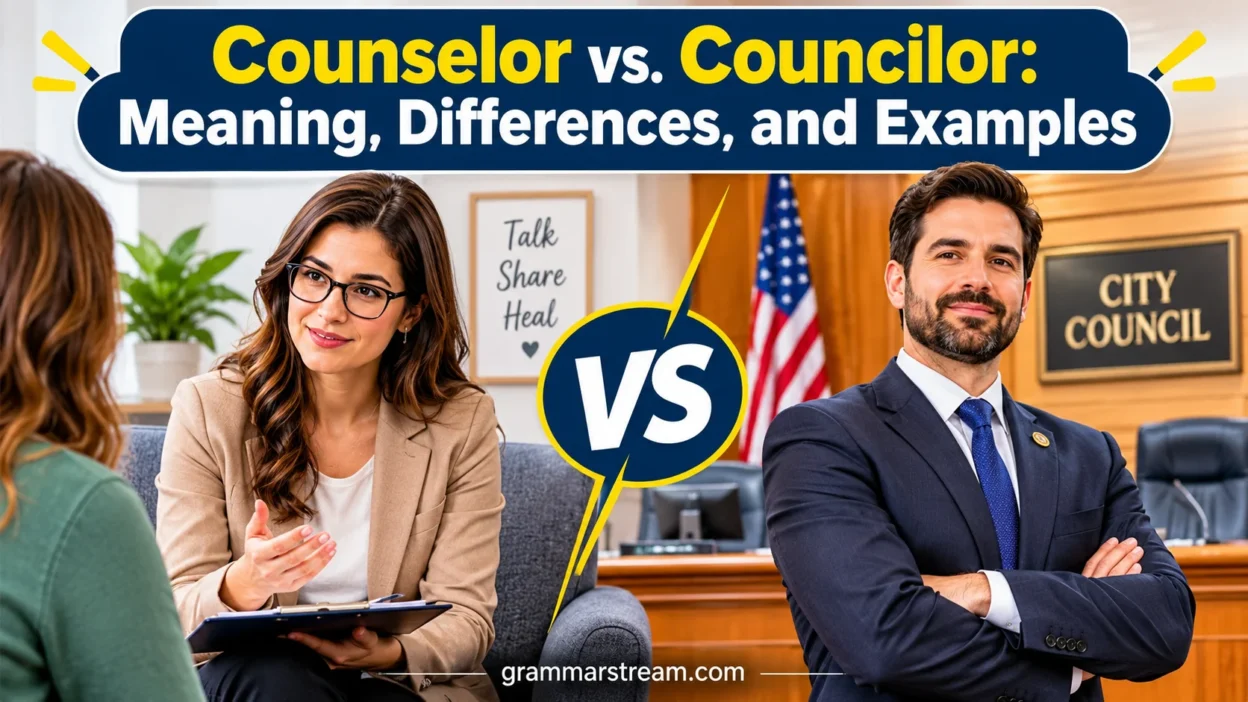
The English language has plenty of words that sound alike but carry completely different meanings. Counselor vs. councilor is a perfect example. Both spellings are correct, and both words relate to people who offer guidance or participate in important decisions. However, they describe two very different roles.
A counselor provides advice, support, or professional guidance. You might meet one at school, a mental health clinic, a career center, or a law office. A councilor, on the other hand, serves as a member of a council. This person may help make local policies, discuss community concerns, or vote on public decisions.
The confusion becomes understandable when you consider their nearly identical pronunciation. In everyday conversation, you usually cannot tell which word someone means just by hearing it. The surrounding context provides the answer.
Whether you’re writing a professional email, preparing a school document, or discussing local government, knowing the difference helps you choose the right spelling. Let’s examine their meanings, uses, origins, and examples.
Quick Answer
Counselor means a person who provides advice, guidance, or professional support. A school counselor helps students with academic choices, personal concerns, and career planning. A mental health counselor offers support for emotional and behavioral challenges.
Councilor means a member of a council, usually an elected or appointed person who participates in discussions and decisions. A city councilor, for example, represents residents and helps address local government matters.
| Word | Meaning | Example |
| Counselor | Someone who provides advice or guidance | The counselor helped Mia choose her college courses. |
| Councilor | A member of a governing or advisory council | The councilor proposed improvements to the local park. |
Easy way to remember:
- Counselor = Counsel: Think of advice, guidance, and support.
- Councilor = Council: Think of a group that discusses and makes decisions.
Both words are correct in American English. Your intended meaning determines which spelling you should use.
Comparison Overview
Although counselor and councilor differ by only a few letters, their meanings, responsibilities, and contexts are distinct. Understanding their basic characteristics makes the difference easier to remember.
| Feature | Counselor | Councilor |
| Definition | A person who provides advice or guidance | A member of a council |
| Part of speech | Noun | Noun |
| Root word | Counsel | Council |
| Main purpose | Advising, supporting, or guiding people | Participating in council decisions |
| Common workplace | Schools, clinics, law offices, and career centers | City halls, government offices, and organizations |
| Responsibilities | Guidance, counseling, and advice | Representation, discussion, and voting |
| Common example | School counselor | City councilor |
| Pronunciation | /ˈkaʊn.sə.lɚ/ | /ˈkaʊn.sə.lɚ/ |
The most important distinction involves the person’s role. A counselor works directly with individuals or groups to provide guidance. A councilor serves on a council and contributes to collective decisions.
For example, a school counselor might help a student manage academic pressure. Meanwhile, a school councilor might participate in an administrative or advisory council, depending on the organization’s structure.
Neither spelling is inherently more correct than the other. They simply serve different purposes.
Main Differences Between Counselor vs. Councilor
The easiest way to understand these words is to examine what each person actually does. Their responsibilities reveal why the spellings aren’t interchangeable.
Counselor: Meaning and Definition
A counselor is someone who provides advice, guidance, or support to individuals facing personal, educational, professional, or emotional challenges. The word generally describes a person who helps others understand their situations and make informed decisions.
Counselors work in several professional environments. Some help students plan their education while others support people dealing with emotional difficulties. Their specific duties depend on their training, qualifications, and workplace.
For instance, a high school counselor might help students select courses, prepare college applications, and explore career opportunities. A mental health counselor may help clients recognize unhealthy patterns and develop practical coping strategies.
The word comes from counsel, which means advice, guidance, or consultation.
Common responsibilities of a counselor include:
- Providing personal and professional guidance.
- Helping students make educational decisions.
- Supporting people through emotional challenges.
- Discussing career options and employment goals.
- Helping individuals identify problems and possible solutions.
- Offering informed advice within their professional qualifications.
Types of Counselors
The term counselor covers several professional roles. Each type focuses on a particular area of guidance or support.
School Counselor
A school counselor helps students handle academic, social, and personal concerns. These professionals often assist with course selection, graduation requirements, college preparation, and educational planning.
For example, a student unsure about choosing science or business subjects might visit a school counselor. The counselor can explain available options and help the student consider future goals.
Mental Health Counselor
A mental health counselor supports people experiencing emotional, behavioral, or psychological difficulties. Depending on their qualifications and professional license, they may provide assessments, counseling sessions, and treatment interventions.
Their work can involve stress management, relationship difficulties, grief, anxiety, and other mental health concerns.
Career Counselor
A career counselor helps people identify suitable career paths and professional opportunities. They may review a person’s interests, skills, education, and experience before suggesting possible directions.
Someone considering a career change might consult a career counselor to explore new industries or training programs.
Marriage and Family Counselor
Marriage and family counselors work with individuals, couples, and families experiencing relationship challenges. They help clients improve communication, understand recurring conflicts, and develop healthier relationship patterns.
Legal Counselor
In legal settings, counselor can refer to an attorney who advises or represents a client. The term also appears in formal professional titles, such as counselor at law.
For example, a company might consult its legal counselor before signing a complicated business agreement.
Councilor: Meaning and Definition
A councilor is a person who serves as a member of a council. A council is an organized group responsible for discussing issues, representing interests, offering advice, or making decisions within a particular institution or government.
Councilors often participate in meetings, examine proposals, discuss public concerns, and vote on important matters. Their responsibilities depend on the council they serve.
In local government, a city councilor may represent a specific district or neighborhood. This person can raise residents’ concerns, participate in budget discussions, and help shape local policies.
Unlike a counselor, a councilor doesn’t primarily provide personal guidance. Their main role involves representing a group and contributing to collective decisions.
Common responsibilities of a councilor include:
- Representing residents or organizational members.
- Attending official council meetings.
- Discussing community problems and proposed solutions.
- Voting on policies, budgets, or resolutions.
- Reviewing development and public service proposals.
- Communicating public concerns to other council members.
Types of Councilors
Councilors serve in different types of councils. Their titles and responsibilities vary according to the organization.
City Councilor
A city councilor serves on a municipal governing body. Depending on local laws, councilors may represent individual districts or the entire city.
They commonly participate in decisions involving public transportation, parks, local development, municipal budgets, and community services.
Town Councilor
A town councilor participates in the administration and governance of a town. Their work may involve local infrastructure, public facilities, planning proposals, and neighborhood concerns.
School Councilor
A school councilor serves on a school-related council or governing body. Depending on the institution, this person may help discuss educational policies, school budgets, student concerns, or administrative matters.
The title isn’t interchangeable with school counselor, who provides guidance and support to students.
Student Councilor
A student councilor participates in a student council or representative body. They may communicate classmates’ concerns, organize school activities, and contribute to decisions about student life.
Organizational Councilor
Some professional associations, nonprofit organizations, and community groups establish councils to oversee specific activities. An organizational councilor serves as a member of one of these bodies.
The position may involve reviewing proposals, representing members, and contributing to organizational decisions.
Counselor vs. Councilor: Key Differences
The central difference is straightforward: a counselor advises people, while a councilor serves on a council.
However, several smaller distinctions help explain their different uses.
Meaning and purpose: A counselor provides guidance or professional support. A councilor participates in a group responsible for discussions, representation, or decisions.
Professional environment: Counselors commonly work in educational, mental health, career, and legal settings. Councilors often serve in municipal governments, schools, associations, and community organizations.
Responsibilities: Counselors focus on helping individuals understand problems and explore solutions. Councilors focus on representing interests and contributing to collective decisions.
Word formation: Counselor comes from counsel, whereas councilor comes from council. Remembering their root words makes spelling much easier.
Examples: A career counselor helps someone choose a profession. A city councilor discusses employment opportunities and economic development policies for the community.
Although their duties can sometimes overlap in advisory settings, their titles describe different positions.
Read More: Nominator vs. Nominee: Meaning, Differences, and Examples
Counselor vs. Councilor Examples in Sentences
Examples make the distinction easier to recognize. Notice how the surrounding words reveal which spelling belongs in each sentence.
Examples Using Counselor
- The school counselor helped Daniel prepare for his college applications.
- My counselor suggested several ways to manage workplace stress.
- The career counselor reviewed her qualifications and recommended suitable jobs.
- Students can contact the counselor whenever they need academic guidance.
- The mental health counselor encouraged him to discuss his concerns openly.
- Our legal counselor reviewed the agreement before the company signed it.
- The counselor organized a workshop about choosing the right university.
- She decided to become a marriage and family counselor after graduation.
- The camp counselor supervised children during outdoor activities.
- A professional counselor helped the couple improve their communication.
Examples Using Councilor
- The councilor introduced a proposal to improve public transportation.
- Every councilor attended the municipal budget meeting.
- The city councilor listened to residents’ complaints about road conditions.
- A councilor requested additional funding for the community library.
- The student councilor represented classmates during the school meeting.
- The councilor voted in favor of the proposed development project.
- Residents invited their local councilor to discuss neighborhood improvements.
- The councilor presented a report about public park maintenance.
- Each councilor received a copy of the proposed policy.
- The councilor promised to raise the issue at the next meeting.
Paired Examples: Counselor vs. Councilor
These paired sentences show how changing one spelling changes the meaning.
| Counselor | Councilor |
| The counselor advised students about university applications. | The councilor discussed university funding with local officials. |
| The counselor helped the family resolve a personal disagreement. | The councilor represented the family’s neighborhood at a public meeting. |
| A counselor provided career guidance to the graduates. | A councilor proposed a new employment initiative. |
| The counselor discussed the student’s academic performance. | The councilor reviewed the school’s administrative proposal. |
The difference becomes clear when you focus on the action. Advice and personal guidance point toward counselor. Council meetings, representation, and voting point toward councilor.
When to Use Counselor
Use counselor whenever you describe someone who provides advice, professional guidance, or personal support.
The word appears in education, healthcare, employment, law, and several other fields.
Consider these situations:
- School guidance: A professional helps students choose classes, understand academic requirements, and plan for college.
- Mental health support: A qualified professional helps clients work through emotional and behavioral challenges.
- Career planning: An adviser helps people explore occupations, improve resumes, and prepare for interviews.
- Legal advice: An attorney provides legal guidance or represents a client.
- Relationship support: A trained professional helps couples or families address communication problems.
- Summer programs: A camp counselor supervises children and supports their participation in activities.
Example: “The counselor helped Olivia understand her graduation requirements.”
Here, counselor is correct because Olivia receives educational guidance from a professional.
When to Use Councilor
Use councilor when referring to someone who belongs to a council. The word is especially common in local government and organizational settings.
You should choose this spelling when the person participates in council activities rather than providing individual counseling.
Typical situations include:
- Municipal government: An elected representative participates in city or town decisions.
- Public meetings: A council member discusses proposals and community concerns.
- Budget planning: A councilor reviews spending plans and votes on financial decisions.
- Educational governance: A member participates in a school governing council.
- Student representation: A student councilor communicates classmates’ views.
- Community development: A council member supports discussions about parks, roads, and public facilities.
Example: “The councilor introduced a proposal to repair the neighborhood’s damaged roads.”
Here, councilor is correct because the person participates in local government.
Counselor vs. Councilor: Pronunciation
One reason people confuse these words is their nearly identical pronunciation. In standard American English, both generally sound the same.
| Word | American IPA | Syllables |
| Counselor | /ˈkaʊn.sə.lɚ/ | 3 |
| Councilor | /ˈkaʊn.sə.lɚ/ | 3 |
Both words begin with the same sound and follow the same basic pronunciation pattern. The first syllable receives the primary stress.
The spelling difference doesn’t create a meaningful pronunciation distinction in ordinary American English. Therefore, listening carefully won’t always help you identify the intended word.
For example:
- “I spoke with my counselor yesterday.”
- “I spoke with the councilor yesterday.”
These sentences sound alike when spoken with the same accent. However, their meanings differ because the two words describe different professional roles.
When writing, always consider the context rather than relying on pronunciation.
Frequently Asked Questions
What Is the Main Difference Between Counselor and Councilor?
The main difference involves their professional roles. A counselor provides advice, guidance, or personal support. A councilor serves as a member of an organized council and participates in discussions or decisions.
For example, a school counselor helps students plan their education. A city councilor represents residents during municipal government meetings.
Is It School Counselor or School Councilor?
The correct term for a professional who guides students is school counselor.
School counselors help students with academic planning, personal concerns, career choices, and college preparation. A school councilor would instead describe someone serving on a school council.
Are Counselor and Councilor Pronounced the Same?
Yes. In standard American English, counselor and councilor are pronounced identically.
Both have three syllables and the same standard pronunciation: /ˈkaʊn.sə.lɚ/. Their different spellings reflect their meanings rather than different sounds.
Is Councilor the British Spelling of Counselor?
No. These words have different meanings rather than different regional spellings.
British English commonly uses councillor for a council member. Meanwhile, counselor refers to someone who provides advice or guidance in both American and British English.
Can Counselor Refer to a Lawyer?
Yes. The word counselor can refer to a lawyer who provides legal advice or represents clients.
The expression counselor-at-law is also a traditional professional title for an attorney. In legal writing, counsel commonly refers to a lawyer or legal representation.
For example: “The company’s counselor reviewed the contract before approval.”
Conclusion:
Understanding counselor vs. councilor becomes easy once you recognize their root words. Although both words sound identical, they describe different roles and responsibilities. A counselor provides advice, professional guidance, or personal support. You might find one at a school, counseling center, career office, or law firm. A councilor serves as a member of a council. This person participates in meetings, represents a community or organization, and contributes to collective decisions.