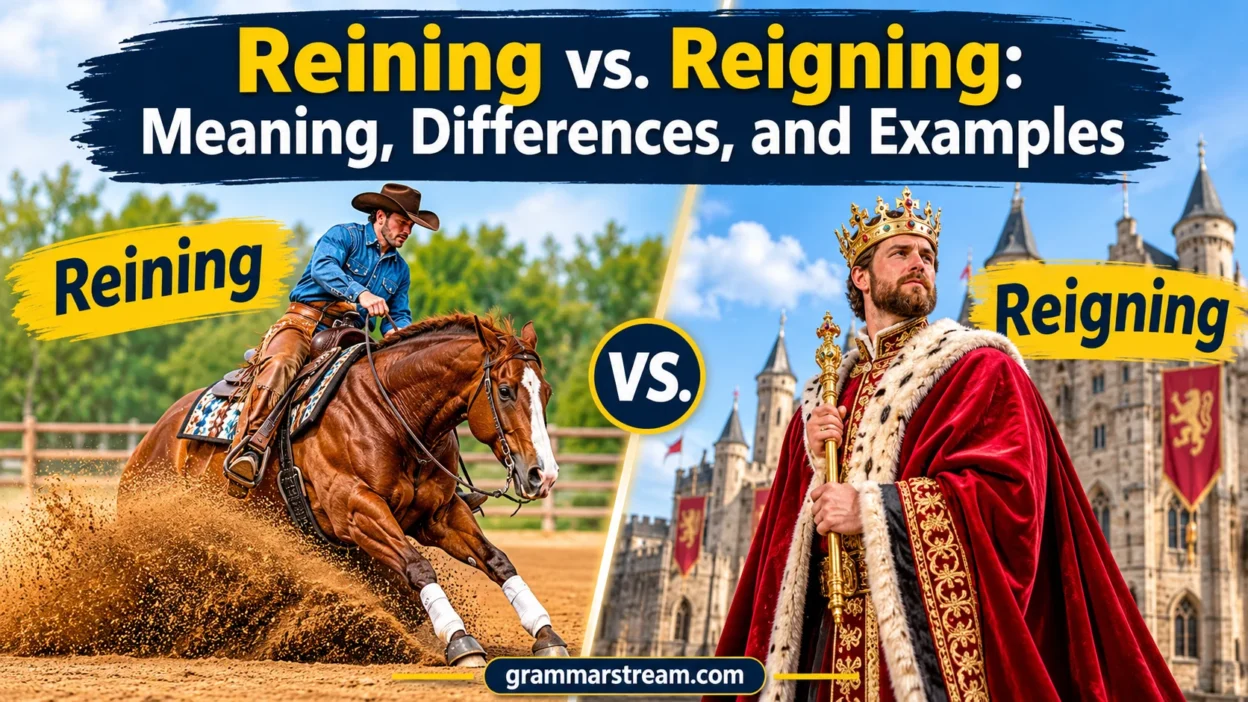
Have you ever wondered whether to write reining or reigning? These two words sound exactly alike, yet their meanings are completely different. One describes controlling or restraining something, while the other refers to ruling or holding authority. Confusing them can change the meaning of your entire sentence.
The confusion usually happens because both words share the same pronunciation. However, their spelling comes from two different root words: rein and reign. Understanding those roots makes choosing the correct spelling much easier.
For example, you might write about a company reining in expenses or a tennis player becoming the reigning champion. Both expressions are correct, but switching the words would create a spelling mistake.
Whether you’re writing an email, an article, or an academic assignment, knowing the difference helps you communicate clearly. Let’s explore their meanings, grammatical forms, common expressions, and practical examples.
Quick Answer:
Reining means controlling, guiding, or restraining something. It comes from the verb rein, which refers to controlling a horse with reins or figuratively keeping something under control.
Reigning means ruling, governing, or currently holding a position or title. It comes from the verb reign, which traditionally describes a monarch’s period of rule.
Consider these examples:
- Reining: The manager is reining in unnecessary business expenses.
- Reigning: The reigning champion won another international competition.
The easiest way to remember the difference is:
- Rein = Control
- Reign = Rule
Both spellings are correct English words. Your intended meaning determines which one you should use.
Comparison Overview
Although reining and reigning sound identical, their meanings, origins, and grammatical uses differ. Understanding their individual characteristics helps you avoid common spelling mistakes.
| Feature | Reining | Reigning |
| Root word | Rein | Reign |
| Part of speech | Present participle | Present participle |
| Main meaning | Controlling or restraining | Ruling or holding authority |
| Original association | Horse riding and reins | Kings, queens, and rulers |
| Figurative meaning | Limiting or managing something | Dominating or holding a position |
| Common expression | Reining in expenses | Reigning champion |
| Example | She is reining in her spending. | He is the reigning champion. |
| Pronunciation | /ˈreɪ.nɪŋ/ | /ˈreɪ.nɪŋ/ |
The biggest difference lies in their root words. Reining comes from rein, which relates to control. Meanwhile, reigning comes from reign, which relates to authority and leadership.
Remembering these connections makes the distinction straightforward.
Main Differences Between Reining and Reigning
The difference between reining and reigning becomes clearer when you examine their definitions and everyday applications. Both words function as present participles, but they describe entirely different actions or situations.
What Does Reining Mean?
Reining is the present participle of the verb rein. It means controlling, guiding, restraining, or limiting something.
The word originally relates to horse riding. A rider uses reins to guide a horse, adjust its movement, and maintain control. Over time, English speakers began using the expression figuratively.
Today, reining often describes controlling something that might otherwise become excessive or difficult to manage.
For example, someone might rein in their spending after noticing unnecessary purchases. A manager might rein in operating costs to protect a company’s budget.
You can use reining in several situations:
- Financial management: Reining in unnecessary expenses.
- Emotional control: Reining in anger during an argument.
- Business decisions: Reining in excessive spending.
- Personal behavior: Reining in impulsive reactions.
- Horse riding: Reining in a horse before changing direction.
One important detail is that reining doesn’t always suggest complete restriction. It often means bringing something under reasonable control.
For instance, a business that reins in expenses doesn’t necessarily stop spending. Instead, it manages its spending more carefully.
What Does Reigning Mean?
Reigning is the present participle of the verb reign. It means ruling, governing, or holding authority over a particular territory, organization, or position.
Historically, the word describes monarchs who exercise royal authority. Kings and queens reign over kingdoms during their periods of rule.
However, its modern usage extends beyond royal families. Sports commentators frequently use reigning to describe someone who currently holds a championship title.
For example, a reigning Olympic champion is the athlete who holds the title from the previous Olympic competition.
The word can also describe something that dominates a particular situation.
Common examples include:
- A reigning monarch ruling a country.
- A reigning champion defending a championship.
- A reigning leader holding political authority.
- A reigning trend dominating popular culture.
- A reigning emotion influencing someone’s decisions.
Unlike reining, which focuses on control or restraint, reigning emphasizes authority, dominance, or an existing position.
Reining vs. Reigning: The Difference in Root Words
The easiest way to understand these words is to examine where they come from.
Reining comes from rein.
A rein is a strap attached to a horse’s bridle. Riders hold the reins to guide and control the animal.
The verb rein developed a broader meaning involving restraint and management. That’s why people use expressions such as reining in expenses or reining in emotions.
Reigning comes from reign.
A reign refers to the period during which a monarch holds royal authority. The verb reign describes exercising that authority.
For example, a queen reigns over her kingdom. A reigning champion currently holds a championship title.
The spelling changes when you add the suffix -ing:
- Rein + ing = Reining
- Reign + ing = Reigning
The silent G remains in reigning because it belongs to the original word reign.
This small spelling difference carries an important meaning.
Reining Meaning, Usage, and Examples
Reining appears in several everyday expressions. Although its original meaning involves horse riding, modern English uses it widely in financial, emotional, professional, and personal contexts.
Reining in Horses
The original meaning of reining comes from controlling a horse through its reins.
Reins are straps that connect to a horse’s bridle. A rider holds them to communicate directions and manage the animal’s movements.
Depending on the riding technique, reins can help a rider:
- Guide a horse left or right.
- Slow down its movement.
- Maintain a particular direction.
- Adjust its speed.
- Prepare it for a turn or stop.
For example:
- The rider was reining in the horse before entering the stable.
- She kept reining in her horse as they approached the crowded road.
- The trainer practiced reining techniques with the young horse.
- He was reining in the horse to prevent it from moving too quickly.
Reining also appears in the name of a recognized Western riding discipline called reining. In this competitive equestrian sport, horses perform precise patterns involving spins, sliding stops, circles, and controlled movements.
The sport demonstrates the original connection between reins and control.
Reining in Spending and Expenses
One of the most common modern expressions is reining in spending.
This phrase means reducing unnecessary expenses or managing money more carefully. Individuals, businesses, and governments use it when financial resources need better control.
For example, imagine someone notices that restaurant meals, subscriptions, and online shopping consume too much of their monthly income.
They might start reining in expenses by creating a budget, canceling unused subscriptions, and limiting unnecessary purchases.
Businesses use the expression in similar ways.
A company experiencing declining profits might reduce travel costs, review supplier contracts, or postpone expensive projects.
Common examples include:
- The family started reining in household expenses.
- The company is reining in its advertising budget.
- Rising prices forced consumers to rein in unnecessary purchases.
- The finance department is reining in operating costs.
- The government introduced measures aimed at reining in public spending.
Notice that reining in doesn’t mean eliminating every expense. It means controlling spending so resources don’t disappear unnecessarily.
Read More: Oversight vs. Oversite: Meaning, Differences, and Examples
Reining in Behavior and Emotions
People also use reining in when discussing emotions, reactions, and personal behavior.
Strong emotions sometimes influence decisions before someone has time to think carefully. Reining them in means exercising self-control.
For example, imagine receiving an unpleasant message during an argument. Instead of responding immediately, you pause and choose your words carefully.
You’re reining in your anger.
This expression works with several emotions and behaviors:
- Reining in frustration during disagreements.
- Reining in excitement before an important announcement.
- Reining in aggressive behavior during competition.
- Reining in impulsive reactions at work.
- Reining in nervousness before public speaking.
Consider these sentences:
- She is learning to rein in her temper.
- The coach asked the players to rein in their aggression.
- He struggled to rein in his excitement before opening the gift.
- The manager was reining in his frustration during the meeting.
- You should rein in emotional reactions before making major decisions.
The expression suggests managing your response rather than allowing emotions to control your actions.
Reining in Growth, Costs, and Activities
In professional environments, reining often describes efforts to control growth, spending, operations, or activities.
For example, rapid business expansion can create financial pressure. A company might open too many locations before establishing a reliable customer base.
Management may decide to rein in expansion until the business becomes more stable.
Government agencies also use this expression when discussing public spending, excessive borrowing, or rising administrative costs.
Other common applications include:
| Situation | Meaning | Example |
| Business growth | Limiting rapid expansion | The company is reining in its expansion plans. |
| Operating costs | Reducing unnecessary expenses | Management is reining in operating costs. |
| Advertising | Controlling promotional spending | The brand is reining in its marketing budget. |
| Production | Managing excessive output | The factory is reining in production. |
| Activities | Limiting unnecessary actions | The organization is reining in unnecessary activities. |
The phrase works particularly well when something needs moderation rather than complete elimination.
Reining in a Sentence: Examples
Here are additional examples showing how to use reining correctly.
- The company is reining in its operating expenses.
- The rider was reining in the horse before the sharp turn.
- She is reining in her frustration during the meeting.
- The manager started reining in unnecessary purchases.
- The government introduced measures for reining in excessive spending.
- Parents sometimes struggle with reining in their children’s screen time.
- The organization is reining in its ambitious expansion plans.
- He had difficulty reining in his excitement.
- The coach focused on reining in the team’s aggressive behavior.
- Rising costs encouraged the business to rein in its budget.
In every example, the word relates to controlling, limiting, or restraining something.
Reigning Meaning, Usage, and Examples
Reigning appears most often when discussing authority, leadership, royalty, and championship titles. It can also describe something that dominates a particular situation.
Reigning as a Ruler or Monarch
The traditional meaning of reigning involves someone exercising royal authority over a kingdom or country.
A monarch’s reign begins when they take the throne and continues while they hold that position. The period can end through abdication, death, or another constitutional or political change.
For example, Queen Elizabeth II reigned over the United Kingdom from 1952 until her death in 2022. Her reign lasted approximately 70 years and seven months.
The word reigning describes the person currently holding royal authority.
Consider these examples:
- The reigning monarch attended the national celebration.
- The queen was reigning over the kingdom during a period of major change.
- The country welcomed its new reigning king.
- The reigning ruler addressed the public during the ceremony.
- The king continued reigning until his abdication.
In these sentences, reigning relates to royal authority rather than controlling or restraining something.
Reigning Champion Meaning
One of the most familiar expressions is reigning champion.
A reigning champion is an individual or team that currently holds a championship title after winning a previous competition.
The title remains theirs until another competitor wins the championship or the competition recognizes a new titleholder.
For example, if a basketball team wins its national championship in one season, it becomes the reigning champion until another team takes the title.
The same expression appears in tennis, boxing, football, athletics, and other competitive activities.
Here are some common expressions:
- Reigning world champion: The current holder of a world championship.
- Reigning national champion: The current national titleholder.
- Reigning league champion: The team that currently holds a league championship.
- Reigning heavyweight champion: The current heavyweight titleholder.
- Reigning titleholder: Someone who currently possesses a particular competitive title.
For example:
“The reigning champion returned to defend her title.”
This sentence means the athlete already holds the championship and has returned to compete again.
An important distinction: A reigning champion doesn’t necessarily mean someone who has won every previous competition. It simply identifies the current titleholder.
Frequently Asked Questions
Is Reining or Reigning Correct?
Both reining and reigning are correct English words. However, they have different meanings.
Reining means controlling or restraining something. Reigning means ruling or currently holding authority or a title.
For example, you are reining in expenses but describing an athlete as the reigning champion.
Is It Reining In or Reigning In?
Reining in is correct when you mean controlling, limiting, or restraining something.
For example, “The company is reining in unnecessary expenses.”
Reigning in is generally incorrect when expressing this meaning because reign means to rule rather than restrain.
Is It Reining Champion or Reigning Champion?
Reigning champion is the correct expression.
It describes someone who currently holds a championship title after winning a previous competition.
For example, “The reigning champion will compete in the upcoming tournament.”
Do Reining and Reigning Sound the Same?
Yes. Both words have the same pronunciation in standard American English: /ˈreɪ.nɪŋ/.
They are homophones because they sound identical but have different spellings and meanings.
The context of a sentence determines which spelling you need.
What Is the Difference Between Rein, Reign, and Raining?
These three words have different meanings.
- Rein: A strap used to control a horse; also means to restrain.
- Reign: A period of royal rule or the act of governing.
- Rain: Water falling from clouds.
Their present participle forms are reining, reigning, and raining.
Conclusion:
The difference between reining vs. reigning comes down to two simple root words: rein and reign. Reining describes controlling, guiding, or restraining something. You might use it when discussing horse riding, personal behavior, financial spending, or business expenses. Reigning describes ruling, exercising authority, or holding a current position. You’ll commonly encounter it in discussions about monarchs, championship titles, and influential trends.