Learning Spanish past tenses can feel confusing at first, especially when two different verb forms describe events that happened in the past. The preterite vs. imperfect distinction is one of the most important grammar concepts to understand if you want to speak Spanish naturally, tell stories, or describe past experiences accurately.
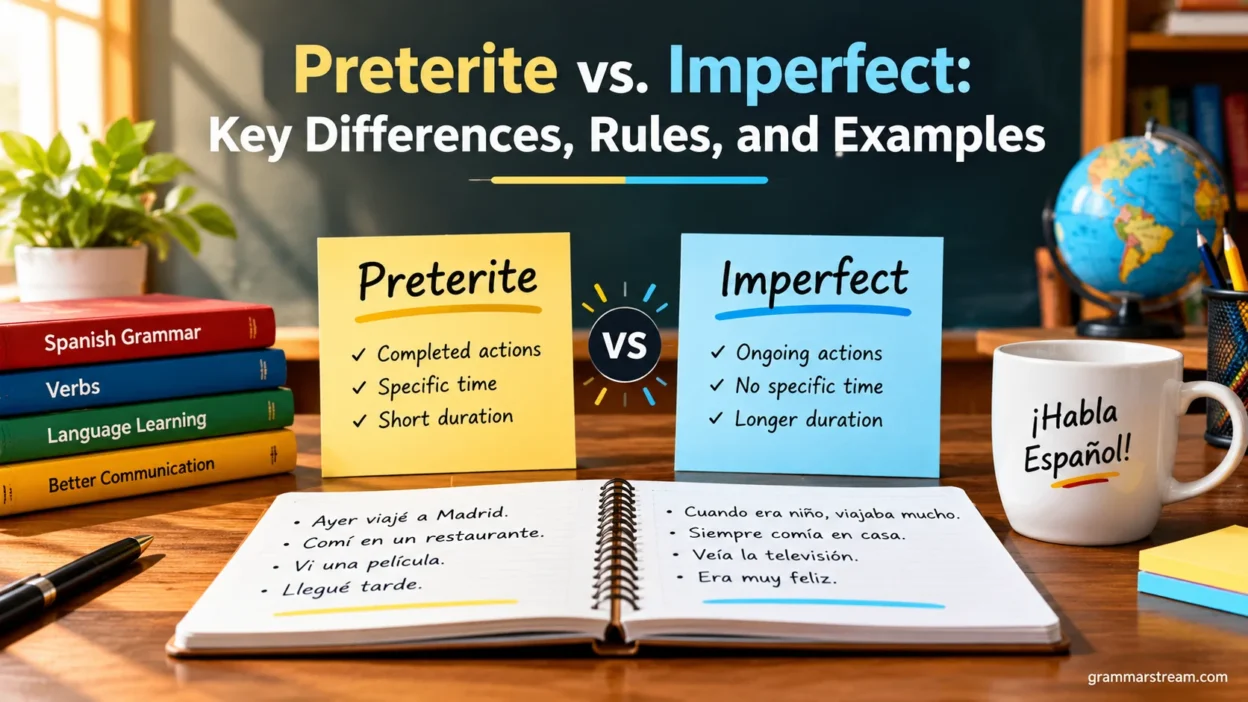
Both tenses talk about the past, but they don’t present past actions in the same way. The preterite generally presents an action as a completed event or a whole occurrence. The imperfect describes past habits, ongoing activities, and background situations without focusing on their boundaries.
For example, Ayer estudié español means “I studied Spanish yesterday.” However, Antes estudiaba español todos los días means “I used to study Spanish every day.” Both sentences describe the past, yet each gives the listener a different picture.
Quick Answer:
The preterite describes past events presented as complete occurrences, while the imperfect describes habitual actions, ongoing activities, and background conditions in the past.
| Feature | Preterite | Imperfect |
| Main purpose | Presents an event as a whole | Describes an ongoing or habitual situation |
| Completed events | Commonly used | Not the main focus |
| Past habits | Usually reports a specific occurrence rather than a habit | Commonly describes repeated habits |
| Storytelling | Advances the action | Establishes background and circumstances |
| Interruptions | Often describes the interrupting event | Often describes the action already in progress |
| English equivalents | Did, went, saw, bought | Used to do, was doing, would do |
| Example | Ayer comí pizza. — I ate pizza yesterday. | De niño, comía pizza los viernes. — As a child, I used to eat pizza on Fridays. |
The easiest way to remember the difference: The preterite tells you what happened, while the imperfect often tells you what was happening, what used to happen, or what things were like.
This is a helpful starting point, but context matters. The distinction isn’t simply between finished and unfinished actions. Spanish speakers also use these tenses to frame events differently.
Comparison Overview
The preterite and imperfect are both past tenses in Spanish, but they serve different purposes in conversation and writing. Understanding their uses side by side makes their differences easier to recognize.
| Situation | Preterite example | Imperfect example |
| A specific event | Ayer fui al mercado. — I went to the market yesterday. | — |
| A past habit | — | Iba al mercado todos los sábados. — I used to go to the market every Saturday. |
| A completed sequence | Me levanté, desayuné y salí. — I got up, ate breakfast, and left. | — |
| An ongoing activity | — | Estudiaba cuando llamaste. — I was studying when you called. |
| Background description | — | La casa era pequeña. — The house was small. |
| An interrupting event | Sonó el teléfono. — The phone rang. | Dormía cuando sonó el teléfono. — I was sleeping when the phone rang. |
| A specific discovery | Supe la verdad ayer. — I found out the truth yesterday. | Sabía la verdad. — I knew the truth. |
The dash indicates that the example is not the typical use of that tense for the particular meaning shown. It doesn’t mean the tense can never appear in a related sentence.
Remember that Spanish past-tense selection depends on the speaker’s perspective. A sentence can describe an event that lasted hours and still use the preterite if the speaker presents it as a complete occurrence.
What Is the Preterite Tense in Spanish?
The Spanish preterite, also called the pretérito indefinido or pretérito perfecto simple, is a past tense used to present events as bounded occurrences. In everyday terms, it often tells the listener what happened.
Consider this sentence:
María compró un coche ayer.
Translation: María bought a car yesterday.
The preterite compró presents the purchase as a particular event. The sentence doesn’t describe María’s ongoing relationship with the car or her general shopping habits. It reports what happened.
When to Use the Preterite
Several common situations call for the preterite.
Completed events: Use the preterite when you present an action as a complete occurrence.
- Terminé mi tarea. — I finished my homework.
- Ella cerró la puerta. — She closed the door.
- Compramos una mesa nueva. — We bought a new table.
Events at a particular time: A specific time reference often accompanies the preterite.
- Llegué a las ocho. — I arrived at eight.
- Ayer vimos una película. — We watched a movie yesterday.
- El año pasado viajaron a México. — They traveled to Mexico last year.
Sequences of events: When telling a story, use the preterite to move from one completed event to another.
- Me desperté, me duché y salí de casa. — I woke up, showered, and left the house.
- Juan abrió la ventana y miró afuera. — Juan opened the window and looked outside.
Events within a defined period: A past action can take the preterite when the speaker views it within a defined time frame.
- Trabajé en Madrid durante dos años. — I worked in Madrid for two years.
- Vivimos allí desde 2018 hasta 2020. — We lived there from 2018 to 2020.
These examples show why duration alone doesn’t determine the tense. A two-year period can be presented as a complete chapter in someone’s life.
Regular Preterite Conjugation Rules
Spanish verbs generally belong to three infinitive groups: -ar, -er, and -ir. Regular verbs follow predictable preterite endings.
| Subject | Hablar (to speak) | Comer (to eat) | Vivir (to live) |
| Yo | hablé | comí | viví |
| Tú | hablaste | comiste | viviste |
| Él, ella, usted | habló | comió | vivió |
| Nosotros/as | hablamos | comimos | vivimos |
| Vosotros/as | hablasteis | comisteis | vivisteis |
| Ellos, ellas, ustedes | hablaron | comieron | vivieron |
The vosotros forms are used mainly in Spain. In most of Latin America, speakers use ustedes when addressing a group.
Notice the written accents in hablé, habló, comí, and comió. These accents matter because they distinguish certain verb forms and their pronunciation.
The first-person plural form hablamos can mean either “we speak” or “we spoke.” The surrounding context tells you which meaning applies.
Common Irregular Preterite Verbs
Some frequent Spanish verbs don’t follow the regular preterite patterns. Learning them early helps you understand everyday conversations.
| Infinitive | Yo form | Él/ella/usted form | English meaning |
| Ser | fui | fue | To be |
| Ir | fui | fue | To go |
| Tener | tuve | tuvo | To have |
| Estar | estuve | estuvo | To be |
| Hacer | hice | hizo | To do or make |
| Poder | pude | pudo | To be able to |
| Poner | puse | puso | To put |
| Decir | dije | dijo | To say or tell |
| Venir | vine | vino | To come |
| Querer | quise | quiso | To want |
Two details deserve special attention.
First, ser and ir share the same preterite forms. Fui al cine means “I went to the movies,” while fui estudiante means “I was a student.” Context makes the meaning clear.
Second, many irregular preterite stems use a different set of endings. For example, tener becomes tuve, tuviste, tuvo, tuvimos, tuvisteis, and tuvieron.
Examples of the Preterite in Sentences
The following examples demonstrate how the preterite works in different situations.
- Ayer escribí tres correos electrónicos. — I wrote three emails yesterday.
- La película terminó a las diez. — The movie ended at ten.
- Primero cenamos y después caminamos por el parque. — First, we ate dinner, and then we walked through the park.
- Mi hermana nació en 2001. — My sister was born in 2001.
- El equipo ganó el partido. — The team won the game.
In each sentence, the speaker presents an event as a particular occurrence or completed whole. The action doesn’t have to happen quickly. What matters is how the speaker frames it.
Read More: What Does HMU Mean in Text? Examples, and How to Respond
What Is the Imperfect Tense in Spanish?
The Spanish imperfect, called the pretérito imperfecto, describes past situations without focusing on their beginning or end. It’s especially useful for habits, ongoing actions, descriptions, and background details.
For example:
Cuando era niño, jugaba en el jardín.
Translation: When I was a child, I used to play in the yard.
The imperfect era describes the speaker’s childhood situation, while jugaba expresses a habitual activity. Neither verb focuses on one particular occasion.
When to Use the Imperfect
The imperfect has several major uses.
Past habits and repeated actions: Use it for activities that happened regularly in the past.
- Todos los veranos visitábamos a nuestros abuelos. — Every summer, we used to visit our grandparents.
- Mi padre leía el periódico cada mañana. — My father used to read the newspaper every morning.
- Antes caminaba al trabajo. — I used to walk to work.
Ongoing past activities: Use the imperfect when you want to describe an action in progress without presenting its endpoint as the main point.
- Estudiaba español. — I was studying Spanish.
- Los niños dormían. — The children were sleeping.
- Llovía mucho. — It was raining heavily.
Descriptions and background information: The imperfect helps describe the setting of a story or explain what someone or something was like.
- La casa era antigua y tenía un jardín grande. — The house was old and had a large garden.
- La calle estaba vacía. — The street was empty.
- El cielo era azul. — The sky was blue.
Age, time, weather, and feelings: These are common areas where the imperfect appears.
- Tenía diez años. — I was ten years old.
- Eran las cinco. — It was five o’clock.
- Hacía frío. — It was cold.
- Estaba cansada. — She was tired.
Past situations without a stated endpoint: The imperfect can describe what a situation was like during a past period.
- Vivíamos cerca de la playa. — We lived near the beach.
- Trabajaba en una escuela. — I worked at a school.
- Conocía bien la ciudad. — I knew the city well.
The imperfect doesn’t necessarily mean that an action never ended. It simply places the focus on the situation rather than its boundaries.
Regular Imperfect Conjugation Rules
The imperfect is relatively straightforward because regular verbs use just two main ending patterns.
| Subject | Hablar (to speak) | Comer (to eat) | Vivir (to live) |
| Yo | hablaba | comía | vivía |
| Tú | hablabas | comías | vivías |
| Él, ella, usted | hablaba | comía | vivía |
| Nosotros/as | hablábamos | comíamos | vivíamos |
| Vosotros/as | hablabais | comíais | vivíais |
| Ellos, ellas, ustedes | hablaban | comían | vivían |
All regular -ar verbs use endings built around -aba. Regular -er and -ir verbs use endings built around -ía.
Unlike the preterite, the imperfect usually doesn’t distinguish the first-person singular from the third-person singular through different endings. Both yo hablaba and él hablaba mean “I was speaking,” “I used to speak,” or a related meaning depending on context.
Irregular Imperfect Verbs
Only three Spanish verbs have irregular imperfect conjugations: ser, ir, and ver.
| Subject | Ser (to be) | Ir (to go) | Ver (to see) |
| Yo | era | iba | veía |
| Tú | eras | ibas | veías |
| Él, ella, usted | era | iba | veía |
| Nosotros/as | éramos | íbamos | veíamos |
| Vosotros/as | erais | ibais | veíais |
| Ellos, ellas, ustedes | eran | iban | veían |
Although these forms require memorization, they’re common in everyday Spanish.
For example, Cuando era pequeño, iba a la escuela a pie means “When I was little, I used to walk to school.” Both verbs describe the speaker’s past circumstances and routine.
Examples of the Imperfect in Sentences
Here are more examples showing how the imperfect describes past life and experiences.
- Mi abuela preparaba pan todos los domingos. — My grandmother used to make bread every Sunday.
- Mientras tú estudiabas, yo escuchaba música. — While you were studying, I was listening to music.
- El restaurante era pequeño, pero tenía una terraza bonita. — The restaurant was small, but it had a lovely terrace.
- Eran las nueve y hacía mucho frío. — It was nine o’clock, and it was very cold.
- De niño, quería ser médico. — As a child, I wanted to be a doctor.
The imperfect gives the reader a sense of what life was like. Instead of listing isolated events, it paints a picture of an ongoing situation or repeated experience.
Main Differences Between Preterite and Imperfect
The biggest difference between the preterite and imperfect lies in how the speaker presents the past. The preterite views an event as a whole, while the imperfect describes an ongoing action, habit, or background situation.
Completed Actions vs. Ongoing Actions
Compare these sentences:
- Ayer estudié español. — I studied Spanish yesterday.
- Ayer estudiaba español cuando me llamaste. — Yesterday, I was studying Spanish when you called me.
In the first sentence, estudié presents the study session as a complete event. In the second, estudiaba describes what was happening when another event occurred.
An important point: the preterite doesn’t always mean a brief action, and the imperfect doesn’t always mean an unfinished action. The distinction depends on the perspective the speaker takes.
For instance, Viví en Madrid durante cinco años means “I lived in Madrid for five years.” The preterite presents that period as a completed chapter. Meanwhile, Vivía en Madrid cuando conocí a Ana means “I was living in Madrid when I met Ana.” The imperfect establishes the background situation.
One-Time Events vs. Repeated Habits
The preterite commonly describes a particular occurrence, while the imperfect often describes something that happened repeatedly.
Preterite:
El sábado fui al gimnasio. — I went to the gym on Saturday.
Imperfect:
Antes iba al gimnasio todos los sábados. — I used to go to the gym every Saturday.
The first sentence reports a specific trip. The second describes a former routine.
However, a single event isn’t the only possible use of the preterite. You can also use it for a series of completed actions. Likewise, repeated actions can sometimes take the preterite when the speaker counts or bounds each occurrence.
For example, Llamé tres veces means “I called three times.” The speaker treats the three calls as a defined set of events.
FAQs:
What Is the Main Difference Between Preterite and Imperfect?
The preterite presents a past event as a whole, while the imperfect describes past habits, ongoing activities, and background situations. For example, comí means “I ate,” while comía can mean “I was eating” or “I used to eat,” depending on context.
Is Preterite Past or Imperfect Past?
Both are past tenses in Spanish. The preterite generally reports bounded events, while the imperfect describes past situations or activities without emphasizing their boundaries. English doesn’t always use a separate verb form for these meanings, so translations vary.
Does the Imperfect Mean an Action Is Unfinished?
No. The imperfect doesn’t necessarily mean that an action remained unfinished in real life. It simply presents the action or situation without focusing on its beginning or end. For instance, Vivía en Madrid can describe a past living situation that has since ended.
Can a Sentence Use Both Preterite and Imperfect?
Yes. Spanish frequently combines them in the same sentence. The imperfect commonly describes an ongoing activity, while the preterite reports an event that happened during it. For example, Estudiaba cuando llegó Ana means “I was studying when Ana arrived.”
How Do You Know Which Spanish Past Tense to Use?
Start by asking whether you’re reporting an event or describing a situation. Use the preterite for completed events presented as a whole and the imperfect for habits, ongoing actions, and background descriptions. Then consider the surrounding context, because time expressions alone don’t determine the correct tense.
Conclusion:
Understanding the preterite vs. imperfect distinction is essential for describing past experiences clearly in Spanish. Both tenses refer to the past, but they help you communicate different perspectives on what happened. Use the preterite to present completed events, specific occurrences, and sequences of actions. Use the imperfect to describe past habits, ongoing activities, feelings, age, weather, and background information.