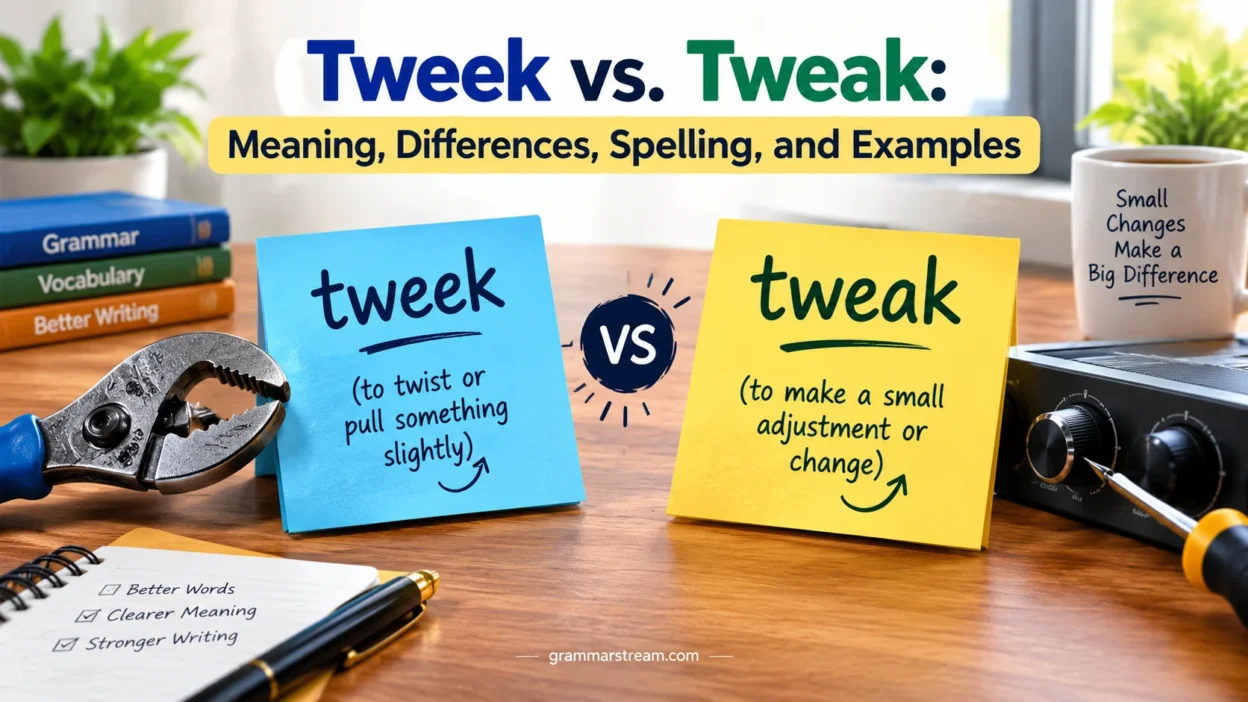
Have you ever wondered whether tweek or tweak is the correct spelling? These words look almost identical, and the difference between their vowels can easily confuse writers. However, when you want to describe making a small adjustment, only one spelling is standard English: tweak.
You might use this word when editing an article, adjusting software settings, improving a recipe, or refining a business plan. In each situation, a tweak involves changing a small detail to achieve a better result. Although tweek appears in some names and other context-specific uses, it generally isn’t the correct spelling of this everyday English word.
Understanding the difference helps you avoid spelling mistakes in emails, school assignments, professional documents, and everyday conversations. It also helps you recognize how tweak works as both a verb and a noun.
This guide explains the meanings, spelling rules, pronunciation, grammatical forms, synonyms, and practical examples of tweek vs. tweak. You’ll also learn how to remember the correct spelling and distinguish tweak from similar words.
Quick Answer
Tweak is the correct standard English spelling when you mean to make a small adjustment or refer to a minor change. Tweek is generally a misspelling when used with this meaning.
Here is the essential difference:
- Tweak (verb): To make a small change to improve, adjust, or refine something.
- Tweak (noun): A small adjustment or modification.
- Tweek: A nonstandard spelling when the intended word is tweak, although it can appear as a proper name or in specialized contexts.
Examples:
- Correct: I need to tweak the article before publishing it.
- Incorrect: I need to tweek the article before publishing it.
- Correct: One small tweak made the presentation much clearer.
Remember this simple rule: When you mean a small adjustment, spell the word t-w-e-a-k.
Comparison Overview
The easiest way to understand tweek vs. tweak is to compare their spelling, meaning, and everyday usage. Although the two forms look similar, they don’t have the same status in standard English.
| Feature | Tweak | Tweek |
| Standard English spelling | Yes | No, not for the usual meaning of tweak |
| Primary meaning | A small adjustment or the act of adjusting something | No standard equivalent to the ordinary meaning of tweak |
| Grammatical role | Verb and noun | Depends on the specific context |
| Common usage | Everyday conversation, writing, technology, and business | Proper names and other context-specific uses |
| Example | She made a small tweak to the design. | Tweek may appear as a character’s name. |
| Correct for describing a minor change | Yes | No |
| Related forms | Tweaks, tweaked, tweaking | Depends on the intended name or specialized use |
The distinction is straightforward. Tweak is the established English word for a small change, while tweek generally represents a spelling error when someone intends that word.
For example, a designer might tweak a website’s colors before launching it. A writer might tweak a sentence to make its meaning clearer. In both situations, tweak is the correct choice.
However, context matters. If you encounter Tweek as someone’s name, you shouldn’t automatically change its spelling. Proper names can follow conventions that differ from standard vocabulary.
Main Differences Between Tweek and Tweak
The difference between tweek and tweak becomes clearer when you examine their meanings, spelling, pronunciation, and grammatical functions. These details also explain why the correct spelling matters in everyday writing.
Meaning of Tweak
The word tweak describes making a small adjustment to something. People commonly use it when they want to improve a result without completely changing the original object, plan, or idea.
Imagine that you’ve written a blog post but find one sentence confusing. You don’t need to rewrite the entire article. Instead, you can tweak that sentence by changing a few words.
The adjustment might be small, but it can make the meaning much clearer.
As a verb, tweak often means to:
- Adjust something slightly.
- Improve a detail through a minor change.
- Refine a plan, design, or process.
- Change settings to achieve a desired result.
- Make a small correction without replacing the entire thing.
Examples:
- I tweaked the headline to make it more engaging.
- The technician tweaked the software settings.
- She tweaked the recipe by adding more garlic.
- We need to tweak our schedule before the meeting.
- He tweaked the brightness to improve the photograph.
In each example, the original item remains largely the same. The change focuses on a specific detail.
Tweak can also describe a physical action, such as pinching or pulling something lightly. For instance, someone might tweak a loose thread on a sweater.
The word therefore has more than one related use. However, the idea of a small, targeted adjustment is especially common in modern everyday English.
Meaning of Tweek
Tweek is generally incorrect when you intend to use the standard English word meaning a small adjustment. If you write, “I need to tweek the settings,” most readers will recognize the intended meaning, but the spelling is nonstandard.
The mistake often occurs because English spelling doesn’t always match pronunciation perfectly. A writer may hear the word and choose ee instead of ea.
However, the fact that two spellings look or sound similar doesn’t make them interchangeable.
Consider these examples:
| Nonstandard spelling | Standard spelling |
| I need to tweek the article. | I need to tweak the article. |
| She made a small tweek to the logo. | She made a small tweak to the logo. |
| He tweeked the settings yesterday. | He tweaked the settings yesterday. |
| They are tweeking the presentation. | They are tweaking the presentation. |
There is one important exception to remember: Tweek can be intentional when used as a proper name or in a context-specific spelling.
For example, Tweek Tweak is the name of a fictional character in the animated television series South Park. In that context, the spelling belongs to the character’s name rather than serving as an alternative spelling of the ordinary word tweak.
The distinction depends on how the word functions in a sentence. When describing an adjustment, use tweak. When reproducing an established name, preserve its correct spelling.
Tweek vs. Tweak: Spelling Rules
The main spelling difference involves two vowel combinations: ea and ee.
The standard word is spelled t-w-e-a-k. Replacing ea with ee produces tweek, which isn’t the standard spelling for the intended meaning.
English contains many words with similar vowel combinations but different spellings. For example, speak, break, week, and seek all contain vowel combinations that behave differently in pronunciation.
These patterns can make English spelling challenging. Unfortunately, no single rule guarantees that every word will follow the same pattern.
The most reliable approach is to learn the established spelling of frequently used words.
Here are three practical ways to remember tweak:
- Remember the letters: The correct spelling contains ea, not ee.
- Connect the word with adjustments: Think of tweaking a headline, a recipe, or a setting.
- Learn the related forms: Remember tweak, tweaks, tweaked, and tweaking as one word family.
For example, if you write articles regularly, remember the phrase “tweak the headline.” The familiar expression reinforces the correct spelling.
Another useful trick is to associate tweak with refinement. Whenever you want to describe a small improvement, picture yourself making a tweak rather than starting from scratch.
Read More: Putting vs. Puting: Meaning, Differences, Spelling, and Examples
Tweek vs. Tweak: Pronunciation
In standard American English, tweak is pronounced /twiːk/. Its pronunciation rhymes with week and seek.
The word begins with the /t/ sound, followed by the /w/ sound. The vowel /iː/ is the long ee sound heard in week. The final /k/ completes the word.
Although the vowel is pronounced like the vowel in week, the standard spelling uses ea rather than ee.
This distinction is important because English spelling and pronunciation don’t always correspond directly.
Consider these words:
| Word | Pronunciation | Spelling observation |
| Tweak | /twiːk/ | Uses ea |
| Week | /wiːk/ | Uses ee |
| Speak | /spiːk/ | Uses ea |
| Seek | /siːk/ | Uses ee |
These examples show why pronunciation alone cannot reliably determine spelling. Words with similar sounds may use different letter combinations.
If you hear someone say tweak, you might naturally think of week. However, remembering the established spelling will help you avoid writing tweek by mistake.
Tweak as a Verb
A verb describes an action, and tweak often describes the act of making a small adjustment.
You can tweak almost anything that allows a minor change. Writers tweak sentences, developers tweak software, cooks tweak recipes, and designers tweak layouts.
The word is especially useful when the change is limited rather than dramatic.
Common Verb Forms of Tweak
The verb tweak follows the regular pattern used by many English verbs.
| Verb form | Usage | Example |
| Tweak | Base form | I want to tweak the introduction. |
| Tweaks | Present tense with a singular third-person subject | She tweaks each headline carefully. |
| Tweaked | Simple past tense | He tweaked the settings yesterday. |
| Tweaked | Past participle | We have tweaked the design. |
| Tweaking | Present participle or gerund | They are tweaking the final draft. |
These forms retain the original spelling pattern.
Notice that tweak becomes tweaked in the past tense. It doesn’t become tweeked. Similarly, the present participle is tweaking, not tweeking.
Examples of Tweak as a Verb
- The editor tweaked the introduction to make it more interesting.
- I need to tweak my presentation before tomorrow’s meeting.
- The developer is tweaking the application’s interface.
- She tweaks her workout routine whenever her schedule changes.
- We tweaked the recipe until the flavor was just right.
Each sentence describes a targeted adjustment.
For instance, changing a few words in an introduction is different from replacing an entire article. The verb tweak communicates that the writer is refining existing material.
Tweak as a Noun
Although people frequently use tweak as a verb, it also functions as a noun.
As a noun, a tweak is a small adjustment or modification. Instead of describing the action of changing something, it identifies the change itself.
Compare these sentences:
- Verb: I need to tweak the website’s layout.
- Noun: The website needs one final tweak.
In the first sentence, tweak describes an action. In the second, it identifies the adjustment that needs to happen.
This distinction becomes especially useful in professional communication.
For example, a manager might tell a designer, “The presentation looks good, but it needs a small tweak.” The manager isn’t requesting a complete redesign. They want one minor improvement.
Common noun expressions include:
- A slight tweak
- A small tweak
- A final tweak
- A minor tweak
- A quick tweak
Examples:
- One small tweak improved the readability of the report.
- The recipe needs a slight tweak to balance its flavor.
- We made a final tweak to the presentation.
- The new update includes several tweaks to the user interface.
In each example, tweak refers to the adjustment rather than the action of making it.
Common Contexts Where Tweak Is Used
The word tweak appears in many areas of everyday life. Its flexibility makes it useful whenever someone wants to describe a small, targeted change.
Tweak in Writing and Editing
Writers often tweak their work during the editing process. They may replace a vague word, shorten a sentence, improve a heading, or correct a minor grammatical problem.
For example, consider this sentence:
“The company made a change to its website to improve the way customers use it.”
A writer might tweak it to make the meaning more direct:
“The company updated its website to improve the customer experience.”
The revised sentence expresses the idea more clearly with fewer words.
Other examples include:
- Tweaking a headline to attract readers.
- Tweaking an introduction to answer a search query.
- Tweaking a paragraph to improve its flow.
- Tweaking a conclusion to reinforce the main point.
For writers, a tweak is often one small step in the larger editing process.
Tweak in Technology and Software
Technology professionals frequently use tweak when discussing settings, configurations, and performance.
A developer might tweak an application’s interface to make navigation easier. A computer user might tweak display settings to improve readability.
Examples include:
- I tweaked the screen brightness for better visibility.
- The developer tweaked the application’s settings.
- We tweaked the configuration to resolve a display issue.
- The technician made a few tweaks to the system.
However, the word doesn’t automatically imply that a change will solve a technical problem. It simply describes the adjustment.
For example, changing a setting might improve performance, have no noticeable effect, or introduce another problem. The result depends on what the user changes.
FAQs:
Is Tweek or Tweak the Correct Spelling?
Tweak is the correct spelling when you mean to make a small adjustment or refer to a minor change. Tweek is generally a misspelling in this context.
For example, write “I need to tweak the article,” not “I need to tweek the article.” However, Tweek may be correct when it appears as an established proper name.
What Does Tweak Mean in Simple Terms?
Tweak means to make a small change to improve or adjust something.
For example, you might tweak a recipe by adding more seasoning or tweak an article by changing a confusing sentence. The word usually suggests a minor change rather than a complete replacement.
Is Tweek Ever a Correct Word?
Tweek can be correct as a proper name or in a specific context. For example, Tweek Tweak is a fictional character in South Park.
However, tweek isn’t the standard spelling of the everyday English word meaning a small adjustment. When you intend that meaning, use tweak.
How Do You Use Tweak in a Sentence?
You can use tweak as either a verb or a noun.
As a verb: “I need to tweak the presentation before the meeting.”
As a noun: “The presentation needs one final tweak.”
The verb describes the action of making an adjustment. The noun identifies the adjustment itself.
What Is the Difference Between Tweak and Modify?
Both words describe making changes, but tweak usually suggests a small, targeted adjustment. Modify can describe changes of different sizes.
For example, tweaking a website might involve adjusting its colors or spacing. Modifying a website could involve anything from minor edits to substantial structural changes.
Conclusion:
The difference between tweek vs. tweak comes down to standard spelling and context. When you want to describe making a small adjustment or refer to a minor change, tweak is the correct English word. You can use tweak as a verb when adjusting something and as a noun when describing the adjustment itself. Its related forms include tweaks, tweaked, and tweaking.