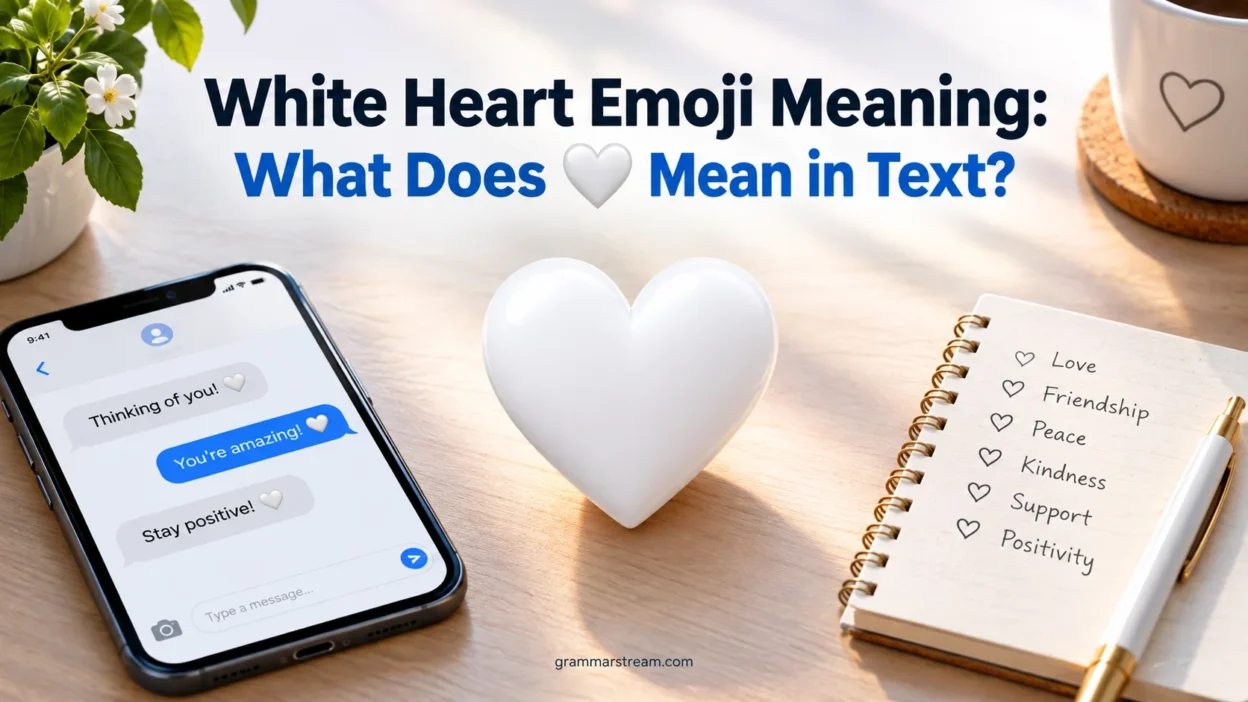
The white heart emoji 🤍 can look simple, but its meaning changes with the conversation around it. Someone might send it to show love, while another person may use the same emoji to offer comfort, friendship, sympathy, or calm affection.
That flexibility makes the white heart different from a message with a fixed meaning. When someone texts “I’m proud of you 🤍,” the emoji adds warmth. When someone comments “Beautiful 🤍” under a photo, it may simply show appreciation. In a difficult conversation, the same symbol can communicate emotional support without needing a long explanation.
The white heart emoji meaning also depends on the relationship between two people. A close friend may use 🤍 casually, while a romantic partner might use it as a softer expression of love. Your best clue usually comes from the words, situation, and communication style surrounding the emoji.
Technically, 🤍 is the White Heart emoji, represented by Unicode as U+1F90D. It became part of the Unicode Standard with Unicode 12.0 in 2019 and was included in Emoji 12.0. Since then, people have adopted it across texting, social media, comments, captions, and private messages.
Quick Answer
The white heart emoji 🤍 commonly expresses love, affection, care, emotional support, kindness, peace, sympathy, purity, or a soft aesthetic feeling.
However, 🤍 doesn’t have one universal meaning. Its interpretation depends on the message and relationship.
Here are some common meanings:
| Context | Common meaning of 🤍 |
| Romantic conversation | Love, affection, tenderness |
| Friendship | Care, appreciation, loyalty |
| Difficult situation | Support and comfort |
| Condolences | Sympathy and compassion |
| “Thank you 🤍” | Warm appreciation |
| “Goodnight 🤍” | Tenderness or affection |
| Social media caption | Aesthetic or emotional emphasis |
| White-themed content | Color or visual symbolism |
| Encouraging message | Support and kindness |
| Message from a crush | Possible affection, but not proof of romance |
The key point is simple: don’t interpret 🤍 in isolation. The surrounding words usually tell you more than the emoji itself.
Comparison Overview
Different heart emojis can communicate different emotional tones, although their meanings overlap.
| Emoji | Common associations | Typical tone |
| 🤍 | Pure love, care, peace, support | Soft and gentle |
| ❤️ | Love, passion, strong affection | Direct and intense |
| 🩷 | Sweetness, tenderness, affection | Cute and warm |
| 🖤 | Dark humor, grief, style, deep emotion | Moody or intense |
| 💙 | Trust, support, friendship, calm | Friendly and steady |
| 💜 | Affection, admiration, support | Warm and expressive |
| 🤎 | Comfort, warmth, earthiness | Cozy and grounded |
| 💚 | Nature, care, growth, support | Fresh and positive |
| 🩵 | Calmness, tenderness, support | Light and gentle |
| 🧡 | Warmth, care, friendship | Friendly and energetic |
These aren’t strict rules. People often choose a heart because they like its color, appearance, or emotional feel.
Main Differences Between White Heart Emoji Meaning and Other Heart Emojis
The biggest difference between 🤍 and other heart emojis is its softer visual and emotional tone.
A red heart often communicates love more directly. A white heart can express affection without necessarily carrying the same romantic intensity. That’s why you’ll often see 🤍 in supportive messages, friendship posts, aesthetic captions, and emotional conversations.
For example:
- “I love you ❤️” can sound openly romantic or passionate.
- “I love you 🤍” can sound softer, gentler, or more tender.
- “Proud of you 🤍” can communicate emotional support.
- “Thinking of you 🤍” can work between friends, family members, or romantic partners.
The difference isn’t a dictionary definition. It’s a matter of tone and context.
What Does the White Heart Emoji 🤍 Mean?
At its core, the white heart represents warmth and affection with a softer emotional tone.
White has long been associated with ideas such as peace, innocence, cleanliness, simplicity, and purity in many visual and cultural contexts. Emoji users can draw on those associations when choosing 🤍.
Still, an emoji doesn’t automatically inherit every traditional meaning of its color. Someone may simply use 🤍 because it looks beautiful with the rest of their message.
Pure and Sincere Love
One of the most common interpretations of 🤍 involves pure or sincere love.
The emoji can communicate affection without making the message feel overly dramatic. That makes it useful when someone wants to express genuine care in a gentle way.
For example:
“You mean so much to me 🤍”
Here, the white heart strengthens the affectionate tone. It doesn’t necessarily make the message romantic. The relationship determines that part.
A parent might send it to a child. A close friend might send it after an emotional conversation. A partner might use it in a romantic message.
Emotional Support and Comfort
Another major white heart emoji meaning involves support.
When someone feels stressed, disappointed, lonely, or overwhelmed, 🤍 can serve as a small emotional gesture. It often appears beside phrases such as:
- “I’m here for you 🤍”
- “You’ve got this 🤍”
- “Sending you love 🤍”
- “I’m thinking about you 🤍”
- “You don’t have to go through this alone 🤍”
In these situations, the emoji doesn’t need to explain anything. It works more like a gentle pat on the shoulder.
Friendship and Platonic Affection
The white heart isn’t exclusively romantic.
Friends frequently use 🤍 to show appreciation, closeness, encouragement, or loyalty. This use becomes especially common in social-media comments and casual texting.
For example:
“Thank you for always being there 🤍”
That sentence can come from one friend to another without any romantic meaning.
Likewise:
“Love you bestie 🤍”
Here, the surrounding phrase clearly frames the heart as friendship.
Peace, Calm, and Positivity
The white heart can also suggest peace, calmness, kindness, and emotional softness.
You’ll sometimes see it alongside messages about peaceful moments, personal growth, relaxation, or positive feelings.
For example:
- “Protect your peace 🤍”
- “Choose kindness 🤍”
- “A peaceful morning 🤍”
- “Keep going. Better days are coming 🤍”
In these cases, the emoji adds a calm visual tone rather than expressing romantic love.
Innocence and Purity
Because white often carries associations with purity and innocence, 🤍 can sometimes reinforce those ideas.
This interpretation can appear in posts involving:
- Weddings
- Babies
- Childhood memories
- White clothing
- Minimalist photography
- Religious or spiritual imagery
- Clean and elegant designs
However, context remains important. A white heart under a wedding photograph might symbolize love, elegance, purity, or simply match the image’s color palette.
Aesthetic and Color-Based Use
Sometimes the simplest explanation is the correct one: the person likes the way 🤍 looks.
Social-media users often choose emojis based on visual style. A white heart fits naturally with minimalist, neutral, winter, fashion, luxury, monochrome, and soft-toned content.
For example:
“White outfit kind of day 🤍”
The heart doesn’t necessarily express a deep emotional message. It complements the visual theme.
White Heart Emoji Meaning in Text Messages
Texting gives 🤍 a particularly broad range of meanings because people often use emojis to add emotional tone to short messages.
Consider these examples:
“Thank You 🤍”
This usually makes a simple thank-you feel warmer.
Without the emoji:
“Thank you.”
With the emoji:
“Thank you 🤍”
The second version can feel more affectionate and personal.
“Goodnight 🤍”
This can express tenderness or affection. Between romantic partners, it may feel intimate. Between close friends, it can remain completely platonic.
“I’m Proud of You 🤍”
This usually communicates encouragement and emotional support.
The heart softens the statement and makes it feel more personal.
“Take Care 🤍”
This can show genuine concern without necessarily implying romance.
“Miss You 🤍”
This one carries more emotional weight. Depending on the relationship, it can be romantic or simply express strong friendship or family affection.
Why Context Matters So Much
The same emoji can mean completely different things in different conversations.
Consider this example:
Person A: “I finally passed my exam!”
Person B: “I’m so proud of you 🤍”
The white heart probably reinforces encouragement and affection.
Now consider:
Person A: “I miss you.”
Person B: “Miss you too 🤍”
The emotional context feels more intimate.
The emoji stayed the same. The conversation changed.
When interpreting 🤍, consider these factors:
- Your relationship with the sender
- The words before the emoji
- The topic of conversation
- Whether the sender regularly uses heart emojis
- Whether they use 🤍 with other people
- The tone of previous messages
- Whether the conversation is romantic, friendly, supportive, or casual
White Heart Emoji Meaning From a Girl
When a girl sends 🤍, it can communicate affection, friendship, support, appreciation, tenderness, or romantic interest.
The emoji alone doesn’t establish which one applies.
For example, if she writes:
“Thank you for helping me today 🤍”
that may simply show appreciation.
If she writes:
“Goodnight, I miss you 🤍”
the surrounding language creates a much more affectionate tone.
Likewise, a friend might comment:
“You’re gorgeous 🤍”
without intending anything romantic.
The safest interpretation comes from the complete conversation rather than the emoji by itself.
White Heart Emoji Meaning From a Guy
Guys can use 🤍 in much the same way.
A guy might send it to:
- Show friendship
- Express appreciation
- Offer emotional support
- Show romantic affection
- Respond warmly to someone
- Add softness to a message
- Match the other person’s emoji style
For instance:
“Thanks for listening to me 🤍”
usually emphasizes appreciation.
Meanwhile:
“Can’t wait to see you tonight 🤍”
could carry a more romantic tone depending on the relationship.
Again, the emoji doesn’t provide enough evidence by itself.
Read More: ASL Meaning in Text: What Does ASL Mean in Texting?
White Heart Emoji 🤍 in Romantic Relationships
Couples often use 🤍 to express affection in a softer way.
A red heart can feel bold and passionate. A white heart can feel more understated and tender.
Romantic examples include:
- “Good morning, beautiful 🤍”
- “I miss you so much 🤍”
- “Can’t wait to see you 🤍”
- “You make me so happy 🤍”
- “Always yours 🤍”
The white heart can work especially well when the rest of the message already communicates romance.
For couples, emoji meanings can also become personal. Two people might give 🤍 a private meaning that outsiders wouldn’t understand.
That’s normal. Digital communication develops its own little vocabulary.
White Heart Emoji 🤍 From Your Crush
If your crush sends 🤍, it’s natural to wonder whether it means something romantic.
However, one emoji can’t confirm someone’s feelings.
Look at the entire interaction instead.
Example One
“Thanks for helping me with that 🤍”
This could simply be appreciation.
Example Two
“I had such a good time with you tonight 🤍”
This carries more emotional warmth, although it still doesn’t prove romantic interest.
Example Three
“Goodnight 🤍”
This can be affectionate, but the meaning depends heavily on your existing relationship.
The most useful clue is often consistent behavior and language, not a single symbol.
White Heart Emoji 🤍 Between Friends
Friends use 🤍 frequently because it expresses closeness without necessarily sounding romantic.
Common examples include:
- “Best friend forever 🤍”
- “You deserve the world 🤍”
- “So happy for you 🤍”
- “Love you girl 🤍”
- “Thanks for always listening 🤍”
The phrase “love you” itself can have different meanings between friends. Adding 🤍 doesn’t automatically turn it into a romantic statement.
Friendship has its own emotional vocabulary.
White Heart Emoji 🤍 on Social Media
Social platforms give the white heart another important role: visual expression.
On Instagram, 🤍 often appears in:
- Fashion captions
- Travel posts
- Friendship photos
- Wedding content
- Minimalist photography
- Self-care posts
- Emotional captions
For example:
“A little piece of peace 🤍”
Here, the emoji reinforces the calm mood.
TikTok
On TikTok, people may use 🤍 in comments to show support, affection, admiration, or emotional connection.
A viewer might comment:
“This made me cry 🤍”
The heart emphasizes the emotional response.
Snapchat
On Snapchat, 🤍 can appear in direct messages, stories, and replies. Its meaning usually depends heavily on the personal relationship between the users.
White Heart Emoji Meaning in Different Situations
| Message or situation | Likely interpretation |
| “I love you 🤍” | Love or affection |
| “Thank you 🤍” | Warm appreciation |
| “Goodnight 🤍” | Tenderness or affection |
| “I’m proud of you 🤍” | Support and care |
| “I’m here for you 🤍” | Emotional support |
| “Miss you 🤍” | Affection or longing |
| “Beautiful 🤍” | Admiration |
| Condolence message + 🤍 | Sympathy |
| White outfit + 🤍 | Aesthetic/color association |
| Wedding photo + 🤍 | Love, elegance, or purity |
These are common interpretations rather than fixed definitions.
White Heart Emoji vs. Red Heart Emoji ❤️
The difference between 🤍 and ❤️ often comes down to emotional intensity and context.
❤️ commonly communicates direct love, strong affection, passion, or romantic feeling.
🤍 can communicate love too, but it often feels softer, calmer, or more understated.
Compare:
“I love you ❤️”
with:
“I love you 🤍”
Both can express love. The second may feel gentler.
Still, people have personal emoji habits. Some users use ❤️ constantly without intending romance. Others rarely use it and prefer 🤍.
White Heart Emoji vs. Pink Heart 🩷
The pink heart often carries associations with sweetness, tenderness, affection, and cute romantic energy.
The white heart can feel more neutral and understated.
For example:
- 🩷 may fit a cute or playful message.
- 🤍 may fit a calm, elegant, or supportive message.
These distinctions aren’t strict. Emoji meanings overlap considerably.
White Heart Emoji vs. Black Heart 🖤
The black heart has a broader range of darker or more alternative associations.
People may use 🖤 for:
- Dark humor
- Alternative fashion
- Grief
- Intense emotions
- Edgy aesthetics
- Strong affection expressed in a darker style
The white heart generally creates a softer visual impression.
White Heart Emoji vs. Blue Heart 💙
The blue heart often appears in contexts involving friendship, trust, support, calmness, or loyalty.
The white heart can overlap with those meanings while adding associations with softness, purity, and simplicity.
Neither emoji has a universal emotional code.
FAQs:
What does the 🤍 white heart emoji mean?
The 🤍 white heart commonly expresses love, affection, care, support, peace, sympathy, kindness, or purity. Its exact meaning depends on the conversation and relationship between the people using it.
Does 🤍 mean love?
Yes, 🤍 can mean love. However, that love doesn’t have to be romantic. Friends and family members can use it to express affection and care.
What does 🤍 mean from a girl?
A girl may use 🤍 to show friendship, appreciation, emotional support, affection, or romantic interest. The emoji alone can’t establish which meaning she intends.
What does 🤍 mean from a guy?
A guy may use 🤍 to express friendship, warmth, support, appreciation, or romantic affection. The surrounding message provides important context.
Is the white heart emoji romantic?
Sometimes. 🤍 can have a romantic meaning when it appears in an affectionate conversation. However, people also use it for friendship, family, sympathy, support, and aesthetics.
Conclusion:
The white heart emoji meaning is broader than simply “pure love.” 🤍 can express affection, friendship, emotional support, sympathy, kindness, peace, appreciation, or even a simple preference for a white aesthetic. Its flexibility explains why people use it across so many situations.
When someone sends you 🤍, don’t automatically assume it’s romantic. Instead, consider the words around it, your relationship with the sender, the topic of conversation, and that person’s usual texting style.