If someone sends you “ASL?” in a text message, the meaning might not be obvious at first. You could be looking at three simple letters while wondering what the other person actually wants to know.
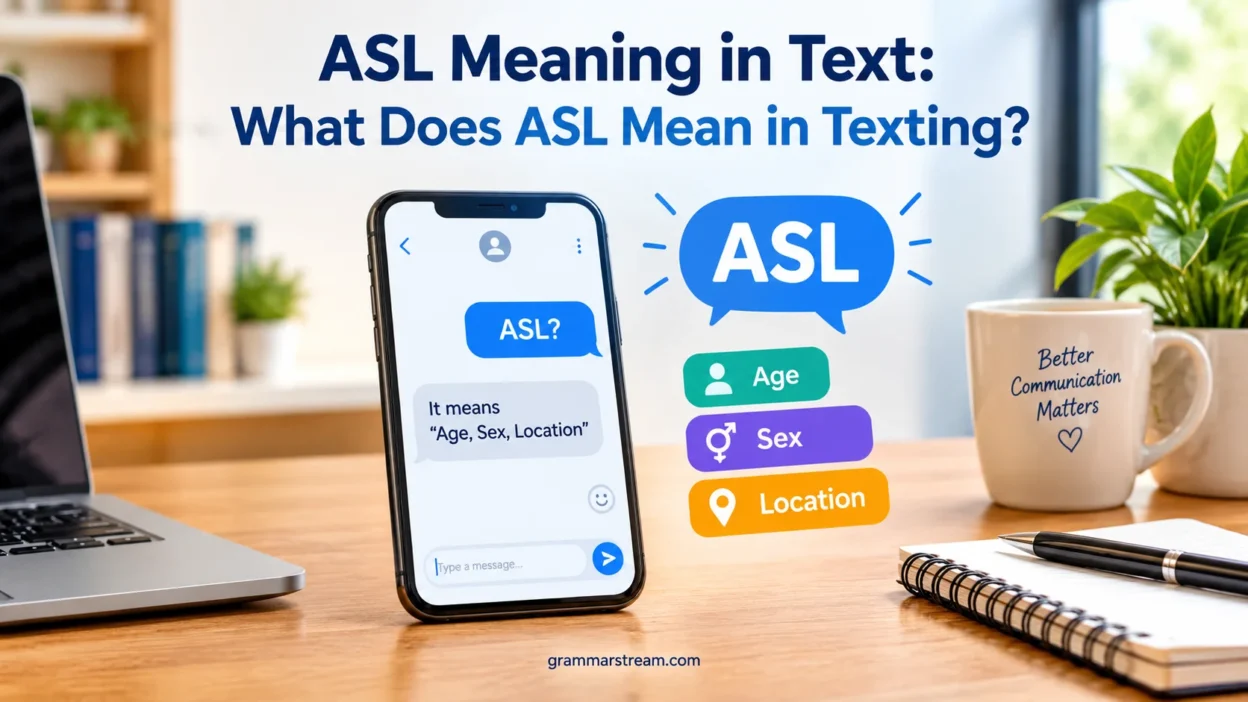
In traditional online chat, ASL means “Age, Sex, Location?” People used this short question to ask for someone’s age, sex, and general location. The abbreviation became especially recognizable during the early days of internet chat rooms and instant messaging.
However, ASL has another major meaning. It can stand for American Sign Language, a complete visual language used by many Deaf and hard-of-hearing people in the United States and parts of Canada.
That difference matters. If someone writes “ASL?” while chatting with a stranger, they may be asking for basic personal information. If someone says “I’m learning ASL,” they almost certainly mean American Sign Language.
Quick Answer
ASL traditionally means “Age, Sex, Location?” in texting and online chat.
The three letters represent:
- A = Age
- S = Sex
- L = Location
For example:
Person 1: Hey, ASL?
Person 2: 22, female, Texas.
Here, the first person is asking for the other person’s age, sex, and general location.
However, ASL can also mean American Sign Language. For example:
“Do you know ASL?”
In this sentence, ASL most likely refers to American Sign Language, not age, sex, and location.
So, the easiest way to understand ASL meaning in text is to check the context.
| ASL Meaning | What It Stands For | Common Context |
| Age, Sex, Location? | Age, sex, and location | Older chat rooms and personal online conversations |
| American Sign Language | A natural visual language | Deaf culture, education, communication, accessibility |
| Other specialized meanings | Depends on the field | Professional or technical contexts |
Comparison Overview
Although the abbreviation looks identical, its meanings can be completely different.
| Feature | ASL: Age, Sex, Location? | ASL: American Sign Language |
| Main purpose | Asking for basic personal information | Referring to a visual language |
| Common setting | Online chats and older messaging culture | Education, accessibility, Deaf communities, communication |
| Typical wording | “ASL?” | “Do you know ASL?” |
| Age involved? | Yes | No |
| Location involved? | Yes | No |
| Refers to a language? | No | Yes |
| Modern usage | Less common than in early chat culture | Widely recognized and actively used |
| Typical response | “25, male, Ohio” | “Yes, I’m learning it” |
The biggest clue is how ASL appears in the sentence.
When someone simply asks “ASL?”, the older chat abbreviation may be intended. When someone discusses learning, teaching, interpreting, signing, Deaf culture, or accessibility, American Sign Language is usually the intended meaning.
Main Differences Between ASL Meaning in Text
The two common meanings of ASL don’t simply differ in definition. They belong to entirely different areas of communication.
ASL Meaning as Age, Sex, Location?
The traditional texting meaning of ASL is a short way to ask three personal questions.
The person is essentially asking:
- How old are you?
- What is your sex?
- Where are you located?
The wording comes from early internet communication, particularly chat rooms and instant messaging.
Instead of typing a full sentence such as “How old are you, what is your sex, and where are you from?”, users could type “ASL?”
That made the exchange faster.
The abbreviation became especially associated with anonymous online conversations. People often met strangers in chat rooms without knowing anything about each other. Asking for age, sex, and location provided a quick introduction.
For example:
“Hey, ASL?”
A traditional response might look like:
“20, male, California.”
The location generally referred to a city, state, country, or broad area, rather than a street address.
ASL Meaning as American Sign Language
The second major meaning is American Sign Language.
American Sign Language is a natural language that uses hand movements, facial expressions, body movements, and visual-spatial grammar rather than spoken sounds.
It isn’t simply English translated into hand signs.
That’s an important distinction.
American Sign Language has its own grammar and linguistic structure. It developed within Deaf communities in the United States and has a long history of use in education, community life, family communication, and everyday interaction.
For example:
“I’m taking an ASL class this semester.”
Here, nobody is asking about age or location. The sentence clearly refers to American Sign Language.
Likewise:
“She knows ASL and works as an interpreter.”
The context makes the meaning obvious.
Why Context Matters So Much
Acronyms can behave like chameleons. Their appearance stays the same while their meaning changes with the conversation.
Consider these two messages:
“ASL?”
and:
“Do you know ASL?”
The first could come from older online chat culture. The second strongly suggests American Sign Language.
Now consider:
“I’m practicing ASL vocabulary.”
There is almost no ambiguity. The writer is talking about the language.
That’s why you shouldn’t automatically assign one definition to every occurrence of ASL.
Read More: WTV Meaning in Text: What Does WTV Mean in Texting?
What Does ASL Mean in Texting?
When someone asks “What does ASL mean in texting?”, the traditional answer is “Age, Sex, Location?”
This usage became popular during an earlier period of internet communication when people commonly interacted with strangers through text-based chat services.
The abbreviation worked almost like a miniature introduction form.
Instead of exchanging several messages, one person could ask:
“ASL?”
The other person could answer with three pieces of information.
What Does Each Letter in ASL Mean?
The traditional abbreviation breaks down as follows:
- A — Age: The person’s age.
- S — Sex: Traditionally, whether the person identified as male or female in the context of the question.
- L — Location: Where the person lives or where they are located.
The expression often appeared as ASL? or A/S/L?
Both forms generally carried the same basic meaning in older chat contexts.
What Does “Location” Mean in ASL?
In this context, location usually means a general geographic area.
Someone might respond:
- “Chicago”
- “Florida”
- “Toronto”
- “New York”
- “Texas”
It doesn’t inherently mean a precise address.
That distinction matters today because sharing your exact location with an unknown person online can create unnecessary privacy risks.
Is ASL Still Common in Text Messages?
The traditional Age, Sex, Location? meaning is much less prominent today than it was during the early internet era.
Modern social platforms have changed how people introduce themselves online. Profiles often display names, photos, ages, interests, locations, or other information without requiring someone to ask “ASL?”
Messaging has changed too.
People now commonly use platforms where conversations happen between people who already know one another. As a result, the old three-letter introduction isn’t as necessary as it once was.
Still, you may encounter ASL in older online conversations, nostalgic discussions about internet culture, gaming communities, chat environments, or conversations with people familiar with early internet slang.
The expression hasn’t vanished. It simply isn’t as central to everyday messaging as it once was.
ASL Meaning on Social Media
The meaning of ASL on social media depends heavily on the conversation.
ASL in a Personal Conversation
If a stranger sends:
“Hey, ASL?”
they may be using the traditional meaning.
They could be asking for:
- Your age
- Your sex
- Your general location
This usage is more likely when the conversation involves meeting someone online or introducing yourselves.
ASL in an Educational Conversation
Now consider:
“I’m studying ASL at school.”
Here, ASL means American Sign Language.
The words around the acronym provide enough information to identify the intended meaning.
Other examples include:
- “I want to learn ASL.”
- “My sister teaches ASL.”
- “Where can I practice ASL?”
- “ASL grammar is different from English grammar.”
- “We watched an ASL interpretation.”
Each example points toward American Sign Language.
ASL in Gaming and Online Communities
Gaming communities can contain a mixture of old and new internet language.
Someone might use ASL as an old-fashioned way to ask personal information. Another person might mention ASL because they’re discussing communication or accessibility.
That means the community alone doesn’t determine the definition.
The sentence itself matters more.
ASL Meaning in Different Texting Contexts
Context gives you the best clue when an acronym has multiple definitions.
| Message | Likely ASL Meaning | Why |
| “ASL?” | Age, Sex, Location? | Direct personal-information request |
| “What’s your ASL?” | Age, Sex, Location? | Personal introduction context |
| “Do you know ASL?” | American Sign Language | Asking about language ability |
| “I’m learning ASL.” | American Sign Language | Refers to language learning |
| “She teaches ASL.” | American Sign Language | Education and language context |
| “ASL interpreter” | American Sign Language | Interpretation context |
| “A/S/L?” | Age, Sex, Location? | Traditional chat abbreviation |
One useful rule is simple: look at the words surrounding ASL before deciding what it means.
ASL and A/S/L: Are They the Same?
In traditional internet chat, ASL and A/S/L generally refer to the same question.
The slash version simply separates the three components:
A/S/L = Age/Sex/Location
The version without slashes is:
ASL = Age, Sex, Location
For example:
“A/S/L?”
and:
“ASL?”
would traditionally communicate the same basic request.
The difference is mostly formatting and internet style.
Why Did People Write A/S/L?
Older chat environments often used punctuation to make abbreviations easier to understand.
The slashes visually separated the three questions.
As online communication became faster and more informal, users often dropped the punctuation and wrote ASL instead.
ASL vs. American Sign Language
The easiest way to avoid confusion is to examine the subject of the conversation.
If the topic involves:
- Deaf people
- Signing
- Interpreters
- Deaf culture
- Language learning
- Accessibility
- Hand signs
- Communication
then ASL probably means American Sign Language.
If the conversation involves:
- Meeting strangers
- Personal introductions
- Online dating
- Chat rooms
- Age
- Gender or sex
- Location
then ASL may mean Age, Sex, Location?
Examples That Make the Difference Clear
Example one:
“ASL? I’m 23, female, and from Arizona.”
The meaning is clearly Age, Sex, Location?
Example two:
“I’m taking ASL classes because I want to communicate with Deaf people.”
The meaning is clearly American Sign Language.
The same three letters appear in both examples. The context completely changes the interpretation.
How to Respond to “ASL?” in a Text
If someone sends “ASL?”, you don’t have to guess immediately.
First, consider the conversation.
If you’ve been discussing languages or signing, ask:
“Do you mean American Sign Language?”
If the conversation involves introductions and the person appears to be using older internet slang, they may be asking for age, sex, and location.
A Simple Response
If you’re comfortable sharing basic information, you could answer:
“24, male, Texas.”
Or:
“I’m 21 and from Florida.”
You don’t have to provide every detail.
A Privacy-Friendly Response
If you don’t know the person well, you can keep your answer general:
“I’m in the U.S. I’m not comfortable sharing more personal details.”
That’s a perfectly reasonable response.
If You Don’t Understand the Question
You can simply ask:
“Do you mean age, sex, location?”
or:
“What do you mean by ASL?”
A short clarification can eliminate the confusion immediately.
Is ASL Safe to Answer?
The acronym itself isn’t dangerous. The bigger issue is how much personal information you choose to share.
If a stranger asks your age, sex, and location, think about whether you actually know who you’re talking to.
Sharing a broad location such as a state or country is very different from giving:
- Your home address
- Your school address
- Your workplace address
- Your phone number
- Your daily schedule
- Your exact real-time location
You don’t owe a stranger personal information simply because they asked.
Safer Ways to Answer
Instead of giving an exact location, you could say:
- “I’m in Texas.”
- “I’m somewhere in the Midwest.”
- “I’m in the U.S.”
- “I’d rather not share my location.”
If you’re uncomfortable with the question, skipping it is also an option.
ASL Texting Examples
Realistic examples make the traditional meaning easier to recognize.
Example: Traditional Chat
Alex: Hey, ASL?
Jordan: 22, female, Ohio.
Here, ASL means Age, Sex, Location?
Alex wants three basic pieces of information.
Example: American Sign Language
Alex: Do you know ASL?
Jordan: A little. I’m taking classes.
Here, ASL means American Sign Language.
The conversation clearly concerns language ability.
Example: Ambiguous Use
Alex: Are you into ASL?
This sentence is harder to interpret without more context.
It could refer to American Sign Language. In a particular old-school chat environment, someone might also be using ASL differently.
A sensible response would be:
“Do you mean American Sign Language?”
Clarification beats guessing.
Example: Social Media Conversation
Alex: Nice to meet you! ASL?
Jordan: 25, male, California.
This follows the traditional chat-room style.
The question asks for basic personal information.
Practical Case Studies for ASL Meaning in Text
Case Study: A Stranger Sends “ASL?”
Imagine you’re chatting with someone you’ve never met.
After a few messages, they suddenly write:
“ASL?”
Nothing in the conversation involves languages, signing, or education.
In this situation, Age, Sex, Location? is the more natural interpretation.
The person is likely asking for basic demographic information.
Case Study: A Student Mentions ASL
Now imagine someone says:
“I have my ASL final tomorrow.”
Here, the traditional texting definition makes no sense.
The person isn’t asking for their age, sex, and location. They’re discussing a course involving American Sign Language.
Context solves the puzzle.
Case Study: A Question About Interpreters
Consider:
“The hospital has an ASL interpreter available.”
The meaning is clearly American Sign Language.
The word interpreter strongly signals that ASL refers to a language.
These examples show why dictionary-style definitions aren’t always enough. The surrounding words tell you what the writer actually means.
FAQs:
What does ASL mean in texting?
In traditional online texting and chat culture, ASL means “Age, Sex, Location?” It asks someone to provide their age, sex, and general location.
For example, if someone writes “ASL?”, they may expect an answer such as “24, female, Texas.”
However, ASL can also mean American Sign Language, so context matters.
What does ASL mean on social media?
On social media, ASL can mean either “Age, Sex, Location?” or “American Sign Language.”
A message such as “ASL?” may use the older chat meaning. A message such as “I’m learning ASL” almost certainly refers to American Sign Language.
Always examine the surrounding conversation.
What does ASL mean in a chat room?
In traditional chat-room language, ASL usually means “Age, Sex, Location?”
The expression became popular when strangers frequently met in text-based chat rooms and instant messaging services.
It offered a quick way to ask basic personal information.
Is ASL an old internet slang term?
The Age, Sex, Location? meaning is strongly associated with older internet and chat culture.
People still recognize the abbreviation, but modern social platforms have made this style of introduction less common.
The acronym remains part of internet slang history.
Does ASL mean American Sign Language?
Yes. ASL commonly means American Sign Language, especially when the conversation involves Deaf communities, signing, education, interpreters, or language learning.
For example:
“I’m taking an ASL course.”
In that sentence, ASL clearly refers to American Sign Language.
Conclusion:
ASL has two meanings that matter most in everyday communication: “Age, Sex, Location?” and “American Sign Language.” The first meaning belongs largely to older internet chat culture. People used it as a quick way to ask strangers for basic personal information. The second meaning refers to a real and established visual language used by Deaf communities and many other people who communicate through ASL.