Have you ever wondered whether to write aswell or as well? You’re not alone. These two forms look almost identical, and their pronunciation makes the confusion even easier. However, only one spelling follows standard English grammar.
The correct form is as well, written as two separate words. It means also, too, or in addition. You can use it when adding another person, action, idea, or piece of information to a statement. On the other hand, aswell is a common spelling mistake. Although people sometimes type it in text messages, emails, and online posts, standard English dictionaries recognize as well as the correct expression.
Understanding this small spelling difference can make your writing clearer and more professional. Whether you’re preparing an assignment, writing a business email, or having a casual conversation, knowing the correct form helps you avoid unnecessary errors.
Quick Answer
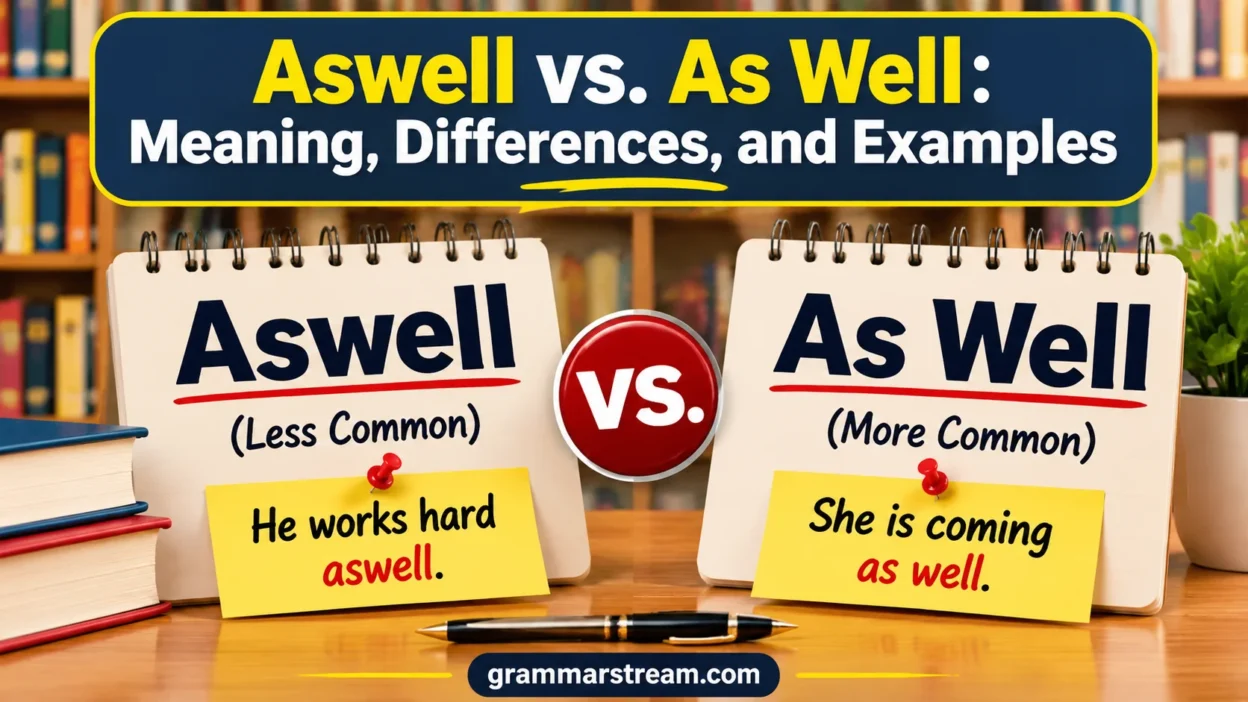
As well is the correct spelling, while aswell is incorrect in standard English. The expression always consists of two separate words.
The phrase as well means also, too, or in addition. It usually appears at the end of a sentence or clause.
For example:
- Correct: I enjoy reading novels, and I enjoy writing as well.
- Incorrect: I enjoy reading novels, and I enjoy writing aswell.
Remember this simple rule: Write as well as two words whenever you mean also or in addition.
Comparison Overview
Although aswell and as well look similar, their spelling and grammatical status differ. One is the accepted English expression, while the other is a common typing or spelling error.
| Feature | Aswell | As Well |
| Spelling | Incorrect | Correct |
| Word count | One | Two |
| Standard English usage | Not accepted as the expression | Accepted |
| Meaning | No standard meaning as this phrase | Also, too, in addition |
| Grammatical function | Not a standard phrase | Adverbial expression |
| Suitable for formal writing | No | Yes |
| Example | She sings aswell. | She sings as well. |
The important distinction is straightforward: as well is the standard expression, and aswell is not its accepted spelling.
Main Differences Between Aswell and As Well
The difference between these forms goes beyond a missing space. Their grammatical status determines which one belongs in standard written English.
As Well Is the Correct Spelling
The expression as well contains two independent words that work together to add information to a sentence.
The word as helps form the expression, while well completes it. Together, they communicate an additional idea, person, or action.
For example:
- My brother enjoys swimming as well.
- She speaks French and Spanish as well.
- We invited our neighbors as well.
- He wants to learn photography as well.
In each example, as well adds something to information already mentioned.
You can usually replace it with also or too without changing the main meaning.
Consider this example:
- I want to visit London as well.
- I also want to visit London.
- I want to visit London too.
All three sentences communicate a similar idea. However, their sentence positions and natural rhythms differ.
Because dictionaries and standard grammar references recognize as well as two words, this is the spelling you should use in everyday and professional writing.
Aswell Is a Common Misspelling
The spelling aswell combines two words into one without following standard English spelling conventions.
People often make this mistake because they pronounce the expression as one connected sound. When spoken quickly, the space between the words becomes less noticeable.
However, pronunciation doesn’t determine whether two words should be combined in writing.
Here are some incorrect examples and their corrections:
| Incorrect Sentence | Correct Sentence |
| I want to come aswell. | I want to come as well. |
| She likes coffee aswell. | She likes coffee as well. |
| We need your help aswell. | We need your help as well. |
| He plays football aswell. | He plays football as well. |
| They attended the meeting aswell. | They attended the meeting as well. |
Notice that every correction requires only one small change: adding a space between as and well.
Although readers can often understand aswell, that doesn’t make it acceptable in standard writing.
Why People Confuse Aswell and As Well
English contains many expressions that combine separate words to create a single meaning. As a result, writers sometimes assume that frequently used phrases should have one-word spellings.
The confusion surrounding aswell often comes from everyday communication.
Several factors contribute to this mistake:
- Fast typing: People sometimes skip spaces when writing quickly.
- Pronunciation: The two words often sound connected during normal conversation.
- Autocorrect: Some keyboards may not identify every spelling mistake.
- Online habits: Informal messages and social media posts sometimes spread incorrect spellings.
- Limited proofreading: Writers may overlook small spacing errors.
For example, someone might write, “I’ll bring my laptop aswell.”
The intended meaning is clear. Nevertheless, the correct sentence is “I’ll bring my laptop as well.”
The easiest solution is to treat as well as a fixed two-word expression. Once you develop that habit, the mistake becomes much less common.
What Does As Well Mean?
The phrase as well means also, too, or in addition. Writers use it to introduce another related person, object, action, or piece of information.
It commonly appears when someone wants to add something without repeating an entire statement.
For example:
“Sarah enjoys painting. She loves photography as well.”
The second sentence adds another hobby to Sarah’s interests. Instead of repeating the complete idea, the writer uses as well to keep the sentence natural.
Here are more examples:
- I bought some vegetables and fresh fruit as well.
- My parents are coming to dinner as well.
- She completed the assignment and helped her classmates as well.
- We visited the museum and explored the nearby park as well.
In everyday English, this expression makes sentences flow smoothly. It also helps connect related ideas without unnecessary repetition.
As Well Means Also
One of the most common meanings of as well is also.
You can use it when someone or something shares an activity, quality, or situation with another person or thing.
For example:
- Daniel plays basketball. He plays tennis as well.
- My sister enjoys cooking. She enjoys baking as well.
- We need a printer and a scanner as well.
- Emma speaks English and understands German as well.
In these sentences, as well introduces additional information.
You can often rewrite these examples using also:
- Daniel also plays tennis.
- My sister also enjoys baking.
- We also need a scanner.
- Emma also understands German.
Both expressions work correctly. However, their placement differs. Also often appears before the main verb, while as well commonly appears toward the end of a clause.
As Well Means In Addition
Another important meaning of as well is in addition.
This use becomes especially helpful when discussing several related items or activities.
For example:
- The hotel provides breakfast and dinner as well.
- The company offers training and career guidance as well.
- We need to review the budget and the project schedule as well.
- The course covers grammar and vocabulary as well.
Here, the expression adds another item to an existing list or statement.
You might also encounter it in professional communication:
“Please send the completed report and the supporting documents as well.”
The writer requests two things. The report is the first requirement, while the supporting documents represent an additional requirement.
This makes as well useful in emails, workplace instructions, presentations, and everyday conversations.
How to Use As Well in a Sentence
Knowing the correct spelling is only the first step. You should also understand where the expression fits naturally within a sentence.
In most everyday sentences, as well appears at the end of a clause. However, its placement can change depending on the sentence structure and intended meaning.
Using As Well at the End of a Sentence
The most common position for as well is at the end of a sentence or clause.
This structure sounds natural in both casual conversations and professional writing.
Examples include:
- I would like some water as well.
- They invited their friends as well.
- My father enjoys gardening as well.
- We should discuss the deadline as well.
- She wants to attend the conference as well.
This placement works because the phrase adds information after the main statement.
For example, consider this sentence:
“Michael purchased a new phone and a tablet as well.”
The reader first learns that Michael purchased a phone. The final phrase adds the tablet to the purchase.
This structure is particularly useful when you want to emphasize an additional item or activity.
Using As Well After a Verb or Object
Although as well commonly appears at the end of a clause, its exact position depends on the sentence structure.
It generally follows the information being added rather than interrupting the main sentence unnecessarily.
Compare these examples:
- Natural: She wants to study biology as well.
- Natural: He invited his cousins as well.
- Awkward: She as well wants to study biology.
- Awkward: He as well invited his cousins.
The first two sentences sound more natural in ordinary conversation.
However, English allows other placements in certain contexts. For example, “She as well as her brother enjoys reading” is grammatically possible, but this construction uses as well as, which has a different grammatical role.
Therefore, don’t confuse the ordinary phrase as well with the longer expression as well as.
Read More: Click vs. Clique: Meaning, Differences, and Examples
Using As Well in Formal and Informal Writing
One advantage of as well is its flexibility. You can use it in casual conversations and many professional situations.
However, the best expression sometimes depends on your audience and writing style.
Informal examples:
- I’ll come to the party as well.
- Bring your camera as well.
- We should grab some snacks as well.
Formal examples:
- The report includes financial projections as well.
- The department will review the proposal as well.
- Participants should submit their identification documents as well.
In formal writing, alternatives such as additionally, also, and furthermore may sometimes create a more polished tone.
However, there’s nothing inherently informal or unprofessional about using as well.
Choose the expression that makes your sentence clear and natural.
Using As Well in Negative Sentences
Negative sentences require special attention because as well doesn’t usually work as a direct substitute for either.
In standard English, either commonly appears at the end of a negative sentence when adding another negative statement.
Consider these examples:
- Incorrect: I don’t like coffee as well.
- Correct: I don’t like coffee either.
Another example:
- Incorrect: She isn’t attending the meeting as well.
- Correct: She isn’t attending the meeting either.
Why does this happen?
The expression as well usually adds an affirmative idea. Meanwhile, either commonly adds another negative idea.
Compare:
| Affirmative Sentence | Negative Sentence |
| I enjoy tea as well. | I don’t enjoy tea either. |
| She likes swimming as well. | She doesn’t like swimming either. |
| We are coming as well. | We aren’t coming either. |
| He wants to participate as well. | He doesn’t want to participate either. |
Remember that the context matters. You can use as well in a sentence containing a negative clause when it adds a separate affirmative idea.
For example:
“Although I don’t enjoy coffee, I like tea as well.”
The expression adds a positive preference for tea. It doesn’t simply extend the negative statement.
As Well vs. Also vs. Too
The words and expressions as well, also, and too share a similar meaning. All three can communicate that something is additional.
However, they don’t always appear in the same position. Understanding their differences helps you write more naturally.
| Expression | Common Position | Meaning | Example |
| As well | Usually at the end | Also, in addition | I want to come as well. |
| Also | Usually before the main verb | In addition | I also want to come. |
| Too | Usually at the end | Also | I want to come too. |
Although these expressions often work interchangeably, their sentence placement creates different rhythms.
When to Use As Well
Use as well when you want to add another related point, especially at the end of a sentence.
It works well in conversations, emails, and everyday writing.
Examples:
- My brother wants to join us as well.
- We need to purchase notebooks as well.
- She attended the workshop as well.
- They invited the entire team as well.
This expression often sounds slightly more measured than too, particularly in longer statements.
When to Use Also
Use also when you want to add information naturally within a sentence.
It commonly appears before the main verb or after a form of the verb be.
Examples:
- I also enjoy reading.
- She also works at a hospital.
- They are also interested in science.
- We also need additional supplies.
Notice the placement:
“I also enjoy reading.”
Here, also appears before the main verb enjoy.
However:
“She is also talented.”
In this sentence, also follows the verb is.
These placements make also particularly useful in essays, reports, and explanatory writing.
When to Use Too
Use too when you want to add something in a simple, conversational way.
It commonly appears at the end of a sentence.
Examples:
- I want some coffee too.
- She likes classical music too.
- We are going to the park too.
- He wants to participate too.
In everyday conversation, too often sounds relaxed and friendly.
You can usually replace it with as well without changing the main meaning.
For example:
“I enjoyed the movie too.”
“I enjoyed the movie as well.”
Both sentences are correct.
Frequently Asked Questions
Is Aswell or As Well Correct?
As well is correct in standard English. It consists of two separate words and means also, too, or in addition. The combined spelling aswell is a common misspelling and should be avoided in ordinary writing.
Is Aswell One Word?
No. Aswell isn’t the standard spelling of this English expression. The correct form is as well, with a space between the words. Always use the two-word version in essays, emails, articles, and professional documents.
What Does As Well Mean?
As well means also, too, or in addition. People use it to introduce another person, activity, object, or idea. For example, “I enjoy reading as well” means that reading is another activity you enjoy.
Is As Well the Same as Also?
Yes, as well and also often communicate the same meaning. However, their usual positions differ. Also commonly appears before the main verb, while as well usually appears at the end of a clause.
For example:
- I also like chocolate.
- I like chocolate as well.
Both sentences are correct.
Should As Well Have a Comma Before It?
Usually, no. When as well appears naturally at the end of an ordinary sentence, you don’t need a comma before it.
For example:
“She invited her cousins as well.”
However, use punctuation when another grammatical structure requires it. Don’t add commas simply because the phrase appears in a sentence.
Conclusion:
The difference between aswell and as well is simple but important. Only the two-word form is correct when expressing the meaning also, too, or in addition. Although people frequently combine the words while typing, aswell remains a spelling mistake in standard English. Remembering the correct form can help you avoid unnecessary errors in everyday conversations, academic assignments, and professional documents.