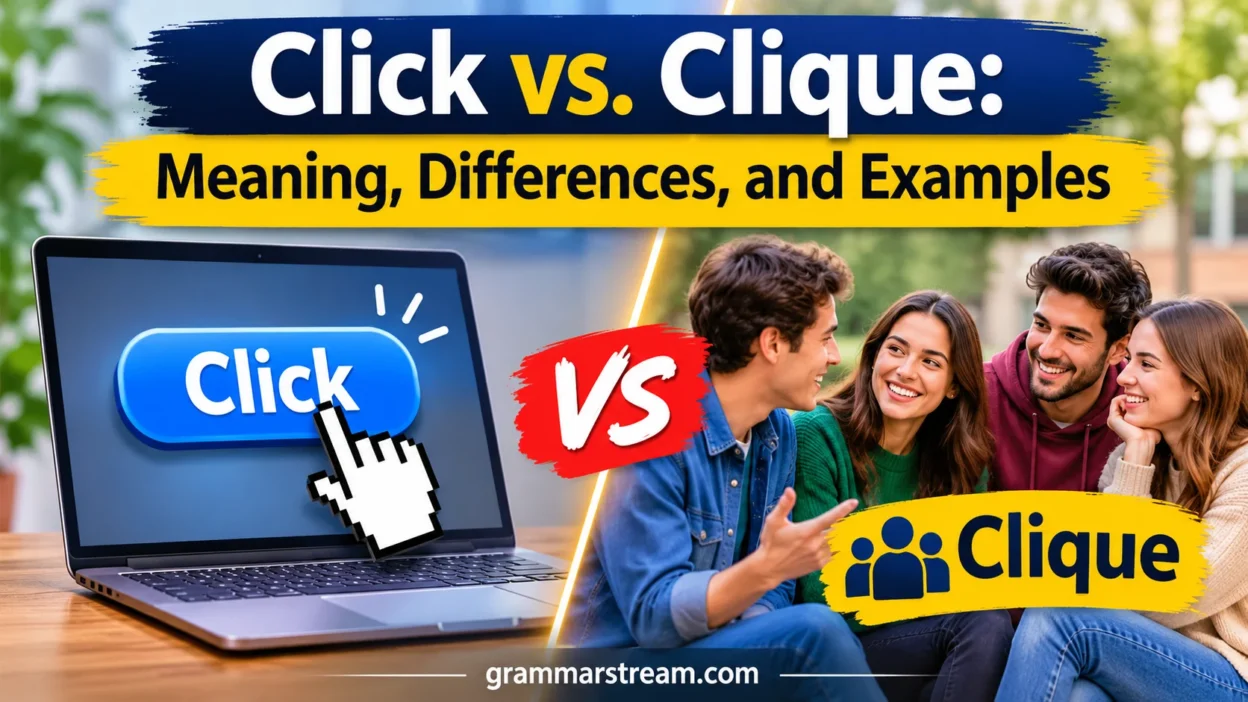
Have you ever wondered whether to write click or clique? These two words sound exactly alike, yet they describe completely different things. One relates to sounds, digital actions, and sudden understanding. The other describes a small, exclusive group of people.
Because both words share the same pronunciation, writers sometimes confuse their spelling and meaning. However, choosing the correct word becomes easy once you understand how each one works.
Whether you’re writing about clicking a computer mouse, connecting with someone, or describing an exclusive social group, knowing the difference matters. A single letter can change the entire meaning of your sentence.
Quick Answer
Click refers to a short, sharp sound, pressing a button, or understanding something suddenly. It can function as both a noun and a verb. Clique refers to a small, close-knit group of people who often exclude others. It is always a noun.
Both words have the same pronunciation, /klɪk/, but their meanings and spellings are different.
Comparison Overview
Although click and clique sound identical, they serve different purposes in everyday English. Their meanings become clear when you examine their grammatical roles and contexts.
| Feature | Click | Clique |
| Part of speech | Noun and verb | Noun |
| Meaning | A short sound, button press, or sudden understanding | An exclusive group of people |
| Pronunciation | /klɪk/ | /klɪk/ |
| Spelling | C-L-I-C-K | C-L-I-Q-U-E |
| Common context | Technology, sounds, relationships, and understanding | Social groups, schools, and workplaces |
| Example | Click the blue button. | The students formed a clique. |
| Plural form | Clicks | Cliques |
| Verb form | Click, clicked, clicking | No standard verb form |
The easiest distinction is straightforward: click describes an action or sound, while clique describes a group of people.
For example:
- Click: I heard a click when she opened the door.
- Clique: A small clique of students sat together during lunch.
Both sentences are grammatically correct, but replacing one word with the other would change their meanings completely.
Main Differences Between Click vs. Clique
The biggest difference between click and clique involves what each word represents. One describes an action, sound, or moment of understanding. The other identifies a particular type of social group.
Let’s examine their meanings and uses more closely.
Meaning of Click
The word click has several meanings in modern English. It commonly describes a short, sharp sound or the action of pressing a button. It also appears in figurative expressions involving understanding and personal connections.
As a noun, click can describe the sound produced when two objects touch or a mechanism operates. For example, a light switch might make a clicking sound when you turn it on.
In computing, a click refers to pressing and releasing a mouse button or selecting an interactive element. You might click a website link, open an application, or select a file.
As a verb, click describes the action of producing that sound or operating a button. It can also describe a moment when something suddenly makes sense.
Examples of click:
- The mouse made a clicking sound.
- Please click the button to continue.
- Suddenly, everything clicked during the lesson.
- We clicked immediately when we first met.
- The door lock produced a loud click.
The word also appears in everyday expressions such as “click into place” and “click with someone.”
Meaning of Clique
A clique is a small group of people who spend time together and often keep outsiders from joining. Members usually share friendships, interests, social connections, or similar backgrounds.
The word frequently appears when discussing schools, workplaces, social circles, and community groups.
For example, a group of students might regularly sit together, share private conversations, and avoid interacting with classmates outside their circle. Other students may describe them as a clique.
However, not every close friendship group qualifies as a clique. The important distinction involves exclusivity and the tendency to exclude others.
A friendship group can welcome new people and encourage different opinions. A clique often creates social boundaries that make outsiders feel unwelcome.
Examples of clique:
- A popular clique controlled the school’s social scene.
- Several workplace cliques formed within the department.
- She never felt comfortable around that exclusive clique.
- The neighborhood clique rarely welcomed newcomers.
- Their social clique often excluded other students.
The word generally carries a negative or critical tone because it suggests social exclusion. However, the exact meaning depends on the context.
Click vs. Clique: Key Differences
Understanding the individual definitions is useful, but comparing their everyday applications makes the distinction even clearer.
Consider these important differences:
Meaning: Click describes a sound, action, or sudden realization. Clique describes an exclusive social group.
Grammar: Click works as a noun and a verb. Clique functions as a noun.
Context: People use click when discussing technology, sounds, understanding, and relationships. They use clique when discussing social behavior and group dynamics.
Spelling: Click contains five letters. Clique contains six letters and ends with the unusual combination “que.”
Examples: You click a mouse button, but you join or belong to a clique.
Here is another useful comparison:
| Situation | Correct Word | Example |
| Pressing a computer mouse | Click | Click the file to open it. |
| Hearing a short sound | Click | I heard a click downstairs. |
| Understanding an idea | Click | The explanation finally clicked. |
| Connecting with someone | Click | We clicked during our first conversation. |
| Describing an exclusive group | Clique | The clique excluded new students. |
| Discussing workplace social groups | Clique | A workplace clique formed around the manager. |
Remember that similar pronunciation doesn’t make two words interchangeable. Their meanings determine which spelling belongs in your sentence.
Click as a Noun: Meaning and Examples
When click functions as a noun, it usually identifies a sound, an action, or a single instance of pressing a button.
Its meaning depends on the surrounding words.
A click as a sound
A click can describe a brief, sharp noise produced by a mechanical object or physical contact.
For example, a keyboard key, camera shutter, door lock, or light switch might produce a click.
Example sentences:
- The camera made a click when I took the picture.
- I heard three clicks from the hallway.
- The old clock produced a strange clicking sound.
- A click from the lock indicated that the door had closed.
A click as a computer action
In technology, a click describes one operation performed by pressing and releasing a mouse button or selecting an interactive control.
For example:
- One click opened the document.
- The website recorded thousands of clicks.
- A single click took me to the next page.
- Each click moved the presentation forward.
In digital marketing, the word also describes an interaction with an online advertisement or search result. Advertisers often track clicks to measure how frequently people interact with their campaigns.
A click, however, doesn’t necessarily mean someone purchased a product or completed another desired action. It only records the interaction itself.
Click as a Verb: Meaning and Examples
As a verb, click describes several actions and experiences. Its meaning changes depending on the situation.
Clicking a button or link
This is one of the most familiar uses of the word. You click when you press and release a mouse button or select something on a touchscreen.
Examples:
- Click the search icon to find the article.
- She clicked the wrong link.
- Please click the image to enlarge it.
- I clicked the download button twice.
Clicking with someone
In informal English, click can describe two people who naturally connect or get along.
When personalities, interests, or communication styles match, people sometimes say they click.
Examples:
- We clicked as soon as we started talking.
- The new teammates clicked immediately.
- They didn’t click during their first meeting.
- I think you’ll click with my friends.
This expression doesn’t mean anyone physically makes a clicking sound. Instead, it describes a natural social connection.
When something suddenly makes sense
Another common expression is “it clicked.” People use it when they finally understand an idea after struggling with it.
For example, imagine learning a difficult grammar rule. You study several examples without understanding the pattern. Then one explanation makes everything clear.
You might say, “It finally clicked!”
Additional examples:
- The math problem finally clicked after practice.
- Once she saw the diagram, everything clicked.
- His explanation helped the concept click.
- The answer clicked when I reread the question.
This figurative meaning makes click especially useful in everyday conversations.
Read More: Granddad vs. Grandad: Meaning, Spelling, and Examples
Clique as a Noun: Meaning and Examples
Unlike click, clique functions as a noun. It identifies an exclusive group whose members tend to associate closely with one another.
The word often describes social groups that create barriers between insiders and outsiders.
School cliques
Schools provide familiar examples of cliques. Students sometimes form exclusive groups based on shared interests, popularity, hobbies, or social status.
For instance, a group of students might always sit together during lunch and refuse to include classmates outside their circle.
Examples:
- The school clique rarely invited other students.
- Several cliques formed during the first semester.
- She avoided the popular clique because it made her uncomfortable.
- The new student struggled to fit into an established clique.
Workplace cliques
Cliques can also develop in professional environments. Employees might form exclusive social circles based on friendships, shared positions, or personal connections.
These groups can affect workplace communication and collaboration.
For example, a small group might share important information among themselves while leaving other employees out of conversations.
Examples:
- The office clique made teamwork difficult.
- Employees complained about favoritism within the clique.
- A workplace clique excluded newer team members.
- The manager encouraged employees to communicate beyond their usual groups.
Social cliques
Outside schools and workplaces, cliques can develop within neighborhoods, clubs, organizations, and other communities.
Members may share common interests, backgrounds, or experiences. Problems arise when the group becomes overly exclusive.
Examples:
- A neighborhood clique organized private gatherings.
- The social clique rarely welcomed unfamiliar people.
- Several cliques competed for influence within the organization.
Clique vs. ordinary friendship group
A clique and a friendship group aren’t necessarily the same thing.
| Friendship Group | Clique |
| Members share personal connections. | Members form an exclusive social circle. |
| New people may receive a warm welcome. | Outsiders may struggle to join. |
| Members can maintain separate friendships. | Members may strongly prefer their established circle. |
| Usually emphasizes companionship. | Often emphasizes group boundaries and exclusivity. |
| Doesn’t necessarily create social divisions. | Can create divisions between insiders and outsiders. |
The distinction isn’t always absolute. A close friendship group can become a clique when its members consistently exclude other people.
Common Expressions and Phrases
Both words appear in everyday English, but their common expressions differ significantly.
Common Expressions with Click
The word click appears in technology, conversations, and informal expressions.
Here are several useful examples:
| Expression | Meaning | Example |
| Click on | Select something using a mouse or touchscreen | Click on the picture. |
| Click a button | Press a digital control | Click the submit button. |
| Click into place | Become clear or understandable | Everything clicked into place. |
| Click with someone | Connect naturally with someone | We clicked immediately. |
| It finally clicked | Someone finally understood something | The grammar rule finally clicked. |
| A mouse click away | Easily accessible with a mouse | The information is one click away. |
These expressions demonstrate how click can describe both literal actions and figurative experiences.
Common Expressions with Clique
Clique commonly appears alongside words that describe social settings or group behavior.
| Expression | Meaning | Example |
| School clique | An exclusive student group | The school clique dominated lunchtime conversations. |
| Social clique | An exclusive friendship circle | She didn’t belong to their social clique. |
| Workplace clique | An exclusive group of coworkers | The workplace clique shared information privately. |
| Exclusive clique | A group that restricts membership | The exclusive clique rarely accepted newcomers. |
| Clique mentality | Thinking or behaving in ways that favor one’s group | Clique mentality damaged team cooperation. |
These phrases usually describe social relationships, group identity, and exclusion.
Click vs. Clique: Examples in Sentences
Looking at complete sentences is one of the easiest ways to understand the difference. The following examples demonstrate how each word works in real situations.
Examples of Click in Sentences
The examples below cover the word’s different grammatical uses.
Click as a noun:
- I heard a click when the door locked.
- The computer registered another click.
- A quiet click came from the kitchen.
- The camera made a click during the photograph.
- One click opened the entire presentation.
Click as a verb:
- Click the green button to save your changes.
- She clicked the wrong menu option.
- I clicked the link in the email.
- The students clicked with their new teacher.
- Everything clicked after the instructor explained the process.
Notice how the same spelling works naturally in several different situations.
Examples of Clique in Sentences
Clique always identifies a group of people.
Here are examples from different social environments:
- The popular clique gathered near the school entrance.
- She refused to join the office clique.
- A small clique controlled most club activities.
- The new employee felt uncomfortable around the established clique.
- Their clique rarely interacted with other neighborhood residents.
- The students formed a clique based on shared interests.
- Several social cliques developed during the summer program.
- The manager discouraged clique behavior within the department.
Each example describes a group rather than a sound or action.
Frequently Asked Questions
What Is the Main Difference Between Click and Clique?
The main difference involves their meanings and grammatical functions. Click describes a sound, an action, or sudden understanding. Clique describes a small, exclusive group of people. Click works as both a noun and a verb, while clique functions as a noun.
Are Click and Clique Pronounced the Same?
Yes. Both words share the same pronunciation in standard American English: /klɪk/. Their spelling and meanings differ, but their spoken forms sound identical.
Is Clique Always a Negative Word?
Clique generally carries a negative connotation because it suggests exclusivity and social exclusion. However, its tone depends on context. Sometimes, people use it simply to describe a close-knit social group without emphasizing harmful behavior.
Can Click Be Used as Both a Noun and a Verb?
Yes. As a noun, click can describe a short sound or a computer action. As a verb, it can describe pressing a button, making a clicking noise, understanding something suddenly, or connecting naturally with someone.
For example:
- Noun: I heard a click from the door.
- Verb: Click the button to continue.
What Is an Example of Clique in a Sentence?
Here’s a simple example: “The popular clique at school rarely included new students.”
In this sentence, clique describes an exclusive group of students who associate closely with one another.
Conclusion:
Although click and clique sound identical, their meanings are completely different. Understanding their grammatical functions and everyday uses helps you choose the correct spelling. Use click when describing a short sound, pressing a button, understanding something suddenly, or connecting with someone. Use clique when referring to a small, exclusive group of people.