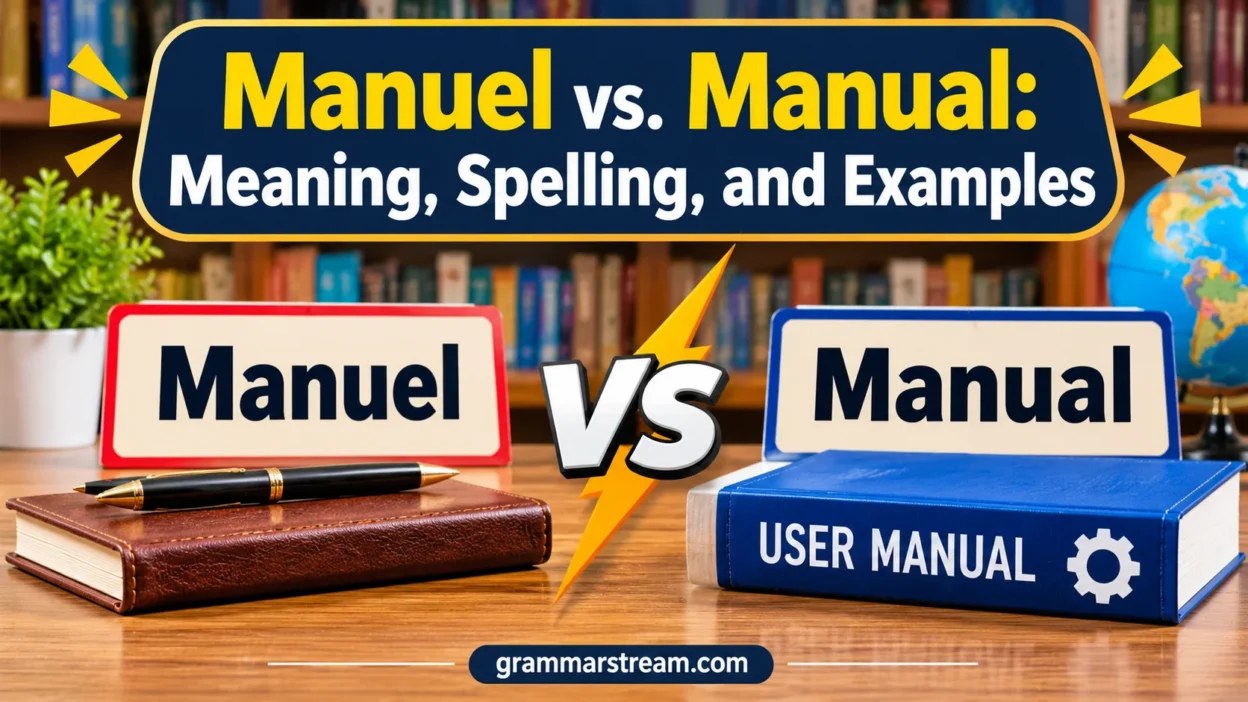
Have you ever confused Manuel with manual while writing? You’re not alone. These two words look almost identical, but they serve entirely different purposes. One usually identifies a person, while the other describes something done by hand or provides instructions.
The confusion comes down to just two letters: -el and -al. However, that tiny spelling difference completely changes the meaning. If you’re writing someone’s name, preparing a document, or discussing an instruction book, choosing the correct word matters.
Understanding Manuel vs. Manual becomes much easier when you examine their meanings, grammatical roles, pronunciation, and everyday uses. Let’s explore both terms with practical examples so you can use them confidently.
Quick Answer
Manuel is a masculine given name commonly used in Spanish- and Portuguese-speaking communities. It’s a proper noun, so you generally capitalize its first letter.
Manual is an English word that functions as both a noun and an adjective. As a noun, it means an instruction book or guide. As an adjective, it describes something performed by hand or without automatic assistance.
Examples:
- Manuel: Manuel works at a local engineering company.
- Manual: Please read the instruction manual before operating the machine.
- Manual: The workers completed the task using manual tools.
Remember this simple distinction: Manuel is a person’s name, while manual relates to instructions or hand-operated activities.
Comparison Overview
Although Manuel and manual share six letters, their meanings and grammatical functions differ significantly. Understanding these differences helps you avoid spelling mistakes.
| Feature | Manuel | Manual |
| Word type | Proper noun | Common noun and adjective |
| Primary meaning | A masculine personal name | Something done by hand or an instruction guide |
| Origin | Spanish and Portuguese usage; ultimately related to Emmanuel | Latin manualis, meaning of or belonging to the hand |
| Pronunciation | Commonly /mænˈwɛl/ in English | /ˈmæn.ju.əl/ |
| Capitalization | Usually capitalized | Usually lowercase |
| Common usage | Names and personal identification | Instructions, work, tools, and processes |
| Example | Manuel is my friend. | I downloaded the user manual. |
The most important difference is their purpose. Manuel identifies someone, whereas manual describes an activity or a written resource.
For example, if you’re talking about a person named Manuel, using manual would change the meaning of your sentence. Similarly, writing Manuel instead of manual when discussing instructions creates an obvious spelling error.
Main Differences Between Manuel vs. Manual
The differences between these words extend beyond their final letters. Their meanings, grammatical functions, pronunciation, and everyday applications all distinguish them.
Meaning of Manuel
Manuel is a masculine given name used in several countries and language communities. It’s particularly common in Spanish- and Portuguese-speaking cultures.
The name is historically related to Emmanuel, which comes from the Hebrew name Immanuel. The traditional meaning is “God is with us.”
Manuel has remained a familiar personal name across generations. You’ll encounter it in Spain, Portugal, Mexico, Brazil, and many other countries.
Although its spelling resembles the English word manual, it doesn’t describe an activity, object, or instruction book.
Consider these examples:
- Manuel is studying computer science at university.
- My brother Manuel lives in Madrid.
- Manuel received an award for his excellent performance.
- Have you spoken to Manuel about the meeting?
- Mr. Manuel will lead the training session tomorrow.
- Manuel enjoys repairing old cars.
In every example, Manuel identifies a particular person.
Important: Manuel is generally capitalized because personal names are proper nouns. This capitalization rule applies whether the name appears at the beginning, middle, or end of a sentence.
Meaning of Manual
Unlike Manuel, manual is an established English vocabulary word with two main grammatical uses. It can function as either a noun or an adjective.
Its meaning depends on the context.
Manual as a noun
As a noun, manual refers to a book, document, or guide containing instructions about a particular subject, product, or process.
For example, a new washing machine usually comes with a manual explaining its features and operation.
Manuals help users understand complicated equipment without relying entirely on professional assistance.
Common examples include:
- User manual
- Instruction manual
- Employee manual
- Training manual
- Technical manual
- Repair manual
- Safety manual
- Operating manual
Example sentences:
- I lost the manual that came with my television.
- The employee manual explains the company’s workplace policies.
- Read the repair manual before replacing the damaged component.
- The technician followed the equipment manual carefully.
Manual as an adjective
As an adjective, manual describes something performed by human effort, usually with the hands rather than through automatic machinery.
For instance, manual labor involves physical work performed by people. Similarly, manual data entry requires someone to enter information rather than relying on an automated system.
Common expressions include:
- Manual labor
- Manual operation
- Manual transmission
- Manual controls
- Manual process
- Manual inspection
- Manual handling
- Manual data entry
Example sentences:
- The factory still uses manual equipment for certain tasks.
- Manual labor requires physical effort and attention.
- She prefers a manual transmission when driving.
- The company introduced software to reduce manual data entry.
The word manual therefore covers several everyday situations. Its meaning becomes clear through the surrounding sentence.
Manuel vs. Manual: Part of Speech
Grammar provides another reliable way to distinguish Manuel from manual.
Manuel is a proper noun. It names a specific individual rather than describing a general category of people or objects.
For example:
- Manuel is waiting outside.
- I invited Manuel to dinner.
- Manuel works as a teacher.
In these sentences, the word identifies a particular person.
Manual has two grammatical roles:
| Part of speech | Meaning | Example |
| Noun | An instructional book or guide | The manual explains the installation process. |
| Adjective | Performed by hand or human effort | Workers completed a manual inspection. |
Notice how the same word performs different functions depending on its position.
When manual appears before a noun, it often acts as an adjective. When it refers directly to an instructional document, it functions as a noun.
Understanding this distinction also helps you recognize related expressions such as manually, which is an adverb.
Manuel vs. Manual: Pronunciation
Although Manuel and manual look similar, they have different pronunciations and syllable patterns.
Manuel pronunciation
In English-speaking contexts, Manuel commonly receives the pronunciation /mænˈwɛl/.
It has two syllables in this English pronunciation. The second syllable receives the primary stress.
Spanish and Portuguese pronunciations differ according to their respective language sound systems. Therefore, you may hear the name pronounced differently depending on the speaker’s background.
Manual pronunciation
The standard American English pronunciation of manual is /ˈmæn.ju.əl/.
It generally has three syllables:
- First syllable: MAN
- Second syllable: you
- Third syllable: uhl
The stress falls on the first syllable.
Pronunciation comparison:
| Word | Common English IPA | Syllables | Main stress |
| Manuel | /mænˈwɛl/ | 2 | Second |
| Manual | /ˈmæn.ju.əl/ | 3 | First |
The difference becomes noticeable when you say both words aloud. Manuel sounds like a personal name, while manual has an additional syllable.
Read More: Aswell vs. As Well: Meaning, Differences, and Examples
Manuel vs. Manual: Spelling Differences
The spelling difference between Manuel and manual is small but important.
Both words begin with the letters M-A-N-U. Their final two letters create the distinction:
- Manuel: Ends with -el.
- Manual: Ends with -al.
This difference changes the word’s identity and meaning.
Consider the following spelling breakdown:
| Letter position | Manuel | Manual |
| First | M | M |
| Second | A | A |
| Third | N | N |
| Fourth | U | U |
| Fifth | E | A |
| Sixth | L | L |
The first four letters and final letter match. Only the fifth letter differs.
However, that single-letter change matters. You cannot replace one spelling with the other without changing the intended meaning.
A useful spelling trick: Associate the final letters EL with the personal name Manuel. Associate AL with manual activities and instruction guides.
This simple reminder can prevent many common typing mistakes.
When to Use Manuel
Use Manuel when referring to someone whose given name is Manuel.
Since it’s a proper noun, capitalize the first letter regardless of where it appears in a sentence.
Here are some common situations where Manuel is appropriate:
Introducing someone
- This is Manuel, our new office manager.
- I’d like you to meet Manuel.
Talking about family or friends
- My cousin Manuel enjoys playing soccer.
- Manuel and I attended the same school.
Writing formal documents
- Manuel submitted his application yesterday.
- The report was prepared by Manuel Garcia.
Discussing historical or public figures
Manuel also appears in the names of historical figures, artists, athletes, and public personalities.
For example, Manuel Neuer is a well-known German soccer goalkeeper. Manuel de Falla was a Spanish composer.
In all these cases, Manuel functions as a personal name rather than an ordinary English vocabulary word.
When to Use Manual
Use manual when discussing instructions, physical work, or activities that require human effort instead of automatic operation.
Its two grammatical functions make it useful in many different contexts.
When referring to an instruction book
Use manual when someone needs guidance about operating, maintaining, or repairing something.
Examples:
- The printer manual explains how to replace the ink cartridge.
- I checked the vehicle manual for maintenance instructions.
- Every employee receives a safety manual during orientation.
When describing physical work
Manual also describes tasks performed through physical effort.
Examples:
- Manual labor remains important in the construction industry.
- The workers use manual tools to complete the repairs.
- Manual harvesting requires considerable time and effort.
When describing nonautomated processes
Businesses often use manual procedures when people must complete tasks themselves.
Examples:
- The company still performs manual inspections.
- Manual data entry can increase the chance of typing errors.
- Employees must approve certain transactions through a manual process.
When discussing vehicles and equipment
Manual commonly describes equipment that requires direct human control.
Examples:
- My father drives a car with a manual transmission.
- The machine includes manual operating controls.
- The technician switched the equipment to manual mode.
Unlike Manuel, the word manual generally stays lowercase unless it begins a sentence or appears in a title.
Examples of Manuel and Manual in Sentences
Seeing both words in practical sentences makes their differences easier to understand. The following examples cover common situations.
Manuel in Sentences
Here are several examples showing how to use Manuel correctly:
- Manuel is preparing for his final university examination.
- My friend Manuel works at a software development company.
- We invited Manuel to join our weekend trip.
- Manuel bought a new bicycle last month.
- The teacher asked Manuel to explain his answer.
- I spoke with Manuel about the upcoming project.
- Manuel enjoys reading historical books.
- Our new neighbor’s name is Manuel.
In each example, Manuel identifies a specific person. It doesn’t describe an object or activity.
Manual in Sentences
The following examples demonstrate manual as both a noun and an adjective.
Manual as a noun:
- The car manual contains important maintenance instructions.
- Please keep the instruction manual somewhere safe.
- I found the solution in the computer manual.
- The employee manual explains the company’s attendance policy.
- The technician downloaded a digital repair manual.
Manual as an adjective:
- Manual labor can be physically demanding.
- The machine requires manual operation.
- Workers performed a manual inspection of the equipment.
- The company replaced its manual filing system with digital software.
- My brother prefers driving a manual car.
These examples demonstrate how context determines the grammatical function of manual.
Manuel vs. Manual: Incorrect and Correct Usage
Some spelling mistakes can completely change a sentence’s meaning. Here are common examples and their corrections.
| Incorrect sentence | Correct sentence | Explanation |
| Please read the Manuel before using the machine. | Please read the manual before using the machine. | An instruction book is a manual. |
| My friend Manual lives in Mexico. | My friend Manuel lives in Mexico. | Manuel is the person’s name. |
| The company hired Manuel workers. | The company hired manual workers. | Manual describes the type of work. |
| I gave the report to manual. | I gave the report to Manuel. | The sentence refers to a person. |
| She purchased a Manuel transmission car. | She purchased a manual transmission car. | Manual describes the transmission type. |
The key is to identify what you’re discussing before choosing the spelling.
If the sentence refers to a person, use Manuel. If it refers to instructions or hands-on work, use manual.
Frequently Asked Questions
What Is the Difference Between Manuel and Manual?
Manuel is a masculine personal name commonly used in Spanish- and Portuguese-speaking communities. Manual is an English word describing something performed by hand or an instructional book. Their spellings differ by one letter, but their meanings are completely different.
Is Manuel a Name or a Word?
Manuel is a proper noun used as a masculine given name. It is historically related to Emmanuel, which has Hebrew origins. Because it identifies a specific person, Manuel normally begins with a capital letter.
What Does Manual Mean in English?
Manual has two main meanings in English. As a noun, it refers to an instruction book or guide. As an adjective, it describes something performed by hand or through human effort rather than automatic operation.
Is Manual Always Related to Doing Something by Hand?
No. Manual can also refer to an instructional book or guide. For example, a product manual explains how to operate a particular device. When used as an adjective, however, manual frequently describes hands-on activities or processes.
Should Manuel Always Be Capitalized?
Yes, when Manuel functions as a person’s proper name, it should begin with a capital letter. This rule applies throughout a sentence. However, manual is generally lowercase unless it starts a sentence or appears in a title.
Is Manuel a Correct Spelling of Manual?
No. Manuel and manual are separate words with different meanings. Manuel is a personal name, while manual refers to instructions or activities involving human effort. You shouldn’t use one as a substitute for the other.
What Is the Difference Between Manual and Manually?
Manual can function as a noun or adjective, while manually is an adverb. For example, a manual process describes a method involving human effort. The sentence “She completed the task manually” explains how someone performed an action.
Conclusion:
Understanding Manuel vs. Manual is simple once you recognize what each word represents. Manuel is a masculine personal name, while manual refers to an instruction guide or something performed through human effort. Although their spellings differ by only one letter, their grammatical functions and meanings are entirely separate.