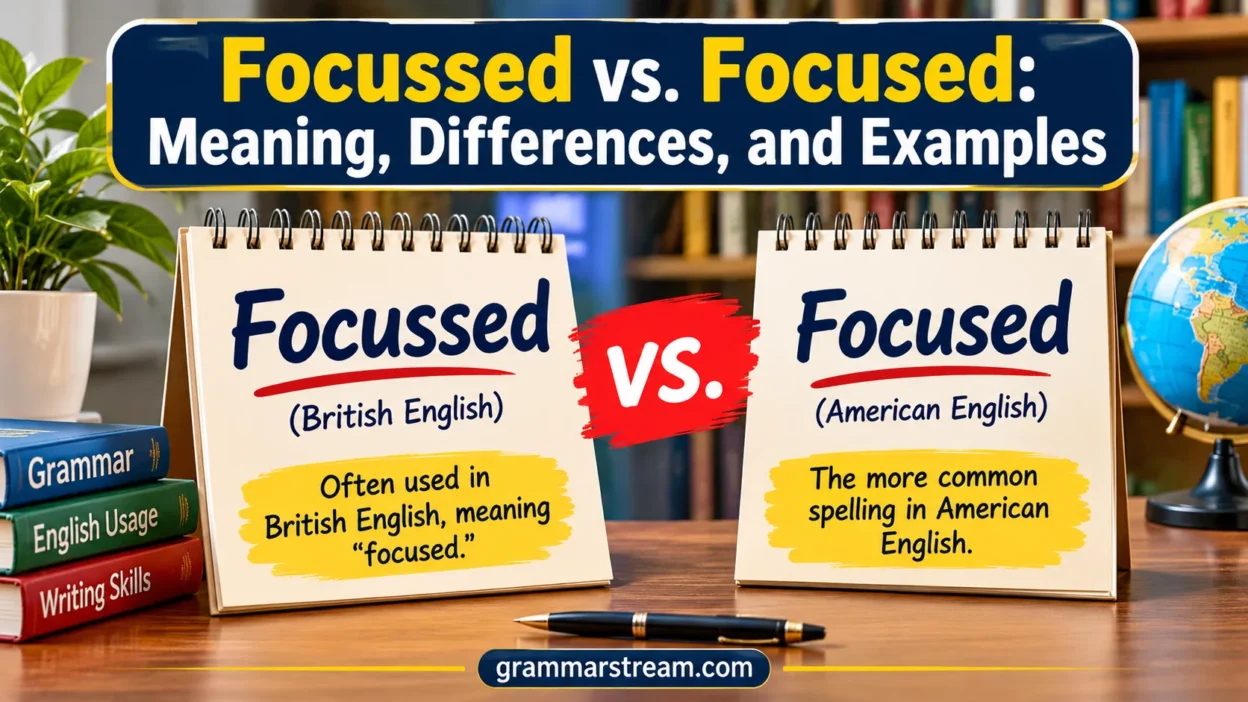
Have you ever wondered whether to write focussed or focused? Both spellings look correct, and neither changes the meaning of the word. However, choosing the right version depends largely on your audience and the English spelling convention you follow.
The confusion comes from a familiar spelling pattern in English. Some words double their final consonant when adding a suffix while others keep a single consonant. The verb focus creates an interesting exception because both focused and focussed appear in standard English usage.
Whether you’re writing a business email, an academic assignment, a blog post, or a professional report, knowing which spelling to choose helps maintain consistency. The regional distinction is particularly important when writing for American and British readers.
Quick Answer
Focused and focussed are both correct spellings of the past tense and past participle of the verb focus. They have exactly the same meaning: directing attention toward something or concentrating on a particular activity.
- Focused: The standard spelling in American English and a widely used form in British English.
- Focussed: An accepted alternative spelling, particularly in British English.
- Meaning: Both describe concentration, attention, or directing something toward a specific point.
- Related forms: Focusing and focussing are also accepted spelling variants.
Example:
- American English: She focused on completing her assignment.
- British English: She focussed on completing her assignment.
Neither sentence is grammatically incorrect. However, if you’re writing for an American audience, choose focused.
Comparison Overview
The following table highlights the main differences between focussed and focused.
| Comparison Point | Focused | Focussed |
| Spelling | One S | Two Ss |
| Meaning | Concentrated or directed attention | Concentrated or directed attention |
| Part of speech | Verb form and adjective | Verb form and adjective |
| American English | Standard spelling | Less common |
| British English | Widely accepted | Accepted alternative |
| Pronunciation | Same | Same |
| Grammar | Correct | Correct |
| Example | He focused on his work. | He focussed on his work. |
The most important distinction concerns spelling preference rather than meaning or grammar. Both versions communicate the same idea and function in the same grammatical situations.
Main Differences Between Focussed vs. Focused
Although these spellings look different, their grammatical roles and meanings remain identical. Understanding their regional preferences and spelling patterns makes choosing between them much easier.
Meaning of Focused and Focussed
Both focused and focussed describe the act of concentrating attention, directing effort, or bringing something toward a particular point.
The original verb, focus, can describe mental concentration as well as the physical or technical adjustment of something. Its meaning depends on the context.
For example, a student might focus on an examination while a photographer focuses a camera lens. Both situations involve directing attention or adjustment toward a particular target.
When you add the past-tense ending, you can use either spelling.
Examples of focused:
- Maria focused on her studies throughout the semester.
- The photographer focused the camera on the mountain.
- Our team focused its efforts on improving customer service.
- He remained focused during the difficult conversation.
- The discussion focused on environmental protection.
Examples of focussed:
- Maria focussed on her studies throughout the semester.
- The photographer focussed the camera on the mountain.
- Our team focussed its efforts on improving customer service.
- He remained focussed during the difficult conversation.
- The discussion focussed on environmental protection.
Notice that changing the spelling doesn’t change the meaning, pronunciation, or grammatical structure.
Both forms can function as the past tense of focus. They can also work as past participles and adjectives.
Is Focused or Focussed the Correct Spelling?
The answer depends on the variety of English you’re using. Both spellings are recognized, but they don’t have equal popularity across all English-speaking regions.
Focused is the preferred spelling in American English. American dictionaries and editorial conventions generally favor the single-s version.
Focussed is an accepted alternative, especially in British English. However, British writers also commonly use focused. Therefore, it’s inaccurate to claim that British English always requires the double-s spelling.
Here is a simple breakdown:
- American English: Focused is the standard choice.
- British English: Both focused and focussed are acceptable.
- Canadian English: Focused is widely used, although regional and editorial preferences can vary.
- Australian English: Both spellings occur, with focused widely accepted.
- International English: Follow the spelling convention of your publication or intended audience.
If you write for American readers, there’s little reason to choose focussed. The single-s spelling is familiar, standard, and widely recognized.
Why Does Focused Have One S While Focussed Has Two?
The difference comes from English spelling conventions and the way writers form past-tense verbs.
The base word focus ends with the letter S. When adding the suffix -ed, English spelling patterns don’t always produce one predictable result. Some verbs double their final consonant while others don’t.
For example:
- Hop becomes hopped.
- Plan becomes planned.
- Stop becomes stopped.
- Focus becomes focused or focussed.
In many English spelling patterns, writers double a final consonant to preserve the short vowel sound in a stressed syllable. However, focus has two accepted spellings when forming its past tense.
The single-s version avoids doubling the final S. The double-s version follows a consonant-doubling approach found in some British spelling conventions.
Both forms developed through established English usage. Neither requires a change in pronunciation.
An important distinction: The spelling difference doesn’t mean that one version uses a different suffix. Both words contain the same past-tense ending, -ed.
Focused vs. Focussed in American and British English
Regional spelling differences often create confusion because English doesn’t follow one universal spelling system.
American and British English share most vocabulary and grammatical rules. However, they sometimes prefer different spellings for the same word.
Consider these familiar examples:
| American English | British English |
| Color | Colour |
| Favorite | Favourite |
| Organize | Organise |
| Traveling | Travelling |
| Focused | Focused or focussed |
| Focusing | Focusing or focussing |
Unlike color and colour, which have a clear regional distinction, focused and focussed overlap considerably.
American English usage
American publications generally use focused and focusing. These spellings appear in newspapers, educational materials, business documents, and everyday writing.
For example:
- The company focused on developing new products.
- Students should remain focused during lessons.
- She is focusing on improving her writing skills.
British English usage
British English recognizes both single-s and double-s forms. Some writers and publications prefer focussed and focussing, while others use focused and focusing.
For example:
- The committee focussed on educational reforms.
- He remained focussed throughout the meeting.
- She is focussing on her professional development.
The practical lesson is simple: British English allows both forms, while American English strongly favors the single-s versions.
When to Use Focused
Use focused whenever you write in American English. It’s the most familiar spelling for American readers and follows standard US editorial conventions.
This spelling works in almost every situation, including formal documents, casual messages, academic assignments, and online content.
Here are the main situations where focused is the better choice:
American business writing
Professional communication benefits from consistent spelling. If your company follows American English, use focused in reports, presentations, emails, and internal documents.
Examples:
- Our marketing team focused on customer retention.
- The manager remained focused on the quarterly targets.
- The company has focused its resources on product development.
Academic writing
Students and researchers frequently use focused when discussing research objectives, experiments, and specific areas of study.
Examples:
- The research focused on childhood literacy.
- This study focused on the effects of climate change.
- The professor remained focused on the central research question.
Blogging and website content
If your website targets American readers, choose focused throughout your articles. Consistent spelling creates a polished reading experience and prevents unnecessary regional confusion.
For example:
- This guide focuses on practical writing techniques.
- A focused approach can improve productivity.
- The article focused on common spelling mistakes.
Everyday communication
You can also use focused in text messages, personal notes, social media posts, and informal conversations.
Examples:
- I stayed focused until I finished my homework.
- Let’s stay focused on the important things.
- She is focused on reaching her goals.
For American English writing, focused is the safest and most natural option.
Read more: Manuel vs. Manual: Meaning, Spelling, and Examples
When to Use Focussed
Use focussed when your writing follows a British English spelling preference that favors double consonants. It’s an accepted spelling, not a grammatical mistake.
However, British English doesn’t require this version in every situation. Many British publications and writers prefer focused instead.
The important thing is to follow the spelling convention of your intended publication.
Consider using focussed in these situations:
British English publications
Some British newspapers, magazines, and publishers retain the double-s spelling. If their editorial guidelines use focussed, follow that convention.
Examples:
- The committee focussed on improving public services.
- The teacher focussed the lesson on practical skills.
- The organization remained focussed on its original mission.
British-style academic writing
Academic institutions and publishers may have their own spelling preferences. If your university or journal follows a double-s convention, use focussed consistently.
Examples:
- The investigation focussed on workplace conditions.
- Researchers focussed their attention on the primary findings.
- The dissertation focussed on changes in modern education.
Personal and professional writing
You can also use focussed in ordinary British English communication. The spelling works in emails, reports, letters, and everyday writing.
Examples:
- I’ve stayed focussed on my goals this year.
- Our department focussed on improving communication.
- She remained focussed despite several distractions.
Remember that choosing focussed doesn’t make your writing more British automatically. Your overall spelling choices should match the same regional convention.
Focused vs. Focussed in Different Writing Contexts
The best spelling sometimes depends on more than geography. Your employer, university, publisher, or client may follow a particular style guide.
Understanding how the two versions work across different contexts helps you make better decisions.
Workplace and business writing
Business documents need consistency because several people may contribute to the same report. Switching between focused and focussed can make a document look poorly edited.
For an American company, use focused. For a British organization that prefers double-s spelling, use focussed.
Example:
- American convention: The department focused on reducing operating costs.
- British double-s convention: The department focussed on reducing operating costs.
Both sentences are correct. The choice reflects the organization’s preferred spelling.
Academic and educational writing
Academic writing often follows institutional guidelines. Universities and journals may specify American, British, or another English spelling convention.
Before submitting an assignment or research paper, check the required style guide. Consistency matters more than choosing the double-s form simply because it looks formal.
For example, an American research paper should generally use:
“The experiment focused on measuring student performance.”
A British publication that prefers double-s spelling might use:
“The experiment focussed on measuring student performance.”
Digital content and blogging
Bloggers should consider their target audience before selecting a spelling. Search engines can recognize both versions, but your content should still use natural language for its intended readers.
For a US-focused website, focused is the sensible choice. British-focused content can use either form according to its editorial style.
Don’t alternate between spellings just to include both keyword variations. That approach makes articles less consistent and rarely improves the reader’s experience.
Formal letters and professional emails
Formal communication should maintain a consistent spelling style from beginning to end.
For example:
- “I have focused my attention on your proposal.”
- “We remained focussed on completing the project.”
Neither sentence has a grammatical problem. However, the spelling should match the rest of the document.
Everyday conversations and informal writing
In casual communication, both spellings are understandable. Most readers won’t misunderstand your message because you use one S instead of two.
Still, choosing one form and sticking with it makes your writing cleaner.
Focused vs. Focussed Example Sentences
Examples make spelling differences easier to understand. Since both forms share the same meaning, you can replace one with the other without changing a sentence’s intended message.
Examples Using Focused
Here are ten examples showing how focused works in different situations.
- Sarah focused on her examination instead of checking her phone.
- The company focused its marketing campaign on younger customers.
- Our discussion focused on improving workplace productivity.
- He remained focused even when the project became challenging.
- The photographer focused the camera on the distant building.
- The research team focused on finding a practical solution.
- She has always focused on developing her communication skills.
- The coach kept the players focused before the championship.
- Their efforts focused on reducing unnecessary expenses.
- A clearly focused strategy can help businesses achieve their goals.
Examples Using Focussed
These examples demonstrate the same grammatical uses with the double-s spelling.
- Sarah focussed on her examination instead of checking her phone.
- The company focussed its marketing campaign on younger customers.
- Our discussion focussed on improving workplace productivity.
- He remained focussed even when the project became challenging.
- The photographer focussed the camera on the distant building.
- The research team focussed on finding a practical solution.
- She has always focussed on developing her communication skills.
- The coach kept the players focussed before the championship.
- Their efforts focussed on reducing unnecessary expenses.
- A clearly focussed strategy can help businesses achieve their goals.
These examples show that the spelling changes while the sentence structure and meaning remain the same.
Frequently Asked Questions
Is Focused or Focussed Correct?
Both focused and focussed are correct spellings of the past tense and past participle of focus. However, focused is the standard spelling in American English. British English accepts both versions.
Is Focussed British or American English?
Focussed is primarily associated with British English. It’s an accepted alternative spelling, although many British writers also use focused. American English strongly favors the single-s version.
Why Does Focused Have One S?
English spelling conventions allow focus to form its past tense as either focused or focussed. The single-s version is standard in American English, while the double-s version remains an accepted British alternative.
Is Focussing or Focusing Correct?
Both focussing and focusing are accepted spellings of the present participle of focus. American English prefers focusing, while British English accepts both forms.
Which Spelling Should I Use in Professional Writing?
Use focused when writing for an American audience. If your organization follows a British spelling convention that prefers double consonants, focussed is also appropriate. Always follow your publication’s style guide.
Conclusion:
The difference between focussed vs. focused comes down to spelling preference rather than meaning or grammar. Both versions describe concentration, attention, or directing something toward a particular point. However, regional conventions help determine which spelling you should choose. American English uses focused as its standard form, while British English accepts both focused and focussed.