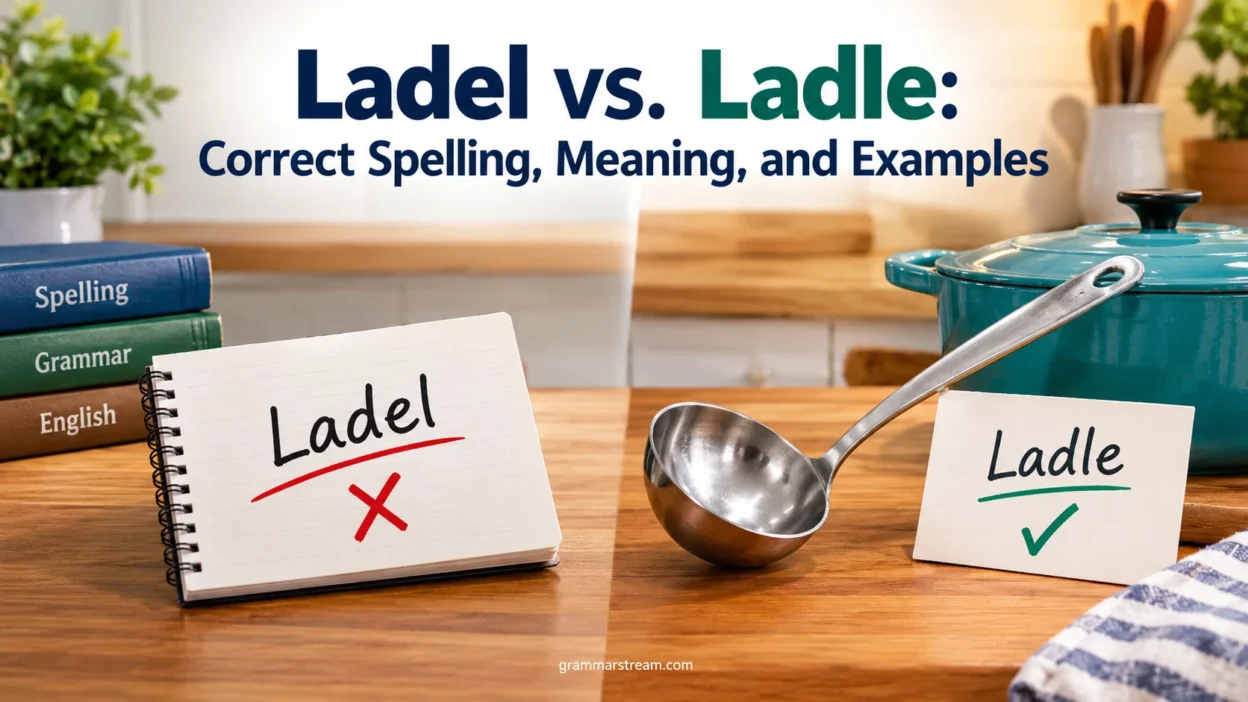
Ladel vs. Ladle is a common spelling confusion, but ladle is the correct spelling in standard English for a kitchen utensil used to serve liquids. A ladle is a large spoon with a deep bowl and a long handle, often used as a serving spoon for soup, stew, gravy, sauce, and other liquid foods. This cooking utensil helps with food preparation and food serving.
The word can also work as a verb, meaning to scoop liquid or serve food with a kitchen tool. For example, you can ladle liquid into a bowl or use a soup ladle when serving soup, serving stew, or serving gravy. In modern English, ladle is the standard spelling, while ladel is a common misspelling and an incorrect spelling.
Although older forms of English, historical word forms, and historical spelling offer clues about the word’s history, they don’t change the modern spelling convention. Learning the word meaning, word origin, and historical usage can help language learners build their vocabulary knowledge, culinary vocabulary, and English vocabulary.
Quick Answer:
Ladle is the correct standard spelling in modern English. Ladel is generally incorrect when referring to the kitchen utensil.
A ladle has a long handle and a deep, rounded bowl that makes it useful for serving liquids and semi-liquid foods. You might use one to serve chicken soup, pour gravy over mashed potatoes, or transfer broth into individual bowls.
Here is the difference at a glance:
- Ladle: The correct spelling of the kitchen utensil and the related verb.
- Ladel: A nonstandard spelling when intended to mean ladle.
- Example: She used a ladle to serve the soup.
- Incorrect example: She used a ladel to serve the soup.
The word ladle works in both American and British English. You don’t need to change its spelling based on which variety of English you’re using.
Comparison Overview
The following table summarizes the key differences between ladel and ladle, including spelling, meaning, pronunciation, and grammatical usage.
| Feature | Ladle | Ladel |
| Spelling status | Standard modern English spelling | Nonstandard spelling for the utensil |
| Meaning | A utensil used to scoop and serve food; also a related verb | Generally a misspelling of ladle |
| Part of speech | Noun and verb | Not the standard form for this meaning |
| Pronunciation | Commonly /ˈleɪdəl/ in American English | Usually intended to represent ladle |
| American English | Correct | Incorrect for the utensil |
| British English | Correct | Incorrect for the utensil |
| Singular form | Ladle | Not applicable as a standard alternative |
| Plural form | Ladles | Not applicable as a standard alternative |
| Past-tense form | Ladled | Not applicable as a standard alternative |
| Example | Please pass me the ladle. | Please pass me the ladle. |
The main point is simple: use ladle whenever you mean the kitchen utensil or the action of serving food with it. The alternative spelling doesn’t identify a different standard kitchen tool.
What Does Ladle Mean?
The word ladle has two common grammatical uses. It can name a physical utensil, or it can describe the action of using that utensil to serve food. Understanding both meanings will help you recognize the word in different contexts.
Ladle as a Noun
As a noun, a ladle is a utensil with a long handle and a deep, cup-shaped bowl. Its design allows you to scoop up liquid or semi-liquid food and transfer it without spilling as easily as you might with a regular spoon.
Ladles come in different sizes, shapes, and materials. A small ladle might work well for gravy or sauce, while a larger one can serve generous portions of soup or stew.
Common types include:
- Soup ladle: A deep-bowled utensil designed to serve soup, broth, and stew.
- Gravy ladle: A smaller utensil used to transfer gravy or other sauces.
- Stainless-steel ladle: A durable option commonly found in home and commercial kitchens.
- Silicone ladle: A utensil that can be useful with cookware that requires a gentler serving tool.
- Plastic ladle: A lightweight option used for certain serving tasks.
- Industrial ladle: A container designed to hold and transfer molten metal in metalworking operations.
Although these tools differ in size and construction, they share a similar purpose: they help people transfer a substance from one place to another.
Examples of ladle as a noun:
- The ladle is hanging beside the stove.
- Please use a clean ladle to serve the soup.
- She bought a stainless-steel ladle for her new kitchen.
- The cook filled each bowl with a large ladle of stew.
- He placed the gravy ladle beside the serving dish.
In each sentence, ladle names a physical object. The word identifies the tool rather than the action being performed.
Ladle as a Verb
The word ladle can also function as a verb. In this form, it means to scoop up and transfer food or another substance using a ladle.
For example, imagine a cook standing beside a large pot of vegetable soup. The cook dips a ladle into the pot, lifts the soup, and pours it into a bowl. The utensil is the noun, while the action of serving the soup is the verb.
This distinction makes the word easy to recognize in a sentence.
Examples of ladle as a verb:
- She ladled soup into four bowls.
- The chef ladled gravy over the mashed potatoes.
- Please ladle the broth into the serving dishes.
- Volunteers ladled hot soup into containers for visitors.
- He is ladling tomato sauce over the pasta.
Notice how the word changes depending on the sentence. In the first example, ladled describes an action completed in the past. In the final example, ladling describes an action in progress.
Read More: Soo vs. So: Meaning, Differences, Spelling, and Examples
Can Ladle Refer to Something Other Than a Kitchen Utensil?
Yes. Although most people encounter the word in kitchens, ladle also has an established technical meaning in metallurgy.
In foundries and metal-processing facilities, an industrial ladle holds and transfers molten metal. These containers are designed to withstand extremely high temperatures and handle heavy loads. Depending on the operation, workers may use them to move molten iron, steel, or other metals between processing stages.
An industrial ladle differs greatly from a household soup ladle in size, construction, and purpose. However, both serve the same basic function: transferring a substance from one location to another.
For example:
- The foundry worker transferred the molten steel using an industrial ladle.
- The kitchen assistant used a ladle to serve vegetable soup.
These examples show how the same word can describe different objects within different settings. The spelling remains ladle in both cases.
What Does Ladel Mean?
In modern standard English, ladel is generally a misspelling of ladle when someone refers to a cooking utensil. It doesn’t serve as the accepted alternative spelling for the word in contemporary American English.
For example, consider this sentence:
Incorrect: She picked up the ladel to serve the chicken soup.
Correct: She picked up the ladle to serve the chicken soup.
The meaning remains clear in the incorrect sentence, but the spelling needs correction. In professional writing, recipes, educational materials, and published articles, the standard form is ladle.
However, there’s an important historical distinction. Older English texts contain spelling forms such as ladel. English spelling wasn’t always as standardized as it is today, and historical documents sometimes preserve forms that modern writers wouldn’t normally use.
That historical evidence doesn’t make ladel an accepted modern alternative for the kitchen utensil. When writing contemporary English, you should use ladle.
It’s also worth distinguishing a spelling error from a proper name or a word in another language. If Ladel appears as a surname, business name, or specialized term, its correctness depends on that particular context. Such uses don’t change the standard spelling of the English kitchen utensil.
Main Differences Between Ladel and Ladle
Although ladel and ladle look similar, they don’t have the same status in modern standard English. The following differences explain why the correct spelling matters and how to use the word confidently.
Spelling Difference Between Ladel and Ladle
The most obvious difference is the order of the final letters.
- Correct: L-A-D-L-E
- Incorrect for the utensil: L-A-D-E-L
The standard spelling places L before E at the end of the word. In ladel, those two letters appear in the opposite order.
This small change can make a word incorrect even when readers understand what the writer means. English contains many words whose spellings depend on specific letter patterns, and ladle is one of them.
A useful way to remember the spelling is to focus on the final three letters: D-L-E.
For example:
- Correct: Put the ladle beside the soup pot.
- Incorrect: Put the ladel beside the soup pot.
The same rule applies whether you’re writing a grocery list, preparing a recipe, or describing kitchen equipment.
Meaning Difference Between Ladel and Ladle
The two forms don’t represent separate standard English words with different meanings in this context.
Ladle has an established definition as both a noun and a verb. As a noun, it identifies the utensil. As a verb, it describes the action of scooping and serving something with that utensil.
By contrast, ladel is generally an incorrect spelling when the intended meaning is the same.
Consider these examples:
- The ladle is in the kitchen drawer.
- She ladled the soup into a bowl.
The first sentence uses ladle as a noun. The second uses a form of the verb ladle. Both are correct, but neither requires the spelling ladel.
Understanding the intended meaning is useful, but meaning alone doesn’t determine whether a spelling is standard. A reader might understand a misspelled word perfectly while still recognizing that it needs correction.
Pronunciation Difference Between Ladel and Ladle
In American English, ladle is commonly pronounced /ˈleɪdəl/.
The pronunciation has two syllables, with the main stress on the first syllable. The initial sound resembles the word lay, followed by an unstressed ending.
For many learners, the final syllable can make the spelling less intuitive. When people learn a word through conversation rather than reading, they might recognize its sound without immediately remembering the exact letter sequence.
This can lead someone to write ladel instead of ladle.
However, the pronunciation doesn’t establish ladel as a correct alternative spelling. When the intended word is the utensil, the standard written form remains ladle.
Example:
“I need a ladle to serve the soup.”
Even if the word sounds unfamiliar when spoken, learning its written form alongside its pronunciation can help you remember it.
Grammar and Word Forms of Ladle
The word ladle follows regular patterns when it functions as a noun or verb. Learning its common forms helps you avoid related spelling mistakes.
| Grammatical use | Correct form | Example |
| Singular noun | Ladle | The ladle is clean. |
| Plural noun | Ladles | The restaurant purchased three ladles. |
| Base verb | Ladle | Please ladle the soup into the bowls. |
| Third-person singular verb | Ladles | She ladles soup for the guests. |
| Simple past tense | Ladled | He ladled gravy onto the plate. |
| Past participle | Ladled | She has ladled soup all afternoon. |
| Present participle | Ladling | He is ladling the stew. |
Pay particular attention to ladling. When adding -ing to ladle, you drop the final e before adding the suffix.
The spelling changes as follows:
- Ladle + -ing = ladling
- Ladle + -ed = ladled
- Ladle + -s = ladles
This pattern appears in many English verbs ending in a silent e. For instance, bake becomes baking, and hope becomes hoping.
Remembering the pattern helps you form the word correctly without memorizing each variation separately.
How to Use Ladle Correctly in Sentences
The easiest way to understand a word is to see how it works in everyday situations. The following examples demonstrate how ladle appears in ordinary writing.
Examples of Ladle as a Noun
When ladle acts as a noun, it identifies the serving utensil. It can appear as the subject, direct object, or object of a preposition.
Here are several examples:
- The ladle hangs beside the stove. The word names the utensil and acts as the subject.
- She bought a stainless-steel ladle. The word acts as the direct object of bought.
- Please pass me the ladle. The word identifies the item someone needs.
- He filled the bowl with a ladle of soup. The word refers to the serving tool and, by extension, the amount it transfers.
- A deep ladle makes serving broth easier. The word identifies a tool suited to the task.
- The soup ladle is larger than the gravy ladle. The word identifies two utensils designed for different serving needs.
- Wash the ladle after using it. The word refers to the utensil that needs cleaning.
These examples demonstrate that the spelling stays the same regardless of the utensil’s size, material, or purpose.
Examples of Ladle as a Verb
When ladle functions as a verb, it describes the act of scooping or serving a substance.
Consider these examples:
- She ladled soup into four bowls. The action happened in the past.
- The chef ladles gravy over the potatoes. The verb describes a repeated or current action.
- Please ladle the broth into the serving dishes. The verb expresses an instruction.
- The volunteers ladled soup into containers. The sentence describes an action performed by a group.
- He is ladling sauce over the pasta. The present participle shows an ongoing action.
- They have ladled hundreds of servings today. The past participle appears with have.
- She carefully ladled the hot stew into a bowl. The adverb carefully explains how she performed the action.
Notice that the spelling changes according to tense and grammatical structure. Nevertheless, every example comes from the same standard word: ladle.
FAQs:
1. Is it spelled ladel or ladle?
Ladle is the correct spelling in modern standard English. Ladel is a common misspelling. Use ladle when referring to the kitchen utensil or the action of serving liquid with it.
2. What is a ladle used for?
A ladle is a kitchen utensil used to serve or transfer liquids and semi-liquid foods. You can use it to serve soup, stew, gravy, sauce, and punch. Its deep bowl and long handle make it easy to scoop and pour food.
3. Why do people confuse ladel and ladle?
People often confuse these spellings because they sound similar when spoken. The pronunciation can make writers unsure about the vowel order. Remember that the correct spelling ends in -dle, not -del.
4. Can ladle be used as a verb?
Yes, ladle can function as both a noun and a verb. As a noun, it refers to a deep serving spoon. As a verb, it means to scoop or serve liquid using this utensil. For example, “She ladled soup into each bowl.”
5. Is ladel an accepted alternative spelling of ladle?
No. Ladel is not an accepted alternative spelling in modern standard English. Although similar forms may appear in historical texts, ladle is the correct choice in contemporary writing.
Conclusion:
Knowing the difference between Ladel vs. Ladle helps you avoid a common English spelling mistake. Ladle is the correct spelling for the kitchen utensil and the related verb, while ladel is a misspelling in modern standard English. Remember the letter order in ladle, practice using it in everyday sentences, and check your spelling when necessary. With this simple trick, you can improve your writing accuracy and use the word confidently in academic and everyday writing.