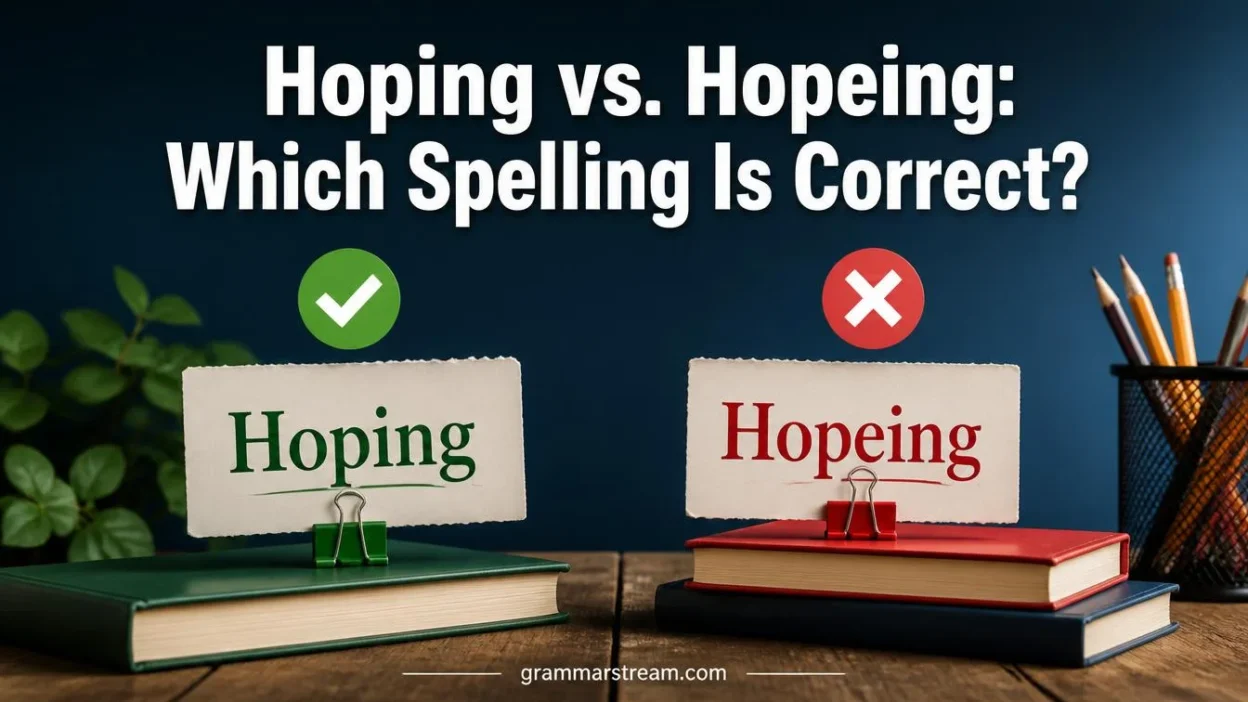
Have you ever typed “hopeing” and wondered whether it actually looks right? You’re not alone. The words hoping and hopeing look almost identical, which makes this a surprisingly common spelling question. The difference comes down to one small letter: the final e in hope.
The correct spelling is hoping. The spelling hopeing is incorrect in standard English. The reason is simple. When you add -ing to a verb that ends in a silent e, you normally remove the final e before adding the suffix. Therefore, hope + ing becomes hoping, not hopeing.
This rule also explains forms such as make → making, write → writing, and smile → smiling. Once you understand the pattern, hoping vs. hopeing becomes much easier to remember.
Quick Answer
Hoping is the correct spelling. Hopeing is a misspelling.
The verb hope becomes hoping when you add -ing:
hope + ing = hoping
You remove the silent e before adding -ing.
For example:
- Correct: I am hoping for good news.
- Incorrect: I am hopeing for good news.
The same spelling pattern appears in many other English verbs:
| Base verb | Correct -ing form |
| hope | hoping |
| make | making |
| write | writing |
| smile | smiling |
| bake | baking |
| drive | driving |
So if you’re choosing between hoping or hopeing, choose hoping every time in standard English.
Comparison Overview
The difference between hoping and hopeing isn’t a difference in meaning. Only one of these forms is correctly spelled.
| Feature | Hoping | Hopeing |
| Correct spelling | Yes | No |
| Base verb | hope | hope |
| Suffix | -ing | -ing |
| Meaning | Wishing or expecting something | Intended meaning is usually the same as hoping |
| Standard English | Accepted | Not accepted |
| Example | I am hoping to visit soon. | I am hopeing to visit soon. |
| Reason | Final silent e is removed | Final e is incorrectly retained |
The important point is that hopeing isn’t an alternative spelling. It doesn’t represent a different grammatical form or a different meaning. It simply results from adding -ing to hope without applying the normal spelling change.
Main Differences Between Hoping vs. Hopeing
The main difference between hoping vs. hopeing is correctness. Hoping follows the standard English spelling rule for verbs ending in silent e, while hopeing does not.
Hoping Is the Correct Form
Hoping is the present participle and gerund form of the verb hope.
The verb hope expresses a wish, desire, or expectation that something will happen.
For example:
- I hope you have a great day.
- She is hoping for a promotion.
- We were hoping to arrive before dark.
- They are hoping that the weather improves.
In each example, hoping keeps the meaning of the original verb while functioning as an -ing form.
Hopeing Is a Spelling Error
Hopeing isn’t the standard English form of hope. The problem comes from keeping the final e when adding -ing.
The incorrect formation looks like this:
hope + ing = hopeing
Standard English instead changes it to:
hope + ing = hoping
That one-letter change matters. In professional writing, academic work, applications, emails, and published content, use hoping.
What Does Hoping Mean?
Hoping means wishing for something to happen or expecting a particular outcome with some degree of uncertainty.
The exact shade of meaning depends on the sentence.
Consider these examples:
“I’m hoping for good weather tomorrow.”
Here, the speaker wants good weather but doesn’t know whether it will happen.
Now consider:
“We’re hoping to finish the project today.”
This expresses an intention or desired outcome. The speakers expect that finishing today is possible, but they aren’t claiming it as a certainty.
That’s an important feature of hope. It usually sits somewhere between a simple wish and a firm expectation.
Hoping as a Verb Form
You can use hoping in continuous verb constructions.
For example:
- I am hoping for a response.
- She is hoping to get the job.
- They were hoping for better results.
- We have been hoping to hear from you.
In these sentences, hoping works with an auxiliary verb such as am, is, were, or have been.
Hoping to Do Something
One of the most common patterns is:
hoping + to + verb
Examples include:
- I am hoping to travel next month.
- She is hoping to win the competition.
- We’re hoping to meet the deadline.
- He was hoping to find a solution.
This construction expresses a desired action or outcome.
Hoping for Something
Another common structure is:
hoping for + noun
Examples:
- We’re hoping for good news.
- She’s hoping for a promotion.
- They’re hoping for better weather.
- I’m hoping for a quick response.
The difference is straightforward. Use hoping to before a verb and hoping for before a noun or noun phrase.
Why Is Hoping the Correct Spelling?
The answer comes from a common English spelling rule involving a silent final e.
The base verb is:
hope
The final e isn’t pronounced. When -ing is added, English generally drops that silent e.
So:
hope → hoping
The same process occurs with many other verbs.
The Silent E Rule
When a verb ends in a silent e, you generally remove that e before adding -ing.
Here are some familiar examples:
| Base verb | Add -ing | Result |
| hope | hope + ing | hoping |
| make | make + ing | making |
| take | take + ing | taking |
| write | write + ing | writing |
| drive | drive + ing | driving |
| smile | smile + ing | smiling |
| bake | bake + ing | baking |
| use | use + ing | using |
The rule helps prevent awkward spellings and preserves the pronunciation patterns associated with these verbs.
Why You Don’t Write Hopeing
The spelling hopeing keeps the final e even though the standard spelling rule tells us to remove it.
Think of the process as two steps:
- Start with hope.
- Remove the final e.
- Add -ing.
- Get hoping.
The mistake happens when the writer jumps directly from hope to hopeing.
It’s similar to writing makeing instead of making. The error isn’t caused by the meaning of the word. It’s caused by applying the suffix incorrectly.
More Examples of the Drop-the-E Rule
Understanding related examples makes hoping vs. hopeing much easier to remember.
Hope → Hoping
I am hoping to see you tomorrow.
Make → Making
She is making dinner.
Not:
She is makeing dinner.
Write → Writing
He is writing a letter.
Not:
He is writeing a letter.
Drive → Driving
They’re driving across the country.
Not:
They’re driveing across the country.
Smile → Smiling
The child was smiling at the camera.
Not:
The child was smileing at the camera.
These examples reveal the pattern clearly: the final silent e disappears before -ing.
Are There Exceptions to the Silent E Rule?
English spelling rules aren’t perfectly mechanical. A few verbs retain the e when adding -ing, usually for pronunciation or clarity.
For example:
- dye → dyeing
- singe → singeing
The form dyeing is particularly useful because dying already exists as the -ing form of die. Keeping the e distinguishes the two words.
Compare:
- dying = approaching death
- dyeing = coloring something with dye
Similarly, singeing keeps the e to distinguish it from other possible readings and preserve the intended pronunciation.
However, hope isn’t one of these exceptions.
Its standard -ing form is firmly:
hope → hoping
There is no standard English situation in which hopeing becomes the preferred spelling.
What Does Hopeing Mean?
Hopeing has no separate standard meaning. When someone writes hopeing, they almost always intend to write hoping.
You might see hopeing in:
- Social media posts
- Informal messages
- Online comments
- Student writing
- Typing mistakes
- Unedited documents
Its appearance doesn’t make it a valid alternative spelling.
For formal or polished writing, replace it with hoping.
Why Do People Spell Hoping as Hopeing?
The mistake is easy to understand.
When people learn that -ing forms come from adding -ing to a verb, they may assume the process is always mechanical.
That produces:
hope + ing → hopeing
But English spelling often requires a small adjustment when suffixes are added.
A learner who knows hope and knows -ing can still miss the spelling change. That’s why hopeing occasionally appears even in otherwise understandable writing.
Another reason involves pronunciation. The final e in hope isn’t pronounced. Because speakers don’t hear the letter, they may not naturally think about what happens to it in writing.
The solution is simple: remember the spelling pattern rather than trying to spell the word entirely from sound.
Read More: Bellies vs Bellys: Which Spelling Is Correct?
Hoping vs. Hopeing: Common Mistakes to Avoid
Several mistakes tend to appear alongside this spelling question.
Adding -ing Without Removing the Final E
This is the most direct error.
Incorrect:
I am hopeing everything works out.
Correct:
I am hoping everything works out.
The correction requires only one change: remove the final e.
Confusing Hoping With Hopping
This is a different spelling issue, but it’s worth understanding because hoping and hopping look similar while carrying completely different meanings.
Hoping comes from:
hope → hoping
It means wishing or expecting something.
Hopping comes from:
hop → hopping
It means jumping or moving with short jumps.
Compare these sentences:
I’m hoping you can come.
The rabbit is hopping across the garden.
The spelling difference matters because the meanings have nothing to do with each other.
Notice another important pattern: hop ends with a single consonant after a short vowel. When -ing is added, the final p is doubled:
hop → hopping
That is completely different from:
hope → hoping
Using Hope and Hoping in the Wrong Context
The forms hope and hoping are both correct. They simply serve different grammatical purposes.
Compare:
I hope you arrive safely.
I am hoping you arrive safely.
The first sentence uses the base verb. The second uses the -ing form as part of a continuous construction.
Both can be grammatically correct depending on context.
Hoping in Different Contexts
The word hoping appears in everyday conversation as well as formal communication. Its meaning remains consistent, but the tone can shift slightly depending on the context.
Hoping in Casual Conversation
People frequently use hoping when discussing plans or expectations.
Examples:
“I’m hoping we can grab dinner tonight.”
“She’s hoping to get tickets.”
“We’re hoping the rain stops soon.”
These sentences sound natural because hoping expresses an outcome that the speaker wants without presenting it as guaranteed.
Hoping in Professional Writing
You can also use hoping in professional communication.
For example:
“We are hoping to receive your feedback by Friday.”
Or:
“The team is hoping to complete the testing phase this week.”
The word itself isn’t informal. Its suitability depends on the surrounding sentence and context.
However, writers should avoid vague or overly repetitive phrasing. In some professional contexts, a more direct construction may communicate the point better.
For example:
“We are hoping to receive the documents by Friday.”
works well when the outcome isn’t certain.
If the request is definite, however:
“Please send the documents by Friday.”
may be clearer.
Hoping in Academic Writing
Academic writers can use hoping when discussing expectations, intentions, or hypothetical outcomes.
For example:
“Researchers are hoping to identify a more efficient treatment method.”
The word works naturally because the researchers want the outcome but don’t know whether it will occur.
The important point is that hoping isn’t restricted to casual English. It’s a standard English word that works across registers.
FAQs:
Is Hoping or Hopeing Correct?
Hoping is correct. Hopeing is a spelling error.
The correct formation is:
hope → hoping
Why Does Hoping Drop the E?
The final e in hope is silent. Standard English spelling generally removes a silent final e before adding -ing.
That’s why hope becomes hoping rather than hopeing.
Is Hopeing Ever Correct?
In standard modern English, hopeing isn’t the correct -ing form of hope. Use hoping instead.
If you encounter hopeing online or in an informal document, it’s generally a spelling mistake.
What Is the Present Participle of Hope?
The present participle of hope is hoping.
For example:
“She is hoping to hear good news.”
The form can also function as a gerund in certain constructions:
“Hoping for a quick solution won’t solve the problem.”
Its grammatical role changes with the sentence, but the spelling remains hoping.
What Is the Difference Between Hoping and Hopping?
Hoping comes from hope and means wishing or expecting something.
Hopping comes from hop and means jumping or moving with short jumps.
Compare:
“I’m hoping for good news.”
“The rabbit is hopping across the field.”
The different spelling reflects different spelling rules and different meanings.
Conclusion:
When choosing between hoping vs. hopeing, there’s a clear winner: hoping. Remember the same pattern with familiar words such as making, writing, driving, and smiling. Once that pattern sticks, hopeing should immediately stand out as incorrect. So whether you’re writing an email, completing an assignment, publishing an article, or sending a quick message, use hoping.