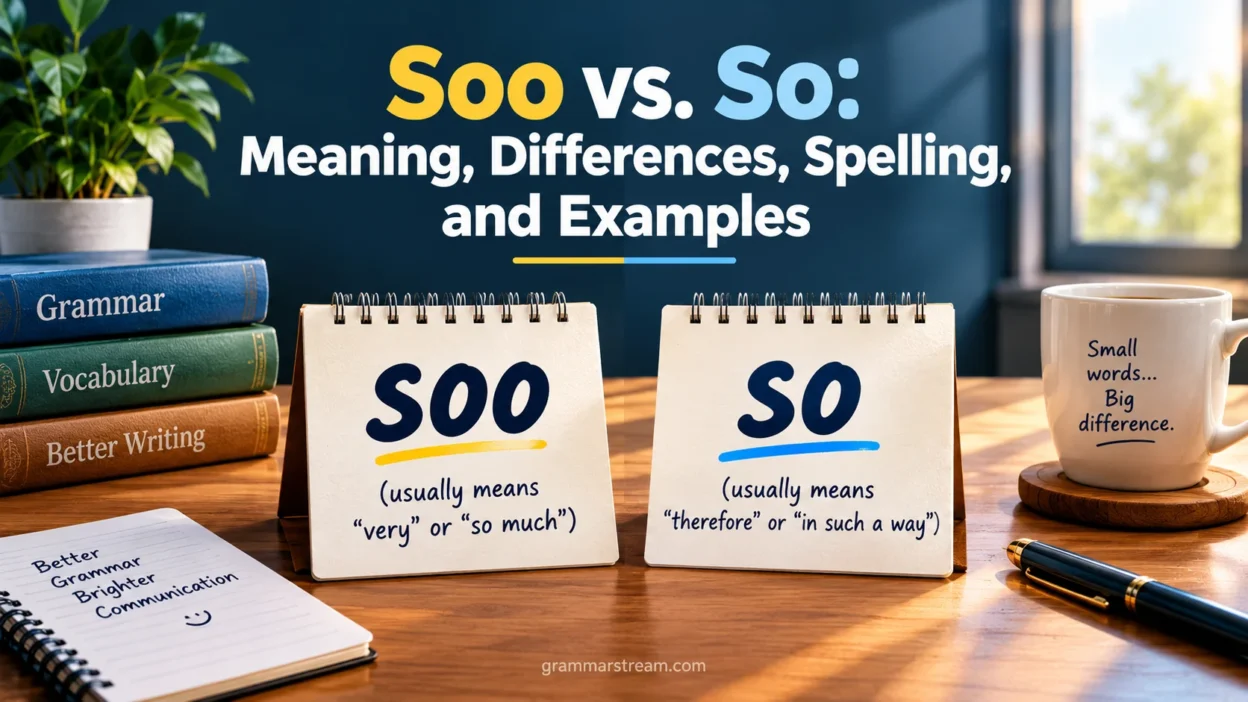
Soo vs. So can be confusing because both spellings sound alike, but only one follows standard English spelling rules in everyday writing. The word so can function as an adverb, conjunction, or intensifier. Its meaning depends on the context and its grammatical function.
For example, “She is so tired” uses so to modify an adjective, while “I was so excited about the news” shows how it adds emphasis. Other parts of speech, including nouns, verbs, adjectives, prepositions, and pronouns, serve different roles in sentence structure.
Understanding verb tense and subject–verb agreement helps you follow English grammar rules and improve grammar accuracy, writing clarity, and communication clarity. Learning these language patterns also helps English learners and native speakers understand correct word usage.
Quick Answer
So is the correct standard English spelling, while soo is generally an informal spelling used to emphasize the word “so” in texts and online conversations.
For example:
- Standard English: I’m so happy to see you.
- Informal texting: I’m soo happy to see you!
- Professional writing: The results were so impressive that we decided to publish them.
- Casual conversation: That concert was soo good!
The two spellings usually communicate the same basic idea when “soo” serves as an expressive version of “so.” The difference lies mainly in spelling conventions and tone. Use so in standard writing, and reserve soo for informal situations where extra emphasis suits your message.
Comparison Overview
The easiest way to understand soo vs. so is to compare their spelling, meaning, grammar, and typical uses. Although they can look similar in a sentence, only “so” is the standard spelling of the ordinary English word.
| Feature | So | Soo |
| Standard English spelling | Yes | No, not as a general substitute for “so” |
| Common function | Adverb, conjunction, and part of several expressions | Informal expressive spelling |
| Basic meaning | Depends on context | Usually retains the meaning of “so” |
| Emotional emphasis | Can express emphasis naturally | Often adds extra visual emphasis |
| Formal writing | Appropriate | Generally inappropriate as a substitute |
| Text messages | Common | Sometimes used for emphasis |
| Social media | Common | Often appears in playful or emotional posts |
| Academic assignments | Appropriate | Avoid unless quoting someone or using a proper name |
| Professional emails | Appropriate | Avoid as an expressive spelling |
| Example | I’m so excited! | I’m soo excited! |
The main rule is simple: “So” is the reliable choice for standard English. “Soo” is an informal stylistic choice when the writer intentionally wants to exaggerate the sound or emotion.
What Does So Mean?
The word so is a versatile English word that can express degree, connect related ideas, introduce a purpose, or refer back to something already mentioned. Its meaning depends on how you use it in a sentence.
Unlike many words with only one common grammatical role, “so” can function as an adverb, a conjunction, or part of a fixed expression. Recognizing these different uses helps you understand why replacing every “so” with “soo” would create problems in standard writing.
So as an Adverb
One of the most common uses of “so” is as an adverb that expresses degree or intensity. It often appears before an adjective or another adverb to show how strongly something applies.
For example:
- The weather is so beautiful today.
- She speaks so clearly that everyone understands her.
- I’m so excited about the upcoming trip.
- This bag is so expensive.
- He ran so quickly that nobody could catch him.
In these examples, “so” strengthens the words that follow it. It tells the reader how beautiful, clearly, excited, expensive, or quickly something is.
In many sentences, “so” has a meaning similar to “very” or “to such a degree.” However, the two words don’t always work interchangeably. For instance, “so expensive that we couldn’t afford it” naturally introduces a result, while “very expensive that we couldn’t afford it” does not follow the same grammatical pattern.
Example: “The movie was so interesting that I watched it twice.”
Here, “so” emphasizes the degree of interest and connects that degree to a result.
So as a Conjunction
The word “so” can also connect two clauses by expressing a result or consequence. In this construction, the second clause explains what happened because of the first.
Consider these examples:
- It started raining, so we stayed inside.
- I missed the bus, so I called a taxi.
- She studied hard, so she passed the exam.
- The restaurant was full, so we went somewhere else.
- He felt tired, so he went to bed early.
Each sentence contains two related ideas. The first clause presents a situation, while the second describes its result.
When “so” joins two independent clauses, a comma generally comes before it. For example, “The store was closed, so we returned home.” Both sides can stand as complete sentences.
This grammatical use differs from the expressive spelling “soo.” In formal writing, the conjunction should retain its standard spelling because it connects ideas rather than merely adding emotional emphasis.
So to Express Purpose
The expression so that introduces a purpose or intended outcome. It explains why someone performs an action or what they hope to achieve.
For example:
- I left early so that I could catch the train.
- She spoke slowly so that everyone could understand her.
- He saved money so that he could buy a new laptop.
- We wrote down the instructions so that nobody would forget them.
English speakers also frequently omit “that” when the meaning remains clear.
For example, “I moved closer so I could hear the speaker.”
In both versions, “so” introduces the purpose behind the action. Writing “soo that” would generally be inappropriate in standard English because the extra letter doesn’t serve a grammatical purpose.
So to Express Agreement or Confirmation
The word “so” also appears in expressions that refer to information already discussed. These expressions help speakers answer questions without repeating an entire statement.
Common examples include:
- I think so.
- I hope so.
- If so, let me know.
- So far, everything is going well.
- Even so, we decided to continue.
Consider this exchange:
Person A: “Do you think they’ll arrive before noon?”
Person B: “I think so.”
The second speaker uses “so” to refer to the possibility that the people will arrive before noon. Repeating the entire idea would be unnecessary.
These expressions are established parts of standard English. In ordinary writing, keep the conventional spelling rather than replacing it with “soo.”
What Does Soo Mean?
The spelling soo commonly appears in informal digital communication as an expressive version of “so.” People use it to emphasize a feeling, exaggerate a description, or give a message a more playful tone.
For example, someone might write, “I’m soo happy today!” instead of “I’m so happy today!” The intended meaning is usually clear, but the extra letter adds visual emphasis.
It’s important to distinguish this informal spelling from a standard English word with its own meaning. In most ordinary sentences, “soo” doesn’t introduce a new grammatical form. Instead, it represents a stylistic choice made by the writer.
Soo in Text Messages
Text messages often lack the facial expressions, gestures, and vocal emphasis that people use during face-to-face conversations. As a result, writers sometimes stretch words to communicate emotion more clearly.
Writing “soo” is one way to do this. It can make a message feel more enthusiastic, affectionate, exaggerated, or playful.
Here are some examples:
- “I’m soo tired right now.”
- “That sounds soo fun!”
- “I miss you soo much.”
- “Your new haircut looks soo good.”
- “I’m soo ready for the weekend.”
In these examples, “soo” doesn’t fundamentally change the meaning of the sentence. Instead, it signals that the writer wants the emotion or description to stand out.
Imagine a friend telling you that they got tickets to their favorite band’s concert. You might respond, “That’s soo exciting!” The additional letter gives your response a more animated feel.
However, this style is optional. You can express the same excitement with “That’s so exciting!” Standard spelling doesn’t prevent you from communicating strong emotions.
Soo on Social Media
Social media encourages creative language, short expressions, and distinctive writing styles. People often modify conventional spelling to make captions, comments, and posts sound more expressive.
The spelling “soo” fits this pattern because it visually stretches the word and draws attention to the emotion being expressed.
Examples include:
- “This outfit is soo cute!”
- “I’m soo ready for summer.”
- “That ending was soo unexpected.”
- “Today has been soo much fun.”
- “These pictures turned out soo beautiful.”
The intended tone depends on the context. A fashion creator might use “soo cute” to express excitement about an outfit, while a friend might write “soo happy for you” to celebrate someone’s achievement.
Neither use requires a special grammatical rule. The spelling simply reflects the writer’s informal style.
Keep in mind: A spelling that works in a social media caption may not suit a professional report. The right choice depends on the audience, purpose, and expectations of the writing situation.
Soo in Names and Other Contexts
Not every appearance of “Soo” represents an informal version of “so.” The spelling can also appear in proper names, place names, and romanizations of words from other languages.
For example, Soo may appear as a person’s given name or as part of an established name. In those situations, its spelling should remain unchanged.
Consider these distinctions:
- Informal expression: “That dessert looks soo delicious!”
- Proper name: “Soo joined the meeting this morning.”
- Established place name: The word may appear as part of a location’s official name.
- Foreign-language romanization: “Soo” may represent a word or name according to a particular language’s romanization system.
These uses shouldn’t be confused with standard English spelling. When “Soo” is someone’s name, changing it to “So” could introduce a spelling error rather than correct one.
Always examine the context before deciding whether the spelling is appropriate.
Read More: Hoping vs. Hopeing: Which Spelling Is Correct?
Main Differences Between Soo and So
Although “soo” and “so” often communicate similar ideas in casual messages, they differ in standard spelling, grammatical use, tone, and suitability for different writing situations.
Difference in Spelling and Correctness
The most important distinction is that so is the standard English spelling, while “soo” is generally nonstandard when used as its expressive substitute.
Standard spelling provides a consistent way to communicate across different settings. Readers expect conventional spellings in school assignments, business documents, news articles, and other formal texts.
Compare these sentences:
- Standard: The presentation was so informative that I took detailed notes.
- Informal: The presentation was soo informative!
- Standard: I’m so grateful for your support.
- Informal: I’m soo grateful for your support!
The informal examples may work in personal messages, but the standard versions are appropriate across a wider range of situations.
An important exception applies when “Soo” is a proper name or appears in a direct quotation. In such cases, the spelling may be correct for that specific purpose.
Difference in Meaning
When “soo” functions as an expressive version of “so,” the basic meaning usually remains the same. The extra letter mainly changes the visual presentation and suggested tone.
For example:
- “I’m so happy.” — Expresses happiness.
- “I’m soo happy!” — Expresses happiness with extra emphasis.
Both sentences communicate the same general idea. The second version makes the emotion appear stronger or more exaggerated.
However, “so” has several grammatical functions that depend on its position in a sentence. It can indicate a result, express a degree, or introduce a purpose. The spelling “soo” doesn’t automatically preserve the conventions of these grammatical constructions in standard writing.
For that reason, use the standard form when grammar and clarity matter more than informal expression.
Difference in Tone and Emotion
Tone is another important difference between “soo” and “so.” Although both spellings can express strong feelings, repeating the vowel often makes the message look more dramatic or playful.
Compare the following examples:
| Sentence | Likely Tone |
| I’m so happy for you. | Warm, sincere, or neutral |
| I’m soo happy for you! | More excited or expressive |
| That was so awkward. | Straightforward observation |
| That was soo awkward! | Emphasizes the awkwardness |
| You’re so sweet. | Friendly or affectionate |
| You’re soo sweet! | Potentially more enthusiastic or affectionate |
These interpretations aren’t fixed rules. Punctuation, surrounding words, and the relationship between speakers can influence how a message sounds.
For instance, “I’m soo tired” might be a playful complaint between friends. In another conversation, it might simply emphasize exhaustion.
The extra letter suggests emphasis, but it doesn’t guarantee a particular emotion.
Difference in Formal and Informal Writing
Different writing situations call for different levels of formality. A message to a friend gives you more freedom to experiment with spelling than a university assignment or professional report.
Use “so” in:
- Academic essays and research papers.
- Professional emails and business correspondence.
- Reports, presentations, and official documents.
- Published articles and educational materials.
- Everyday writing that follows standard English conventions.
You may use “soo” in:
- Casual text messages.
- Informal conversations with friends.
- Playful social media captions.
- Personal posts where exaggerated spelling suits your voice.
- Creative dialogue when you want to preserve a character’s informal style.
For example, “I’m so excited about the new project” works in a professional email. In a text to a friend, “I’m soo excited about this!” may feel more natural to the writer.
The goal isn’t to eliminate personality from your writing. It’s to match your language to the situation.
When Should You Use So or Soo?
Choosing between these spellings becomes easier when you consider three things: your audience, your purpose, and the tone you want to create.
If you aren’t sure which spelling to use, choose “so.” It’s the standard form and works in both formal and informal writing.
When to Use So
Use “so” whenever you need the standard English word. This includes situations where you want to emphasize a description, connect two clauses, explain a purpose, or refer back to previously mentioned information.
Here are some examples:
- For emphasis: The weather is so pleasant today.
- For a result: I missed the train, so I took a taxi.
- For purpose: She whispered so that nobody would hear.
- For agreement: I think so.
- For professional writing: The findings were so important that the team conducted further research.
Notice that “so” remains appropriate even when the sentence expresses strong emotion. You don’t need an extra letter to make a statement enthusiastic.
For example, “I’m so proud of you!” can sound warm and heartfelt. The exclamation point and surrounding words already communicate emotion.
Practical rule: If you’re writing something that other people will evaluate for spelling and grammar, use “so” unless a different spelling is required by a name or quotation.
When to Use Soo
Use “soo” only when you intentionally want an informal, expressive style and the context supports it.
For example:
- “That puppy is soo adorable!”
- “I’m soo excited to see you!”
- “This song is soo good!”
- “You’re soo funny!”
- “I miss summer soo much!”
These sentences work as informal expressions because readers can easily understand the intended meaning.
Still, you don’t need to use “soo” every time you want to sound enthusiastic. Repeated letters can become distracting when they appear too often.
Compare these messages:
Overdone: “I’m soo soo soo excited because this is soo soo amazing!”
More natural: “I’m soo excited! This is amazing!”
The second version emphasizes the feeling without overwhelming the reader.
Good informal writing still benefits from variety, clarity, and restraint.
Can You Use Soo in Formal Writing?
Generally, you should avoid using “soo” as a substitute for “so” in formal writing.
For example:
Informal: The results were soo impressive that the researchers repeated the experiment.
Standard: The results were so impressive that the researchers repeated the experiment.
The standard version follows conventional English spelling and is appropriate for academic or professional settings.
However, there are legitimate exceptions. You may retain “Soo” in a person’s name, an official title, a brand name, or a direct quotation where the original spelling matters.
For example, if you’re quoting a message that says, “I’m soo happy,” changing the spelling may fail to preserve the original wording. In that case, keeping the original spelling is appropriate.
The key distinction is whether you’re using “soo” as a deliberate part of the source material or simply replacing the standard word in your own formal writing.
Soo vs. So in Texting and Slang
Digital communication has created many opportunities for creative spelling. People stretch words, repeat punctuation, and use abbreviations to communicate feelings quickly.
The spelling “soo” is one example of this informal style. It adds emphasis without changing the basic word being expressed.
However, soo isn’t a separate standard slang word with one universally accepted definition. Its interpretation depends on how the writer uses it.
What Does Soo Mean in Text?
In text messages, “soo” usually means “so” with extra emphasis. It can communicate excitement, frustration, affection, surprise, or exaggeration.
Consider these examples:
- “I’m soo happy for you!” — Expresses strong happiness or support.
- “That was soo awkward.” — Emphasizes an uncomfortable experience.
- “I love this soo much!” — Communicates strong enthusiasm or affection.
- “I’m soo done with this.” — Emphasizes frustration or exhaustion.
- “You’re soo right!” — Adds emphasis to agreement.
In each example, the surrounding words determine the exact meaning. The extra “o” strengthens the expression rather than creating an entirely new word.
This is similar to writing “nooo” instead of “no” or “yesss” instead of “yes.” The modified spelling can suggest a more expressive delivery, even though the conventional spelling remains unchanged.
Does Soo Mean the Same as So?
Usually, yes, when “soo” appears as an informal substitute for “so.”
For example:
- “This cake is so good.”
- “This cake is soo good!”
Both statements praise the cake. The second simply emphasizes the speaker’s enthusiasm.
However, the two spellings aren’t interchangeable in every context. “So” appears in standard grammatical constructions, including “so that,” “if so,” and “I think so.” Replacing it with “soo” in formal writing would generally be inappropriate.
Also, “Soo” may function as a proper name or appear in a different linguistic context. Its meaning in those cases depends on the specific name or language involved.
Therefore, always consider the sentence rather than assuming every occurrence of “soo” means the same thing.
Is Soo Flirty or Romantic?
The spelling “soo” can appear in romantic messages, but it isn’t inherently flirty.
Its effect depends on the words surrounding it, the relationship between the people communicating, and the overall tone of the conversation.
For example:
- “You’re soo sweet!” — Could be friendly, appreciative, or flirtatious.
- “I miss you soo much.” — Often expresses affection, although the relationship matters.
- “That song is soo good.” — Usually communicates enthusiasm about the song.
- “You look soo cute today!” — May be a friendly compliment or a flirtatious remark.
Notice that the spelling alone doesn’t reveal someone’s intentions. A message that seems romantic between partners may sound entirely friendly between close friends.
If you’re trying to interpret a text, look at the whole conversation rather than treating the extra “o” as a hidden romantic signal.
FAQs:
1. Is it Soo or So?
So is the correct spelling in standard English. People sometimes write soo in informal messages or social media posts to add emphasis, but it isn’t appropriate for formal writing.
2. What Does Soo Mean in Text Messages?
Soo is an informal spelling of so that people use to express strong emotions, excitement, happiness, or exaggeration. For example, “I’m soo happy!” shows more enthusiasm than the standard spelling.
3. Is Soo Grammatically Correct?
No, soo isn’t a standard English spelling. Although people commonly use it in casual conversations and online communication, you should use so in academic assignments, professional emails, and other formal writing.
4. When Should You Use So Instead of Soo?
Use so in formal and informal writing whenever you need the standard English word. It works as an adverb, conjunction, or intensifier. For example, “The movie was so interesting” is correct in every writing context.
5. Why Do People Write Soo Instead of So?
People write soo to express emotions, emphasize a point, or create a playful tone. This spelling is common in text messages, Instagram captions, and online conversations, where informal language and creative spelling are popular.
Conclusion:
Understanding soo vs. so is simple once you know the difference between standard spelling and informal expression. So is the correct English word for everyday communication, academic work, and professional writing. Soo is a nonstandard variation that people use online to express excitement, happiness, or emphasis. Although both spellings sound the same, they aren’t interchangeable in every context. Choose so when you want correct, clear English, and save soo for casual messages where a playful tone fits.