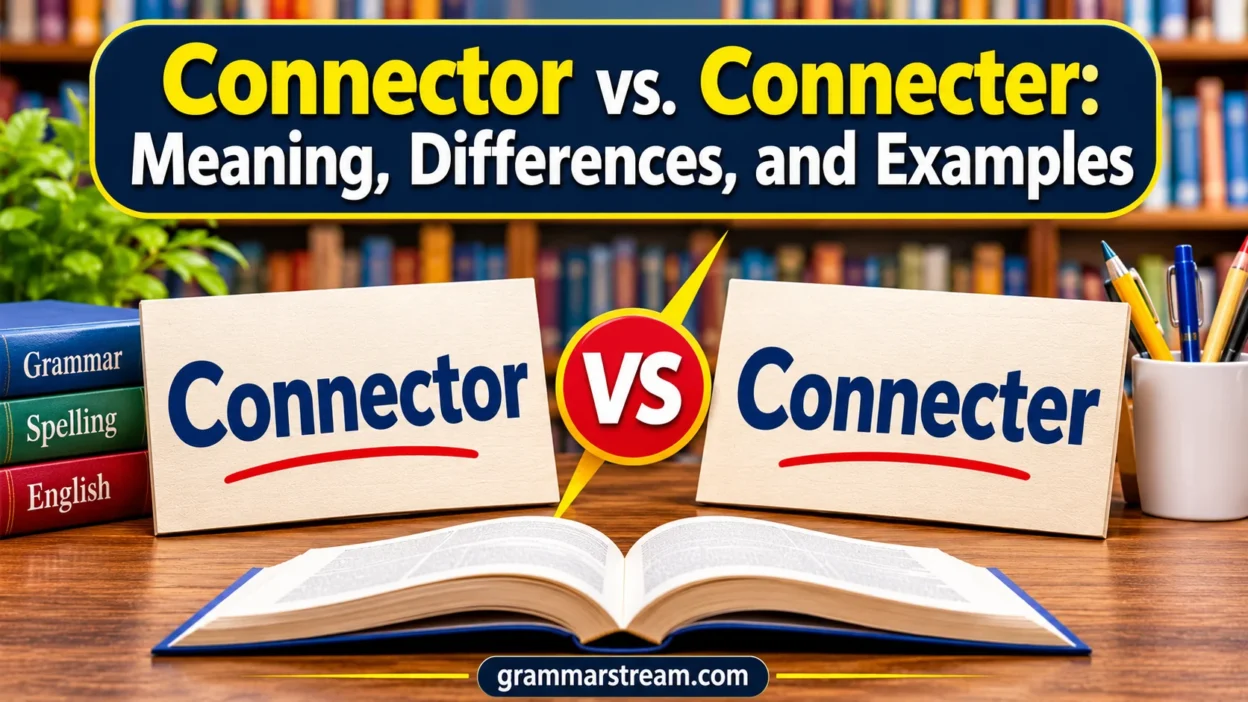
Have you ever wondered whether the correct spelling is connector or connecter? These two words look almost identical. Just one letter separates them, yet their usage differs significantly in modern English.
If you’re writing an article, preparing a business document, or describing an electronic device, choosing the right spelling matters. A small spelling mistake can distract readers and make otherwise polished writing look careless.
The confusion usually comes from the verb connect and the way English forms nouns by adding suffixes. Both spellings may appear in written material, but they don’t enjoy the same level of acceptance in everyday English.
So, should you write connector or connecter? The answer is straightforward: connector is the standard and preferred spelling in modern English. Although connecter occasionally appears as a variant, most writers should avoid it.
Quick Answer
Connector is the standard and widely preferred spelling in modern English. It refers to a person, device, or thing that connects two or more objects, systems, people, or ideas.
Connecter is a rare alternative spelling of the same noun. However, it appears much less frequently in contemporary writing and isn’t the usual choice in professional, academic, or technical communication.
For example:
- Correct and preferred: The USB connector links the keyboard to the computer.
- Rare variant: The USB connecter links the keyboard to the computer.
When you’re unsure, choose connector. It’s the familiar spelling readers expect.
Comparison Overview
The easiest way to understand connector vs. connecter is to compare their spelling, meaning, and everyday usage. Both forms relate to the verb connect, but one clearly dominates modern English.
| Feature | Connector | Connecter |
| Spelling | Standard and preferred | Rare variant |
| Meaning | Something or someone that connects | Something or someone that connects |
| Part of speech | Noun | Noun |
| Root word | Connect | Connect |
| Suffix | -or | -er |
| Common usage | Very common | Uncommon |
| Professional writing | Recommended | Generally avoided |
| Technical writing | Standard choice | Rarely used |
| Plural form | Connectors | Connecters |
| General acceptance | Widely accepted | Limited usage |
The main difference is spelling preference rather than meaning. Connector is the established form you’ll encounter in ordinary English, technical documents, product descriptions, and educational materials.
Connecter isn’t necessarily an invented word. It has appeared as a spelling variant, but its limited use makes it a poor choice for most modern writing.
Main Differences Between Connector vs. Connecter
Understanding the differences requires looking beyond one letter. Their relationship with the verb connect explains why both spellings exist and why English speakers overwhelmingly favor one.
Connector: Definition and Meaning
Connector is a noun that describes something or someone that joins two or more things together. It can refer to a physical object, a technical component, or a person who brings others together.
The word comes from the verb connect, which means to join, link, or establish a relationship between separate things.
You probably encounter connectors more often than you realize. Your phone charger, computer cables, and network equipment all contain components that help establish connections.
For example, a USB connector joins a cable to an electronic device. Similarly, a person who introduces two business professionals can act as a connector.
The word has several common applications:
- Electronics: A component that joins electrical circuits or cables.
- Computing: A component or interface that allows systems to communicate.
- Grammar: A word or expression that links ideas or parts of a sentence.
- Business: A person who introduces individuals or establishes professional relationships.
- Transportation: A route or service that links different destinations.
Consider these sentences:
- The HDMI connector links the laptop to the television.
- A network connector allows two devices to exchange information.
- She became an important connector within the local business community.
- The grammar lesson explains how each connector joins related ideas.
- The technician replaced the damaged cable connector.
Each example uses connector to describe something that establishes a link.
Connecter: Definition and Meaning
Connecter is a rare spelling variant of connector. It can describe a person or thing that connects separate objects, systems, or individuals.
Its meaning generally matches connector. The difference lies in how English writers form and spell the noun.
Although connecter has appeared in historical and dictionary records, it isn’t the conventional spelling in modern everyday English. Most readers expect connector, especially when discussing electronics, computing, grammar, or professional relationships.
For example:
- The connecter joins the two separate components.
- A connecter helps establish communication between different systems.
These sentences communicate the intended meaning. However, replacing connecter with connector makes them more consistent with standard contemporary usage.
It’s also important not to confuse a rare spelling with a separate technical term. Connecter doesn’t normally describe a different type of connecting device.
If you’re writing for a general audience, there’s little reason to choose this uncommon form.
Connector vs. Connecter: Which Spelling Is Correct?
The best choice is connector.
Modern English uses connector as the established spelling for the noun derived from connect. It appears across technical industries, educational writing, business communication, and everyday conversations.
Connecter exists as a less common variant. However, its presence doesn’t make it equally suitable for every situation.
Here’s how to choose:
| Writing situation | Recommended spelling |
| School assignments | Connector |
| Academic papers | Connector |
| Business documents | Connector |
| Technical manuals | Connector |
| Product descriptions | Connector |
| Blog articles | Connector |
| Everyday messages | Connector |
For instance, if you’re describing a USB-C component, write:
“The USB-C connector supports charging and data transfer.”
Avoid switching between connector and connecter throughout the same document. Consistency helps readers follow your writing without unnecessary distractions.
Read More: Traveler vs. Traveller: Meaning, Differences, and Examples
Examples of Connector in Sentences
Examples make spelling rules easier to remember. They also show how connector works across different situations.
Here are practical sentences using the standard spelling.
Everyday examples
- The connector holds both pieces together securely.
- I need a new connector for my charging cable.
- This connector doesn’t fit the older device.
- The mechanic replaced the broken hose connector.
- A loose connector caused the device to stop working.
Technology and electronics examples
- The HDMI connector carries digital audio and video signals.
- A USB connector allows compatible devices to exchange data.
- The technician inspected every electrical connector.
- The network connector links the computer to the local network.
- This adapter includes a connector for older equipment.
Grammar and writing examples
- A coordinating conjunction can serve as a connector between two independent clauses.
- The word “however” acts as a connector between contrasting ideas.
- Transitional connectors help readers understand relationships between paragraphs.
- The teacher explained how connectors improve sentence flow.
Business and networking examples
- Sarah is a natural connector who introduces people with shared interests.
- The conference brought together several influential business connectors.
- A reliable connector can help entrepreneurs build valuable relationships.
- His role as a community connector strengthened local partnerships.
Notice how the meaning changes with the context. Nevertheless, the spelling stays exactly the same.
Why Is Connector Spelled With an “O”?
The spelling of connector becomes easier to understand when you examine its root word and suffix.
The word connect serves as the base. English commonly forms nouns by adding suffixes such as -or and -er to verbs.
Both suffixes can describe a person or thing that performs an action. However, English doesn’t apply one universal suffix rule to every verb.
For connector, the established spelling uses -or:
Connect + -or = Connector
The resulting noun describes something or someone that performs the action of connecting.
Similar examples include:
| Verb | Noun |
| Connect | Connector |
| Act | Actor |
| Inspect | Inspector |
| Direct | Director |
| Invent | Inventor |
| Collect | Collector |
| Conduct | Conductor |
These examples show that English frequently uses the -or ending to create nouns from verbs.
However, don’t assume that every verb ending in a particular letter must follow the same pattern. English spelling developed through historical influences, word formation, and established usage.
The spelling connector became conventional through repeated use. That’s why modern writers generally choose it instead of connecter.
Common Mistakes When Using Connector and Connecter
Even simple spelling differences can create confusion. Fortunately, a few practical guidelines can help you avoid mistakes.
Using connecter in professional writing
One common mistake is choosing connecter because it looks similar to other English nouns ending in -er.
Although the spelling is recognizable, connector is the established form. Use it in reports, emails, articles, and technical documents.
Assuming both spellings are equally common
The existence of two spelling variants doesn’t mean they’re equally accepted in everyday writing.
Connector dominates contemporary usage. Connecter remains uncommon.
Confusing connector with a connecting word
In grammar, a connector describes a word or expression that links ideas. However, not every connector belongs to the same grammatical category.
For example, conjunctions connect clauses, while transitional adverbs show relationships between ideas.
Changing spellings within one article
Switching between connector and connecter makes your writing inconsistent. Choose the standard spelling and maintain it throughout your content.
Ignoring the context
A connector in electronics isn’t necessarily the same type of component as a connector in grammar. The word retains its general connecting function, but its specific meaning depends on context.
The safest approach is simple: use connector and explain its intended meaning clearly.
Connector vs. Connecter: Usage in Different Contexts
The word connector appears in several fields, and its meaning depends on what it connects. Understanding these applications helps you recognize the word in different types of writing.
Connector in Technology and Electronics
Technology provides some of the clearest examples of connector usage. Electronic connectors allow devices, cables, and circuits to establish physical connections.
Without these components, many electronic systems couldn’t transfer power or information effectively.
A connector may contain metal contacts, insulating materials, locking mechanisms, or protective housings. Its design depends on the equipment and connection type.
For example, a USB connector transfers data and can deliver electrical power. An HDMI connector carries digital video and audio between compatible devices.
| Connector type | Main purpose | Common application |
| USB connector | Transfers data and power | Phones and computers |
| HDMI connector | Carries digital audio and video | TVs and monitors |
| Ethernet connector | Supports wired network connections | Routers and computers |
| Audio connector | Carries audio signals | Headphones and speakers |
| Power connector | Supplies electrical power | Electronic equipment |
Real-world example: Imagine connecting a laptop to an external monitor. You might use an HDMI connector to establish the connection. If that connector becomes damaged, the monitor may stop receiving the signal.
In this situation, connector describes a physical component rather than a person or an abstract relationship.
The spelling doesn’t change regardless of the connector’s size, shape, or technical purpose.
Connector in Grammar and Writing
Connectors also play an important role in written English. They help readers understand how words, phrases, sentences, and ideas relate to one another.
In grammar, connectors are words or expressions that establish relationships between different parts of a text. Writers use them to show contrast, addition, cause, consequence, and sequence.
For example, consider these sentences:
- I wanted to attend the meeting, but I had another appointment.
- She studied regularly; therefore, she passed the examination.
- Additionally, the company introduced several new services.
- We stayed indoors because it was raining.
Each highlighted expression helps establish a relationship between ideas.
Common grammatical connectors include:
| Connector | Function | Example |
| And | Adds information | Tom and Sarah arrived early. |
| But | Shows contrast | I called him, but he didn’t answer. |
| Because | Explains a reason | She stayed home because she felt tired. |
| Therefore | Shows a result | The road was closed; therefore, we changed our route. |
| However | Introduces contrast | The product is expensive. However, it’s reliable. |
| Although | Shows contrast or concession | Although it was late, they continued working. |
| Furthermore | Adds supporting information | Furthermore, the report includes recent figures. |
| Meanwhile | Shows simultaneous events | Meanwhile, the team prepared the presentation. |
Connectors make writing easier to follow because they reveal how information fits together.
However, using too many connectors can make paragraphs feel mechanical. Choose expressions that genuinely clarify the relationship between your ideas.
Frequently Asked Questions
Is Connector or Connecter Correct?
Connector is the standard and preferred spelling in modern English. It describes a person, device, or thing that connects separate elements.
Connecter is a rare alternative spelling. For everyday, academic, and professional writing, choose connector.
Is Connecter a Real Word?
Yes, connecter has appeared as a spelling variant of connector. However, it’s uncommon in contemporary English.
Most modern writers and readers recognize connector as the conventional spelling. Therefore, using connecter may look unusual in professional documents or published content.
What Does Connector Mean?
A connector is something or someone that joins two or more things together.
Its meaning depends on the context. In electronics, it describes a component that joins cables or circuits. In grammar, it refers to words that link ideas. In business, it can describe someone who introduces people and builds relationships.
Why Is Connector Spelled With an O?
Connector uses the suffix -or rather than -er.
The word comes from the verb connect and follows its established noun form:
Connect + -or = Connector
English uses both -or and -er to form nouns. However, individual words follow established spelling conventions rather than one universal rule.
What Is the Plural of Connector?
The plural of connector is connectors.
You form the plural by adding -s to the singular noun.
Examples:
- The computer has several USB connectors.
- The technician replaced two damaged electrical connectors.
- These connectors support different types of cables.
The plural form of the rare variant connecter is connecters. However, connectors remains the standard choice.
Conclusion:
The difference between connector and connecter mainly concerns spelling preference rather than meaning. Both forms relate to the action of connecting, but they don’t enjoy equal acceptance in modern English. Connector is the standard spelling you’ll encounter in electronics, technology, grammar, business, and everyday communication. Connecter remains a rare alternative that most writers should avoid.