Have you ever written acception when you actually meant exception? These two words look almost identical, which makes them easy to confuse. However, their meanings and uses differ considerably.
The confusion often comes from their similar spelling and their connection to words such as accept, acceptance, and except. While one has a historical meaning related to accepting or interpreting something, the other describes something excluded from a general rule.
Understanding acception vs. exception helps you avoid spelling mistakes and choose the right word in everyday conversations, professional communication, and academic writing. Although acception appears in historical English dictionaries, exception remains the familiar and widely accepted word in modern English. Knowing when each term applies will make your writing clearer and more accurate.
Quick Answer:
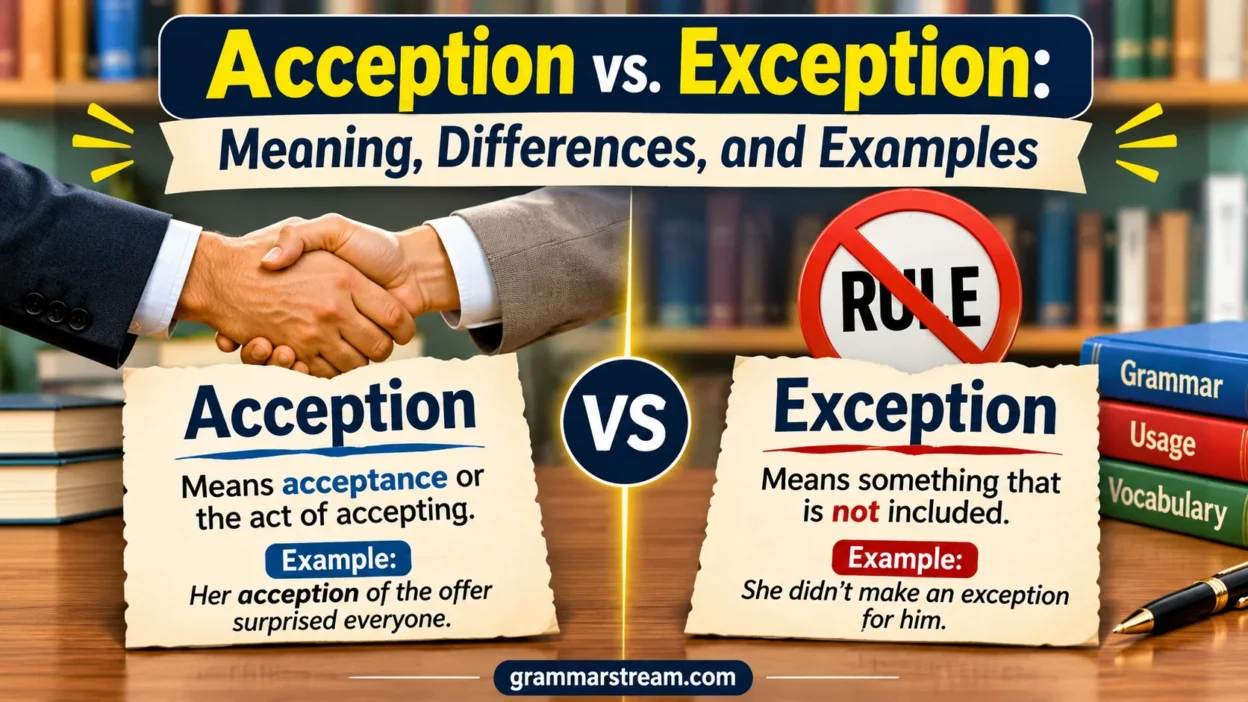
Acception is a rare, historical English noun associated with acceptance or the interpretation of a word or expression. It occasionally appears in older texts and specialized discussions about language.
Exception is a common modern English noun that describes someone or something excluded from a general rule. It can also refer to an unusual case that differs from what normally happens.
Here is the simplest way to remember the difference:
- Acception: A historical term associated with acceptance or interpretation.
- Exception: Something excluded from a rule or general statement.
Examples:
- Acception: The older text discussed the acception of a particular expression.
- Exception: Everyone must follow the classroom rules without exception.
In modern writing, use exception when discussing an unusual case or exclusion. If you mean the act of accepting something, use acceptance rather than acception.
Comparison Overview:
Although these words share several letters, they serve different purposes. Their meanings, frequency, and modern applications make them easy to distinguish once you understand their origins.
| Feature | Acception | Exception |
| Part of speech | Noun | Noun |
| Meaning | Historical term associated with acceptance or interpretation | Something excluded from a rule |
| Modern usage | Rare and largely obsolete | Common and widely used |
| Context | Historical and specialized language | Everyday, academic, legal, and professional writing |
| Related word | Accept | Except |
| Common expression | No widely established modern expression | Exception to the rule |
| Pronunciation | ak-SEP-shun | ik-SEP-shun |
| Recommended usage | Generally avoid in modern writing | Use when referring to exclusions or unusual cases |
The biggest difference involves their meanings. Acception belongs mainly to historical vocabulary while exception remains an essential part of everyday English.
For example, if a teacher allows one student to skip a particular assignment, that student receives an exception. If you’re discussing the interpretation of an older expression, acception might appear in a historical linguistic context.
What Does Exception Mean?
Exception refers to a person, situation, item, or condition that doesn’t follow a general rule. It describes something that differs from an established standard or receives special treatment.
People use this word in everyday conversations, workplace policies, academic discussions, legal documents, and official regulations.
For example, imagine a school requiring every student to wear a uniform. However, the principal allows one student to wear different clothing for a medical reason. That student has an exception to the uniform policy.
The general rule remains unchanged. Only one particular situation receives different treatment.
The word also describes something unusual compared with a normal pattern.
Consider this sentence:
The restaurant is usually crowded on weekends, but today was an exception.
Here, the word describes an unusual situation rather than someone being excluded from a rule.
Definitions of Exception
The word exception has several closely related meanings depending on its context.
1. Something excluded from a general rule
This is the most common meaning. It describes a person or thing that doesn’t follow an established requirement.
Example: Every employee must attend the meeting, with the exception of those on approved leave.
2. An unusual or uncommon situation
An exception can describe something that differs from an expected pattern.
Example: Heavy snowfall is an exception in this part of the country.
3. An objection or disagreement
The word can also describe opposition to something, particularly in the expression take exception to.
Example: She took exception to the manager’s unfair comments.
These meanings share an underlying idea: something stands apart from an accepted condition, rule, or expectation.
Examples of Exception in Sentences
The best way to understand a word is to see how people use it in different situations.
Here are several examples of exception in everyday English:
- Everyone must submit the application by Friday without exception.
- The teacher made an exception for students who were sick.
- This store remains open every day except Sunday.
- His excellent performance makes him an exception to the usual pattern.
- There are no exceptions to the company’s safety requirements.
- She took exception to the negative comments about her work.
- Every member attended the event, with one exception.
- The new policy applies to all departments without exception.
- The weather was unusually warm for December, making it an exception.
- Children under five are an exception to the admission fee.
Notice how the word consistently describes an exclusion, unusual circumstance, or objection.
Common Expressions Using Exception
English speakers frequently use exception in established phrases. Learning these expressions will help you recognize the word in different contexts.
Exception to the rule
This expression describes something that doesn’t follow a general principle.
Example: Most birds can fly, but penguins are an exception to the rule.
Make an exception
This means allowing someone or something to receive different treatment.
Example: The manager decided to make an exception for an employee facing an emergency.
With the exception of
This phrase identifies a person or thing excluded from a general statement.
Example: With the exception of Monday, the office operates throughout the week.
Without exception
This means that something applies to everyone or everything.
Example: All passengers must show identification without exception.
Take exception to
This expression means feeling offended or disagreeing with something.
Example: He took exception to the suggestion that he hadn’t completed his work.
These expressions appear frequently in professional communication, news articles, conversations, and formal documents.
What Does Acception Mean?
Acception is a real but uncommon English word with historical usage. It has been associated with the act of accepting something and, in older linguistic contexts, the meaning or interpretation attached to a word or expression.
However, modern English speakers rarely use it.
The word appears in older dictionaries and historical writing, but it doesn’t function as a normal substitute for acceptance. Contemporary writers generally choose more familiar alternatives that communicate the intended meaning clearly.
For instance, someone discussing whether a person agrees to an invitation would normally write:
Her acceptance of the invitation made everyone happy.
Using acception in this sentence would sound unusual and outdated.
The same applies when discussing the meaning of a word. Depending on the context, meaning, interpretation, or sense usually communicates the idea more naturally.
Definitions of Acception
The historical meaning of acception centers on acceptance and interpretation.
Its usage can be understood through two related ideas.
1. Acceptance
In older English usage, acception could refer to the act or condition of accepting something.
However, modern English has standardized the word acceptance for this purpose.
Example of modern usage:
The acceptance of the proposal surprised the entire team.
2. Interpretation or meaning
In historical linguistic discussions, acception could refer to the particular sense or interpretation assigned to a word or expression.
For example, an older writer might discuss the different acceptions of a term to explain how its meaning changes according to context.
Today, writers would usually say different meanings or different interpretations.
These historical meanings explain why the word exists. They don’t make it a practical choice for ordinary modern communication.
Examples of Acception in Sentences
Because acception is uncommon, finding natural modern examples can be difficult. Its use is best understood through historical or deliberately illustrative contexts.
Here are examples showing its historical sense:
- The scholar examined the acception of the expression in an older manuscript.
- The passage discussed the various acceptions attached to a particular term.
- The writer explored the historical acception of a religious phrase.
- Different scholars offered different explanations of the word’s acception.
- The manuscript preserved an older acception that later writers abandoned.
These sentences illustrate the historical meaning rather than recommend the word for modern writing.
For clearer contemporary English, consider these alternatives:
| Historical wording | Better modern wording |
| The acception of the term | The meaning of the term |
| Different acceptions of a word | Different meanings of a word |
| The acception of an idea | The acceptance of an idea |
| An unusual acception | An unusual interpretation |
The correct replacement depends on what the original sentence intends to communicate.
Read More: Connector vs. Connecter: Meaning, Differences, and Examples
Is Acception a Correct English Word?
Yes, acception is a genuine historical English word. However, that doesn’t mean it’s appropriate for ordinary modern writing.
English contains many words that once appeared regularly but gradually became uncommon. Some survive in specialized fields while others remain mainly in historical records.
Acception belongs to this less frequently used vocabulary.
There are three important points to remember:
- It has historical dictionary recognition.
- Its meanings are connected with acceptance and interpretation.
- Modern English generally favors acceptance, meaning, and interpretation.
For example, consider these sentences:
Unusual modern wording: Her acception of the invitation was appreciated.
Natural modern wording: Her acceptance of the invitation was appreciated.
The second sentence sounds clearer and more familiar to contemporary readers.
Therefore, although acception isn’t simply a fabricated spelling, most writers should avoid it unless they’re discussing historical language or quoting an older source.
Main Differences Between Acception and Exception
Understanding the individual definitions is helpful, but comparing their differences makes the distinction even clearer.
Both words contain similar letters and share a similar ending. Nevertheless, their meanings and grammatical applications are different.
Difference in Meaning
The most important difference between acception and exception involves what each word communicates.
Acception historically relates to acceptance or the interpretation of language. Exception describes something that falls outside a general rule or differs from an expected condition.
Consider these examples:
- The historical document examined the acception of an expression.
- The employee received an exception to the attendance policy.
The first sentence discusses historical terminology. The second describes special permission to avoid a general requirement.
You cannot exchange these words without changing the sentence’s meaning.
Difference in Spelling
Their spelling creates much of the confusion.
Both words begin with similar letter combinations and end with the familiar suffix -tion. However, their middle letters distinguish them.
| Word | Spelling |
| Acception | A-C-C-E-P-T-I-O-N |
| Exception | E-X-C-E-P-T-I-O-N |
The easiest way to recognize the difference is to examine their beginnings.
- Acception starts with A.
- Exception starts with EX.
The spelling also connects exception with except, which helps explain its meaning.
For example:
Everyone attended except Daniel.
Daniel was the only exception.
Both sentences communicate the same basic exclusion.
Difference in Pronunciation
Although their spellings look similar, their standard American English pronunciations begin differently.
| Word | Pronunciation | Stress |
| Acception | ak-SEP-shun | Second syllable |
| Exception | ik-SEP-shun | Second syllable |
Both words have stress on the middle syllable.
The main difference appears in the first vowel sound. Acception begins with an A sound while exception begins with a short I sound.
Since acception is rare, its pronunciation may be less familiar to modern English speakers.
Difference in Grammar and Usage
Both words function as nouns. However, their grammatical roles depend on their meanings.
Acception appears mainly in historical or specialized discussions about acceptance and interpretation.
Example: The manuscript described an older acception of the expression.
Exception appears in ordinary sentences involving exclusions, unusual situations, and objections.
Example: The manager approved an exception to the company policy.
You can also use exception with several common grammatical structures:
- An exception to a rule
- An exception from a requirement
- Make an exception
- Take exception to something
- Without exception
These established expressions make exception much more useful in everyday English.
Difference in Modern English Usage
Modern English strongly favors exception for ordinary communication.
You encounter it in schools, offices, government policies, legal discussions, and everyday conversations.
For example, a company might write:
Employees must follow the attendance policy without exception.
A school might announce:
Students with approved medical conditions may receive an exception.
By comparison, acception rarely appears outside historical or specialized discussions.
This difference matters when writing articles, emails, reports, and academic assignments. Choosing a familiar word makes your message easier to understand.
Acception vs. Exception: Examples in Different Contexts
Context helps determine which word belongs in a sentence. The following examples show how their meanings differ across several writing situations.
Examples in Everyday Conversation
Everyday English generally requires exception, not acception.
Here are some natural examples:
- Everyone is coming to dinner except my brother.
- The restaurant makes exceptions for customers with allergies.
- My teacher allowed one exception because I was sick.
- This neighborhood is quiet every night without exception.
- Her behavior was an exception to her usual personality.
In ordinary conversations, you would rarely need acception.
Examples in Academic Writing
Academic writing sometimes discusses historical vocabulary, word meanings, and language development.
In these situations, acception might appear when an author examines older terminology.
For example:
The researcher investigated the historical acception of the expression in early English manuscripts.
However, modern academic writing usually benefits from clearer alternatives.
Consider these examples:
- The study examined the different meanings of the term.
- Researchers identified an exception to the established theory.
- The author discussed an alternative interpretation of the passage.
- The historical document preserved an outdated expression.
The appropriate word depends on whether you’re discussing meaning or an unusual case.
Frequently Asked Questions
Is Acception a Real Word?
Yes. Acception is a real historical English word associated with acceptance and interpretation. However, it is extremely uncommon in modern English. Most contemporary writers use acceptance, meaning, or interpretation instead.
Is Acception the Same as Acceptance?
No. Although their historical meanings are related, acception and acceptance aren’t interchangeable in ordinary modern English. Acceptance is the standard word for receiving, approving, or agreeing to something.
Is Exception the Correct Spelling?
Yes, exception is the correct spelling when describing something excluded from a general rule or an unusual situation. For example, everyone followed the instructions without exception.
What Is the Difference Between Acception and Exception?
Acception is a rare historical term associated with acceptance or interpretation. Exception describes something excluded from a general rule or something that differs from normal circumstances.
Can I Use Acception in Modern English?
You can use it when discussing historical vocabulary or quoting an older text. However, it isn’t suitable for most everyday writing. Use acceptance when referring to approval and interpretation when discussing meaning.
Conclusion:
Understanding acception vs. exception comes down to recognizing their different meanings and modern usage. Acception is a genuine historical word associated with acceptance and interpretation. However, it rarely appears in contemporary English. Most writers should choose more familiar alternatives such as acceptance, meaning, or interpretation. On the other hand, exception remains a common and useful word. It describes something excluded from a rule, an unusual situation, or an objection to something.