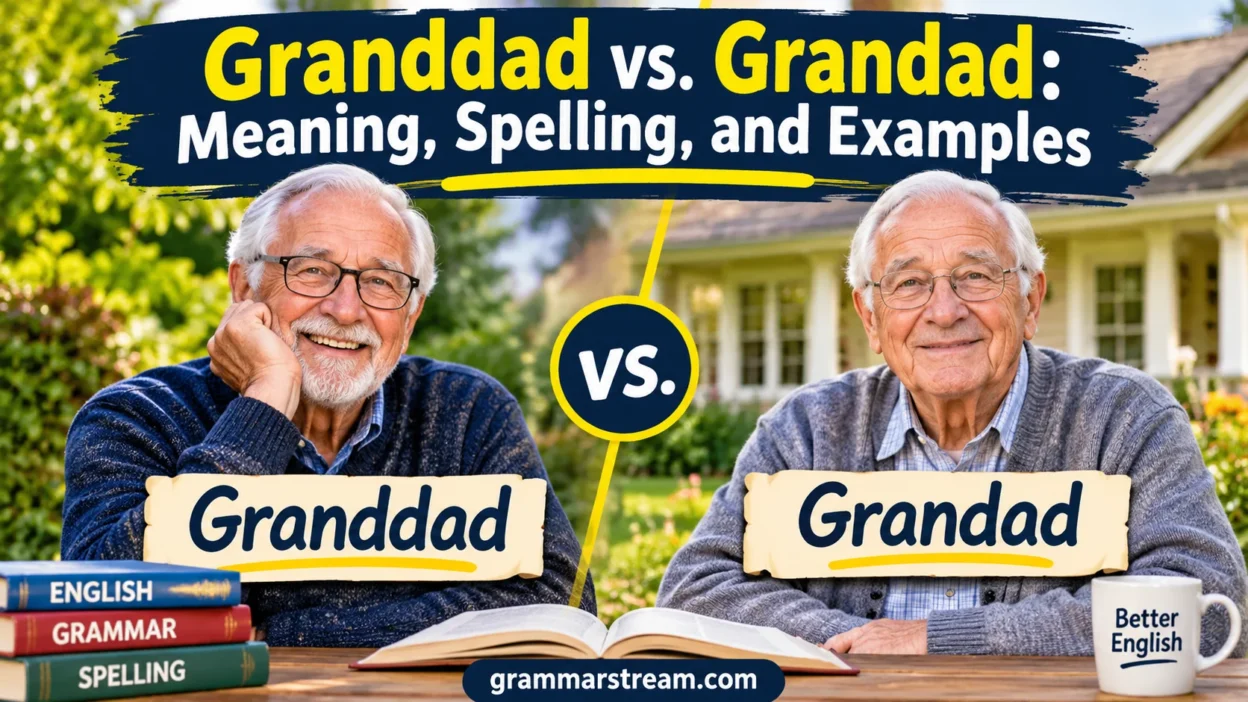
Have you ever wondered whether to write granddad or grandad? Both spellings appear in everyday English, family conversations, books, and personal messages. Although they look slightly different, they refer to the same family member: your grandfather.
The confusion comes from one small detail. Granddad contains two consecutive letter Ds in the middle, while grandad contains only one. That extra letter doesn’t change the word’s meaning or its usual pronunciation.
However, the two spellings have slightly different usage patterns across English-speaking regions. Understanding these patterns can help you choose the right version for your audience. Whether you’re writing a birthday card, a family story, or an everyday message, knowing the difference makes your writing more consistent.
Quick Answer
Granddad and grandad are both correct spellings of the informal word for grandfather. They have the same meaning and generally share the same pronunciation.
The primary difference is their spelling and regional usage:
- Granddad: A widely recognized spelling used in British English and other English-speaking communities.
- Grandad: Another accepted spelling, particularly familiar in British English.
- Grandfather: The standard and more formal term used in everyday and professional writing.
For example:
- My granddad taught me how to play chess.
- My grandad loves spending time in his garden.
- My grandfather lives in a small town.
You can use either granddad or grandad without changing the meaning of your sentence. When writing about a particular person, follow their family’s preferred spelling.
Comparison Overview
Granddad and grandad describe the same family relationship. Both words function as informal nouns and refer to someone’s father’s father or mother’s father.
The difference becomes clearer when you compare their spelling, pronunciation, and common usage.
| Feature | Granddad | Grandad |
| Meaning | Grandfather | Grandfather |
| Spelling | Two Ds together in the middle | One D in the middle |
| Pronunciation | Generally the same | Generally the same |
| Word type | Noun | Noun |
| Tone | Informal and affectionate | Informal and affectionate |
| British English | Commonly used | Commonly used |
| American English | Recognized, though less common than grandfather | Recognized |
| Formality | Informal | Informal |
| Correctness | Correct | Correct |
The main takeaway: Neither spelling is automatically wrong. Your choice depends on personal preference, regional convention, and writing consistency.
What Does Granddad Mean?
Granddad is an informal noun that means grandfather. People use it when talking about their father’s father or mother’s father.
The word often carries a warm, familiar feeling. It appears in family conversations, children’s stories, birthday messages, and personal writing.
For many people, granddad feels more personal than the formal word grandfather. It can bring to mind family traditions, childhood memories, holiday gatherings, and time spent with an older family member.
Definition of Granddad
Granddad is a familiar term for a male grandparent. It describes the same family relationship as grandfather but uses a more relaxed and affectionate tone.
The word consists of two recognizable parts:
- Grand: A word element associated with something large, important, or extended. In family terms, it helps describe relationships across generations.
- Dad: An informal word for father.
Together, these elements create a familiar family term for a grandfather.
Granddad is a countable noun. You can use it as a subject, object, or part of a possessive phrase.
Consider these examples:
- Subject: My granddad enjoys fishing.
- Object: I visited my granddad yesterday.
- Possessive: My granddad’s favorite hobby is gardening.
The word can also appear in direct address.
For example, you might say, “Granddad, can you tell me a story?”
Examples of Granddad in Sentences
Understanding a word becomes easier when you see how people use it naturally.
Here are several examples:
- My granddad taught me how to ride a bicycle when I was six.
- We’re visiting Granddad during the summer holidays.
- My granddad makes the best homemade cookies.
- I called my granddad to wish him a happy birthday.
- Every Sunday, my granddad tells us stories about his childhood.
- My granddad’s old photographs remind me of our family history.
- I spent the afternoon helping Granddad repair his garden fence.
Notice that the spelling remains unchanged regardless of the sentence structure.
When to Use Granddad
Granddad works well when you want an informal, friendly alternative to grandfather.
You can use it in several situations:
- Family conversations: “My granddad is coming over for dinner.”
- Personal messages: “Happy birthday, Granddad! I hope you have a wonderful day.”
- Family stories: “My granddad grew up in a small farming village.”
- Social media captions: “Nothing beats spending time with Granddad.”
- Children’s writing: “Granddad took his grandson to the park.”
It’s also suitable for informal articles and personal essays.
One important detail concerns capitalization. When you use granddad as a general noun, lowercase spelling is usually appropriate. When you use it as a name or direct form of address, capitalize it.
Compare these sentences:
- I visited my granddad yesterday.
- Granddad took me to the museum.
The first sentence uses a general family term. The second treats Granddad like a personal name.
What Does Grandad Mean?
Grandad is another informal term for grandfather. It has the same definition, grammatical function, and familiar tone as granddad.
The only noticeable difference is its spelling. Grandad uses one D in the middle instead of the two Ds found in granddad.
This spelling is especially familiar in British English. However, both forms appear in English-language writing, and individual families may prefer either version.
Definition of Grandad
Grandad refers to the father of someone’s mother or father. It describes a male grandparent and works as an informal alternative to grandfather.
Like granddad, it is a noun.
You can use grandad in ordinary statements, questions, possessive constructions, and direct address.
For example:
- My grandad lives in the countryside.
- I bought a present for my grandad.
- My grandad’s garden looks beautiful.
- Grandad, would you like another cup of tea?
The word doesn’t identify whether the person is a paternal or maternal grandfather.
Both relationships use the same term.
Examples of Grandad in Sentences
Here are some natural examples showing how grandad works in everyday English:
- My grandad enjoys reading newspapers every morning.
- We visited Grandad during the winter holidays.
- My grandad taught me how to grow vegetables.
- I love listening to my grandad’s childhood stories.
- Grandad always makes everyone laugh at family gatherings.
- My grandad gave me his old wristwatch.
- We celebrated my grandad’s birthday with a family dinner.
These examples demonstrate that grandad can appear in different sentence positions without changing its meaning.
When to Use Grandad
Grandad is a suitable choice for informal communication, particularly when this spelling matches your family’s preference or your audience’s regional convention.
Common situations include:
- British English writing: The spelling is familiar to many British English readers.
- Family conversations: It sounds natural when talking about a grandfather.
- Birthday cards: “Happy birthday, Grandad! Thanks for always being there.”
- Personal stories: “My grandad used to take me fishing every weekend.”
- Everyday messages: “I’ll visit my grandad tomorrow.”
You don’t need to avoid grandad in American English. Readers can understand it, although grandfather is a more standard choice in formal American writing.
Main Differences Between Granddad and Grandad
Although granddad and grandad share the same definition, their spelling creates a common question. Is one more correct? Does the extra letter change pronunciation? Are they used differently in different countries?
Let’s examine the main differences.
Spelling and Word Structure
The most obvious difference is the number of Ds.
- Granddad: G-R-A-N-D-D-A-D
- Grandad: G-R-A-N-D-A-D
Granddad contains two consecutive Ds at the boundary between grand and dad. Grandad contains only one D at that point.
This difference reflects how the word developed from the familiar expression grand dad. The double-D spelling makes the two elements more visible.
However, both spellings have become established as single-word forms.
| Spelling | Letter breakdown | Middle letters |
| Granddad | G-R-A-N-D-D-A-D | DD |
| Grandad | G-R-A-N-D-A-D | D |
Neither spelling changes the underlying family relationship.
A useful way to remember the difference is to associate granddad with the two-part construction grand + dad. Grandad is simply the shorter spelling.
Read More: Counselor vs. Councilor: Meaning, Differences, and Examples
Meaning and Definition
The two words have identical meanings.
Both refer to a person’s grandfather, whether he belongs to the mother’s side or father’s side of the family.
For example:
- My granddad lives with my grandmother.
- My grandad lives with my grandmother.
These sentences communicate the same information.
Neither spelling indicates age, personality, family position, or biological relationship.
A person can use granddad or grandad for a biological grandfather, an adoptive grandfather, or another family figure who holds that role.
The surrounding sentence provides any additional relationship details.
Pronunciation
One extra letter might make you wonder whether granddad and grandad sound different.
In ordinary English speech, they generally have the same pronunciation. The additional D in granddad doesn’t create another syllable or a separate sound.
Both words are commonly pronounced as one syllable.
Their pronunciation can vary slightly between accents, particularly in the vowel sound. However, that variation generally reflects regional speech rather than the spelling difference.
For example, someone in England may pronounce the word differently from someone in Scotland or the United States. That doesn’t make one spelling more accurate.
Remember: The spelling changes, but the intended word and its usual pronunciation remain the same.
Regional Usage
Regional preferences can influence which spelling people choose.
However, it’s important not to treat these preferences as strict spelling rules.
British English
Both granddad and grandad are established in British English. Grandad is particularly familiar in British family writing and everyday usage.
You may encounter either spelling in books, newspapers, conversations, and personal messages.
American English
American English commonly uses grandfather as the standard general term. Granddad is also familiar as an informal family expression.
Grandad is understandable to American readers, although it may look less familiar depending on their reading habits.
Other English-speaking regions
Usage varies across countries such as Canada, Australia, and New Zealand. Family preference and local writing conventions can influence the spelling.
Here’s a simple comparison:
| Region | Common usage pattern |
| United States | Grandfather is widely used; granddad is also familiar |
| United Kingdom | Both granddad and grandad are established |
| Canada | Grandfather and informal family alternatives are used |
| Australia | Grandad and granddad are both recognizable |
| New Zealand | Both spellings can appear in everyday English |
These are general usage observations rather than exclusive national rules.
Formality and Tone
Granddad and grandad have the same informal tone.
Neither is especially more formal or respectful than the other. Both sound familiar and affectionate.
However, grandfather is generally more appropriate when a neutral or formal tone matters.
Consider these examples:
| Situation | Suitable word |
| Academic writing | Grandfather |
| Official family records | Grandfather |
| Casual conversation | Granddad or grandad |
| Birthday card | Granddad or grandad |
| Children’s story | Granddad or grandad |
| Personal family history | Either spelling |
For example, a sentence in a family research report might say:
“My grandfather was born in 1945.”
In a personal story, the same information could sound more natural as:
“My granddad was born in 1945.”
The meaning stays the same. Only the tone changes.
Granddad vs. Grandad: Which Spelling Is Correct?
Here’s the good news: both granddad and grandad are correct English spellings.
You don’t need to treat one as a spelling mistake or replace it automatically.
Both forms are recognized as informal terms for grandfather. Their acceptance means writers can choose either version without changing the intended meaning.
However, a few practical guidelines can help you make the right choice.
- Use granddad when it matches your preferred spelling or the convention of your publication.
- Use grandad when your family or audience prefers that form.
- Follow a person’s preferred spelling when writing about them personally.
- Choose one spelling and maintain consistency throughout your article.
- Use grandfather when you need a more formal or neutral expression.
Why Do Both Spellings Exist?
English spelling often preserves different forms of familiar words.
Granddad and grandad developed as written alternatives to an affectionate family expression. The double-D spelling makes the relationship between grand and dad more visible.
The shorter spelling reflects a simplified written form.
English has many examples of words with accepted spelling variations. Some differences come from regional traditions, while others develop through everyday language use.
Granddad and grandad demonstrate how spelling can vary without changing meaning.
Which Spelling Should You Choose?
Your audience and purpose should guide your decision.
Imagine you’re writing a birthday message for your grandfather. If your family has always written grandad, there’s no reason to change it to granddad.
Likewise, if your preferred spelling is granddad, you can confidently use it.
For professional or educational writing, consider your publication’s style guide. If it doesn’t specify a preference, choose one accepted spelling and use it consistently.
Consistency matters more than choosing between these two valid forms.
Frequently Asked Questions
Is Granddad or Grandad Correct?
Both granddad and grandad are correct English spellings. They have the same meaning and refer to someone’s grandfather.
The difference is simply the extra D in granddad. Neither spelling is universally required.
Is Grandad British or American English?
Grandad is particularly familiar in British English, although it isn’t exclusive to Britain.
American English readers can understand it too. However, grandfather is a widely used standard term in American English.
Why Does Granddad Have Two Ds?
Granddad contains two consecutive Ds because its spelling reflects the combination of grand and dad.
The first D belongs to grand, while the second begins dad. Grandad uses a shorter spelling that leaves out one of those consecutive letters.
Both forms are accepted.
Do Granddad and Grandad Have the Same Pronunciation?
Yes, they generally have the same pronunciation.
Both words are usually spoken as one syllable. The extra D in granddad doesn’t add another syllable or create a different word sound.
Regional accents can produce slight pronunciation differences.
Is Grandfather More Formal Than Granddad or Grandad?
Yes. Grandfather is generally more formal and neutral than granddad or grandad.
You can use grandfather in official documents, academic writing, and professional communication. The informal alternatives work especially well in family conversations and personal messages.
Conclusion:
The difference between granddad and grandad is much simpler than it first appears. Both spellings refer to a grandfather and carry the same informal, affectionate meaning. Granddad contains two consecutive Ds, while grandad uses one. Neither spelling changes the pronunciation in ordinary speech or identifies a different family relationship. Although regional preferences can influence which version people choose, both forms are accepted English spellings.