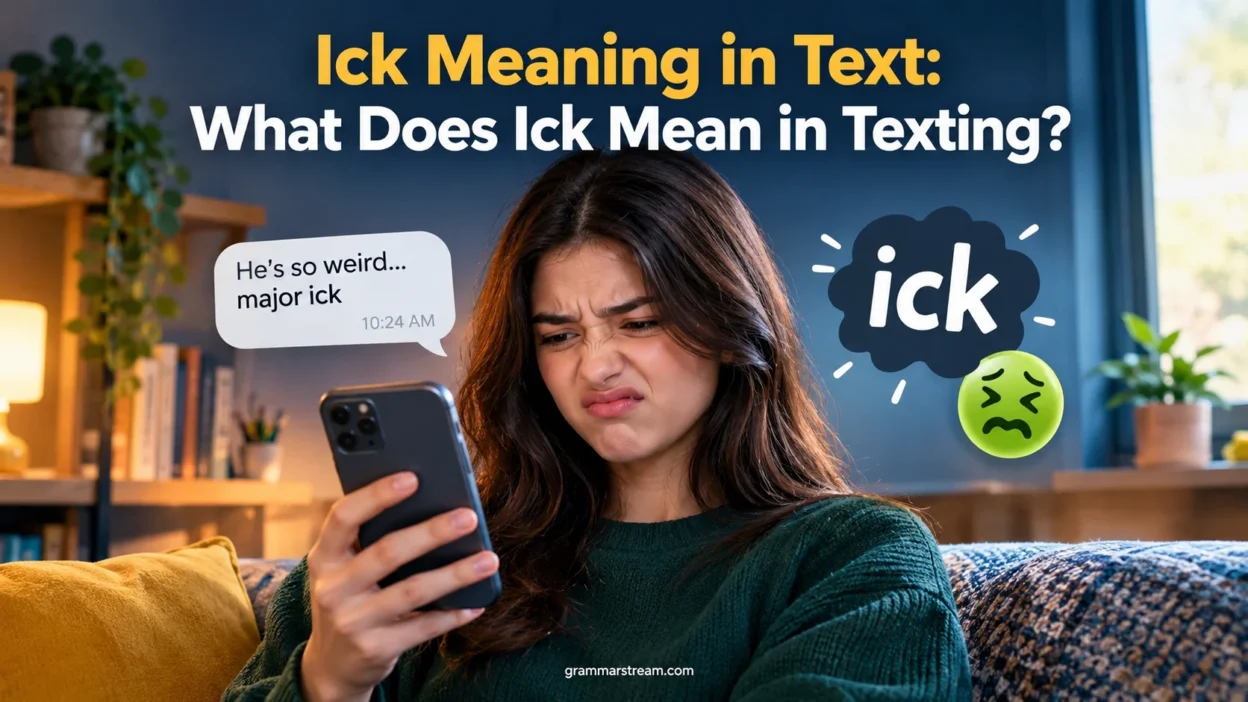
Have you ever liked someone, watched them do one tiny thing, and suddenly thought, “Nope”? That sudden shift is often what people mean by the ick. The word ick has become a common part of texting, dating conversations, social media, and casual English.
Someone might text, “That gave me the ick,” after seeing an awkward behavior. Another person might simply reply, “Ick!” when something looks gross or unpleasant. Although the word is short, its meaning depends heavily on context. In dating, ick often describes a sudden loss of attraction caused by something a person says or does.
In everyday conversation, it can simply express disgust, dislike, or discomfort. Cambridge Dictionary defines the ick as an informal, sudden feeling of dislike toward someone or something, including a situation where someone is no longer attracted to a person because of their behavior.
Quick Answer
Ick meaning in text usually refers to a sudden feeling of dislike, disgust, discomfort, or lost attraction. In dating conversations, getting the ick means that something about a person suddenly makes them seem less attractive or appealing. In general texting, ick can simply mean “gross,” “ew,” or “that makes me uncomfortable.”
For example:
“I really liked him until he started being rude to the waiter. I got the ick.”
Here, got the ick means the person’s behavior suddenly changed the speaker’s feelings toward him.
In another conversation, someone might text:
“That video was so gross. Ick!”
This use doesn’t necessarily involve dating. It simply expresses a strong negative reaction.
Cambridge Dictionary recognizes ick as an informal expression of shock or dislike that can produce a feeling of sickness or disgust. It also lists the ick, get the ick, and give someone the ick as informal expressions.
Comparison Overview
| Expression | Meaning | Common Context |
| Ick | A reaction of dislike, disgust, or discomfort | Texting and casual conversation |
| The ick | A sudden feeling of dislike or lost attraction | Dating and relationships |
| Get the ick | Suddenly develop a negative feeling | Dating or personal preferences |
| Give me the ick | Make me feel uncomfortable or disgusted | Dating, food, habits, situations |
| Icky | Unpleasant, gross, or uncomfortable | General conversation |
| Cringe | Embarrassment or secondhand embarrassment | Social situations and online content |
| Turn-off | Something that reduces attraction | Dating and relationships |
| Gross | Unpleasant or disgusting | Food, smells, behavior, images |
The important distinction is that ick often describes a feeling that arrives suddenly. You may have liked something five minutes earlier and then experience a complete change in how you perceive it.
Main Differences Between Ick Meaning in Text
The biggest difference comes down to context. When someone says “ick” during a dating conversation, they may be talking about attraction. When they send “ick” after seeing a disgusting picture, they probably mean something closer to “gross.”
The expression can therefore carry several related meanings.
| Use of “Ick” | What It Usually Means |
| Dating | Sudden loss of attraction |
| Food | Disgust or unpleasantness |
| Smells | Strong dislike |
| Behavior | Discomfort, embarrassment, or disapproval |
| Social media | Negative reaction to something seen online |
| Appearance | Something personally unattractive or off-putting |
| Conversation | An informal reaction similar to “ew” |
Understanding the surrounding conversation usually makes the intended meaning obvious.
What Does Ick Mean in Text?
In texting, ick is an informal expression that communicates a quick negative reaction.
It can mean something like:
- “That grosses me out.”
- “That makes me uncomfortable.”
- “That behavior is unattractive.”
- “That completely turned me off.”
- “I don’t like that.”
- “That feels awkward.”
- “Ew, no.”
The expression works because it is short and emotionally clear. Instead of writing a long explanation, someone can type “ick” and let the surrounding conversation provide the details.
For example:
Friend: “He sent me 14 messages because I didn’t reply for ten minutes.”
You: “Ick.”
The response suggests that the behavior feels unattractive or uncomfortable.
However, another conversation might look completely different:
Friend: “I accidentally smelled the milk after it had gone bad.”
You: “Ick!”
Here, the word expresses disgust rather than romantic rejection.
That flexibility explains why ick meaning in text can’t be reduced to a single translation.
What Does “The Ick” Mean?
The ick refers to a sudden feeling that makes someone less attracted to another person or strongly uncomfortable with something.
The phrase is especially common in dating. A person might feel interested in someone at first, then notice a particular habit or behavior that suddenly changes their perception.
For example:
“I thought he was cute until he started yelling at the server. That gave me the ick.”
The speaker isn’t necessarily saying the person committed some serious offense. The point is that the behavior created an immediate negative reaction.
Cambridge Dictionary specifically describes the ick as a sudden feeling of dislike toward someone or something, including suddenly no longer being attracted to someone because of something they do.
That suddenness is an important part of the expression.
You might think of it like switching a mental light from green to red. The person hasn’t necessarily changed physically. Your perception of them has.
Ick Meaning in Different Texting Contexts
Ick in Dating Texts
Dating is probably the context where the ick gets the most attention.
Someone may say:
“I got the ick after our second date.”
This means something during the date caused their attraction to drop sharply.
Common examples can include:
- Constantly bragging
- Being disrespectful toward service workers
- Talking badly about everyone
- Making inappropriate comments
- Acting very differently from their dating profile
- Being excessively rude
- Displaying a habit the other person finds unattractive
- Ignoring obvious social boundaries
Not every “ick” represents a serious character problem. Sometimes it reflects a highly personal preference.
For instance, one person may find a particular habit charming while another person finds the exact same habit annoying. The word describes the speaker’s reaction rather than establishing an objective rule about what everyone should dislike.
Ick in Casual Texting
Outside dating, ick can simply mean that something feels unpleasant.
Consider:
“I touched something slimy under the sink.”
A friend might answer:
“Ick.”
That response means something like “Ew, that’s disgusting.”
Similarly:
“The leftovers smelled weird.”
“Ick. Throw them out.”
The word doesn’t imply romantic attraction in these examples. Context changes the meaning.
Ick on Social Media
Social media has helped make short emotional expressions such as ick especially useful.
People often use the term when reacting to:
- Dating stories
- Celebrity behavior
- Viral videos
- Fashion choices
- Awkward interviews
- Uncomfortable interactions
- Strange habits
- Relationship stories
You may see phrases such as “major ick,” “instant ick,” “that’s an ick,” or “that gives me the ick.”
These expressions let people summarize an emotional reaction without writing a full explanation.
Examples of Ick in Text Messages
Realistic examples make the meaning much easier to understand.
Dating Example
A: “He spent the entire dinner talking about how rich he is.”
B: “Yeah, that’s an ick.”
Here, ick means that the behavior reduced the person’s attraction.
Friendship Example
A: “My friend chews with her mouth open.”
B: “Ick. I couldn’t handle that.”
This expresses personal discomfort.
Food Example
A: “I found something fuzzy growing on the bread.”
B: “ICK!”
Here, the word expresses disgust.
Social Media Example
A: “Did you see that video?”
B: “Yes. Major ick.”
The speaker strongly dislikes or feels uncomfortable about what they saw.
Dating-App Example
A: “His profile says he hates tipping.”
B: “Instant ick.”
The speaker is saying that the information immediately made the person less appealing.
Smell Example
A: “Something smells awful in the fridge.”
B: “Ick. Check the leftovers.”
Again, there is no romantic meaning.
Common Phrases With Ick
“I Got the Ick”
I got the ick means you suddenly developed a strong negative reaction toward someone or something.
Dating example:
“I got the ick when he started insulting his ex.”
General example:
“I got the ick after seeing what was inside the old refrigerator.”
The first example concerns attraction. The second describes disgust.
“That Gives Me the Ick”
That gives me the ick means something causes an unpleasant reaction.
For example:
“People talking with food in their mouths gives me the ick.”
In dating:
“Constant bragging gives me the ick.”
The phrase is useful because it doesn’t necessarily explain exactly why something feels unpleasant. It simply identifies the reaction.
“Major Ick”
Major ick intensifies the reaction.
If someone says:
“He lied about something that didn’t even matter. Major ick.”
They mean the behavior created a particularly strong negative impression.
The word major adds emphasis. It’s similar to saying “a really big turn-off” in casual conversation.
“Instant Ick”
Instant ick means the negative reaction happened immediately.
For example:
“He was rude to the cashier. Instant ick.”
The expression focuses on speed. The person didn’t need weeks to develop the reaction. One moment changed the way they viewed the situation.
“Icky”
Icky is related to ick, but it works differently in a sentence.
You can describe something as icky when it feels unpleasant, gross, uncomfortable, or slightly disgusting.
For example:
“This bathroom floor feels icky.”
Or:
“That was an icky situation.”
While ick often names or expresses the reaction, icky commonly works as an adjective describing the thing that causes the reaction.
Read More: YOLO Meaning in Text: What Does YOLO Mean in Text Messages?
Why Do People Get the Ick?
The reasons behind an ick can vary widely.
Sometimes the reaction comes from a genuine behavior problem. Other times, it comes from personal taste. A particular habit might remind someone of an unpleasant experience, conflict with their expectations, or simply feel unattractive to them.
Several factors can play a role:
- Personal preferences: Everyone has different likes and dislikes.
- Changing perception: Learning something new can change how you see someone.
- Social expectations: Certain behaviors may conflict with someone’s idea of acceptable conduct.
- Embarrassment: An awkward moment can suddenly change the mood.
- Compatibility: A small habit can reveal a larger difference in lifestyle or values.
- Loss of attraction: A behavior can make someone stop seeing another person romantically.
The key point is that an ick is a reaction, not automatically a verdict about someone’s character.
For example, imagine someone discovers that their date has an unusual hobby. One person might find it fascinating. Another might feel no attraction afterward. The hobby itself hasn’t become objectively bad. The individual’s response has changed.
A Simple Case Study: How an Ick Can Change a Dating Conversation
Imagine two people have been texting for several days.
At first, the conversation flows easily. They exchange jokes, share interests, and eventually arrange a date.
During dinner, however, one person notices that the other repeatedly interrupts the waiter.
Nothing dramatic happens. There is no major argument. Still, the behavior changes the atmosphere.
Later, they text a friend:
“He seemed really nice, but the way he treated the waiter gave me the ick.”
In this situation, ick describes a sudden change in attraction caused by observed behavior.
Notice what the phrase doesn’t necessarily mean. It doesn’t automatically mean the person is terrible. It explains how the speaker’s feelings changed after seeing something they found off-putting.
That’s why context matters so much when interpreting the word.
Ick vs. Cringe vs. Disgust
These words overlap, but they aren’t interchangeable in every situation.
| Word | Main Idea | Example |
| Ick | Sudden dislike, discomfort, or lost attraction | “His behavior gave me the ick.” |
| Cringe | Embarrassment or awkwardness | “That speech was so cringe.” |
| Disgust | Strong revulsion | “The smell caused immediate disgust.” |
| Gross | Something unpleasant or revolting | “That food looks gross.” |
| Turn-off | Something that reduces attraction | “Being rude is a major turn-off.” |
Cringe usually focuses on embarrassment or awkwardness. Disgust is stronger and more directly connected to revulsion. Turn-off commonly concerns attraction.
Ick sits somewhere in the middle. It can combine elements of discomfort, disgust, embarrassment, and reduced attraction depending on the situation.
Ick vs. Turn-Off
Ick and turn-off are closely related when people talk about dating.
A turn-off is something that reduces attraction. It can be an ongoing trait, behavior, preference, or circumstance.
An ick often feels more sudden and specific.
| Ick | Turn-Off |
| Often sudden | Can develop gradually |
| Frequently linked to one behavior | Can involve a broader trait |
| Common in casual slang | More general everyday expression |
| Often emotional and immediate | Can be more deliberate |
| Popular in dating discussions | Used broadly in relationships |
For example:
“His constant bragging is a turn-off.”
This sounds like a general judgment about a recurring behavior.
Compare it with:
“When he bragged about his car for 20 minutes, I got the ick.”
The second sentence feels more immediate and conversational.
Is “Ick” a Negative Word?
Yes. Ick normally communicates a negative reaction.
However, the strength of that reaction depends on the situation.
Someone saying:
“Ick, I hate spiders.”
may simply be expressing disgust.
Someone saying:
“I got the ick after our date.”
may be describing a meaningful change in romantic attraction.
The word itself doesn’t tell you exactly how serious the reaction is. You need to read the surrounding conversation.
It can also be playful. Friends may exaggerate their “icks” for humor without genuinely feeling intense disgust.
Is Ick Only Used for Dating?
No.
Dating is one of the most recognizable contexts for the ick, but the word has a wider informal use.
People can use it for:
- Food
- Smells
- Messes
- Strange textures
- Unpleasant sounds
- Awkward behavior
- Social situations
- Online videos
- Hygiene issues
- Certain habits
- Romantic behavior
For example:
“Wet socks give me the ick.”
This has nothing to do with dating.
Likewise:
“That video gave me the ick.”
The meaning could involve disgust, discomfort, or an unpleasant emotional reaction.
When someone uses ick without mentioning dating, don’t automatically assume they’re talking about attraction.
Is “Ick” Slang or a Formal English Word?
Ick is informal English.
Cambridge Dictionary labels the word informal and recognizes both its exclamatory use and the noun phrase the ick.
That makes it perfectly natural in:
- Text messages
- Social media posts
- Casual conversations
- Dating discussions
- Informal online writing
- Friendly chats
It isn’t usually the best choice for formal academic or professional writing.
Instead of:
“The behavior gave the committee the ick.”
a formal report might say:
“The behavior caused discomfort among committee members.”
The second version communicates the idea without relying on slang.
FAQs:
What does “ick” mean in texting?
Ick usually means a sudden feeling of dislike, disgust, discomfort, or unattraction. The exact meaning depends on the conversation. In dating, it often means something caused a sudden loss of attraction.
What does “I got the ick” mean?
I got the ick means that something suddenly made a person feel less attracted, comfortable, or interested. The phrase is especially common when discussing dates and romantic relationships.
What does “the ick” mean in dating?
In dating, the ick describes a sudden negative reaction to something a romantic interest says or does. It can make the person seem less attractive even if the speaker previously liked them.
Is “ick” the same as cringe?
Not exactly. Cringe usually describes embarrassment or awkwardness. Ick can describe disgust, discomfort, or lost attraction. The two feelings can overlap.
Can “ick” mean disgust?
Yes. Ick can express disgust or strong dislike. For example, someone might text “Ick!” after seeing spoiled food or something unpleasant.
Conclusion:
The meaning of ick in text is simple at its core: it describes an unpleasant reaction, but the exact feeling depends on context. In casual conversation, ick can mean “ew,” “gross,” or “that makes me uncomfortable.” In dating, the ick usually describes a sudden drop in attraction caused by something a person says or does.