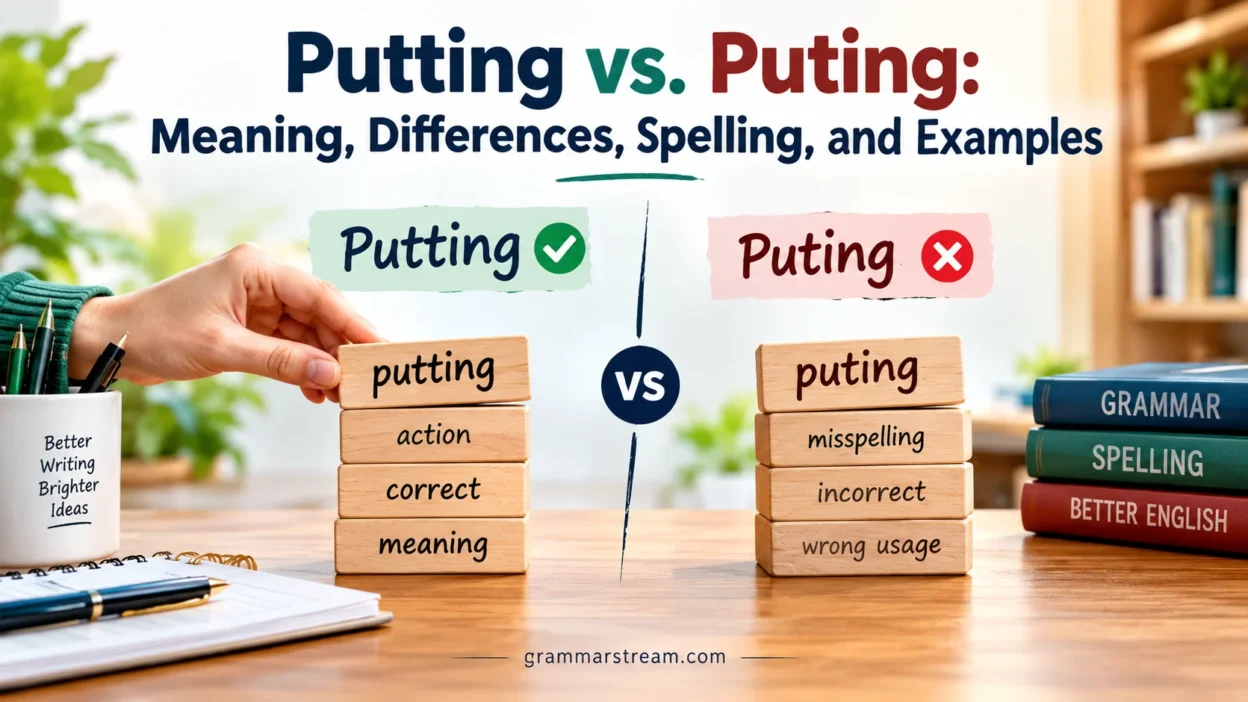
Have you ever wondered whether to write putting or puting? You’re not alone. This spelling mistake happens because English has several rules for adding endings to verbs, and it’s easy to overlook a repeated consonant. However, only one spelling is correct in standard English: putting.
The word putting appears in everyday conversations, school assignments, workplace emails, and even golf discussions. You might use it when putting groceries away, putting an idea into practice, or putting a golf ball toward the hole. Despite these different meanings, the spelling stays the same.
On the other hand, puting is a misspelling of putting when you intend to use the standard English verb form. The difference comes down to one small letter, but that letter matters. Understanding why the spelling requires two ts will help you avoid similar mistakes with words such as sitting, running, and stopping.
Quick Answer:
Putting is the correct spelling in American English. It is the -ing form of the verb put and can function as a present participle or gerund. Puting is an incorrect spelling when you mean the English word putting.
The correct spelling doubles the final t before adding -ing. Therefore, the proper transformation is put + ing = putting, not puting.
| Word | Correct or Incorrect? | Meaning | Example |
| Putting | Correct | Placing something somewhere or performing another action associated with put | She is putting the groceries away. |
| Puting | Incorrect | A misspelling of putting in standard English | Incorrect: He is puting his shoes away. |
| Put | Correct | The base form of the verb | Please put the book on the desk. |
| Putt | Correct | A golf stroke intended to roll the ball toward the hole | He made a short putt. |
Easy rule to remember: Whenever you add -ing to put, double the final t to form putting.
Comparison Overview
The difference between putting and puting is a spelling issue rather than a difference in meaning. Standard English recognizes putting as the correct form of the verb put when the -ing suffix is required.
The incorrect spelling puting often appears when someone forgets to double the final consonant. This mistake may happen while typing quickly, writing by hand, or applying an incorrect spelling pattern.
| Feature | Putting | Puting |
| Standard spelling | Yes | No |
| Grammatical status | Correct -ing form of put | Misspelling when intended to mean putting |
| Base word | Put | Intended base word is put |
| Spelling pattern | Doubles the final t before -ing | Omits the required second t |
| Use in sentences | Correct | Incorrect in standard English |
| Use in continuous tenses | Yes | No |
| Use as a gerund | Yes | No |
| Example | She is putting the dishes away. | Incorrect: She is puting the dishes away. |
Key Differences Between Putting and Puting
The most important difference is the extra t in putting. That letter isn’t optional when you’re writing the standard English form.
Here are the main distinctions:
- Putting is correct: Use it when describing the action of placing something or when using another meaning of the verb put.
- Puting is incorrect: Avoid this spelling in essays, emails, articles, and everyday writing.
- Putting has several grammatical uses: It can function as a present participle in continuous tenses or as a gerund.
- The spelling rule explains the double consonant: The base verb put ends in a consonant-vowel-consonant pattern, so the final consonant doubles before -ing.
- The meaning depends on context: Putting groceries away and putting a golf ball are different actions, but both use the same spelling.
For example, both sentences below use the correct form:
- She is putting the flowers in a vase.
- He is putting on his golf shoes.
The action changes, but the spelling doesn’t.
What Does Putting Mean?
Putting is the -ing form of the verb put. The base verb generally means to place, move, position, or cause something to be somewhere.
However, put also appears in many expressions with meanings that extend beyond physically placing an object. For example, putting off means postponing something, while putting together can mean assembling an object or organizing information.
The meaning of putting depends on the sentence and the words surrounding it.
Putting as a Verb
When putting functions as a verb form, it often describes an action in progress. It commonly appears with a form of the auxiliary verb be, such as am, is, are, was, or were.
This construction helps form continuous tenses.
Examples:
- I am putting my books into the backpack.
- She is putting the groceries in the refrigerator.
- They are putting new furniture in the living room.
- He was putting his phone in his pocket.
- We were putting the finishing touches on the presentation.
In each example, putting describes an action that is happening or was happening at a particular time.
Notice that the base verb remains recognizable. You simply add -ing after doubling the final consonant.
Putting as a Gerund
A gerund is a verb form ending in -ing that functions as a noun. Although it looks like a verb, it can occupy a position usually filled by a noun.
Putting can function as a gerund when it names an activity or action.
Examples:
- Putting things in order takes patience.
- She enjoys putting puzzles together.
- Putting safety first is essential.
- He dislikes putting his personal information online.
- Putting the plan into action requires careful preparation.
In the first example, putting things in order acts as the subject of the sentence. In the second, putting puzzles together acts as the object of the verb enjoys.
This distinction matters because the word’s grammatical role changes according to how you use it. The spelling, however, remains putting.
Putting in Golf
In golf, putting refers to using a putter to strike a golf ball, usually on the putting green, to roll it toward the hole.
Putting is an important part of the game because players often need accurate distance control and direction to finish a hole successfully.
Examples:
- Her putting improved after several weeks of practice.
- He spent an hour putting on the practice green.
- The golfer’s putting helped him save several strokes.
- Good putting requires control, touch, and careful judgment.
The related noun putt refers to a golf stroke, while putter names the club commonly used for that stroke.
Remember that putting is correct in both golf terminology and everyday English.
What Does Puting Mean?
In standard English, puting is not the correct spelling of the -ing form of put. If you intend to describe the action of placing something, use putting instead.
For example:
- Incorrect: She is puting the plates on the table.
- Correct: She is putting the plates on the table.
The incorrect version omits one t. Although readers can usually understand the intended meaning, the spelling error can make your writing look careless.
Why Puting Is Incorrect
The verb put follows a consonant-doubling spelling pattern when you add the suffix -ing.
The base word contains three letters:
- P: Consonant
- U: Vowel
- T: Consonant
This creates a consonant-vowel-consonant pattern, often shortened to CVC.
When the relevant spelling rule applies, the final consonant doubles before the suffix. Therefore, the correct form is putting.
Compare these forms:
| Base Verb | Suffix | Correct Form |
| Put | -ing | Putting |
| Sit | -ing | Sitting |
| Run | -ing | Running |
| Stop | -ing | Stopping |
| Plan | -ing | Planning |
Writing puting skips the required consonant doubling. That’s why the spelling is incorrect when you mean putting.
Common Situations Where People Write Puting
Spelling errors often happen when writers apply a familiar pattern without checking whether it fits the word.
Several situations can lead to the mistake:
- Typing too quickly: You might leave out the second t while writing a message.
- Forgetting the spelling rule: You may remember to add -ing but forget to double the final consonant.
- Confusing different verb patterns: Some verbs take -ing without doubling their final consonants.
- Relying on appearance: The spelling puting may look reasonable if you haven’t learned the rule.
- Skipping proofreading: A quick review might catch the missing letter before you submit your work.
For instance, a student might write, “I am puting my homework in my bag.” The sentence is easy to understand, but the spelling is wrong.
The correction is simple: “I am putting my homework in my bag.”
Why Is Putting Spelled With Two Ts?
The spelling of putting follows an established English rule for adding suffixes to certain verbs.
When a suitable short verb ends in a consonant-vowel-consonant pattern, the final consonant often doubles before a vowel-initial suffix such as -ing. This pattern helps maintain the expected pronunciation of the base word.
For put, the process works like this:
Put + ing → Putting
The final t doubles before the suffix attaches.
The same pattern appears in words such as sitting, running, and stopping. Learning these examples can help you recognize the rule in other words.
Read More: Their vs. Thier: Meaning, Spelling, and Examples
The Consonant-Vowel-Consonant Rule
The consonant-vowel-consonant rule is a useful spelling pattern for English learners. However, it isn’t a rule that applies to every verb ending in a consonant.
For many short, single-syllable verbs, you double the final consonant before adding -ing when the word ends in one vowel followed by one consonant.
Consider these examples:
| Base Verb | Final Three Letters | Correct -ing Form |
| Put | U-T follows the initial consonant | Putting |
| Sit | I-T | Sitting |
| Run | U-N | Running |
| Hop | O-P | Hopping |
| Stop | O-P follows S-T | Stopping |
| Plan | A-N | Planning |
The pattern is easiest to recognize when you look at the final consonant-vowel-consonant sequence rather than treating the entire word as a fixed formula.
In put, the final three letters are P-U-T. Because the word has one syllable and ends with the relevant pattern, the final t doubles before -ing.
This produces putting, not puting.
Why the Rule Does Not Apply to Every Verb
English spelling includes several patterns for adding -ing. Consonant doubling depends on the word’s spelling, syllable structure, and stress pattern.
Compare the following examples:
| Base Verb | Correct Form | Why? |
| Put | Putting | Doubles the final consonant |
| Play | Playing | Ends in a vowel letter followed by a vowel sound represented by y |
| Help | Helping | Ends in two consonants |
| Open | Opening | Does not double the final consonant in this form |
| Visit | Visiting | Does not double the final consonant |
| Begin | Beginning | Doubles the final consonant because the final syllable is stressed |
| Travel | Traveling | Common American English spelling uses one l |
The word play doesn’t become playying, and help doesn’t become helpping. Their spelling patterns differ from put.
Also, American and British English sometimes use different consonant-doubling conventions. For example, American English commonly uses traveling, while British English commonly uses travelling.
However, this regional difference doesn’t affect putting. Both American and British English use the double-t spelling.
Putting vs. Puting in Different Grammatical Contexts
The correct spelling remains putting regardless of its grammatical function. Understanding how the word works in different sentence structures will help you use it confidently.
Putting in the Present Continuous Tense
The present continuous tense describes an action happening now or around the present time.
It uses a present-tense form of be followed by the -ing form of the main verb.
Structure: Subject + am/is/are + putting
Examples:
- I am putting the dishes away.
- She is putting her ideas into practice.
- We are putting the plan together.
- The workers are putting up a new fence.
- He is putting his documents in a folder.
In these sentences, putting describes an ongoing action. Each sentence requires the double-t spelling.
Writing puting would introduce a spelling error without changing the intended meaning.
Putting in the Past Continuous Tense
The past continuous tense describes an action that was in progress at a particular time in the past.
It uses was or were followed by the -ing form.
Examples:
- He was putting the children to bed when the phone rang.
- They were putting up decorations before the party.
- I was putting my groceries away when the lights went out.
- She was putting the final details into her report.
These sentences emphasize an action that was underway. The spelling remains unchanged because tense changes affect the auxiliary verb, not the spelling of putting.
Putting in Gerunds and Participial Phrases
The word putting can also appear in gerunds and participial phrases.
A gerund functions as a noun, while a present participle can help form a verb tense or modify a noun through a participial phrase.
Compare these examples:
Gerund:
- Putting your keys in the same place helps prevent misplacing them.
- She enjoys putting together jigsaw puzzles.
Present participle in a continuous tense:
- He is putting the chairs around the table.
Participial phrase:
- She entered the room, putting her phone in her pocket.
In the first two examples, putting names an activity. In the continuous-tense example, it forms part of the verb phrase. In the final example, it introduces an additional action associated with the subject.
Although the grammatical roles differ, the spelling stays the same.
Putting vs. Puting: Correct and Incorrect Examples
Examples make the difference between putting and puting easier to recognize. The following sentences show common errors and their corrections.
Everyday Examples of Putting vs. Puting
Everyday writing offers plenty of opportunities to use the verb put. Whether you’re describing household chores or organizing personal belongings, remember the double t.
| Incorrect Sentence | Correct Sentence |
| She is puting the milk in the refrigerator. | She is putting the milk in the refrigerator. |
| I am puting my shoes by the door. | I am putting my shoes by the door. |
| They are puting their belongings in the car. | They are putting their belongings in the car. |
| He is puting his wallet on the desk. | He is putting his wallet on the desk. |
| We are puting the groceries away. | We are putting the groceries away. |
Each corrected sentence follows the same spelling rule. The final t doubles before the suffix -ing.
Workplace and Academic Examples
Correct spelling matters in professional and academic writing because small errors can distract readers from your message.
Consider these examples:
- Incorrect: The team is puting together a new proposal.
- Correct: The team is putting together a new proposal.
- Incorrect: He is puting the research findings into a report.
- Correct: He is putting the research findings into a report.
- Incorrect: The teacher is puting the instructions on the board.
- Correct: The teacher is putting the instructions on the board.
- Incorrect: We are puting the new policy into practice.
- Correct: We are putting the new policy into practice.
A useful proofreading habit is to check common suffixes such as -ing, -ed, and -er. These endings sometimes require spelling changes that are easy to overlook.
Golf-Related Examples of Putting vs. Puting
Golf provides another useful context because putting has a specific meaning in the sport.
| Incorrect Sentence | Correct Sentence |
| Her puting has improved this season. | Her putting has improved this season. |
| He spent an hour puting on the practice green. | He spent an hour putting on the practice green. |
| The coach is helping him improve his puting technique. | The coach is helping him improve his putting technique. |
| Good puting can help a golfer finish holes efficiently. | Good putting can help a golfer finish holes efficiently. |
In golf, putting refers to the skill or action of making putts. The double-t spelling remains necessary in this specialized context.
Common Expressions and Phrases With Putting
The word putting appears in many common English expressions. Learning these phrases helps you recognize the word in different contexts and expand your vocabulary.
Putting Off
Putting off means postponing something until a later time.
Examples:
- She keeps putting off her dentist appointment.
- Stop putting off your homework until the last minute.
- They are putting off the meeting until Friday.
The phrase often suggests that someone is delaying a task they could complete sooner.
Putting On
Putting on has several meanings. It can describe wearing clothing, applying something to a surface, or presenting a performance.
Examples:
- He is putting on his jacket.
- She is putting on sunscreen before going outside.
- The school is putting on a musical this weekend.
The surrounding words determine the intended meaning.
Putting Away
Putting away means returning something to its proper place or storing it.
Examples:
- The children are putting away their toys.
- She is putting away the clean dishes.
- He spent ten minutes putting away his tools.
The phrase commonly appears in conversations about cleaning, organizing, and household routines.
Putting Together
Putting together can mean assembling something, combining separate parts, or organizing information into a complete result.
Examples:
- They are putting together a new bookshelf.
- She is putting together a presentation for the meeting.
- We are putting together a list of useful resources.
The expression works for both physical objects and abstract tasks.
Putting Into Practice
Putting into practice means applying knowledge, advice, or a plan in a real situation.
Examples:
- She is putting her training into practice at work.
- The students are putting their classroom knowledge into practice.
- He is putting the coach’s advice into practice during training.
These expressions show how widely putting appears in English. None uses the incorrect spelling puting.
FAQs:
Is Putting or Puting Correct?
Putting is correct in standard English. Puting is a misspelling when you intend to use the -ing form of put. The final consonant must double before the suffix is added.
Why Does Putting Have Two Ts?
Putting has two ts because the verb put follows a consonant-doubling pattern when you add -ing. The spelling changes from put to putting.
Is Puting Ever Correct in English?
Puting isn’t the standard spelling of the English verb form. If you mean the action of placing something somewhere, write putting. A separately defined proper name or specialized term would need to be evaluated in its own context.
What Is the Difference Between Put and Putting?
Put is the base form of the verb, while putting is its -ing form.
Examples:
- Put the keys on the table.
- She is putting the keys on the table.
The first sentence uses the base verb. The second describes an action in progress.
How Do You Use Putting in a Sentence?
Use putting when describing an ongoing action or naming an activity.
Examples:
- She is putting the groceries away.
- Putting your phone in the same place can help you find it.
The first sentence uses putting in a continuous verb phrase. The second uses it as a gerund.
Conclusion:
The difference between putting and puting is simple once you understand the spelling rule. Putting is the correct spelling, while puting is a misspelling in standard English. The word putting serves several grammatical purposes. It can describe an action in progress, function as a gerund, or refer to a golf skill. Its meaning changes with context, but its spelling remains consistent.