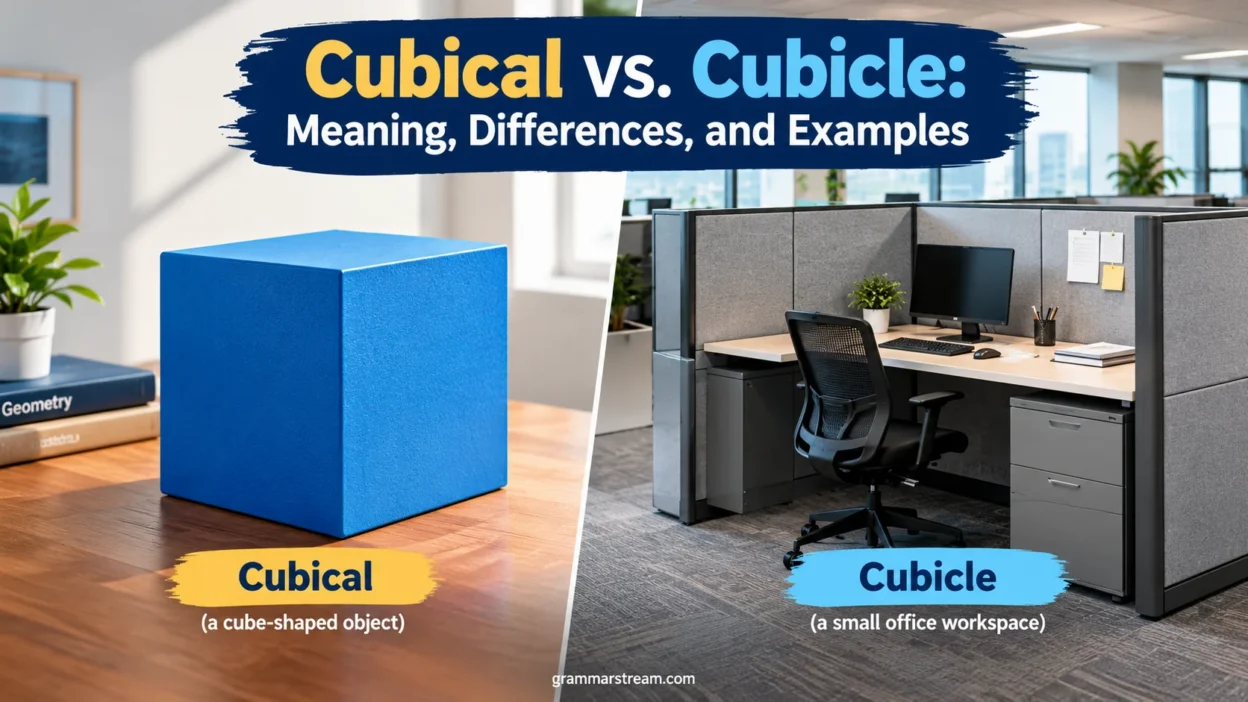
Have you ever wondered whether to write cubical or cubicle when describing an office workspace or a cube-shaped object? These two words look almost identical, but they serve different purposes in English. Choosing the wrong one can change your sentence’s meaning and make your writing less clear.
The confusion often appears in workplace conversations, school assignments, geometry lessons, and everyday writing. For example, you might leave your notebook in an office cubicle or describe a sculpture as having a cubical shape. Both expressions are correct, but switching the two words would create an error.
Understanding cubical vs. cubicle becomes much easier when you recognize their grammatical roles. Cubical is an adjective that describes something resembling a cube. Cubicle is a noun that refers to a small, separated space, such as an office workstation or a shower compartment.
Although their spellings and pronunciations are similar, their meanings are distinct. This guide explains their definitions, grammatical functions, common uses, differences, and examples so you can choose the right word confidently.
Quick Answer
Cubical describes something shaped like a cube or resembling one. Cubicle refers to a small space separated from a larger area by partitions or walls.
- Cubical (adjective): Describes the shape or form of an object. Example: The artist created a cubical sculpture.
- Cubicle (noun): Names a small, separated space. Example: I work in a quiet office cubicle.
Easy memory trick: Use cubical when describing a shape and cubicle when naming a space.
Comparison Overview
The simplest way to understand cubical vs. cubicle is to compare their meanings, grammatical functions, and everyday applications. The following table highlights their main differences.
| Feature | Cubical | Cubicle |
| Part of speech | Adjective | Noun |
| Primary meaning | Cube-shaped or resembling a cube | A small, separated space |
| Main purpose | Describes an object’s shape or form | Names a physical space |
| Common contexts | Geometry, design, architecture, and sculpture | Offices, changing rooms, and shower areas |
| Example phrase | A cubical structure | An office cubicle |
| Example sentence | The sculpture has a cubical shape. | She decorated her cubicle. |
| Plural behavior | Usually unchanged when used as an adjective | Becomes cubicles |
| Related words | Cube, cubic, cubically | Cubicles, cubicle partition |
| Common mistake | Using it to mean an office workstation | Using it to describe a cube-shaped object |
Both words are correct English words, but they aren’t interchangeable. Cubical describes a characteristic, whereas cubicle identifies a place or compartment.
For example, imagine an office with several workstations. Each workstation might have a desk, a computer, and partitions. You would call each separated workspace a cubicle.
Now imagine a decorative object sitting on one of those desks. If the object resembles a cube, you could describe it as cubical.
The distinction becomes clear when you focus on what each word contributes to the sentence.
Main Differences Between Cubical vs. Cubicle
The most important difference between these words involves their meanings and grammatical roles. Although both relate to the idea of a cube, English uses them in different ways.
What Does Cubical Mean?
Cubical is an adjective that means cube-shaped or resembling a cube. It describes an object’s appearance, form, or geometric characteristics.
A cube has six equal square faces, twelve equal edges, and eight vertices. When something has a similar shape, you can describe it as cubical.
However, an object doesn’t always need to be a mathematically perfect cube to have a cubical appearance. In everyday descriptions, the word can suggest a roughly cube-like form.
Consider these examples:
- The artist designed a cubical sculpture for the gallery.
- The building features a cubical structure with clean geometric lines.
- The toy consists of several cubical blocks.
- The architect incorporated cubical forms into the building’s exterior.
- The container has a nearly cubical shape.
In each example, cubical describes a characteristic of something else. The sculpture, structure, blocks, forms, and shape are the things being discussed.
The word can also appear in technical discussions about geometry and three-dimensional forms. However, cubic is often the more natural choice in mathematical expressions involving volume or the third power.
For example, mathematicians commonly discuss cubic equations and cubic units. In everyday descriptions, cubical works well when the intended meaning is cube-like in shape.
What Does Cubicle Mean?
Cubicle is a noun that refers to a small space separated from a larger area by partitions, walls, or other dividers.
The word commonly appears in offices, where employees use individual workstations separated by panels. It also describes compartments in some public facilities, including showers and changing rooms.
Unlike cubical, the word cubicle names the space itself. It doesn’t describe the space’s geometric shape.
Here are some examples:
- I keep my notebooks inside my office cubicle.
- The company installed new cubicles for its employees.
- Her cubicle is near the conference room.
- The gym provides separate shower cubicles.
- He moved his computer to another cubicle.
Notice that each sentence identifies a particular space. The cubicle might contain furniture, equipment, or personal belongings, but those items don’t define the word’s meaning.
A cubicle also doesn’t have to resemble a perfect cube. Many office cubicles are rectangular and have open sides or low partitions.
The essential point is that a cubicle is a designated space, not a description of its shape.
Read More: Until vs. Untill: Meaning, Differences, and Examples
Cubical vs. Cubicle: The Difference in Parts of Speech
Grammar provides another reliable way to distinguish these words. Cubical functions primarily as an adjective, while cubicle functions as a noun.
An adjective describes a noun. It can tell readers what something looks like, what quality it has, or what characteristic distinguishes it.
A noun names a person, place, object, or concept. In this comparison, cubicle names a physical compartment or workspace.
Compare the following sentences:
| Sentence | Word | Grammatical function |
| The artist created a cubical sculpture. | Cubical | Describes the sculpture’s shape |
| The employee decorated her cubicle. | Cubicle | Names the employee’s workspace |
| The building has a cubical design. | Cubical | Describes the building’s design |
| Several cubicles occupy the office. | Cubicles | Names multiple workspaces |
| The model contains cubical blocks. | Cubical | Describes the blocks’ shape |
This difference explains why you can’t simply replace one word with the other.
For instance, a cubical sculpture describes a sculpture with a cube-like shape. Meanwhile, a sculpture’s cubicle would refer to a compartment associated with the sculpture, if such a space existed.
The words perform different grammatical jobs, so the surrounding sentence determines which one makes sense.
Are Cubical and Cubicle Interchangeable?
No. Cubical and cubicle have different meanings, so you should use each word according to the context.
However, the same object or space can sometimes involve both concepts.
Imagine an office workstation built in the shape of a cube. You could describe it as a cubical cubicle because the first word describes its shape and the second names the space.
Although this phrase is grammatically possible, it sounds unusual in most everyday situations. A more natural sentence might be:
The office cubicle has a cube-like design.
This sentence communicates the same basic idea without unnecessary repetition.
Here are additional comparisons:
- Correct: The sculpture has a cubical shape.
- Correct: The employee works in a cubicle.
- Incorrect for the intended meaning: The employee works in a cubical.
- Incorrect for the intended meaning: The sculpture has a cubicle shape.
The last two examples use the wrong word for the intended meaning. In a different context, however, a noun derived from cubical might be possible, so context always matters.
How to Use Cubical Correctly
Using cubical correctly requires you to focus on an object’s shape or geometric appearance. The word works best when you want to describe something that resembles a cube.
Cubical in Geometry and Mathematics
Geometry offers one of the clearest settings for understanding cubical. A cube is a three-dimensional solid with six square faces of equal size.
An object described as cubical resembles this shape. Depending on the context, it may have perfectly equal dimensions or simply look cube-like.
For example, a mathematical model might represent a cube with equal sides. A designer might also call a decorative object cubical because its overall form resembles a cube.
It’s important to distinguish cubical from cubic, especially in mathematical writing.
Consider a cube whose side length measures three inches. Its volume is calculated by multiplying the side length by itself three times:
Volume = side length × side length × side length
Therefore, a cube measuring three inches on each side has a volume of 27 cubic inches.
Here, cubic inches is the standard unit for volume. You wouldn’t normally replace it with cubical inches.
Remember these distinctions:
- Cubical: Describes something resembling a cube.
- Cubic: Commonly describes cube-related measurements, mathematical expressions, or three-dimensional forms.
- Cube: Names the geometric solid itself.
These words are related, but they aren’t identical in meaning or usage.
Cubical in Architecture and Design
Architects and designers often work with geometric shapes to create buildings, furniture, sculptures, and decorative objects.
In this context, cubical describes a form that resembles a cube. The word can communicate a sense of symmetry, simplicity, and geometric structure.
For example, a building with a box-like exterior might have a cubical appearance. A designer might also create a cubical side table or a sculpture composed of cube-like forms.
Consider these sentences:
- The architect proposed a cubical building with a minimalist exterior.
- The designer created a cubical table for the exhibition.
- Several cubical structures form part of the public art installation.
- The sculpture’s cubical shape contrasts with the curved objects nearby.
In each case, the adjective focuses on physical form rather than purpose.
A cubical table could serve as a side table, display stand, or decorative object. Its function doesn’t change the meaning of cubical.
Likewise, a cubical building might contain offices, apartments, or retail spaces. The word describes its appearance, not its intended use.
Example Sentences Using Cubical
The following examples show how cubical works in different contexts.
Example 1: The artist created a cubical sculpture for the exhibition.
Explanation: The adjective describes the sculpture’s cube-like shape.
Example 2: The building features a simple cubical structure.
Explanation: The word emphasizes the building’s overall geometric form.
Example 3: The designer arranged several cubical objects on the display table.
Explanation: The adjective describes the objects, which resemble cubes.
Example 4: The toy company manufactures cubical blocks for children.
Explanation: The blocks have cube-like shapes.
Example 5: The architect incorporated cubical forms into the building’s exterior.
Explanation: The word describes the geometric forms used in the design.
These examples share a common pattern: cubical modifies a noun to explain its shape or appearance.
When writing your own sentences, ask yourself whether you’re describing an object’s form. If you are, cubical may be the correct choice.
How to Use Cubicle Correctly
Use cubicle when referring to a small, separated space. The word appears most frequently in workplace descriptions, but its meaning extends to other types of compartments.
Cubicle in an Office or Workplace
Office cubicles provide employees with designated work areas inside a larger room. Partitions separate these spaces without necessarily creating fully enclosed offices.
A typical office cubicle might include a desk, chair, computer, drawers, shelves, or personal decorations. Its exact features depend on the workplace and the employee’s needs.
For example, an employee might say, “My cubicle is near the break room.” The sentence identifies the employee’s workstation rather than describing its shape.
Office cubicles can vary considerably in size and design. Some have tall partitions that provide privacy, while others use low dividers that keep the office feeling open.
Here are several natural examples:
- I left my notebook in my cubicle.
- The company redesigned its cubicles to create more collaborative workspaces.
- Her cubicle has enough room for a computer and two monitors.
- The new employee received a cubicle near the manager’s office.
- He decorated his cubicle with family photographs.
In these sentences, cubicle functions as a noun because it identifies a particular workspace.
A cubicle may have a cubical design, but that detail isn’t necessary for the word to apply. Its defining feature is its use as a separate or partitioned space.
Cubicle in Bathrooms and Changing Areas
The word cubicle also describes compartments in certain public or shared facilities.
For example, a shower cubicle provides a separate area for showering. A changing cubicle gives someone a designated space to change clothes.
These spaces don’t need to resemble cubes. Many have rectangular floor plans and partitions designed to provide privacy.
Consider these examples:
- The fitness center has individual shower cubicles.
- She changed into her uniform in a private cubicle.
- The swimming facility provides separate changing cubicles.
- Each shower cubicle has its own door.
The same principle applies in every sentence. The noun identifies a compartment with a particular purpose.
However, not every small room is necessarily a cubicle. A fully enclosed room might be better described as a room, stall, booth, or compartment, depending on its design and function.
FAQs:
Is Cubical or Cubicle Correct?
Both cubical and cubicle are correct English words. However, they have different meanings.
Cubical is an adjective that describes something resembling a cube. Cubicle is a noun for a small, separated space, such as an office workstation.
Choose the word that fits the meaning of your sentence.
Is an Office Called a Cubical or a Cubicle?
An office workstation separated by partitions is called a cubicle.
For example, “I work in a cubicle near the window” uses the correct word.
Although a cubicle may have a box-like appearance, that doesn’t make cubical the correct noun for the workspace.
What Is the Difference Between Cubical and Cubicle?
The primary difference is their grammatical function and meaning.
Cubical describes an object’s cube-like shape. Cubicle names a small, separated space.
For example, a cubical sculpture has a cube-like form, while an office cubicle is a designated workstation.
What Is the Plural of Cubicle?
The standard plural of cubicle is cubicles.
For example, “The office has twelve cubicles” correctly refers to twelve separate workstations.
Cubicals isn’t the standard plural when referring to office workspaces.
Can Something Be Both Cubical and a Cubicle?
Yes. A cubicle can have a cubical shape, although many cubicles are rectangular or irregularly shaped.
For example, “The designer created a cubical cubicle” is grammatically possible, but it sounds repetitive and unnatural.
A clearer alternative is “The designer created a cubicle with a cube-like shape.”
Conclusion:
Understanding cubical vs. cubicle comes down to one essential distinction: shape versus space. Cubical is an adjective that describes something resembling a cube. You might use it for a sculpture, geometric model, building, or decorative object. Cubicle is a noun that names a small, separated space. Common examples include office workstations, shower compartments, and changing areas.