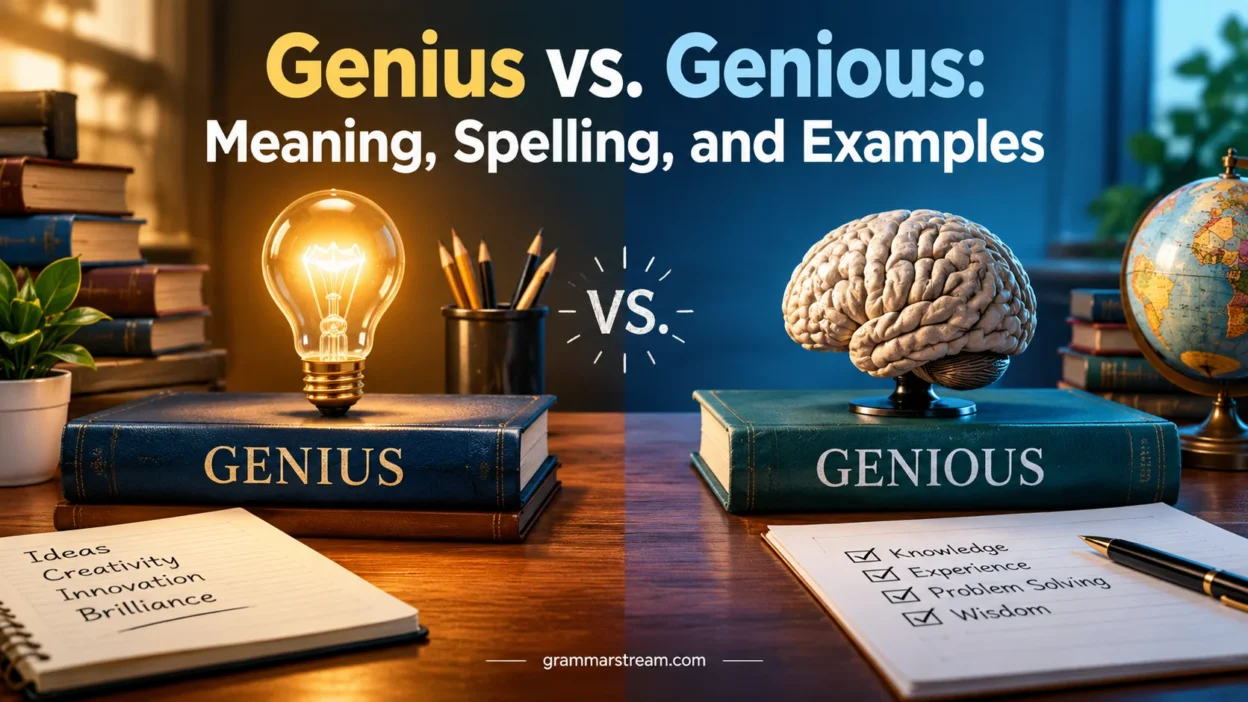
Have you ever wondered whether genius or genious is the correct spelling? You’re not alone. Many English writers confuse these two spellings because they look similar and contain nearly the same letters. However, only one is correct in standard English. Whether you’re writing a school assignment, preparing a professional email, or sharing an exciting idea online, knowing the correct spelling helps you communicate clearly.
The confusion usually comes from adding an unnecessary letter to a familiar word. People sometimes write genious when they mean genius. Although the mistake is understandable, the extra letter makes the spelling incorrect. The word genius has established meanings related to exceptional intelligence, creativity, and remarkable talent.
Understanding the difference between genius and genious involves more than memorizing a spelling. You should also know how to use genius in sentences, recognize its different meanings, understand related words, and avoid common grammatical mistakes. Once you learn the correct spelling pattern, choosing the right form becomes much easier.
Quick Answer: Genius vs. Genious
Genius is the correct spelling. Genious is a common misspelling that you should avoid in standard English writing. The word genius describes exceptional intellectual ability, remarkable creativity, or a person who demonstrates extraordinary talent. For example, “She is a mathematical genius” correctly describes someone with exceptional mathematical ability. Writing “She is a mathematical genious” introduces a spelling error. Remember that genius contains six letters and does not include the letter o.
Comparison Overview
The following table summarizes the essential differences between genius and genious.
| Feature | Genius | Genious |
| Correct spelling | Yes | No |
| Number of letters | Six | Seven |
| Standard English word | Yes | No, not as an alternative spelling of genius |
| Meaning | Exceptional intelligence, talent, or a highly gifted person | No established standard meaning as a spelling variant of genius |
| Part of speech | Primarily a noun | Not a standard grammatical alternative |
| Pronunciation | Commonly /ˈdʒiːniəs/ in American English | No standard pronunciation as a variant spelling |
| Correct example | He is a genius at chess. | He is a genious at chess. |
| Appropriate for formal writing | Yes | No |
| Standard plural | Geniuses | Not applicable |
| Common correction | Genius | Replace with genius when that is the intended word |
The main difference is simple: genius is correct, while genious is a misspelling. You don’t need to choose between two words with different meanings because genious is not a standard alternative spelling of genius.
However, understanding why the error occurs can help you avoid repeating it.
Main Differences Between Genius and Genious
Spelling Difference Between Genius and Genious
The most important difference between genius and genious is their spelling. The correct word contains six letters arranged in this order: G-E-N-I-U-S. The incorrect version adds an extra letter, producing G-E-N-I-O-U-S.
That additional o doesn’t belong in the standard spelling of genius. Even though the two forms look similar, English spelling rules don’t allow you to add letters simply because a word’s pronunciation seems to suggest them.
Consider these examples:
- Correct: My brother is a genius at solving puzzles.
- Incorrect: My brother is a genious at solving puzzles.
- Correct: That was a genius idea.
- Incorrect: That was a genious idea.
Notice that the meaning remains understandable in the incorrect sentences. Nevertheless, understandable writing isn’t always correct writing. In school assignments, professional documents, and published articles, you should use the established spelling.
One helpful technique is to memorize the final four letters of genius: NIUS. When you write the word, move directly from the letter i to u without inserting an o.
Meaning Difference Between Genius and Genious
The word genius has several established meanings. It can describe exceptional intellectual ability, a person with outstanding talent, or remarkable skill in a particular area.
For example, someone might demonstrate genius through scientific discoveries, musical compositions, mathematical reasoning, or inventive problem-solving. The word doesn’t apply exclusively to academic intelligence. Exceptional creativity and practical ingenuity can also inspire people to describe someone as a genius.
Consider these sentences:
- Albert Einstein is widely regarded as a scientific genius.
- Her genius for storytelling attracts readers of all ages.
- The engineer showed remarkable genius when designing the machine.
- That simple solution was a stroke of genius.
In each sentence, genius communicates an unusually high level of ability or cleverness.
By contrast, genious has no established standard meaning as an alternative spelling of this noun. If you encounter it in a sentence, the writer probably intended to use genius.
Part of Speech: Is Genius a Noun?
Yes. Genius is primarily a noun in modern English. It identifies a quality, ability, or person rather than directly describing another noun as an adjective would.
You can use it in several common grammatical patterns.
Genius as a countable noun
When referring to an exceptionally talented person, genius is usually countable.
Examples:
- She is a genius.
- He is a musical genius.
- The university invited three young geniuses to present their research.
The plural form is geniuses, not genii in ordinary references to exceptionally talented people.
Genius as an uncountable noun
When discussing exceptional intellectual or creative ability as a quality, genius can function as an uncountable noun.
Examples:
- Her genius became apparent at an early age.
- The invention demonstrated genuine genius.
- His genius for design transformed the entire project.
The grammatical form depends on the intended meaning. When you refer to people, you can count them. When you refer to the quality itself, you generally don’t count separate units of genius.
Genius in compound expressions
The word also appears in familiar expressions such as creative genius, mathematical genius, and stroke of genius.
Examples:
- The artist’s creative genius influenced an entire generation.
- Her mathematical genius helped her solve the equation.
- Replacing the broken component was a stroke of genius.
None of these expressions requires the misspelling genious.
Pronunciation of Genius vs. Genious
In American English, genius is commonly pronounced JEE-nee-us, with the primary stress on the first syllable.
Its standard IPA transcription is /ˈdʒiːniəs/.
The pronunciation can be broken into three syllables:
- JEE: The first syllable receives the main stress.
- nee: The second syllable follows with less emphasis.
- us: The final syllable completes the word.
The first sound resembles the beginning of jeep. The word ends with a light, unstressed sound.
Although some readers may attempt to pronounce genious similarly, that doesn’t make it a recognized alternative spelling. A spelling error doesn’t automatically create a separate standard pronunciation.
When learning the word, focus on both its spelling and sound. Saying it aloud while writing G-E-N-I-U-S can help reinforce the correct letter sequence.
Read More: Currier vs. Courier: Meaning, Spelling, and Examples
Correct Usage of Genius in Everyday Writing
The word genius works in many everyday situations. You can use it in formal writing, casual conversations, educational discussions, and creative descriptions.
However, its precise meaning depends on context.
In academic writing
Use genius when discussing exceptional intellectual ability or achievement.
Example: “The researcher’s genius for mathematical reasoning helped advance the field.”
In professional communication
The word can describe an unusually clever solution or a person’s exceptional skill.
Example: “Her approach to organizing the project was a stroke of genius.”
In everyday conversation
People often use genius informally to praise a clever idea.
Example: “You put the charging station beside the desk? That’s genius!”
Here, the speaker expresses admiration rather than making a formal assessment of the person’s intelligence.
In creative writing
Writers may use genius to portray a character’s intelligence, artistic talent, or unusual problem-solving ability.
Example: “The detective’s genius became clear when he noticed the tiny inconsistency everyone else had missed.”
In every context, use genius when that is the word you intend. Avoid genious, even when the tone is informal.
What Does Genius Mean?
Genius as Exceptional Intelligence
One common meaning of genius involves an unusually high level of intellectual ability. A person described this way may recognize patterns quickly, solve complex problems, or develop original ideas.
Scientific research, mathematics, philosophy, and engineering provide familiar examples of fields where exceptional intellectual ability can produce significant achievements.
Albert Einstein, for instance, is widely associated with scientific genius because of his contributions to modern physics, including the development of relativity theory.
However, intelligence alone doesn’t explain every use of the word. People also use genius to describe creativity, artistic expression, and remarkable practical insight.
It’s also important to recognize that genius is often used informally. Calling someone a genius doesn’t establish a scientific measurement of that person’s intelligence. In casual conversation, the word may simply express admiration for an impressive achievement.
Genius as a Highly Talented Person
The word genius can refer directly to someone who demonstrates exceptional ability.
Such a person might excel in music, literature, mathematics, sports strategy, engineering, or another specialized field. The word often highlights talent that stands out from ordinary performance.
For example:
- Mozart is remembered as a musical genius.
- The chess player demonstrated remarkable strategic genius.
- The young inventor was considered a mechanical genius.
- Her genius for languages helped her learn several languages quickly.
These examples show that the word isn’t restricted to one profession or skill.
Nevertheless, context matters. Someone can be a genius in one area without demonstrating exceptional ability in every aspect of life. A brilliant programmer, for instance, might struggle with public speaking or financial planning.
The word identifies remarkable ability, not universal perfection.
Genius as Exceptional Skill or Creativity
Sometimes, genius describes a quality rather than a particular person. This usage emphasizes an idea, design, decision, or method that demonstrates unusual effectiveness or creativity.
Imagine a teacher who develops a simple visual explanation for a difficult mathematical concept. Students understand the lesson immediately because the explanation makes an abstract idea easier to grasp.
You might describe that teaching method as brilliant or a stroke of genius.
Consider these additional examples:
- The designer’s genius was evident in the building’s practical layout.
- Her decision to simplify the process demonstrated real genius.
- The clever ending revealed the author’s creative genius.
In these sentences, genius highlights the quality of the work or decision.
This meaning explains why the word appears in discussions about inventions, business strategies, art, education, and everyday problem-solving.
Genius in Everyday Conversation
In casual English, genius often serves as an enthusiastic compliment.
Someone might call a friend a genius for finding a lost phone, fixing a computer problem, or remembering an important appointment. These statements don’t necessarily suggest extraordinary intellectual ability. Instead, they express appreciation for a clever or helpful action.
For example:
“Putting the spare key in that labeled drawer was genius!”
The speaker means that the decision was particularly smart or practical.
However, tone can change the meaning. People sometimes use genius sarcastically when someone makes an obvious mistake.
For example:
“Brilliant move! You locked the keys inside the car. Absolute genius.”
Here, the phrase conveys criticism rather than genuine praise.
Regardless of whether the word is literal, enthusiastic, or sarcastic, the correct spelling remains genius.
Why Do People Spell Genius as Genious?
Confusion About Word Endings
English spelling can be unpredictable. Some words contain letter combinations that sound similar but follow different spelling patterns.
When people write genious, they may mistakenly insert an o because they aren’t certain about the sequence of vowels near the end of the word.
This error is understandable, especially when someone writes quickly or relies on memory instead of checking the spelling.
However, genius doesn’t need an additional vowel. Its standard spelling is fixed, and the correct letter sequence is I-U, not I-O-U.
A simple way to remember this distinction is to compare the two forms visually:
- Correct: genius
- Incorrect: genious
The first form contains no o. The second adds one unnecessarily.
Practicing the correct form in complete sentences can help make the spelling more familiar.
Typing Errors and Autocorrect
Typing quickly can introduce spelling mistakes, particularly when you’re composing a message on a small screen or concentrating on the meaning rather than individual letters.
Autocorrect and spell-checking tools can help identify errors such as genious. However, their effectiveness depends on the software, dictionary, language settings, and surrounding text.
Some tools may miss unusual errors or suggest corrections that don’t fit the intended meaning.
For that reason, don’t rely entirely on automatic corrections. Review important documents before submitting or publishing them.
A practical proofreading routine includes three steps:
- Read the sentence slowly.
- Check unfamiliar or questionable spellings.
- Confirm that the corrected word fits the sentence’s meaning.
For example, if you write “The designer is a genious,” check the final letters before publishing. The correct sentence is “The designer is a genius.”
FAQs:
Is Genius or Genious the Correct Spelling?
Genius is the correct spelling in standard English. Genious is a common misspelling and should not replace genius in formal or informal writing. Use genius when referring to exceptional intelligence, remarkable talent, or an unusually clever idea.
What Does Genius Mean?
Genius refers to exceptional intellectual ability, outstanding creativity, or a person who demonstrates remarkable talent. It can also describe an exceptionally clever idea or decision. For example, “Her solution was a stroke of genius” praises the effectiveness and originality of her idea.
Why Do People Spell Genius as Genious?
People may write genious because they’re uncertain about the word’s letter sequence or make a typing mistake. The extra o doesn’t belong in the standard spelling. Remembering the final letters, I-U-S, can help you avoid this error.
What Is the Plural of Genius?
The standard plural is geniuses when referring to exceptionally intelligent or talented people.
For example: “The competition brought together several young geniuses.”
Although genii appears in some historical and specialized contexts, geniuses is the appropriate everyday plural for gifted people.
What Is the Difference Between Genius and Ingenious?
Genius is primarily a noun that refers to exceptional ability, a talented person, or a remarkably clever idea. Ingenious is an adjective that describes something clever, inventive, or resourceful.
For example:
- “She is a genius.”
- “She developed an ingenious solution.”
Both words are correct, but they serve different grammatical purposes.
Conclusion:
The difference between genius and genious comes down to one simple spelling rule. Genius is the correct standard English word, while genious is a common misspelling. The correct form refers to exceptional intelligence, remarkable creativity, a highly talented person, or an unusually clever idea. Remember that genius contains six letters: G-E-N-I-U-S. Don’t insert an extra o before the final letters. Whether you’re writing about a brilliant scientist, describing a creative solution, or complimenting a friend’s clever idea, the same spelling applies.