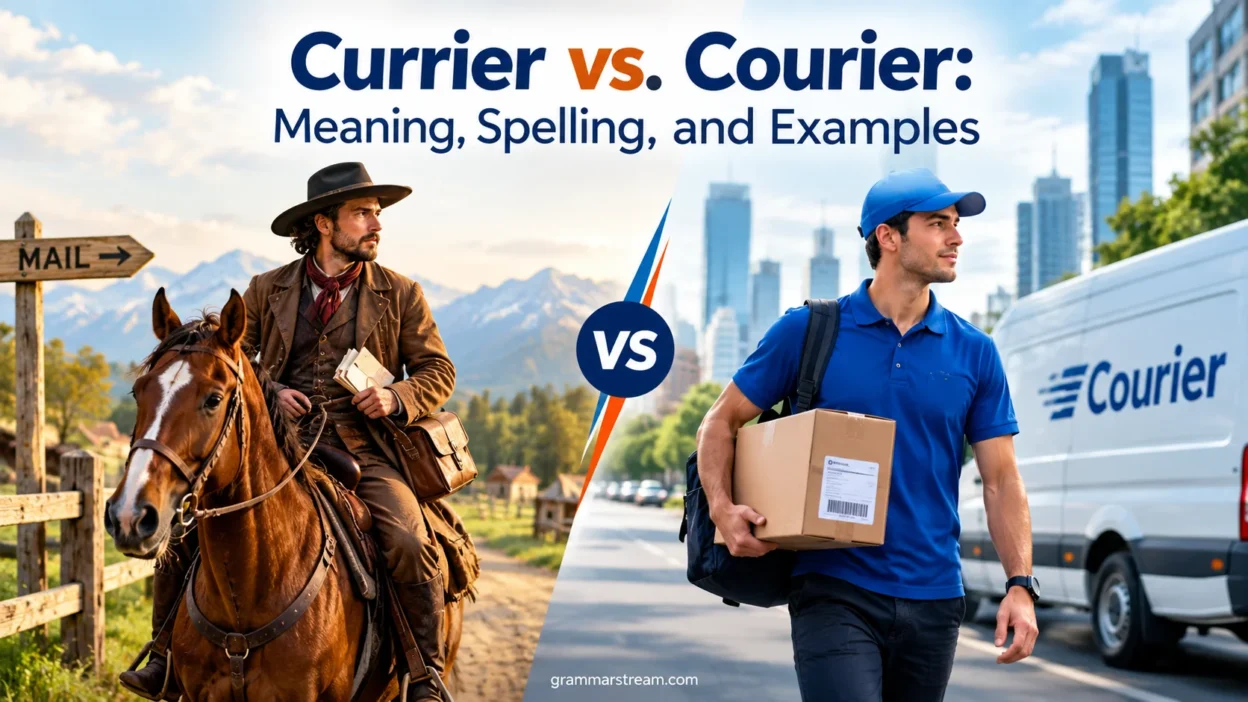
Have you ever wondered whether currier or courier is the correct word? These two words look similar, but their meanings are quite different. Choosing the wrong one can change the meaning of your sentence entirely.
The confusion often arises because both words contain similar letters and have familiar English spelling patterns. However, each word serves a distinct purpose. A courier delivers packages, documents, and messages, while a currier traditionally prepares and finishes leather.
Understanding the difference between currier vs. courier helps you avoid spelling mistakes and communicate more clearly. Whether you’re writing a business email, describing a delivery, or discussing traditional leatherworking, knowing which word fits your sentence makes a difference.
This guide explains the meanings, definitions, pronunciations, origins, grammatical uses, and practical examples of both words. You’ll also learn simple ways to remember the difference and avoid common mistakes.
Quick Answer: Currier vs. Courier
Courier refers to a person or service that transports and delivers packages, documents, messages, or other items. For example, “The courier delivered my package this morning.” Currier refers to someone who prepares and finishes leather after tanning. For example, “The currier softened the leather before it was used to make shoes.”
Both words are correctly spelled English words. Neither is a general alternative spelling of the other. The correct choice depends on what you want to describe.
- Courier: A delivery person, messenger, or delivery service.
- Currier: A traditional leatherworking professional who prepares and finishes leather.
- Courier as a verb: To send something using a courier service.
- Currier as a noun: A person who works with leather during the finishing process.
Easy way to remember: A courier delivers items, while a currier works with leather.
Comparison Overview
The differences between currier and courier become easier to understand when you compare their meanings, grammatical functions, and common uses. Although their spellings look alike, they belong to different occupational contexts.
| Feature | Currier | Courier |
| Correct spelling | Currier | Courier |
| Primary meaning | A person who prepares and finishes leather | A person or service that delivers items |
| Part of speech | Noun | Noun and verb |
| Common context | Leatherworking and traditional trades | Shipping, logistics, business, and communication |
| Modern usage | Specialized and relatively uncommon | Common in everyday and professional English |
| Related activity | Treating and finishing leather | Transporting and delivering packages or documents |
| Example | The currier prepared the leather. | The courier delivered the package. |
| Common mistake | Using it to describe a delivery worker | Using it to describe a leatherworker |
The most important distinction concerns the work each person performs. A courier transports something from one place to another. A currier prepares leather for practical use.
For example, imagine a leather workshop that orders a shipment of finished tools. The person delivering those tools is the courier. The craftsperson preparing leather for the workshop’s products is the currier.
Both occupations involve practical work, but their responsibilities are entirely different.
Main Differences Between Currier and Courier
The main differences between currier and courier involve meaning, spelling, grammar, and context. Understanding these distinctions helps you choose the correct word without relying on guesswork.
Difference in Meaning
The clearest difference between these words is what they describe.
A courier transports items between people, businesses, and locations. Depending on the situation, a courier might deliver an online order, carry legal documents, or transport an important business package.
A currier, on the other hand, prepares and finishes leather. Traditionally, this work takes place after tanning, when the leather requires additional treatment to achieve the desired texture, flexibility, appearance, or finish.
Consider these examples:
- Courier: The courier delivered the signed contract to the office.
- Currier: The currier prepared the leather for the saddlemaker.
Both sentences use a valid English word. However, switching the words would change the intended meaning.
If someone delivers a package, courier is the appropriate term. If someone treats and finishes leather, currier is the appropriate occupational term.
Difference in Spelling
The words currier and courier share several letters, which makes them easy to confuse when reading quickly or typing from memory.
Their exact spellings are:
- Currier: C-U-R-R-I-E-R
- Courier: C-O-U-R-I-E-R
The main difference appears near the beginning of each word. Currier begins with cur-, while courier begins with cou-.
This small spelling difference matters because both words exist in English dictionaries. A spellchecker might accept either word even when only one fits your sentence.
For example:
- Incorrect for a delivery context: The currier brought my order.
- Correct: The courier brought my order.
The first sentence uses a real word in the wrong context. The second sentence correctly identifies the delivery worker.
To avoid this mistake, don’t check spelling alone. Confirm that the word also matches the meaning you intend to express.
Difference in Grammatical Usage
Another important distinction concerns how each word functions in a sentence.
Currier primarily functions as a noun. It identifies a person who prepares and finishes leather.
Examples:
- The currier treated the leather carefully.
- An experienced currier supervised the finishing process.
- The workshop hired a currier to prepare leather for production.
Courier functions as both a noun and a verb.
As a noun, it identifies a delivery person, messenger, or service.
Examples:
- The courier collected the parcel.
- A courier delivered the documents to the client.
- We hired a courier for an urgent shipment.
As a verb, courier means to send or transport something using a courier service.
Examples:
- The company will courier the signed contract tomorrow.
- We couriered the replacement parts to the customer.
- She asked the office to courier the documents overnight.
This verbal use appears particularly in business and professional contexts. In casual conversation, people might instead say “send by courier” or “ship.”
Difference in Everyday Usage
The two words also differ in how often people encounter them.
Courier is widely used in modern life. Online shopping, business deliveries, document transportation, and express shipping make the term familiar to many English speakers.
For instance, someone might say, “The courier is running late,” when waiting for a package. A business might also use a courier service to deliver confidential paperwork.
Currier appears less often in everyday conversation because its meaning relates to a specialized traditional trade. Readers are more likely to encounter it in historical records, discussions of leatherworking, or descriptions of traditional crafts.
This difference in familiarity explains why people sometimes assume currier is simply a misspelling of courier. That assumption is incorrect. Both words are legitimate, but their meanings are distinct.
Read More: Tonite vs. Tonight: Meaning, Differences, and Examples
What Does Courier Mean?
A courier is a person or service responsible for transporting and delivering items. These items may include packages, letters, contracts, business documents, or other materials that need to reach a particular destination.
The word can refer to an individual delivery worker or to a service that arranges transportation. The precise meaning depends on the sentence.
For example, in “The courier called before arriving,” the word refers to the delivery person. In “We hired a courier for the shipment,” it may refer more broadly to the delivery service.
Common Uses of Courier
Couriers serve different purposes depending on the needs of individuals and organizations.
Common examples include:
- Package delivery: Transporting purchases, gifts, and personal belongings.
- Business documents: Delivering contracts, signed forms, and official paperwork.
- Express shipping: Moving urgent items within a short delivery window.
- Legal documents: Transporting paperwork between offices, clients, and other authorized recipients.
- Specialized deliveries: Moving items that require particular handling or direct transportation.
Consider an online store that sells handmade leather wallets. When a customer places an order, the store packages the wallet and arranges delivery. The person who collects and transports that package is the courier.
The courier’s job is to move the item safely to its destination. The courier doesn’t need to know how the leather was prepared or who made the wallet.
Courier as a Noun
The noun courier appears in everyday conversations and professional writing.
Here are several examples:
Example 1: The courier delivered my online order before noon.
This sentence identifies the person responsible for delivering the purchase.
Example 2: We hired a courier to transport the signed contract.
The courier carries an important business document from one location to another.
Example 3: The courier called to confirm the delivery address.
Here, the word refers to the delivery worker who contacts the recipient.
Example 4: Our company uses a courier service for urgent documents.
In this example, courier service refers to an organized delivery service rather than one specific worker.
Example 5: A courier collected the package from the reception desk.
The courier picks up the item before transporting it to its destination.
These examples demonstrate how courier applies to individuals, delivery activities, and organized services.
Courier as a Verb
Although many people first learn courier as a noun, it can also function as a verb.
To courier something means to send or transport it using a courier service.
For example:
- The company will courier the replacement equipment tomorrow.
- We couriered the signed documents to the regional office.
- Please courier the original contract to our headquarters.
In each sentence, the word describes the action of sending something through a delivery service.
However, the verb can sound more formal or business-oriented than everyday alternatives. Depending on your audience, you could write, “We’ll send the documents by courier,” instead of “We’ll courier the documents.”
Both constructions communicate the same general idea.
What Is a Courier Service?
A courier service arranges the transportation and delivery of items from one location to another. Businesses and individuals use these services when they need packages or documents delivered.
Courier services may offer standard, express, same-day, or scheduled delivery options. The available services depend on the provider, delivery route, package type, and destination.
For example, a law firm might use a courier service to transport signed paperwork between offices. An online retailer might use one to deliver customer orders.
The distinction is straightforward: the courier performs or arranges the delivery, not the leatherworking process.
What Does Currier Mean?
A currier is a person who prepares and finishes leather after tanning. The term belongs to the traditional leatherworking trade and describes a specialized role in leather production.
Leather doesn’t always become ready for its final use immediately after tanning. Depending on the material and intended product, it may require further treatment to achieve the desired softness, flexibility, thickness, color, or surface finish.
A currier traditionally performs some of this finishing work.
For example, a currier might prepare leather intended for shoes, saddles, belts, or other leather goods. The exact techniques depend on the type of leather and the requirements of the finished product.
What Does a Currier Do?
A currier works with leather to improve its condition and prepare it for use.
Traditional currying and leather-finishing work may involve:
- Softening: Helping leather achieve the required flexibility and feel.
- Dressing: Applying suitable treatments to condition or finish the material.
- Coloring: Adding or refining color when the process calls for it.
- Surface finishing: Improving the leather’s appearance and texture.
- Preparation for manufacturing: Getting the material ready for products such as footwear, saddlery, or other leather goods.
Not every currier performs every task. Leather production methods vary, and different workshops may divide responsibilities among several specialists.
It’s also important to distinguish a currier from a tanner.
A tanner processes animal hides or skins into leather through tanning. A currier traditionally carries out further preparation and finishing work on that leather.
The occupations are related, but they aren’t identical.
Imagine a workshop producing leather boots. The tanner processes the hide into leather, the currier prepares the material for its intended use, and the shoemaker turns the finished material into footwear.
This example illustrates how the three roles can contribute to different stages of production.
Currier in Historical and Specialized Contexts
The word currier is especially useful when discussing traditional occupations and historical industries.
Before modern industrial production transformed leather manufacturing, skilled craftspeople performed many specialized tasks by hand. Currying formed part of the broader process of preparing leather for practical use.
Historical documents might mention curriers alongside tanners, saddlers, shoemakers, and other tradespeople. In these contexts, the term identifies an occupation rather than a delivery role.
For example:
“The currier prepared the leather that local shoemakers used to manufacture boots.”
This sentence describes a traditional production relationship. The currier works on the material, while the shoemaker uses it to make a finished product.
Currier can also appear as a surname. When it functions as a family name, its meaning depends on the person or family being discussed rather than the occupational definition.
Capitalization helps distinguish a surname from the common noun in many contexts, although sentence position and naming conventions also matter.
Currier vs. Courier Examples in Sentences
Examples make the difference between these words easier to recognize. The following sentences show how each spelling works in a natural context.
FAQs:
Is Currier or Courier the Correct Spelling?
Both currier and courier are correct English spellings, but they have different meanings. Use courier for a delivery person or service and currier for someone who traditionally prepares and finishes leather.
Is Currier a Misspelling of Courier?
No. Currier is a legitimate English word, not simply a misspelling of courier. It becomes the wrong choice when the sentence refers to delivery rather than leatherworking.
What Is the Difference Between a Currier and a Courier?
A currier prepares and finishes leather after tanning. A courier transports and delivers packages, documents, messages, or other items. Their jobs involve different activities, even though the words look similar.
Can Courier Be Used as a Verb?
Yes. Courier can function as a verb meaning to send something using a courier service.
For example: “The company will courier the signed documents tomorrow.”
The noun form is more familiar to many readers, but the verb is also established English usage.
How Can I Remember Currier vs. Courier?
Use this simple distinction: courier means delivery, while currier means leatherworking. Remembering the activities associated with each word makes the spelling easier to choose.
Conclusion:
The difference between currier vs. courier is simple once you understand what each word means. A courier delivers packages, documents, messages, and other items. The word also functions as a verb when someone sends something using a courier service. A currier traditionally prepares and finishes leather after tanning. The term appears mainly in discussions of leatherworking, traditional crafts, and historical occupations.