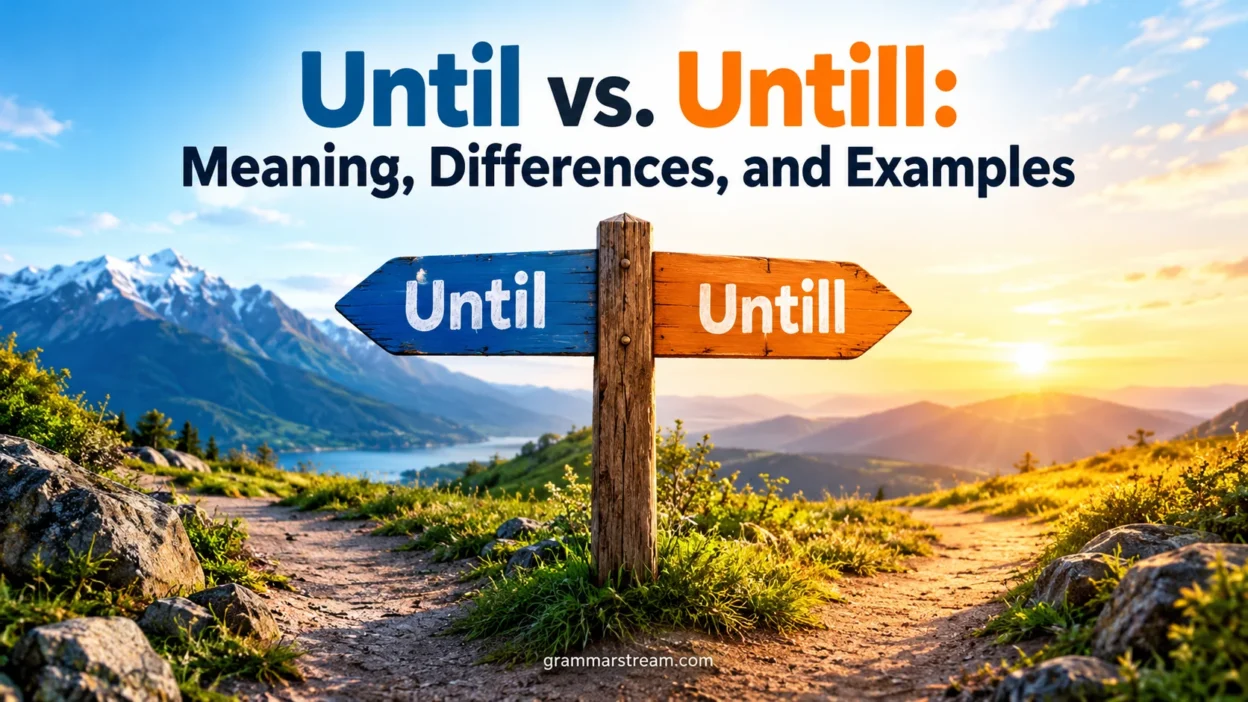
Have you ever wondered whether until or untill is the correct spelling? You’re not alone. Many English learners and native speakers make this mistake when writing emails, messages, assignments, and blog posts. The confusion usually comes from the extra L that some people add to the end of the word.
The good news is that the difference between until vs. untill is simple. Until is the correct spelling in standard English, while untill is a misspelling. Both forms may look similar, but only one belongs in properly edited writing.
Understanding this spelling difference also helps you use until correctly in sentences about deadlines, waiting periods, schedules, and future events. You’ll also learn how until compares with till and ’til, two forms that often cause additional confusion.
Whether you’re writing a professional email, completing a school assignment, or improving your English grammar, this guide will help you choose the right word confidently.
Quick Answer:
Until is the correct spelling, and untill is incorrect in standard English. Use until when referring to a point in time before which something continues or after which something happens. Never add a second L to the end.
- Correct: I’ll wait until you arrive.
- Incorrect: I’ll wait untill you arrive.
- Correct: The library stays open until 8 p.m.
- Incorrect: The library stays open untill 8 p.m.
Easy rule to remember: Until has one L at the end. If you see untill in ordinary English writing, correct it to until.
Comparison Overview
The following table summarizes the essential differences between until and untill.
| Feature | Until | Untill |
| Spelling | Correct | Incorrect |
| Standard English word | Yes | No |
| Meaning | Up to a particular time or event | No separate standard meaning |
| Part of speech | Preposition and conjunction | Not a standard grammatical form |
| Use in formal writing | Appropriate | Avoid |
| Use in everyday conversation | Common | May appear as a spelling mistake |
| Example | Stay here until noon. | Stay here untill noon. |
| Correct replacement | Until | Until |
| Number of Ls at the end | One | Two |
| The key distinction is straightforward: until is a recognized English word, but untill is a spelling error when someone intends to write until. |
Unlike some English spelling differences, this isn’t a matter of American versus British English. Both varieties use until. Adding another L doesn’t make the word more correct in either variety.
For example, an American might write, “The office is closed until Monday.” A British writer could use exactly the same sentence. Neither should write untill Monday in standard English.
What Does Until Mean?
The word until identifies a time or event that marks the end of an action, situation, or period. It tells readers how long something continues or when a change occurs.
Consider this sentence:
“She studied until midnight.”
The word until tells you that her studying continued up to midnight. It establishes an endpoint for the action without specifying exactly when she started.
Here are some additional examples:
- We waited until the rain stopped.
- The store remains open until 9 p.m.
- He didn’t understand the instructions until his teacher explained them.
- You must submit the application until Friday.
- I’ll stay here until you return.
The fourth example illustrates an important usage distinction. When giving a deadline, English speakers would usually say, “You must submit the application by Friday.” In some contexts, until Friday describes how long a state or action continues rather than setting a submission deadline.
Understanding this distinction helps you choose between until and other time expressions.
Until as a Preposition
A preposition connects a noun phrase or pronoun to another part of a sentence. When until functions as a preposition, it introduces a time expression that marks an endpoint.
Examples include:
- The restaurant serves breakfast until 11 a.m.
- The students have until Friday to complete their projects.
- We stayed at the beach until sunset.
- The office will remain closed until next Tuesday.
- You can borrow the book until the end of the month.
In these sentences, until introduces expressions such as 11 a.m., Friday, sunset, and next Tuesday.
Each expression identifies a time limit or endpoint.
Notice that the subject doesn’t have to perform a physical action. A condition can also continue until a specified time.
For example, “The road remains closed until noon” describes a situation that continues up to a particular point.
Until as a Conjunction
A conjunction connects words, phrases, or clauses. When until functions as a conjunction, it introduces a clause that identifies when an action ends or a situation changes.
Examples include:
- Wait here until I call you.
- She didn’t leave until the meeting ended.
- I’ll keep working until I finish the report.
- We won’t start until everyone arrives.
- He stayed awake until his brother came home.
In each sentence, the clause following until contains a subject and a verb.
Take the sentence “Wait here until I call you.” The main clause gives an instruction, while the until clause explains how long the person should wait.
Grammar tip: When until introduces a future time clause, English generally uses the present tense rather than will.
For example:
- Correct: I’ll wait until she arrives.
- Incorrect in standard usage: I’ll wait until she will arrive.
The future meaning comes from the main clause. The subordinate clause uses the present tense to refer to the future event.
Common Uses of Until in Everyday English
People use until in many everyday situations. It appears in conversations about work, travel, school, relationships, and personal plans.
Here are four common uses.
Describing how long something lasts
- The movie runs until 10 p.m.
- I’ll stay at the party until midnight.
- The promotion lasts until the end of the week.
Explaining when someone will do something
- She won’t leave until her friend arrives.
- I’ll keep practicing until I improve.
- He won’t make a decision until he has all the information.
Describing when a situation changes
- The children played outside until it started raining.
- The shop remained quiet until the customers arrived.
- Nothing changed until the new manager took over.
Talking about a period of waiting
- Please wait until your name is called.
- Don’t open the package until your birthday.
- Stay on the line until a representative answers.
These examples demonstrate why until is such a useful word. It connects an action or situation to a clear endpoint.
Read More: Pricy vs. Pricey: Meaning, Differences, Spelling, and Examples
What Does Untill Mean?
The spelling untill is generally an error caused by adding an unnecessary second l to until. It doesn’t have a separate standard English meaning.
When someone writes, “I’ll call you untill I get home,” the intended word is almost certainly until. The correct sentence is “I’ll call you until I get home.”
Although you may encounter untill in social media posts, informal messages, online comments, or unedited documents, seeing a spelling doesn’t automatically make it standard English.
Is Untill a Correct English Word?
No. Untill is not the standard spelling of until in modern English.
Standard dictionaries recognize until as a preposition and conjunction. The spelling untill is not an accepted alternative in ordinary contemporary English.
For example:
- Correct: The meeting continued until noon.
- Incorrect: The meeting continued untill noon.
- Correct: We can’t begin until the manager arrives.
- Incorrect: We can’t begin untill the manager arrives.
The same rule applies to professional and academic writing. If you’re preparing a resume, writing a research paper, publishing a blog post, or sending a business email, use until.
There is one practical exception worth understanding. Someone might deliberately use Untill as a username, fictional name, brand name, or stylized title. That choice doesn’t make it a standard spelling of the English word.
Why Do People Spell Until as Untill?
Several factors can explain why people add an extra l to until.
Confusion with the word till
The word till is a correct English word with a meaning similar to until. Because till ends with two instances of the letter l, writers may mistakenly transfer that spelling pattern to until.
For example:
- Correct: I’ll stay until Friday.
- Correct: I’ll stay till Friday.
- Incorrect: I’ll stay untill Friday.
The correct spelling of till doesn’t change the spelling of until.
Typing mistakes
When typing quickly, people sometimes repeat letters accidentally. A writer might type untill without noticing the extra l.
Spell-checking tools often catch this mistake, but not every writing environment flags errors consistently.
Uncertainty about English spelling
English spelling contains many patterns that seem inconsistent. Words such as traveling and travelling differ between common American and British conventions, while other words follow different spelling rules.
This variety can make writers question whether until has an alternative spelling. In this case, however, the extra l isn’t a standard regional variation.
Repeated exposure to incorrect spelling
People may encounter untill in online posts or informal messages. Repeated exposure can make an error look familiar, even when it remains incorrect.
The best solution is to learn the correct form and use it consistently.
Should You Ever Use Untill?
In ordinary English writing, you should avoid untill.
Use until in:
- Emails and business correspondence
- School assignments and essays
- Blog posts and website content
- Reports and presentations
- Social media captions
- Everyday text messages
A deliberate creative use is different. For example, a fictional character might use Untill as a username or a business might choose it as a distinctive brand name.
In such cases, the spelling functions as a chosen name rather than the standard English word. Outside those special circumstances, write until.
Main Differences Between Until and Untill
Although the two forms look almost identical, their status in English differs considerably. The following sections explain the spelling, meaning, and grammatical distinctions.
Spelling Difference Between Until and Untill
The spelling difference comes down to one letter.
Until contains six letters: U-N-T-I-L.
Untill contains seven letters: U-N-T-I-L-L.
The standard word ends with a single L. Adding another creates a misspelling.
Compare these examples:
| Incorrect Spelling | Correct Spelling |
| Untill tomorrow | Until tomorrow |
| Untill Monday | Until Monday |
| Untill further notice | Until further notice |
| Wait untill I arrive | Wait until I arrive |
| Not untill next week | Not until next week |
A useful way to remember the rule is to focus on the final letter. The word until ends with one l, even though the related word till ends with two.
Meaning Difference Between Until and Untill
The word until has a clear meaning: it refers to the time or event up to which something continues.
For example, “The museum is open until 5 p.m.” tells visitors that the museum’s opening period extends to 5 p.m.
By contrast, untill has no separate standard English meaning. Readers will generally interpret it as a misspelling of until.
Consider this comparison:
- Until: We waited until the train arrived.
- Untill: We waited untill the train arrived.
The first sentence is correctly written. The second communicates the intended idea but contains a spelling mistake.
That distinction matters in professional writing because spelling errors can distract readers and weaken the impression your writing creates.
Grammar and Usage Difference Between Until and Untill
Because until is the correct form, it can function as a preposition or conjunction.
As a preposition:
- The office is closed until Tuesday.
- We talked until midnight.
As a conjunction:
- Stay until I return.
- She waited until the bus arrived.
The spelling untill doesn’t become grammatically correct simply because the sentence structure is otherwise sound.
For example, “She waited untill the bus arrived” contains a valid sentence structure but an incorrect spelling.
The corrected version is “She waited until the bus arrived.”
Remember: Grammar and spelling are related but separate. A sentence can have correct grammar while containing a misspelled word.
Examples of Correct and Incorrect Usage
The following examples show how to recognize and correct common mistakes.
| Incorrect Sentence | Correct Sentence | Explanation |
| I’ll stay untill noon. | I’ll stay until noon. | Remove the extra l. |
| Wait untill I call. | Wait until I call. | Use the standard spelling. |
| We worked untill midnight. | We worked until midnight. | Until identifies the endpoint. |
| Don’t leave untill Friday. | Don’t leave until Friday. | The correct form ends with one l. |
| She waited untill the rain stopped. | She waited until the rain stopped. | Until introduces the ending event. |
| The store is open untill 9 p.m. | The store is open until 9 p.m. | Use until before a time expression. |
You can correct every example by replacing untill with until. No other grammatical change is necessary.
FAQs:
Is Until or Untill Correct?
Until is correct in standard English. Untill is a misspelling that adds an unnecessary second l. Write “I’ll call you until I arrive” rather than “I’ll call you untill I arrive.”
Why Is Until Spelled With One L?
The standard spelling of until ends with one l. Although till has two ls, its spelling doesn’t change the spelling of until. The two words are both established English forms with similar time-related meanings.
Is Untill Ever Correct?
Not as the standard English word meaning “up to a particular time.” You might encounter Untill as a deliberately chosen name or stylized brand, but that doesn’t make it an accepted alternative spelling of until.
Are Until and Till Interchangeable?
Often, yes. Both words can mean “up to a particular time or event.” For example, “Wait until Monday” and “Wait till Monday” are both correct. The best choice depends on context, style, and personal preference.
Is ‘Til Correct English?
The spelling ’til appears in informal writing as a shortened form associated with until. Its acceptance varies by editorial style. For formal writing, until is generally the safest choice, while till is also a standard word.
Conclusion:
The difference between until vs. untill is simple once you remember the spelling rule. Until is the correct standard English word, while untill is a misspelling with an unnecessary extra l. Use until when describing a period that continues to a particular time or event. For example, you can write, “I’ll stay until Friday,” or “Wait until the meeting ends.” Both sentences use the word correctly. Remember that till is also an established English word and can often replace until. The informal spelling ’til appears in some contexts, but editorial preferences vary.