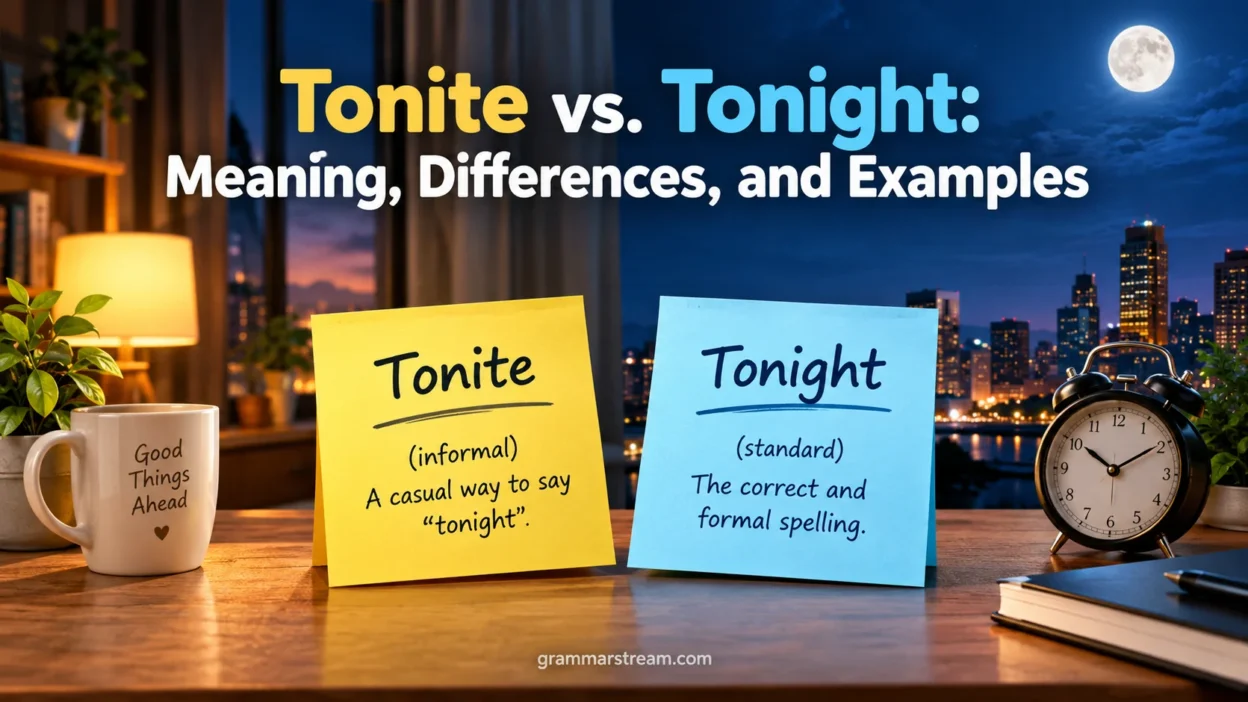
Have you ever wondered whether to write tonite or tonight? Both spellings appear in text messages, advertisements, social media posts, and everyday conversations. However, only one is the standard spelling in modern English.
The confusion makes sense because both versions represent the same word and are generally pronounced alike. When you hear someone say the word aloud, you cannot tell which spelling they intend to use.
The difference becomes important when you write an email, publish an article, complete a school assignment, or create professional content. Choosing the right spelling helps your message look polished and makes your writing easier to trust.
In this guide, you’ll learn the meanings of tonite and tonight, discover their differences, explore practical sentence examples, and understand when each spelling might appear. You’ll also find answers to common questions about their spelling, pronunciation, and grammatical usage.
Quick Answer
Tonight is the correct standard spelling in modern English. It refers to the evening or night of the current day. Tonite is a nonstandard spelling that people sometimes use in casual messages, advertisements, and stylized names. Although readers generally understand both versions, you should use tonight in formal writing, professional communication, schoolwork, and published articles.
- Tonight: The standard spelling used in everyday and professional English.
- Tonite: An informal, nonstandard variant sometimes used for stylistic purposes.
- Meaning: Both generally communicate the same idea.
- Pronunciation: Both spellings are usually intended to represent the same pronunciation.
- Best choice: Use tonight whenever you want to follow standard English spelling.
Example:
- Standard: I’m going to finish my homework tonight.
- Nonstandard: I’m going to finish my homework tonite.
The first sentence follows standard spelling conventions. The second communicates the same message but uses a nonstandard spelling.
Comparison Overview
The easiest way to understand tonite vs. tonight is to compare their spelling, meaning, and appropriate contexts. Although the words look different, they don’t normally express different meanings.
| Feature | Tonight | Tonite |
| Spelling status | Standard English spelling | Nonstandard spelling |
| Meaning | The evening or night of the current day | Generally intended to mean tonight |
| Part of speech | Adverb or noun | Informal respelling of tonight |
| Pronunciation | /təˈnaɪt/ | Generally intended to match tonight |
| Formal writing | Appropriate | Generally avoided |
| Academic writing | Recommended | Generally inappropriate |
| Professional emails | Recommended | Avoid unless reproducing a name or quotation |
| Text messages | Appropriate | Sometimes used informally |
| Advertising | Common | Sometimes used for stylistic effect |
| Social media | Appropriate | May appear in casual or stylized posts |
| General recommendation | Use in standard writing | Reserve for intentional informal or stylized usage |
The most important distinction is standard spelling versus nonstandard spelling. Tonight belongs in ordinary English sentences, regardless of whether you’re writing casually or professionally.
Tonite appears in certain informal contexts, but its familiarity doesn’t make it the preferred spelling.
Main Differences Between Tonite and Tonight
The differences between tonite and tonight involve spelling conventions, context, and writing style rather than meaning. Understanding these distinctions helps you choose the appropriate form without second-guessing yourself.
Meaning of Tonight
Tonight refers to the evening or night of the current day. People use it when discussing plans, activities, events, or situations expected to happen later that day.
For example, if you make plans with a friend in the afternoon, you might say, “Let’s have dinner tonight.” The word connects the planned activity to the current day’s evening.
Tonight can function as both an adverb and a noun. Its grammatical role depends on how you use it in a sentence.
Tonight as an adverb
An adverb modifies a verb or provides information about when an action happens. When tonight functions as an adverb, it tells readers or listeners when something will occur.
Examples include:
- We’re watching a movie tonight.
- I’ll finish the report tonight.
- My parents are visiting tonight.
- The restaurant is hosting a special event tonight.
- Are you working tonight?
In each example, tonight explains when the action will happen.
Tonight as a noun
Tonight can also function as a noun when it refers to the current evening or night itself.
Consider these examples:
- Tonight is going to be exciting.
- We have a lot planned for tonight.
- Tonight was more enjoyable than I expected.
- What are your plans for tonight?
In these sentences, tonight refers to the evening or night as a period of time.
A useful detail about meaning
Tonight doesn’t always refer to the hours after sunset. Its exact time frame depends on the situation and how the speaker uses the word.
For instance, someone might say, “I’m working tonight,” while discussing a shift that begins at 5 p.m. Another person might use tonight to describe an event starting at 10 p.m.
The central idea remains the same: tonight refers to the current day’s evening or night.
Meaning of Tonite
Tonite is a nonstandard spelling that generally represents the word tonight. People may use it in informal messages, advertisements, promotional slogans, or stylized titles.
For example, a person might write, “See you tonite!” in a casual text message. The reader will probably understand the intended meaning immediately.
However, the spelling doesn’t have a separate, established meaning that distinguishes it from tonight in ordinary usage.
Consider these examples:
- The poster advertises a concert called “Live Music Tonite.”
- A friend sends the message, “Are we meeting tonite?”
- A promotional graphic displays the phrase “Party Tonite!”
- Someone writes, “Movie night tonite?” in a group chat.
These examples illustrate how people sometimes use tonite in informal communication.
Why does tonite appear in writing?
Several factors can explain its use:
- Informal style: Some people prefer unconventional spellings in casual messages.
- Visual appearance: Advertisers may choose shorter spellings to create a particular look.
- Branding: A business or event organizer might use tonite as part of a name or promotional identity.
- Personal preference: Some writers use it simply because they like how it looks.
These possibilities don’t mean every writer has the same motivation. The important point is that tonite generally represents tonight rather than a different word.
Read More: Cubical vs. Cubicle: Meaning, Differences, and Examples
Which Spelling Is Correct: Tonite or Tonight?
If you’re deciding which spelling to use, choose tonight.
Tonight is the accepted standard spelling in contemporary English. It appears in ordinary prose, dictionaries, educational materials, newspapers, business documents, and professional publications.
Tonite is recognizable, but it isn’t the standard form for ordinary English writing.
Consider the following examples:
Correct standard usage:
- I’ll call you tonight.
- The meeting starts tonight.
- We’re leaving for the airport tonight.
- She plans to submit the assignment tonight.
Nonstandard spelling:
- I’ll call you tonite.
- The meeting starts tonite.
- We’re leaving for the airport tonite.
- She plans to submit the assignment tonite.
The second group remains understandable. Nevertheless, the first group follows standard spelling conventions.
This distinction matters because readers often expect consistent spelling in professional and academic settings. An unnecessary nonstandard spelling may distract readers from your message.
Remember: You don’t need to avoid tonight in casual writing to sound natural. It’s perfectly appropriate in text messages, social media posts, and everyday conversations.
When to Use Tonight
Use tonight whenever you want to communicate that something happens during the current evening or night.
Its versatility makes it appropriate for nearly every ordinary writing situation.
Everyday conversations
People frequently use tonight to discuss their plans or ask about someone else’s schedule.
Examples:
- Are you free tonight?
- Let’s order pizza tonight.
- I’ll see you tonight.
- What do you want to watch tonight?
Work and professional communication
Tonight works naturally in emails, workplace messages, schedules, and project updates.
Examples:
- I’ll send you the revised document tonight.
- The team will review the final proposal tonight.
- We expect the system update to finish tonight.
- The office will remain open until 9 p.m. tonight.
School and academic writing
Students can use tonight when describing study plans, assignments, or upcoming academic activities.
Examples:
- I plan to finish my research tonight.
- Our study group is meeting tonight.
- I’ll review the chapter tonight before the examination.
Invitations and announcements
Tonight is also useful when inviting people to events or announcing activities.
Examples:
- Join us tonight for live entertainment.
- The school is hosting a fundraiser tonight.
- Our community meeting takes place tonight.
Across all these situations, tonight offers a clear and standard way to express the intended meaning.
When to Use Tonite
Although tonight is the preferred spelling, tonite may appear in contexts where informal or stylized wording is intentional.
The key is understanding the difference between reproducing a stylistic choice and using nonstandard spelling in ordinary prose.
Casual text messages
Friends sometimes use tonite in informal conversations.
Example:
“Want to grab something to eat tonite?”
The meaning is clear, but tonight would be equally natural and follows standard spelling.
Advertisements and promotional material
An event organizer might use tonite in a promotional slogan because it suits the design or established wording.
Examples:
- “Live Music Tonite!”
- “One Night Only: Comedy Tonite!”
- “Dance Party Tonite!”
These examples show possible stylistic uses. They don’t establish tonite as the correct spelling for standard writing.
Business names and titles
A business, entertainment event, or publication may include Tonite in its official name.
If the name is officially styled that way, preserve the spelling when referring to it.
For example, if an event’s official title is “Comedy Tonite,” changing it to “Comedy Tonight” would alter the title.
Creative writing
A writer might use tonite in dialogue to reflect a character’s informal texting habits or reproduce wording from a sign.
However, there’s usually no need to replace tonight with tonite just to make a character sound casual. The surrounding dialogue can communicate the character’s voice without changing standard spelling.
Tonite vs. Tonight in Text Messages and Social Media
Text messages and social media encourage quick, informal communication. As a result, readers regularly encounter abbreviations, shortened expressions, creative spellings, and slang.
Tonite fits into this broader pattern of informal written language. However, using nonstandard spelling isn’t necessary to communicate casually.
Compare these messages:
| Standard Message | Informal Variant |
| Are you free tonight? | Are you free tonite? |
| See you tonight! | See you tonite! |
| Let’s watch a movie tonight. | Let’s watch a movie tonite. |
| The game starts tonight. | The game starts tonite. |
| We’re going out tonight. | We’re going out tonite. |
Both columns communicate essentially the same information. The first column uses standard spelling, while the second uses a nonstandard variant.
Which spelling works better on social media?
For personal messages, either spelling will usually be understood. However, tonight is still the more reliable choice because it looks natural and follows standard English conventions.
For business accounts, professional profiles, news updates, and promotional posts, standard spelling is generally preferable. It helps maintain a polished, consistent style.
For example, a restaurant posting its evening schedule could write:
“We’re serving dinner until 10 p.m. tonight!”
The sentence is friendly, concise, and professional. There’s no need to replace tonight with tonite to make the message engaging.
Tonite vs. Tonight in Formal and Professional Writing
Formal writing follows established conventions to make information clear, consistent, and credible. Because tonight is the standard spelling, it belongs in professional documents and academic work.
Use tonight in these situations:
- Business emails and workplace messages.
- Academic essays and assignments.
- News articles and blog posts.
- Reports and project updates.
- Professional advertisements.
- Official schedules and announcements.
- Customer service communications.
Consider this workplace message:
“We expect to complete the scheduled maintenance tonight. The system should be available again by tomorrow morning.”
The wording communicates the timeline clearly. It also follows standard spelling conventions.
Now compare it with this version:
“We expect to complete the scheduled maintenance tonite. The system should be available again by tomorrow morning.”
The second version remains understandable, but tonite introduces an unnecessary departure from standard spelling.
Does using tonite automatically make a message unprofessional?
Not necessarily. One spelling choice doesn’t determine the quality of an entire document. However, repeatedly using nonstandard forms can make formal writing look less polished.
Context also matters. If you’re discussing an event whose official name includes Tonite, preserve that spelling. Standard writing conventions don’t require you to alter proper names or exact quotations.
For ordinary sentences, though, tonight is the appropriate choice.
FAQs:
Is Tonite or Tonight Correct?
Tonight is the correct standard spelling in contemporary English. Tonite is a nonstandard variant that people sometimes use in informal messages or stylized wording.
For ordinary writing, including emails, essays, and articles, choose tonight.
Does Tonite Mean the Same as Tonight?
Yes. Tonite is generally intended to represent the same word as tonight.
Both usually refer to the evening or night of the current day. The difference lies in spelling conventions rather than meaning.
For example, “I’ll see you tonight” and “I’ll see you tonite” generally communicate the same message. The first uses standard spelling.
Is Tonite Grammatically Correct?
Tonite is nonstandard as a spelling in ordinary English prose. However, its use in a title, brand name, exact quotation, or deliberately informal message may be intentional.
It’s useful to distinguish spelling conventions from grammar. A nonstandard spelling doesn’t necessarily make every other part of a sentence grammatically incorrect.
When standard English is expected, use tonight.
Why Do People Write Tonite Instead of Tonight?
People may write tonite because they prefer its appearance, encounter it in advertisements, or use it as an informal spelling in messages.
Others may choose it for a promotional slogan or established name. The reason varies by context.
Regardless of the motivation, tonight remains the standard spelling for ordinary English writing.
Should I Use Tonite in a Professional Email?
No. In a professional email, use tonight unless you’re reproducing an official name or exact quotation that contains tonite.
For example, write, “I’ll send you the updated report tonight.”
This sentence is clear, natural, and consistent with standard spelling conventions.
Conclusion:
The difference between tonite and tonight is straightforward: tonight is the standard English spelling, while tonite is a nonstandard variant sometimes used in informal or stylized contexts. Both spellings generally communicate the same meaning. They refer to the evening or night of the current day, and they’re usually intended to have the same pronunciation. However, their appropriate uses differ. Tonight belongs in everyday conversations, text messages, school assignments, professional emails, blog posts, and other ordinary writing.